|
https://worldlocalizationday.org
@@@@@@@@@@@@@@@@@@@@@@@@@@@@@@@@@@
https://michaelhshuman.com
https://mainstreetjournal.substack.com
@@@@@@@@@@@@@@@@@@@@@@@@@@@@@@@@@@
Some of you may recall that six years ago Michael Shuman was nice enough to speak at a webinar I organized, cosponsored by the Bard Center for Environmental Policy, Sustainable Hudson Valley, Re>Think Local, Northern Dutchess NAACP, Citizens for Local Power, and Protect Orange County
https://www.facebook.com/events/httpbluejeanscom764625502/michael-shuman-webinar-new-economy-plan-dutchess-help-small-biz/1477488845712353
@@@@@@@@@@@@@@@@@@@@@@@@@@@@@@@@@@
Seven years ago I launched this new-economy petition inspired by MS:
https://www.change.org/p/dutchess-county-executive-marcus-molinaro-revitalize-dutchess-with-new-economy-pro-small-business-innovative-strategies-new-jobs
@@@@@@@@@@@@@@@@@@@@@@@@@@@@@@@@@@
Michael Shuman's brilliant Jan. op-ed for the Hudson Valley Pilot:
https://www.hvpilot.com/living/why-invest-locally/article_7101e8b0-bbc0-11ee-beea-d78246e73855.html
@@@@@@@@@@@@@@@@@@@@@@@@@@@@@@@@@@
Join dozens of other local folks on FB @ Local Investment Dutchess(!):
https://www.facebook.com/groups/6960200684025920
@@@@@@@@@@@@@@@@@@@@@@@@@@@@@@@@@@
Yep-- tis true-- the brilliant Michael Shuman (Director of Local Economy Programs for Neighborhood Associates Corporation, Adjunct Professor at Bard Business School in New York City, and Co-Author of Northern Dutchess Alliance Blueprint for Economic Development) joined us for a Zoom 10/18/23-- you really need to watch it (and share it): "12 Ways to Create a Local Investment Ecosystem: Innovative Pro-Small Business-Jobs Ways to End Corporate Welfare in Your County"-- click here to watch video(!): https://youtu.be/spCa-DvOllE
Also participating in that 10/18/23 Local Investment Dutchess Zoom:
-- Neil Seldman (Cornucopia Recycling Project Director for Zero Waste USA and Institute for Local Self-Reliance Cofounder);
-- Judy Malstrom (Zero Waste Dutchess Co-Director)
-- Doreen Tignanelli (Town of Poughkeepsie Taxpayer Watchdog); both Shuman and Seldman have worked in Montgomery County/MD; Seldman was able to chime in during the Zoom with pertinent recycling and circular economy ideas that fit perfectly together with Shuman's message.]
@@@@@@@@@@@@@@@@@@@@@@@@@@@@@@@@@@
Update— just yesterday (6/20/24) Benjamin Schwartz of the White Pine Community Farm in Dover called me to discuss possibilities of building a LION (Local Investing Opportunities Network) in Dutchess(!).
https://www.afarmforallnewyork.org/our-team
Contact Ben at whitepinecommunityfarm@gmail.com or localinvestmentdutchess@gmail.com to get involved-- Ben told us last Dec. that his goal is to really launch a regional LION in the spring with a massive potluck at the White Pine Community Farm in Dover!
@@@@@@@@@@@@@@@@@@@@@@@@@@@@@@@@@@
`
Quite a few local business owners indicated strong interested to me last Dec. in collaborating (with or without local chambers of commerce) to
now build a LION (Local Investment Opportunity Network) to help locally owned small businesses connect with socially conscious folks with $$$!
Click on this link to see how various chambers of commerce in Washington (state) have been launching LION's across the state there(!):
https://www.peninsuladailynews.com/business/small-network-for-loans-in-works/
@@@@@@@@@@@@@@@@@@@@@@@@@@@@@@@@@@
Michael Shuman: "in Port Townsend, Washington, a community of 10,000 residents formed a group called a LION (Local Investment Opportunity Network), bringing together local investors and businesses through monthly potlucks; the result has been nearly $1 million per year of new local investment since 2007."
https://www.jeffersonlion.net
@@@@@@@@@@@@@@@@@@@@@@@@@@@@@@@@@@
Fact: A LION for Dutchess would be vastly beneficial for the local economy-- in stark contrast to the millions doled out annually in corporate welfare through Th!nk Dutchess, Dutchess County Industrial Development Agency, and Dutchess County Local Development Corporation-- as Doreen Tignanelli and Jim Beretta so thoroughly documented for years now (see below).
Shuman and Doreen Tignanelli are right-- corporate welfare via the Dutchess County Industrial Development Agency and Dutchess County Local Development Corporation is wasteful-- see Doreen's research on this here: http://conta.cc/44tRu0k .
@@@@@@@@@@@@@@@@@@@@@@@@@@@@@@@@@@
From Michael Shuman's Main Street Journal
V.2, N.50
Localization is a global phenomenon growing stronger every day. And it’s the foundation of everything we do here at The Main Street Journal. About one in ten of our readers is not American, and many of the stories we bring you offer new international examples of local investment models, cutting-edge business designs, and supportive policies. In last week’s MSJ Extra!, for instance, we interviewed Marc Almon on the strengths and challenges of Nova Scotia’s neighborhood-based pension funds. If the United States had as many of these funds per capita, we would have nearly 21,000 operating in the country.
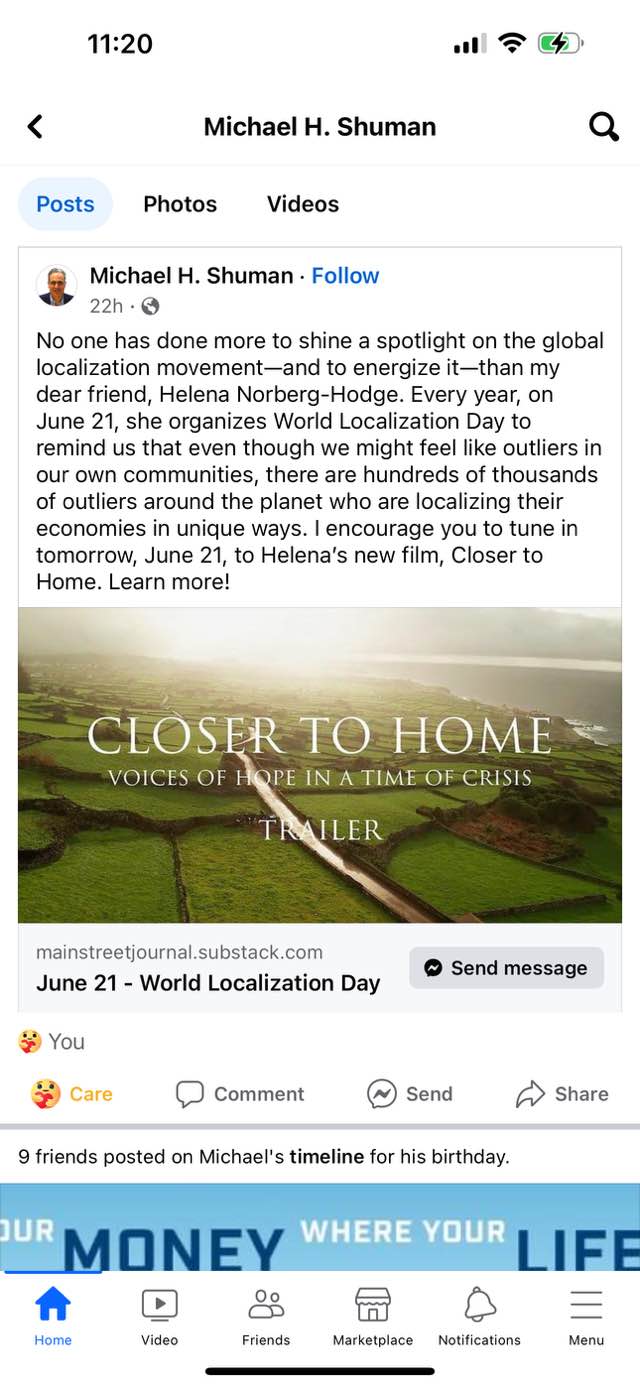
No one has done more to shine a spotlight on the global localization movement—and to energize it—than my dear friend, Helena Norberg-Hodge. Every year, on June 21, she organizes World Localization Day to remind us that even though we might feel like outliers in our own communities, there are hundreds of thousands of outliers around the planet who are localizing their economies in unique ways. I encourage you to tune in tomorrow, June 21, to Helena’s new film, Closer to Home. Here’s a brief description:
We live in a time of multiple crises, from climate chaos to skyrocketing costs of living. It can seem overwhelming—until we realize that we have the power to change things. Closer to Home brings together an extraordinary array of thinkers, writers, and activists from every continent to make a simple but revolutionary argument: by reducing the scale of the economy, we can not only stop the rush toward social and ecological breakdown but restore damaged ecosystems and increase our own personal well-being. It’s a message of hope that the world cannot afford to ignore.
Helena’s organization, Local Futures, will screen the film in three time zones, followed by a discussion group made up of different voices from the movie—one of which I’ll help lead.
Other stories you’ll find in this issue:
- WaterBottle is a new worker-owned co-op in Baltimore, helping its members rehab and buy abandoned properties. It currently owns 22 properties—in a city with 13,000 empty homes.
- Homium is a new company based in Colorado that helps people struggling to become homeowners share their equity with outside investors. The concept can reduce the downpayment burden upfront and also allow equity to be converted into cash without a second mortgage.
- NPR’s Marketplace reports that young people are increasingly asking—and getting—their parents to invest in their first homes.
- One reason many Americans feel awful about the economy, according to an article in The American Prospect, is more debt. Total credit card debt now exceeds $1 trillion, and the average cardholder pays $250 more in interest per year.
- Last year, Patagonia’s founder put his $3 billion in stock shares into a nonprofit, effectively turning the company into a public engine for sustainability. Dozens of other companies are now pioneering interesting new approaches to bring stakeholders onto their boards and into their governance structure.
- Finally, Colorful Capital just released a report on how investors can profit (and are profiting) from investing in LGBTQIA+ startups.
As we announced previously, we now welcome sponsors for each issue of The Main Street Journal as a way of paying our bills. Let us know what you think of this idea. And if you want to sponsor an issue yourself, please reach out!
As always, if you want more news, please subscribe to the MSJ Extra! through this link.
~ Michael Shuman, Publisher
Upgrade Now
NEWS
Jump to a Section:
News from NC3
Partner News & Voices
Events
Jobs Board
WHAT YOU MISSED IN LAST WEEK’S MSJ EXTRA!
Marc Almon is a well-known filmmaker in Nova Scotia, Canada, and the founder of a Community Interest Company dedicated to placemaking called Culture Link CIC. He also has been an articulate advocate for the steady improvement of the province’s local investment ecosystem.
MS: Marc, thanks for talking with us. When people ask me about great examples of local investment innovation outside the United States, I usually begin by talking about CEDIFs in Nova Scotia, which are effectively community-controlled pension funds. Tell us about the origin of CEDIFs. Why and when were they created?
MA: In the 19th century, Nova Scotia was a place with considerable capital. It had extensive sea-going trading networks undergirding the local economy. The Bank of Nova Scotia and Royal Bank of Canada were founded in Nova Scotia during this heyday, as was the Cunard Line. But in the 20th century, the local economy struggled, particularly after a ship exploded in the Halifax harbor in 1917 and devastated the city’s industrial areas. Central Canadian firms bought up local firms, and there was little opportunity to invest locally. Risk capital for Nova Scotian firms became very hard to come by.
That’s why the Nova Scotia government introduced the Equity Tax Credit in 1993 and Community Economic Development Investment Funds (CEDIF) in 1999. These were pioneering pieces of legislation. Local investors could receive substantial tax credits for investing in local businesses. Essentially, investors receive 35% of their money back in the first year, 20% in the fifth year, and 10% in year ten, provided they keep their investment in the organization for 15 years (quite a long horizon). If a person invests in a CEDIF via a registered retirement savings account, it provides further tax savings. In terms of patient capital, it’s a remarkable system that can provide substantial risk mitigation for investors investing in local ventures.
Twenty-five years after the CEDIF program was introduced, we can say the program has resulted in some remarkable outcomes. A study by Dr. George Karaphillis showed that by 2019, the Nova Scotia government spent $700,000 in forgone taxes to foster $2 million of investment in 116 local businesses. Those businesses contributed $118 million annually in gross domestic product (GDP), generated 1,200 jobs, $52 million in annual wages, and $25 million in taxes. That means for every $1,000 invested by the Nova Scotia government through the CEDIF program, the program resulted in the creation or retention of 1.75 jobs—or $575 per job! Nothing else in the universe of economic development compares to these metrics.
MSJ EXTRA!
JUN 14
Earlier this year, we suggested that every U.S. community—all 36,000 of them—should have its own investment fund. Maybe even two or three. If you want to get a glimpse of what this world of Main Street finance might look like, check out Nova Scotia, a small Canadian province east of Maine with about a million residents. Thanks to legislation passed in 1…
Read full story
SPONSOR CORNER
The National Coalition for Community Capital (NC3) is dedicated to educating, advocating, and activating community capital—and serves as MSJ's fiscal sponsor. Thank you for being a part of a growing movement! Be sure to reach out to us for support integrating local investing in your work: info@nc3now.org.
NC3 UPDATES AND ANNOUNCEMENTS
-
Announcing NC3's Technical Assistance Directory has a new name: Practitioner's Directory. This list has informed folks of the organizations and individuals who offer services that support further integration of community capital around the country. NC3 hosted our first Practitioner's Gathering in April and a second this past week. Find community capital practitioners to move your work forward here! Are you an expert? Consider joining us at this link (scroll past the table).
-
Crowdfund Better CEO and Founder Kathleen Minogue joined NC3 Board Chair Chris Miller for a presentation at the IEDC Economic Future Forum in Spokane, Washington, this week. The title of their presentation was 'Democratizing Community Development.' During the presentation, Kathleen and Chris made the case for community investing, discussed several models, and led the attendees through scenarios voted on by the participants.
-
In addition to their presentation, Kathleen and Chris had a number of in-depth conversations with folks who'd arranged for a meet-up ahead of time or some who struck up conversations and were intrigued by the introduction of our work and its benefits. In those conversations and the formal presentation, a number of real-world examples were presented—including the pending launch of a Diversified Community Investment Fund (DCIF) by Local Return in Rhode Island—and some telling data, including the significantly lower rate of failures for community-funded businesses versus those funded by traditional capital sources. The presentation also included this quote from one of the NC3 founding board members, Janice Shade, now CEO and Founder of Capital Innovation Lab on Community Investment Funds:
"Community Investment Funds fill a critical gap in a region's capital landscape. Guided by their investors' relationship to and lived experience within a community, CIF's go where angels (and banks) fear to tread; because they see opportunity and need where traditional capital providers see only risk. By providing that missing source of ‘possibility capital,’ CIFs facilitate local economic resilience and prosperity for all."
PARTNER NEWS & VOICES
NEW INVESTMENT OPPORTUNITIES
Our complete list of recently posted investment opportunities has moved to MSJ Extra! As a teaser, here is an offering from our list. (Please note that our listing of these opportunities is not an endorsement, and remember that all investments are risky, so click on the hyperlinks and read all the details carefully before investing.)
-
Obodo Serendipity Books (Stratford, CT) - Honeycomb Credit: A small, independent bookstore offering diverse books rooted in social and emotional development (Choose Indie Pride: LGBTQ+ owned, Minority-owned).
Subscribe Now
NOTABLE NEW RESOURCES
FEATURED EVENT
-
Closer to Home Film Premier: Followed by a live webinar with voices of hope from the film, including Michael Shuman - Virtual Event: June 21, 7 pm ET
MORE EVENTS
View More Events
ICYMI
JOBS BOARD
IF YOU LIKE THE MAIN STREET JOURNAL…
…please share with friends, family, colleagues, and skeptics of local investing. Subscribers to our flagship publication pay nothing, but we encourage supporters also to consider making a tax-deductible donation here:
Make a Donation
BECOME A MAIN STREET CHAMPION
Have you always wanted to start a local investment club? A website of local investment offerings in your community? A local investment study group?
Whatever your interest or ambition, we invite you to “go public” to help others in your region find you, scheme with you, and start a local investment movement in your community. We aim to identify dozens, then hundreds, then thousands of Main Street Champions like you in every corner of the globe. Together, we can move our hard-earned savings from Wall Street to Main Street into our own communities. Fill out the intake survey below to join this growing cohort!
@@@@@@@@@@@@@@@@@@@@@@@@@@@@@@@@@@
[again-- to learn more about Michael Shuman, the Riverbed Collective, and/or the event below from Jan., contact Ethan Pomerance at ethanpomerance@gmail.com, or Michael himself at shuman@igc.org!]
@@@@@@@@@@@@@@@@@@@@@@@@@@@@@@@@@@
https://www.hvpilot.com/living/why-invest-locally/article_7101e8b0-bbc0-11ee-beea-d78246e73855.html
Why Invest Locally?
by Michael H. Shuman Jan 25, 2024 Updated 13 hrs ago
According to national data from the Federal Reserve, the 2.3 million Hudson Valley residents probably have about half a trillion dollars in long-term savings. This money is almost entirely invested in global stocks, bonds, mutual funds, pension funds, and insurance funds, which means that little of this money benefits the region. But there is an alternative. You can invest in local people, projects, and businesses instead.
Why bother? Here are six reasons:
- It’s good for the region. If residents shifted just 10% of their savings from Wall Street to Main Street, the Hudson Valley would have $50 billion more available for affordable housing, energy efficiency businesses, and myriad other local priorities. It’s hard to imagine any economic development initiative that could have nearly this kind of impact on the region.
-
It’s good for social justice. A study by the Federal Reserve in Atlanta showed that in those counties with the highest density of thriving local businesses, there was the highest per capita income growth rate. Investing locally means bringing down poverty and improving social equality locally.
https://www.atlantafed.org/community-development/publications/discussion-papers/2013/01-do-local-business-ownership-size-matter-for-local-economic-well-being-2013-08-19
-
It’s easy to do. Since the legalization of investment crowdfunding in 2016, Crowdfund Advisers reports that about 6,400 local companies in the U.S. have raised $2 billion from 1.5 million Americans. The options for local investment are expanding every day, and now include local cooperatives, nonprofits, real estate projects, municipal bonds, and local investment funds.
https://crowdfundcapitaladvisors.com/celebrating-a-milestone-investment-crowdfunding-soars-beyond-2-billion-2/
- It’s good for your wallet. With smart shopping, you can find investments that match or exceed Wall Street returns. If you invest in yourself, your family, or your friends—which is another form of local investment—you can enjoy potentially huge rates of return. Every dollar invested in paying off your (or someone else’s) credit card debt, for example, generates a 25-30% rate of return in avoided interest. Putting solar on your roof creates a great rate of return, especially because you qualify for IRA tax credits.
-
It’s lower risk. People assume that investment locally means investing in risky business startups. You can do that, but a risk-averse local investor can focus on existing businesses—and ground the business or project before you put a penny into it. This explains why the default rates for local banks, which rely on long-term relationships for lending decisions, are lower than those for big banks, which rely on computerized credit scores.
https://www.sciencedirect.com/science/article/abs/pii/S0378426621000832
-
It’s doable with tax-deferred money. Most people have 401(k) or IRA plans that provide no local investment options. Zip. But with a little work you can move your money into a solo 401(k) or self-directed IRA that enables you to invest in all the options mentioned above.
https://www.penguinrandomhouse.com/books/634053/put-your-money-where-your-life-is-by-michael-h-shuman/
And providing a community of practice for all these activities, with the mission of creating a thriving local investment ecosystem, is the work currently being done by the Riverbed Collective, which is a nonprofit confluence of organizations and individuals building local financial infrastructure to redirect the streams of economic resources in the Hudson Valley bioregion.
Some members of the Riverbed Collective have organized a socially-just investment fund. Starting later this month, part of that practice includes sponsoring a course I’ll be teaching (partially in person, partially online) called “Local Investment 101,” where you will learn all about local investment options, and strategies to maximize rewards and minimize risk. Participants will also create a personal investment plan for moving money into local options, and a community plan for organizing other investors, businesses, and policymakers to create a thriving local investment ecosystem in the Hudson Valley.
If you're interested in learning more, please contact stewards@riverbedcollective.org. You can register for the course here:
https://www.eventbrite.com/e/local-investment-101-tickets-778363194267?aff=oddtdtcreator
Michael H. Shuman is an economist, attorney, and author of ten books, including, most recently, “Put Your Money Where Your Life Is.” He also teaches in Bard’s Green MBA Program.
########################################
[and on that note-- recall below sent out 12/29 re: same topic]
Recall-- in 2008 Michael Shuman (now with Bard College), Melissa Everett of Sustainable Hudson Valley, and Ann Davis of the Marist Bureau of Economic Research put together a "Blueprint for Economic Development" report for the Northern Dutchess Alliance about Locally Owned Import Substitution-- it's time to make LOIS reality in the Town of Clinton and Dutchess County.
https://www.northerndutchessalliance.org/downloads
More Shuman: "the Maryland Neighborhood Exchange, which has listed Baltimore businesses looking for crowdfunding investment since 2019, a project that has cost about $10,000 per year, has helped 72 businesses raise $3.8 million from 9,700 investors."
https://www.communitywealthbuilders.org/md-exchange.html
Here are Michael Shuman's 12 ways-- learn 'em live 'em love 'em(!):
1.Educate Leaders & Citizens re: Innovative Pro-Small Business Policies
2.Unleash LIONS (Local Investment Opportunity Networks)
3.Publish a List of Locally Owned Businesses Seeking Investment
4.Circulate Listings of New Investment Opportunities
5.Organize Investment Advisors to Promote Locally Owned Small Biz
6.Promote Pre-Selling of Products Sold by Locally Owned Small Biz
7.Facilitate Self-Direction for Local Investment in Small Businesses
8.Spread New Ownership Models to Stimulate Local Investment
9.Create Community Investment Funds to Help Local Small Businesses
10.Issue Municipal Bonds for Local Investment in Small Businesses
11.Initiate Investment Tax Credits for Local Investment in Small Biz
12.Shift Government Banking to Local Financial Institutions
Fact: The status quo that passes as “economic development” in Dutchess County is unacceptable and unsustainable.
Fact: Nuvance got $99 million in Du. Co. Local Development Corp. tax-exempt bonds in ’99; laid off 116 workers this year.
Fact: The Dutchess Co. IDA approved $150 million in tax exemptions for Hyde Park Bellefield project creating only 154 jobs.
Fact: Amazon got $16.5 million in tax exemptions from the Dutchess County IDA in 2021 for a warehouse in East Fishkill.
Fact: Only 32% of job creation target numbers were met by Du. Co. Industrial Development Agency for 3 large 2022 projects.
Fact: The frack-gas Cricket Valley power plant got $101 million in tax breaks from Dutchess IDA in 2017 ($1 billion by 2050).
Fact: Cricket Valley emits 3,600,000 tons of dangerous pollution annually; Dover Middle/High Schools are just 2000 ft. away.
Note as well-- this effort is inspired by the Hudson Valley Startup Fund, Good Work Institute’s Hudson Valley Prosperity Network, and Hudson Valley Current: true models for Local Investment Dutchess and hopefully our partners in the near future!
####################################
From the Town of Poughkeepsie's Doreen Tignanelli (Doreentig@aol.com) Nov. 16th:
PepsiCo/Frito-Lay, given millions in DCIDA tax exemptions, accused of littering Buffalo River per AG James lawsuit
Dutchess County taxpayers are subsidizing a company that is allegedly polluting New York's environment and the drinking water of communities like Buffalo that source their drinking water from Lake Erie according to a lawsuit filed by NYS Attorney General Letitia James.
The Dutchess County IDA granted Frito-Lay, a subsidiary of PepsiCo, millions of dollars in tax exemptions in November of 2021. At that time, PepsiCo, according to Forbes, had a net worth of over $200 billion dollars. The sales tax exemption alone was nearly $6 million and there was also a payment in lieu of taxes (PILOT) granted.
The lawsuit accuses PepsiCo and its Frito-Lay subsidiaries of creating a public nuisance and endangering the public's water supply by plastic pollution of the Buffalo River and associated water bodies.
Taxpayers should not be subsidizing a company that, according to the article, has been identified as the "single largest identifiable contributor" to litter in the Buffalo River.
https://apnews.com/article/pepsico-buffalo-river-drinking-water-new-york-59bcaa6bd324bab5c4c683fea2801db0
@@@@@@@@@@@@@@@@@@@@@@@@@@@@@@@@@@
The Magnificent 7: Seven Ways to Grow Your Local Economy Now
by Michael Shuman Sept. 8, 2023
https://michaelhshuman.com/7-ways-to-grow-your-economy-now/
@@@@@@@@@@@@@@@@@@@@@@@@@@@@@@@@@@
You may recall that 1000+ folks from all over the Hudson Valley signed on to a petition I launched six years to stop Cricket Valley from being built in the first place-- "It is also a simple fact that, as far as emissions from the frack-gas Cricket Valley power plant in Dover are concerned, we're talking at least: Over 200 tons of nitrogen oxides. Over 100 tons of particulate matter. Over 60 tons of volatile organic compounds. Over a dozen tons of sulfuric acid mist. Over 50 tons of sulfur dioxide. Over 10 tons of hazardous air pollutants. Over a ton of formaldehyde. 4 million tons of carbon dioxide (even more from the gas pipelines feeding it); bare minimums are cited here."
http://www.blog.protectorangecounty.org/faq-2/
https://www.change.org/p/governor-andrew-cuomo-stop-cricket-valley-from-starting-up-polluting-our-air-and-poisoning-our-planet
For more on that corporate welfare for Cricket Valley see:
https://www.dutchessny.gov/Departments/Comptroller/Docs/Audit-Report-on-Dutchess-County-LDC-IDA-September-27-2018.PDF
https://highlandscurrent.org/2019/04/03/letter-cricket-valley/
https://www.savedover.org/cricketvalleyenergy
@@@@@@@@@@@@@@@@@@@@@@@@@@@@@@@@@@
Recall-- even the Poughkeepsie Journal reported on a few recent particularly glaring examples of corporate welfare from GOP-run Dutchess County Industrial Development Agency/Local Development Corporation-- "Should Gap, Amazon, Frito-Lay receive $12M in Dutchess sales tax exemptions? IDA to decide"
https://www.poughkeepsiejournal.com/story/news/local/2021/11/10/gap-amazon-frito-lay-ask-dutchess-county-ny-ida-sales-tax-exemptions/6351958001/
@@@@@@@@@@@@@@@@@@@@@@@@@@@@@@@@@@
From Doreen Tignanelli (Doreentig@aol.com) of the Town of Poughkeepsie Aug. 27th:
DCIDA approves nearly $1 million per job tax subsidy for Bellefield Phase II project in Hyde Park
On August 25, 2023, the Dutchess County IDA approved nearly $151 million in tax exemptions to create 154 jobs for Phase II of the Bellefield project in Hyde Park. Therefore, the per job subsidy is nearly $1 million that will be footed by Dutchess County taxpayers. The deal included a 20-year PILOT, payment in lieu of taxes.
A public hearing was held with written comments submitted by myself and by Jim Beretta, both against granting of Financial Assistance. There was one member of the public that spoke in person, Marta Knapp, who also was against the assistance.
In my opinion, these hearings are really nothing more than a formality as the DCIDA is a rubber-stamp board. In the nearly four years that I have been attending DCIDA/LDC meetings, the DCIDA has never failed to grant Final Approval for Financial Assistance for projects.
https://midhudsonnews.com/2023/08/25/bellefield-phase-2-secures-ida-financial-incentives/
@@@@@@@@@@@@@@@@@@@@@@@@@@@@@@@@@@
Nuvance received $99 million in tax-exempt bonds from the Dutchess County Local Development Corporation in 2019 for massive expansion.
https://www.bondview.com/bond/267045ME9
https://www.abo.ny.gov/annualreports/PARISAuditReports/FYE2019/Local-LDC/DutchessCountyLocalDevelopmentCorporation2019.pdf
Nuvance just laid off 14 nurses at the Vassar Brothers Medical Center.
https://midhudsonnews.com/2023/09/29/nursing-layoffs-at-vassar-draw-criticism-from-jacobson/
Nuvance laid off 102 workers at Thompson House in Rhinebeck in Mar.
https://www.dailyfreeman.com/2023/03/31/northern-dutchess-hospital-parent-nuvance-to-close-thompson-house-laying-off-102-employees/
@@@@@@@@@@@@@@@@@@@@@@@@@@@@@@@@@@
Taxpayer advocate Doreen Tignanelli of the Town of Poughkeepsie: "Regarding permanent job numbers, materials for the Dutchess County Industrial Development Agency March 22, 2023 meeting show a failure to meet DCIDA job creation and retention numbers for the three IDA projects closed in 2022: Arthur May Redevelopment, One Dutchess Phase 3 and Built Parcel 3. For the IDA, only 32% of the target for new jobs was met and only 40% of the target for job retention was met.
https://www.thinkdutchess.com/clientuploads/directory/meetings_minutes/IDA/2023/2023_0322_IDA_Reg_Mtg_Packet.pdf
@@@@@@@@@@@@@@@@@@@@@@@@@@@@@@@@@@
Shuman Idea #3: Local Banking – Shift governmental banking to local banks/credit unions (as Phoenix/Tucson have done)-- why not here?
https://michaelhshuman.com/7-ways-to-grow-your-economy-now/
https://www.hollandsentinel.com/story/news/2010/03/23/towns-shift-money-into-local/46280495007/
Shuman Idea #4: Connecticut recently issued $25 million of “micro-bonds” in small denominations for local purchase to support solar energy expansion—and it was bought out in 48 hours (idea for NYS!).
https://www.ctgreenbank.com/green-liberty-bonds-2nd-issuance-sells-out/
@@@@@@@@@@@@@@@@@@@@@@@@@@@@@@@@@@
https://www.nyjournalofbooks.com/people/michael-shuman
@@@@@@@@@@@@@@@@@@@@@@@@@@@@@@@@@@
Fact: "Compared to nonlocal businesses, 'every dollar that goes through local businesses generates two to four times [more] jobs and income effects,' said Michael H. Shuman, an economist and author focused on community economics."
https://www.washingtonpost.com/brand-studio/wp/2020/08/26/what-local-contractors-bring-to-a-home-renovation-project/
@@@@@@@@@@@@@@@@@@@@@@@@@@@@@@@@@@
https://centerforneweconomics.org/people/michael-h-shuman/
Michael Shuman: "Local Investment for Local Economies"
https://www.youtube.com/watch?v=KqCVYaANl44
@@@@@@@@@@@@@@@@@@@@@@@@@@@@@@@@@@
https://goodjobsfirst.org
@@@@@@@@@@@@@@@@@@@@@@@@@@@@@@@@@@
https://www.mercatus.org/research/research-papers/interstate-compact-end-economic-development-subsidy-arms-race
@@@@@@@@@@@@@@@@@@@@@@@@@@@@@@@@@@
https://hudsonvalleycurrent.org
@@@@@@@@@@@@@@@@@@@@@@@@@@@@@@@@@@
https://michaelhshuman.com/7-ways-to-grow-your-economy-now/
Seven Ways to Grow Your Economy Now
by Michael Shuman Sept. 8, 2023
###################################
Michael H. Shuman is an economist, attorney, author, and entrepreneur, and a leading visionary on community economics. He’s Director of Local Economy Programs for Neighborhood Associates Corporation, and an Adjunct Professor at Bard Business School in New York City. He is also a Senior Researcher for Council Fire and Local Analytics, where he performed economic-development analyses for states, local governments, and businesses around North America. He is credited with being one of the architects of the 2012 JOBS Act and dozens of state laws overhauling securities regulation of crowdfunding. He has authored, coauthored, or edited ten books. His three most recent books are Put Your Money Where Your Life Is: How to Invest Locally Using Solo 401ks and Self-Directed IRAs; The Local Economy Solution: How Innovative, Self-Financing Pollinator Enterprises Can Grow Jobs and Prosperity; and Local Dollars, Local Sense: How to Shift Your Money from Wall Street to Main Street. One of his previous books, The Small Mart Revolution: How Local Businesses Are Beating the Global Competition (Berrett-Koehler, 2006), received as bronze prize from the Independent Publishers Association for best business book of 2006. A prolific speaker, Shuman has given an average of more than one invited talk per week, mostly to local governments and universities, for the past 30 years in nearly every U.S. state and more than a dozen countries.
|