|
NACD has been funded $3 million to administer a competitive subgrant program on behalf of the Environmental Protection Agency’s (EPA) Gulf of Mexico Division. The division protects, maintains, and restores the health and productivity of the Gulf of Mexico in ways consistent with the economic well-being of the Region (which contains parts of Colorado, New Mexico, Texas, Alabama, Mississippi, Georgia, and Florida). It is committed to voluntary, non-regulatory solutions and actions based on sound scientific and technical information.
Through this grant, NACD will invest in local partnerships and collaborations within and amongst farm communities. Subrecipients will work directly with historically underserved farmers on novel or innovative techniques, methods, or approaches that reduce nonpoint source pollution and increase adoption of resilient and sustainable agricultural operations. Funded projects will include water quality, habitat restoration and/or sustainable forest management initiatives.
“NACD is excited about this meaningful opportunity to increase collaboration with partners and minority serving institutions within this region and improve outreach and technical assistance to historically underserved producers,” said NACD CEO Jeremy Peters. “NACD and EPA share the goal of advancing equity and increasing access to federally funded programs.”
Additional program details can be found on NACD’s website. A request for proposals will be released in 2023. Sign up for updates to be notified when new resources and information become available.
| INDIANA AWARDS LOCAL DISTRICT SUCCESSES | |
Indiana’s District Showcase Award is designed to highlight the success of four local Soil and Water Conservation Districts (SWCD) in the Hoosier state. The award focus allows Indiana Districts the opportunity to share new project ideas or better ways to design and implement existing conservation projects. The annual District Showcase Award program has inspired additional districts to duplicate these successful programs and has encouraged them to try something new. This award is sponsored by the Indiana Conservation Partnership and will be given during the 2023 Indiana Association of Soil and Water Conservation Districts’ (IASWCD) Annual Conference in January. Below is a list of the 2022 award recipients and a brief synopsis about each of their showcase projects.
Gibson County Soil and Water Conservation District: Gibson County SWCD was the lead SWCD on a 23 county collaboration to provide education and outreach to the public regarding natural resource concerns and non-point source pollution. Agricultural soil health workshops were planned and many partners from the Indiana Conservation Partnership assisted with this project. Clean Water Indiana provided funding and each district pledged cash match plus in-kind dollars, with producers also pledging above the cost-share.
Hendricks County Soil and Water Conservation District: Porter Farm is a partnership between the Stamper family, the Indiana Farmer Veteran Coalition and Hendricks County SWCD. It is veteran-focused and has become a demonstration and educational space for veterans to learn essential conservation skills and to begin farming careers. During the initial three years of this partnership a Clean Water Indiana (CWI) grant supported the installation of various conservation practices around the farm. Traditional and non-traditional partners have supported this farm, where they have hosted many workshops focusing on small farm and residential conservation topics such as pollinators, cover crops, and livestock.
Miami County Soil and Water Conservation District: In 2013, to promote cover crops on Miami County acres, the Miami County SWCD introduced a cover crop cost share program that would incentivize all county landowners to try cover crops on a few acres, without being committed to a three-year federal program. A well-attended, annual Soil Health Workshop promotes the cover crop cost share program before the application deadline in August. Now, ten years later, this cost share program has proven successful as over $260,000 SWCD dollars have been used to provide over 26,000 acres with cover crops. Various grants were procured to support this funding.
Warrick County Soil and Water Conservation District: Recent studies indicate that only 30% of American kids spend any time outside playing compared to their parents who spent 60% of time outdoors (SGB Media, 2018) while growing up. Seeing the need for kids to connect to the natural world, Warrick County SWCD, in partnership with Purdue Extension and Friedman Park, created "Conservation Crusaders." This free program provides education of our natural world to children ages 5-12 years and demonstrates why the outdoors is such an integral part of their lives and society. The response from the community and participation of children was overwhelming and the program has now expanded to several locations and times each year!
Article by Amy Work, IASWCD Communications and Member Programs Manager. Learn more on IASWCD's website.
| WETLAND RESTORATION HELPS WISCONSIN "SLOW THE FLOW" TO THE GREAT LAKES | |
The good health of the Great Lakes and their freshwater estuaries depends also upon the health of the watersheds and rivers that drain into them. In Wisconsin, conservation partners have a long history of taking a proactive approach to implementing upstream conservation practices to help improve downstream water quality and the health of Lake Michigan, Lake Superior and their freshwater estuaries.
“Slow the flow” is a common mantra among Wisconsin’s conservation partners. This means implementing a variety of conservation practices across the landscape to help reduce and filter runoff caused by heavy rains and storms. These practices slow down the flow of water across the landscape, capturing sediment and pollutants carried by runoff that can harm water quality and habitat.
One way to slow the flow is by restoring wetlands. In northern Wisconsin, the Ashland County Land & Water Conservation Department has restored 101 acres of wetlands near Lake Superior since 2001. In Wisconsin, conservation districts are known as Land & Water Conservation Departments. They are part of their county government and governed by publicly elected Land Conservation Committees. The northern part of Ashland County sits on Lake Superior, on the Chequamegon Bay. Despite comprising less than 2% of the size of Wisconsin, the county accounts for 3% of the total wetland acres found in Wisconsin. It’s no surprise that the Ashland County Land & Water Conservation Department has one of the strongest wetland restoration programs in the state. Many of these restored wetlands are upstream in agricultural areas of the county where historic wetlands have been lost.
Read more about Wisconsin’s upstream conservation efforts in the full blog post on NACD’s website.
|  | |
Addressing the availability of habitat for pollinators is among the many resource concerns addressed by grantees through the joint NACD-NRCS Urban Agriculture Conservation (UAC) grant initiative, a concern that Indiana County Conservation District (ICCD) in Pennsylvania chose to focus on for their 2020 UAC grant.
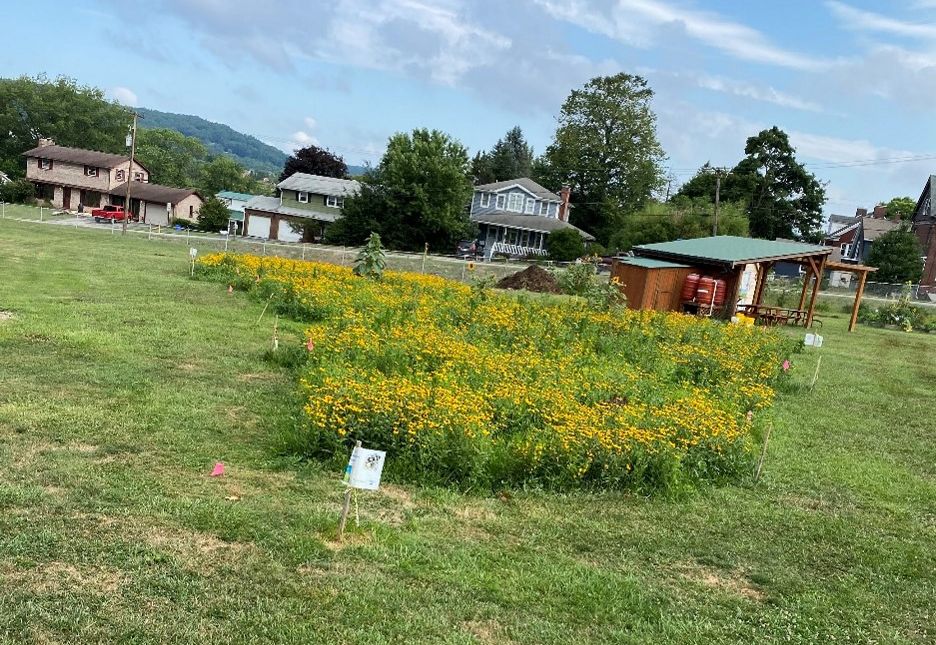
In partnership with the Indiana Community Garden and Mack Park, ICCD installed a pollinator meadow at Mack Park. The goal of this project was to help educate people on the benefits of pollinators.
The district designed an educational sign to serve as a passive tool to inform the public of the purpose and benefits of the pollinator meadow. This sign was produced by Pannier Graphics and installed in Mack Park next to the meadow.
The district also worked with an environmental architect, Upstreet Architects, to design a pollinator meadow that is both visually pleasing and beneficial to the gardens in the Indiana Community Garden. This design became part of a larger vision for this section of Mack Park, as additional phases were also planned that extend beyond the scope of our project.
|  | |
In preparation to plant the pollinator meadow we laid down a series of tarps and plastic sheeting over the area that was intended to become the pollinator meadow to kill the existing turf grasses a few weeks prior to the planned planting.
The pollinator meadow was planted with a pollinator mix from Ernst Seeds, consisting of a native wildflower mix. This mix was designed to change in appearance and composition over time as certain species that bloom in the first few years will eventually be overtaken by species that will begin to bloom after a few years.
As a part of this project, we conducted four educational webinars to help educate and reach the public and specifically members of the community that reside within Environmental Justice (EJ) areas surrounding Mack Park, many of whom were previously unreached clients of the district. These EJ areas are defined as a census tract where 20% or more of the population live at or below the federal poverty line, or 30% of the population identify as a nonwhite minority.
The webinars featured topics like “Starting a Community Garden,” “Backyard Conservation,” “Ramping up for Spring: Garden and Soil Conservation,” and “Multi-purpose Flower and Rain Gardens.” The webinars were a change to the original plan of having in person workshops at the Indiana Community Garden, but as COVID-19 appeared and changed things, ICCD had to adapt and find new and innovative ways to reach our audience.
“Being able to adapt quickly in a changing environment is very important,” said Robert Sabo, watershed coordinator for the district. “It is very likely in the future other unforeseen circumstances will arise and any organization must be able to adjust accordingly to continue providing useful services, specifically for underserved communities.”
The district’s partners at the Indiana Community Garden (ICG) have been taught how-to, and have committed to maintain the pollinator meadow in the future to keep its beauty and benefits active for years to come.
Read more about all grantees through the UAC program on NACD’s urban and community conservation webpage.
| |
Support NCF's Fall Fundraiser | |
NACD's sister organization, the National Conservation Foundation (NCF) is asking for your support in the development of the next generation of conservation leaders. This fall they aim to raise $75,000 by the end of 2022! NCF programs and partnerships advance locally-led conservation and work to develop the next generation of conservation leaders. Their two flagship programs, the NCF-Envirothon and Next Generation Leadership Institute (NGLI) help deliver those results.
NCF needs your help to continue to expand its influential and crucial programming! Tackling conservation and natural resource management must begin with education and training of the next generation.
| Apply for Friends of NACD District Grants Program! | |
What would your conservation district do with a Friends of NACD District Grant? Learn more here about past grantees and their projects, like the Farm to Table Camp the Valencia Soil and Water Conservation District held this year.
Conservation districts still have time to apply for a $2,500 Friends of NACD District Grant before the Nov. 30, 2021 deadline. Review the full RFP and eligibility criteria on the Friends of NACD District Grant webpage.
Questions may be directed to NACD Southeast Region Representative Candice Abinanti at candice-abinanti@nacdnet.org.
| Help USDA by Answering Survey | |
The USDA’s Farm Production and Conservation (FPAC) is a vital partner of NACD and works to support agriculture by helping farmers, ranchers, and forest managers leverage natural resources and mitigate the significant risks of farming through crop insurance, conservation programs, farm safety net programs, lending and disaster programs.
USDA are asking all farmers, ranchers and forest managers to take their survey. Survey feedback will assist USDA in learning about ways to enhance support and improve programs and services, increase access and advance equity for new and existing customers.
| Wisconsin Watershed Planner Job Opportunity | The Vernon County Land & Water Conservation Department in Vernon County, Wisconsin is seeking a Watershed Planner to join the team! The Watershed Planner works closely with other members of the department to coordinate watershed management cost benefit analysis, review and map flood damage, and work with landowners to designate watersheds. The position will remain open until filled. The full position description can be found here. | NACD Seeks Feedback on Urban Webinar Series | NACD’s Urban and Community Resource Policy Group is currently evaluating the monthly urban and community conservation webinars, and we would like your input! To help us understand how you use the monthly webinars and opportunities for the future, please fill out our review form online. We will use the information collected to plan the webinars for Fiscal Year 2023, so we thank you for your contributions in helping organize informative sessions. Please reach out to Dr. Ariel Rivers with any questions, and check the webinar archive on YouTube for many great sessions! | Donate to NCF's Live Auction | |
During the 2023 NACD Annual Meeting in New Orleans, LA, NCF will host their annual Live Auction on February 13, 2023, benefiting the foundation's conservation education programs. The auction is a great opportunity to support the Foundation’s conservation programs including the NCF-Envirothon program and the Next Generation Leadership Institute!
Learn more about the auction, and make a donation here.
|
Promote your conservation district or state association's tree sale, annual meeting, webinar, field day, or other events on NACD's Calendar of Events!
| |