|
Legislative Update and Bill Tracker: Week 5
February 6 - February 10, 2023
| |
Greetings, Members of the Idaho Caregiver Alliance (ICA). My name is Heather Ophir, and I will be serving as the ICA legislative intern during the 2023 session. I am currently completing my Master of Social Work degree at Boise State, after spending three decades in the fields of education and fitness, helping others grow and thrive. The goal of this weekly newsletter is to provide a succinct summary of key legislative activities as well as resources to support your endeavors as a caregiver and public health advocate. Please contact me if you have any questions, comments, or suggestions regarding newsletter updates at heatherophir@u.boisestate.edu.
| |
|
Medicaid Funding: the Discussion Continues
The legislature spent a fair amount of time this week wrestling with Medicaid, Medicaid expansion, and concerns about the growing budget. Recommendations to continue expansion were submitted by both Senate and House Health and Welfare Committees on January 31, 2023. Since then, both committees have heard three presentations. On February 6 Michael Heifetz from the national health care consulting firm Sellers Dorsey presented a review of Idaho’s Medicaid program. The Sellers Dorsey team was tasked with finding $45 million in potential cuts; they actually presented $65.7 in cost-savings recommendations, including the complete elimination of the adult dental benefit ($5.8 million), and a significant reduction in professional services ($21 million). The consultants will provide a second report in April which will be a much more thorough analysis and will provide information on value-based care. Heifetz acknowledged the lean nature of the Idaho Medicaid administrative team, and praised how well they manage such a big program.
On February 7, Jill Randolph of the Division of Budget and Policy Analysis shared with the House and Senate H&W committees budget information that included what is being spent, where and upon whom it is being spent, and what the legislature can expect to see in the future. Her comments included references to the high need among special populations (pregnant women, children, and disabled persons), which Sen. Melissa Wintrow (D-19, Boise) underscored as Idaho’s vulnerable populations.
On February 8, both committees were offered a follow up discussion on Medicaid cost with Health and Human Services Director Dave Jeppeson. His presentation was a thorough overview of the Health and Welfare programs which require funding as well as the benefits they provide Idaho’s residents. He highlighted the new 988 Behavioral Health Hotline, youth crisis services, outpatient services and the coordination of care needed, child welfare (which has experienced significant staffing challenges, but has recently added 24 new staff members and is implementing a new staffing model), the Developmental Disabilities budget and START model, and the 211 Care Line Resource Referral Database. Director Jeppeson also mentioned the good that has come of the Childcare Stabilization Grant which supports both small business childcare facilities and the parents who rely on them to remain in the workforce.
After three days of Medicaid presentations, and recommendations from both committees to extend Medicaid expansion, Representative John Vander Woude (R-22, Nampa) proposed HB123 to completely eliminate Idaho’s Medicaid Expansion program. This would rescind healthcare coverage currently available to over 100,000 Idahoans. To read recommendation letters from both committees in their entirety, as well as comprehensive coverage, please click below.
| |
Elimination of the
Joint Legislative Oversight Committee
In 1994, Republican Representative Bruce Newcombe and Democratic Senator Bruce Sweeney worked together to create the bi-partisan Joint Legislative Oversight Committee (JLOC), composed of 4 Senators and 4 Representatives, 4 Republicans and 4 Democrats. They saw the importance of having a bi-partisan, neutral approach to gathering information important for legislative decision making.
JLOC oversees the non-partisan Office of Performance Evaluation (OPE). Since its inception, this small office has conducted 170 in-depth studies of subjects ranging from prison capacity to school building funding to the child foster care system. Often they take on topics that are controversial but needed for future policy development. This past year, OPE has conducted research, directed by JLOC, on the recruitment, retention and sustainability of direct care workers who help people with disabilities and seniors live independently at home.
Many are waiting anxiously for the report on this research to be released. But first it needs to be presented to JLOC which currently lacks two Representative members. Why? Speaker of the House Mike Moyle (R-10, Star) is waiting to make these appointments to see if House Bill 68, carried by House Majority Leader Megan Blanksma (R-8, Hammett), will pass. This bill eliminates JLOC and moves OPE, with significantly changed responsibilities, under the direction of the Legislative Council, a bi-cameral but majority-controlled committee. This bill has already passed the House on nearly a party-line vote. When it was before the House State Affairs Committee, 8 people testified as to the value of the work of OPE and the importance of keeping the oversight bi-partisan; all opposed H68, expressing concerns that the neutral approach and the in-depth work of OPE would be compromised. The bill’s next stop is the Senate State Affairs Committee which meets Monday, Wednesday and Friday at 8:00 am in Room WW55. It has not yet been scheduled for a hearing.
| |
Narrow Passage of Launch Grants
BY RYAN SUPPE of the Idaho Statesman
“The Idaho House on Monday narrowly approved a proposal from Gov. Brad Little to create workforce grants targeting in-demand careers, part of the $410 million lawmakers set aside for education during last year’s special legislative session. The bill would create a fund, administered by the Idaho Workforce Development Council, that provides up to $8,500 in grants to Idaho high school graduates enrolling in state and community colleges as well as workforce training programs. It would expand an existing program, Idaho Launch, which is currently designed for mid-career training and job seeking. Little, a Republican, made the grants a priority in his budget proposal before the legislative session. The majority of House Republicans opposed the bill, which passed by just one vote. The $102 million fund would prioritize in-demand careers, as employers say they’re struggling to find qualified workers. ‘This is about jobs, not diplomas,’ said House Majority Leader Megan Blanksma, R-Hammett, who’s sponsoring the bill. ‘What we’re doing is trying to fulfill our workforce needs and get kids into jobs that they love.’”
| |
To access the Department of Labor’s In Demand Occupations tool click the button below. This interactive tool allows users to filter job need by region, education requirement, average salary, projected growth, number of positions posted, and industry.
| |
Untangling the Property Tax Relief Bills
From Idaho Center for Fiscal Policy
Two property tax relief bills presented in the Idaho Legislature last week aim to make housing more affordable, but only for homeowners. House Bill 77 and House Bill 79 propose using considerable sales tax revenue to provide this targeted relief. With nearly one-third of Idaho taxpayers being renters, a significant number of Idahoans who pay sales tax will be excluded from relief if these bills pass.
Instead of pitting hardworking Idahoans against one another, Idaho should continue on the path of inclusive support for all taxpayers. Last year’s minimum tax rebate accomplished this in part by ensuring at least $300 was accessible to families no matter their economic status or type of housing they lived in. Policymakers should add similar equity to current sales tax homeowner relief proposals. This could be done through a well-crafted rebate or tax credit that helps reach all sales taxpayers.
To read Alejandra Cerna Rios’s full blog report, click the article button below:
| Silver Lining: Renter’s Rights | |
On February 8, the Senate Judiciary and Rules committee heard Senate Bill 1039, which will require residential landlords to (1) disclose all rental fees in the lease or other written notice and (2) that fees be reasonable, sponsored by Sen. Ali Rabe (D-16, Boise). Her presentation revealed the unprotected status of renters in Idaho by citing examples of $500 flat late fees, $100 per day late fees, renters who pay $500 in rent but show a debt of $3,000 on their landlord’s ledger, and renters who are charged $100 for the first day late and $30 each day thereafter. Idaho is one of the few states that offers no guidance around late fees, either in law or case law.
Sen. Rabe reminded the committee that renters are not on equal footing with landlords when it comes to negotiating a lease agreement. Contracts are offered on a “take it or leave it” basis. In Idaho Code “reasonable fee” protection language is attached to court fees, legal fees, credit card fees, mortgages, and storage unit fees. Nowhere does Idaho code outline reasonable fees (“any damages must be related to actual costs”) for rental agreements.
The comments from the committee were overwhelmingly positive, and the bill was referred to several times as a “friendly bill” that “everyone can agree on.” The bill was referred to the 14th order for amendment to ensure that it would not be retroactive but have an effective date of July 1, 2023
|
Housing Cost Burden
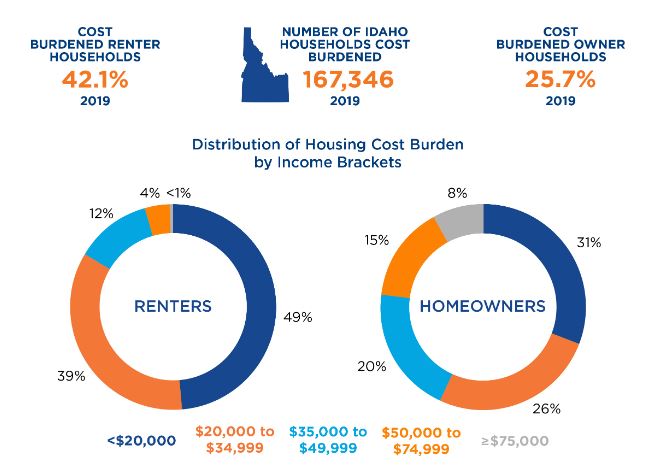
Households that spend 30 percent or more of household income on housing are considered cost burdened. These households devote too great a proportion of their budget to housing and are often unable to pay for other necessities, like food, transportation, or healthcare. The chart below shows that cost burden disproportionately affects Idaho renters and lower income households (Idaho Policy Institute at Boise State, 2023). To explore the interactive Statewide Housing Analysis Dashboard, please click below:
| |
Changes to JFAC Voting Procedures
Put in Motion
JFAC, which is the Idaho Legislature’s powerful budget committee, hasn’t taken any votes on the dozens of supplemental budget requests pending before the committee. Some of these requests include emergency rental assistance funding made by a children’s advocacy group, the deadline for which has come and gone.
But on Jan. 13, House Speaker Mike Moyle, R-Star, told the Idaho Capital Sun he favors splitting JFAC’s votes in two so that the members of the Idaho House and Idaho Senate would vote separately, and any budget bill would need to get a simple majority in both votes to advance. Under the new agreement, JFAC will continue to vote jointly, but the votes of House and Senate committee members will be announced separately, as well. The statement was signed by JFAC’s two co-chairs, Rep. Wendy Horman, R-Idaho Falls, and Sen. C. Scott Grow, R-Eagle.
To read the full coverage on the change in voting procedures in JFAC and the delays those changes have caused, please click the article links below.
| |
UPCOMING: New Bills to Watch
HB063 Counselors, therapists, principles.
A bill introduced by Julianne Young (R-Blackfoot) on “Sincerely held beliefs” of counselors and therapists was reported out of the House Health and Welfare Committee with a Do Pass recommendation. This bill would allow a counselor to refuse to treat a client if that client’s goals, outcomes, or behaviors conflict with the sincerely held principles of the counselor or therapist. Six licensed counselors testified in opposition to the bill, citing that the Idaho Counseling Association was not consulted and is not in support of the bill, which is in direct conflict with the Counselors Code of Ethics. When pressed for explanation on the rationale for the bill, Rep. Young replied, “We’re writing statute for a profession. The profession needs to conform.” Concerns raised by those counselors who testified include the need to protect vulnerable clients who come seeking help and support, the lack of mental health care access in Idaho, long waitlists to see practitioners, the danger in which this bill places those with suicidal thoughts, and the likelihood that this bill would promote racism, homophobia, and xenophobia. Therapists reiterated that their Code of Ethics already has provisions for ethical referrals for clients who would be better served by a provider with additional or different training. The Do Pass vote was a narrow 7 to 6.
| |
|
Idaho Caregiver Alliance Bill Tracker
A comprehensive list of bills introduced in the Idaho House and Senate will now be hosted in a document accessible below. This document will reflect the most up-to-date information on each bill's status, and can be viewed at any time. If you have questions or feedback about the content or format, please contact Heather Ophir at heatherophir@u.boisestate.edu.
| | |
Important Medicaid Update:
Renewals Started Feb. 1st
Hillarie Hagen, LSW, Idaho Voices for Children
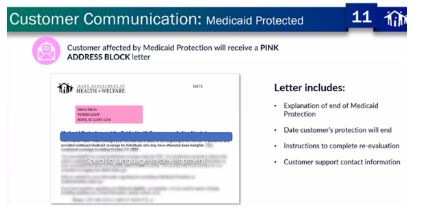
Idaho began the renewal process on Feb. 1st, meaning the first 30,000 participants received a notice that they will need to renew their Medicaid coverage by completing a renewal. Households that receive a pink notice will have 60 days to complete their renewal process to prove eligibility, or they could lose coverage April 1st, 2023. Learn more.
Medicaid Unwinding Messaging Toolkit: Please Share!
Idaho Voices for Children has created a Medicaid unwinding toolkit and guide that includes messages to help stakeholders working with Medicaid enrollees be able to have the tools they need to communicate about the end of the Medicaid Protection, encourage renewal completions, and share information to maximize successful coverage transitions for those no longer eligible for Medicaid. Access the Medicaid Protection Unwinding Messaging Toolkit by clicking the button below:
| Stay Connected ~ Get Involved | Transportation equals access to employment, health care, services, and social opportunity. If you have thoughts about transportation in Canyon County, please make your voice heard! | |
|
Legislative Luncheon
Please join us on February 14, 2023 at the Idaho Capitol Building for the opportunity to meet your legislative representatives and to share with them your experiences with caregiving. All family caregivers are welcome!
| |
|
AARP Telephone Town Hall
with Idaho Senate Leadership
| |
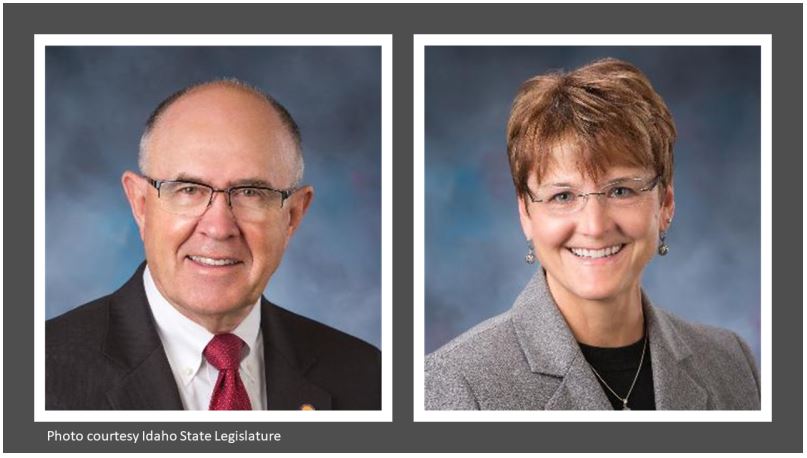
AARP Idaho is inviting Idahoans to join Senate Majority Leader Chuck Winder and Senate Minority Leader Melissa Wintrow for a statewide telephone town meeting. The one-hour conversation, moderated by AARP Idaho state director Lupe Wissel, will focus on the legislative session, property taxes, health issues and other topics important to Idahoans of all ages.
The hour-long conversation begins Thursday, February 23rd at 2:30pm MT.
Participants can join by:
This is an interactive forum and participants are encouraged to call and speak directly with Senator Winder and Senator Wintrow. Questions may also be submitted ahead of time via email at aarpid@aarp.org, or during the Facebook live conversation and on Twitter @AARPIdaho.
This call is open to everyone whether they are an AARP member or not
| |
|
Operation Advocacy: Let's Talk to Our Legislators
February 20 and 21, 2023
Boise, Idaho
Join us!
| |
Idaho Caregiver Alliance | idahocaregiveralliance@gmail.com | idahocaregiveralliance.com | |
See what's happening on our social sites: | | | | |