|
Once the first pioneers, who came to this area in 1836, got their land cleared and crops planted and harvested, they had to grind their own grains into course meal, which was not an easy undertaking, or make a long trip to the nearest grist mill. At that time the closest one was in Michigan City, IN, one hundred miles away. Early settler John Sanborn would make this trip in a cart hauled by four yoke of oxen carrying one hundred bushels of wheat, and would bring back flour for his neighbors. The roundtrip took one month.
It’s no wonder that he became one of the founders of the Blivin’s Grist Mill, helping Joseph Bliven and his son-in-law John E. Mann build the mill in 1843. The mill could grind grain into flour, course meal or feed for animals from a variety of grains including corn.
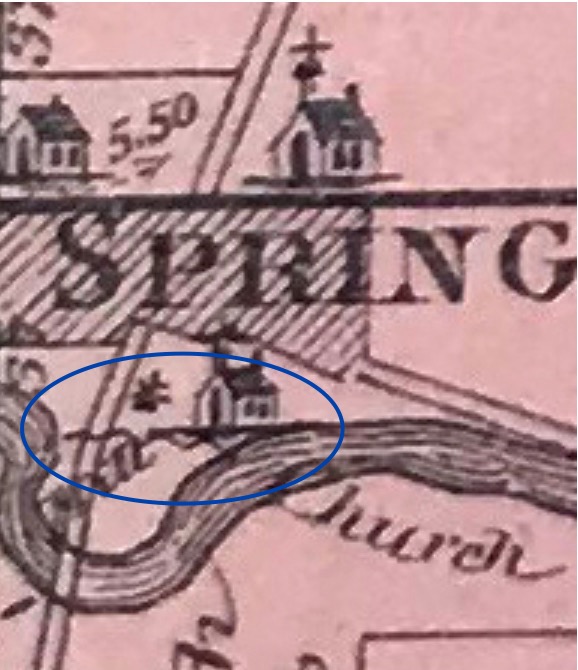
They chose a location around 8002 Blivin, because they saw a way to divert water from the meandering Nippersink Creek to supply a steady current of water to the mill. An earthen dam was built on the Nippersink about 50 yards south of the home at 8001 Blivin. This created a mill pond on the west side of the road. A mill race, or channel, leading from the mill pond ran through a tunnel dug under Blivin Street to the mill on the east side of Blivin. This would turn the waterwheel and set the mill stone in motion. The mill race continued east, then went in a southernly direction to empty back into the Nippersink.
Around 1868, partners Weber and Lorig were running the mill. Mr. Weber was "a thorough business man", doing what many millers were finding it difficult to do: make it pay. The townspeople were happy to hear the mill “humming from morning till night…notwithstanding the hard times.” However, in 1874, Lewis Hatch ran a notice for a mortgage sale. The mortgages of Weber and Lorig, dated 1867 & 1868, went into default and Hatch secured possession of the property, so was now looking to sell.
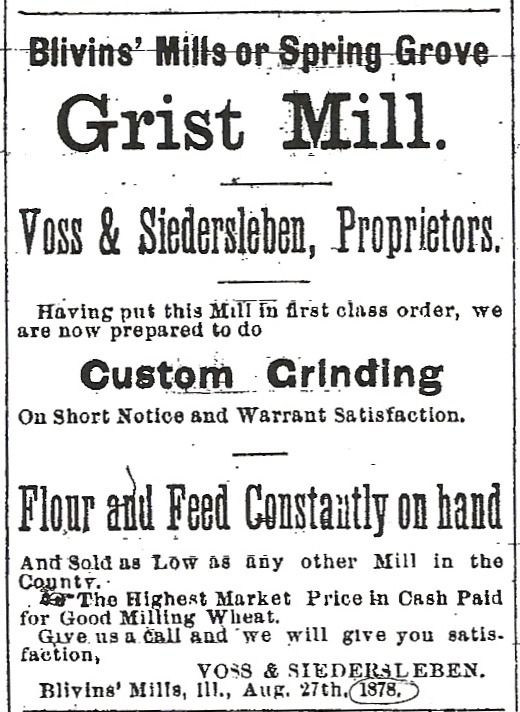
The grist mill changed hands many times after that. Voss & Siedersleben, Thos. Dayment, and others ran ads in the paper. In 1881 Henry Dayment “got the mill in running order and was prepared to do grinding”. The town was thrilled saying, “It makes it seem like the Spring Grove of yore to hear the rattle of the mill again.”
By the fall of 1882, for reasons unknown, the mill was no longer in operation. A “real live saloon” opened in the mill house and appeared to be doing good business. But in late 1883 the property was vandalized by someone “who must be miserably low and cussed to cut the belt cloth, break the windows, etc”, according to the newspaper.
Then the mill was turned into rental housing. In February 1899, the citizens were startled to see flames coming from the upper story of the mill house. Tenant Mr. Campbell hastily wrapped his ill little son and took him to safety. Neighbors helped save their things, but it was impossible to save the building and it was totally destroyed. It was “one of the old landmarks here and was built on the mill property own by Lewis Hatch. No insurance was carried.”
In1901 the mill power (water rights) and building site were purchased from Hatch and “the buyer was ready to erect a building at once.” Soon a new engine for the mill arrived and masons from Antioch were busy at the mill. In August 1902 the mill was running again and resident Louis Nulk was “ready to attend to grinding promptly”. Nulk already had a wheat threshing business and could now mill the grain. “Nulk and Pierce” were two of the busiest men in town grinding feed from morning until night.
No pictures are known to exist of either mill, and the exact location is unknown, but there are some interesting old foundations in the area of where it once stood. It’s also unknown when this new mill stopped production or what happened to it. In time, the dam was removed so the creek could run its natural course. The mill pond and mill race, now dry, can still be seen and Bliven family descendants think the mill stone was left behind in the mill race. But this wasn’t the only mill in town! Read more about Hatch’s saw mill in the next Blast from the Past!
Story by Laura Frumet
|