|
Theme:
- High-Leverage Practices in Special Education: HLP10: FBAs and Behavior Plans
Articles:
- All Behavior is Communication
- National Deaf History Month
News from RMTC-D/HH
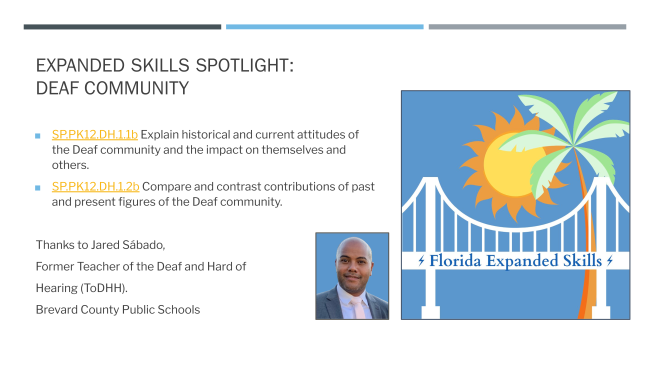
Expanded Skills Spotlight
- Title: Famous Artists, Inventors, & Athletes with Hearing Loss
- Author: Jared Sãbado, Brevard County Public Schools
-
Standards: SP.PK12.DH.1.1b & SP.PK12.DH.1.2b
Teacher Toolkit
- LiveBinder of Tools for HLPs
- Loan Library Resources
Did You Know?
- Online Modules for Students who are Dual-Sensory Impaired
- Motion Light Lab - ASL Story Apps and Lesson Plans
- The Flat Laurent Challenge for Schools
Upcoming Events
| |
Theme: High-Leverage Practices (HLPs) | |
HLP10 - FBAs and Behavior Plans | |
Happy Spring! The theme for this month is based on the tenth high-leverage practice from the Collaboration for Effective Educator Development, Accountability, and Reform (CEEDAR) Center and Council for Exceptional Children (CEC)’s High-Leverage Practices (HLPs) in Special Education: Conduct functional behavioral assessments to develop individual student behavior support plans. Keep reading for resources and more! | | | |
All Behavior is Communication | |
|
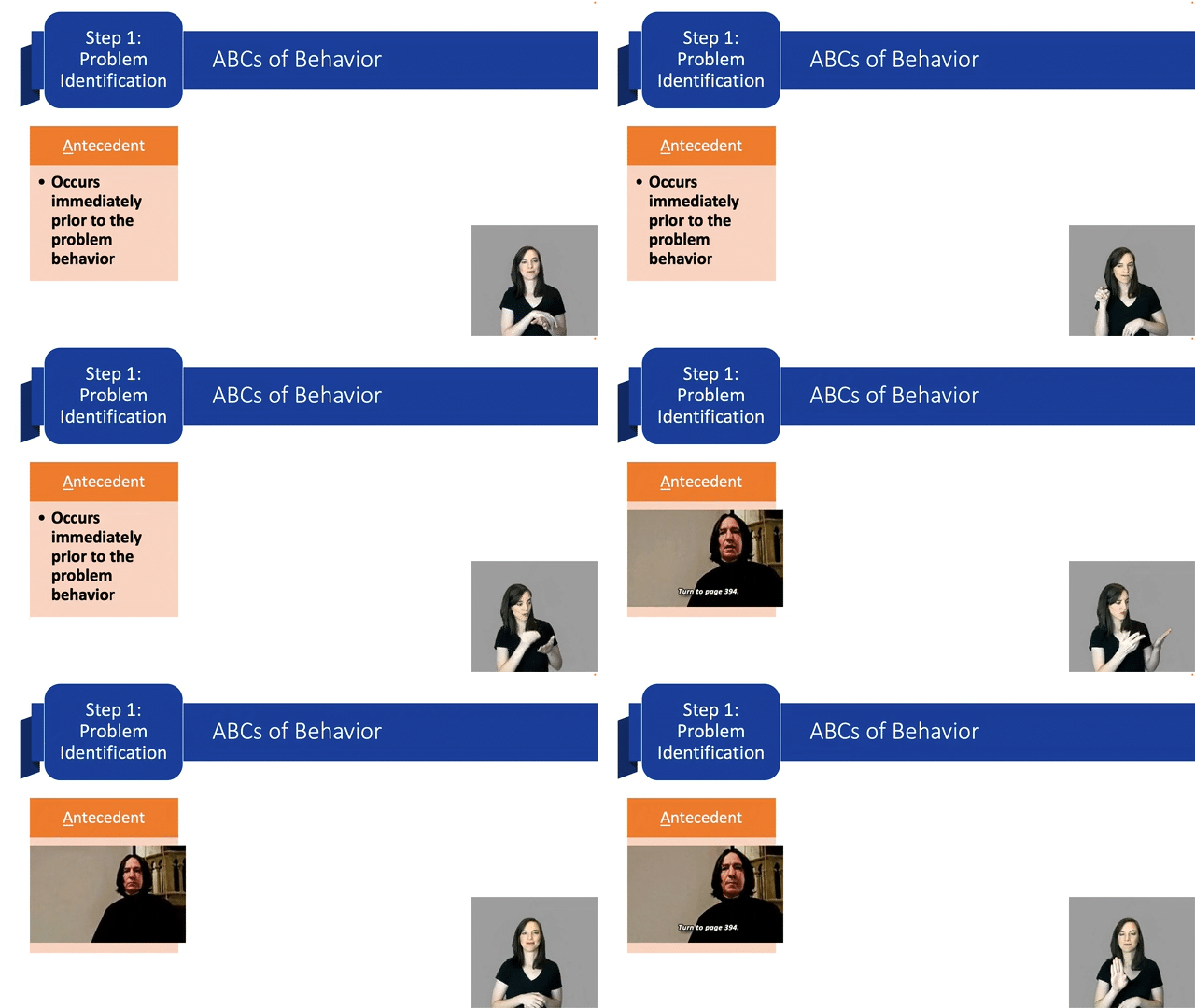
ABC - All Behavior is Communication - when students who are deaf or hard of hearing (DHH) have experienced language deprivation they often will communicate in ways that get responses - sometimes those responses are not what many adults would consider desirable.
Read a snippet from the High-Leverage Practices in Special Education publication regarding HLP10 (p. 60):
- Creating individual behavior plans is a central role of all special educators. Key to successful plans is to conduct a functional behavioral assessment (FBA) any time behavior is chronic, intense, or impedes learning. A comprehensive FBA results in a hypothesis about the function of the student’s problem behavior. Once the function is determined, a behavior intervention plan is developed that (a) teaches the student a pro-social replacement behavior that will serve the same or similar function, (b) alters the environment to make the replacement behavior more efficient and effective than the problem behavior, (c) alters the environment to no longer allow the problem behavior to access the previous outcome, and (d) includes ongoing data collection to monitor progress.
To learn more about behavior plans and FBAs and how they may be different for students who are DHH, watch the RMTC-D/HH video on HLP10.
| |
National Deaf History Month | |
|
The National Association of the Deaf (NAD) recently announced that the dates for National Deaf History Month will be April 1-30 (NAD, 2022).
Deaf history has become a cornerstone in Deaf Culture* among the Deaf Community* for many years. It’s celebrated, reflected upon, and has empowered many individuals to advocate and stand up for equal access. Members of the Deaf Community are proud of their heritage, their language, and their culture. During Deaf events, historical figures that have been influential to the community are often the center of discussions. Gallaudet University, which holds a prominent position among the community as one of the only universities to offer all instructional coursework in American Sign Language, has developed a historical timeline reflecting on historical figures and events that have shaped the Deaf Community into what it is today. Gallaudet has also produced a documentary called Through Deaf Eyes that captures the progression of the Deaf Community throughout history. The documentary can be borrowed from the RMTC-D/HH Media and Materials Loan Library at no cost for Florida stakeholders.
*Using capitalization for “Deaf,” “Deaf Culture,” and “Deaf Community” is common for individuals who are deaf and culturally identify with the Deaf Community.
| |
End of the Year Needs Assessment Survey | RMTC-D/HH works hard to serve your needs and interests. Your opinions and concerns are an important part of our planning efforts. Your input is critical to help us understand your needs and provide effective and focused support. Please help us by completing the 2022-2023 RMTC-D/HH Annual Survey. |
When?
The survey closes April 14, 2023.
| | |
LAST TA-Live! for 2022-2023 | |
In the TA-Live! series, RMTC-D/HH is diving deep into the High-Leverage Practices in Special Education from the CEC and CEEDAR Center.
Before the next scheduled discussion, participants will be encouraged to*:
*Unable to complete the homework? Please still feel free to join RMTC-D/HH staff for a discussion on resources and tools Florida educators utilize related to the HLP discussed.
| |
For this month’s TA-Live! discussion session, RMTC-D/HH will be joined by the Florida Positive Behavioral Interventions & Supports Project (PBIS). Have questions for PBIS you would like to submit before the discussion session? Please fill out this form.
|
When?
April 12, 2022 from 2:00 p.m. to 3:00 p.m. ET (1:00 p.m. to 2:00 p.m. CT). With a watch party of the homework starting at 1:45 p.m. ET (12:45 p.m. CT).
| | | |
Registration coming soon! | |
Save the Date: SIWI
Please join RMTC-D/HH for an introductory professional development in Strategic and Interactive Writing Instruction (SIWI). SIWI is an evidence-based framework for writing instruction specifically designed for students who are deaf/hard of hearing (DHH).
Date(s): May 15, 2023 to May 25, 2023
Time(s): Asynchronous AND various facilitated 60-90 minute sessions
| | |
Expanded Skills Spotlight | |
Famous People who are DHH | |
|
|
Resources:
In order to keep all the resources in one place, RMTC-D/HH has created a LiveBinder that is categorized by the twenty-two “High-Leverage Practices for Students with Disabilities” from the CEEDAR Center and the Council for Exceptional Children (CEC). To see the resources available by each category, check out the LiveBinder!
| | | |
Resources from the RMTC-D/HH Media and Materials Loan Library:
The below resources are from the Media and Materials Loan Library* that have relevance to the high-leverage practice "HLP10 - Conduct functional behavioral assessments to develop individual student behavior support plans."
*Florida stakeholders may borrow these and many other resources from RMTC-D/HH's Media and Materials Loan Library, for FREE. Each material comes with a return label, making even the shipping at no charge to the borrower.
| | | |
|
|
Advocacy in Action - A Self-Advocacy Curriculum for Students who are D/HH
(Catalog Number: 1938): Advocacy in Action provides tools for teachers to help students identify and develop self-advocacy skills. The text is designed to be easily individualized for each student or small group of students and for each teacher or parent.
| | | |
|
|
C.O.A.C.H.–Self-Advocacy & Transition Skills for Secondary Students who are Deaf or Hard of Hearing
(Catalog Number: 1939): This book uses a problem solving model of C.O.A.C.H. – Concern- Observe- Access- Collaborate- make it Happen to address access and communication needs. The book includes: rationale for the instruction model, step-by-step directions, goals and activities, assessments, and reproducible worksheets. Each section addresses specific aspects of advocacy and develops underlying skills to support application.
| | | |
|
|
Building Skills for Independence in the Mainstream
(Catalog Number: 1940): Building Skills for Independence in the Mainstream was developed as a guide for DHH professionals to support their work with classroom teachers and with students to develop the skills needed for independence with hearing aids and self-advocacy.
| | | |
|
|
Steps to Assessment - A Guide to Identifying Educational Needs for D/HH Students
(Catalog Number: 1943): The focus of this guide is appropriate assessment practices for children from transition to school at age three through high school. Categories of assessment are presented, as are ways to apply information from assessment results to identify instructional and accommodation needs for students who are DHH.
| | | |
|
|
Building Skills for Success in the Fast-Paced Classroom
(Catalog Number: 1958): The purpose of this book is to provide resources that will assist students who are DHH in optimizing their achievement through improved access and self-advocacy. It targets skills that must be mastered in order to benefit from the general education curriculum.
| | | |
|
|
Steps to Success
(Catalog Number: 1959): Steps to Success is an instructional model for students who are deaf or hard of hearing in grades kindergarten through 12. It is designed to develop skills that will enable a student to be an effective listener, a successful communicator, a proficient reader, and a knowledgeable consumer of goods & services related to hearing needs.
| | | |
Online Modules for Students who are
Dual-Sensory Impaired
The Florida and Virgin Islands Deaf-Blind Collaborative (FAVI) and FIMC-VI have collaborated to create a new self-paced, independent learning opportunity using materials developed by the National Center on Deaf-Blindness. These are professional development modules for practitioners who want to improve their knowledge of deaf-blindness and gain practical skills that are essential for working with students who are deaf-blind. The intended audience is teachers from a variety of areas (e.g., special education, visual impairment, deaf/hard of hearing, and severe/multiple disabilities), related service providers and administrators. Participants may earn 14 inservice credit hours if approved by your school district. To register, please visit The Impact of Deafblindness on Learning and Development. For questions, contact Tiffany Conrad.
| |
Motion Light Lab - ASL Story Apps and Lesson Plans
TWO new bilingual storybook apps are coming to your iPad! Motion Light Lab is thrilled to announce the launch of A Day in Kitty’s Life, and A Day in Puppy’s Life.
They are designed for early readers, ages 0 - 5. Artist Jessica Arealo brings the story alive. Children will learn about the daily life of Kitty and Puppy through talented storytellers Antonio Brown (Kitty) and Juliana Bahan (Puppy). In both stories, readers will learn more about the pets’ feelings and action verbs. Bonus: Each app holds more than 50 vocabulary words, signed and fingerspelled.
Both apps are being offered for free.
App Store links:
In addition to new storybook apps, they also have a new section in ASL Literacy Activities featuring A Day in Kitty’s Life and A Day in Puppy’s Life weekly lesson plan. They are also free. Sign up today! Everything in ASL Literacy Activities is FREE!
| |
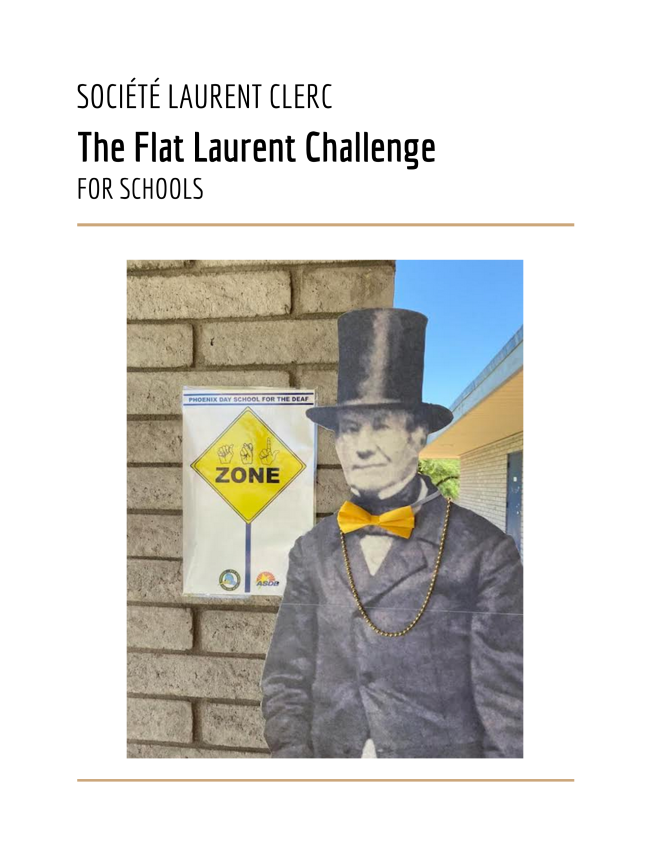
The Flat Laurent Challenge for Schools
Celebrate Deaf History Month by having Flat Larent Clerc visit your school. He is shipped to your school at no cost and you pay for him to visit the next location. He can visit for up to 2 months. Take selfies with Flat Larent in your school and community to share with the Société Laurent Clerc community.
Download the handout to learn more about the Flat Laurent Challenge.
| |
|
RMTC-D/HH provides Tech Notes as a free resource to teachers, professionals, and families around the state in order to pass along potentially useful information and expand the knowledge and opportunities available to educators and families of children who are deaf/hard of hearing. This email was funded by the Florida Department of Education Bureau of Exceptional Education through federal assistance under the Individuals with Disabilities Education Act (IDEA), Part B funds. The information included does not reflect any specific endorsement by any parties involved. | |
Suggested Citation:
Resource Materials and Technology Center for the Deaf/Hard [RMTC-D/HH]. (2023, April). HLP10: FBAs and behavior intervention plans. Tech Notes. https://www.rmtcdhh.org/tech-notes-archive/
| | | | |