A Word From Our Publisher | |
|
Greetings JSOM Newsletter Subscribers
You may notice our newsletter design has changed. Over the years, we have maintained a unified design aesthetic incorporating the JSOM brand colors. As technology has evolved, we realize that our style had to change in order to accommodate mobile advancements and digital settings that were sometimes distorting the colors and text of our newsletters and emails. In addition, our website is undergoing a complete redesign which will include a much more contemporary and streamlined Online Store experience. We anticipate the launch of our new website very soon and we will be sending out a more detailed email to all JSOM subscribers explaining the changes we've made and how to navigate the new system.
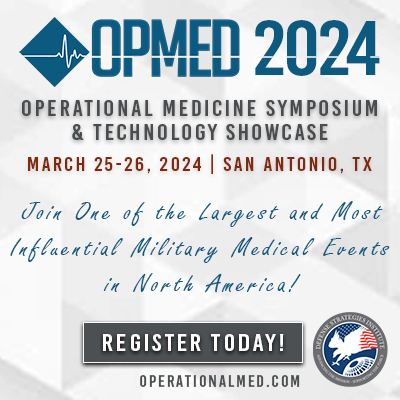
Please remember to look for the JSOM booth at the upcoming OPMED conference. This is one of the year's premier conferences and we are excited to be a Media Partner of the event. The JSOM team will be at booth 104. We will have complimentary journals available while they last and handbooks for sale.
The JSOM Featured Sponsor of the Month is Delta Development Team. To learn more about what they are doing to revolutionize frontline medical care, please read https://www.prnewswire.com/news-releases/idf-and-delta-development-team-forge-strategic-partnership-to-enhance-emergency-blood-transfusions-on-the-frontlines-302065403.html
Respectfully,
Michelle DuGuay Landers, MBA, BSN, RN
Breakaway Media, LLC
Publisher
Journal of Special Operations Medicine (JSOM)
Lt Col, USAF/NC (Ret)
publisher@jsomonline.org
www.JSOMonline.org
Purchase our Handbooks
| |
|
ABSTRACT
Introduction: To prepare military doctors to face mass casualty incidents (MCIs), the French Army Health Service contributed to the development of TRAUMASIMS, a serious game (SG) for training medical responders to MCIs. Methods: French military doctors participated in a three-phase training study. The initial war trauma training was a combination of didactic lectures (Phase 1), laboratory exercises (Phase 2), and situational training exercises (STX) (Phase 3). Phase 1 lectures reviewed French Forward Combat Casualty Care (FFCCC) practices based on the acronym MARCHE (Massive bleeding, Airway, Respiration, Circulation, Head, hypothermia, Evacuation) for the detection of care priorities and implementation of life-saving interventions, triage, and medical evacuation (MEDEVAC) requests. Phase 2 was a case-control study that consisted of a traditional text-based simulation of MCIs (control group) or SG training (study group). Phase 3 was clinical: military students had to simultaneously manage five combat casualties in a prehospital setting. MCI management was evaluated using a standard 20-item scale of FFCCC benchmarks, 9-line MEDEVAC request, and time to evacuate the casualty collection point (CCP). Emotional responses of study participants were secondarily analyzed. Results: Among the 81 postgraduate military students included, 38 took SG training, and 35 trained with a text-based simulation in Phase 2. Regarding the error rates made during STX (Phase 3), SG improved FFCCC compliance (11.9% vs. 23.4%; p < .001). Additionally, triage was more accurate in the SG group (93.4% vs. 88.0%; p = .09). SG training mainly benefited priority and routine casualties, allowing faster clearance of the CCP (p = .001). Stress evaluations did not demonstrate any effect of immersive simulation. Conclusion: A brief SG-based curriculum (2 hours) improved FFCCC performance and categorization of casualties in MCI STX.
| |
|
How the Five Principles of High Reliability Organizations Align with the Five Truths of Special Operations
Biggs A, Jewell J, Littlejohn LF. 23(2). 94 - 98. (Journal Article)
ABSTRACT
Special Operations medicine must provide highly reliable healthcare under intense and sometimes dangerous circumstances. In turn, it is important to understand the principles inherent to building a High Reliability Organization (HRO). These principles include (1) sensitivity to operations; (2) preoccupation with failure; (3) reluctance to simplify; (4) resilience; and (5) deference to expertise. Understanding them is crucial to turning good ideas into sound practical benefit in operational medicine. A prime teaching opportunity involves an interesting coincidence that occurred during the emergence of HROs. Specifically, United States Special Operations Command (USSOCOM) adopted five Special Operations Forces (SOF) Truths that contribute to success in Special Operations, including (1) humans are more important than hardware; (2) quality is better than quantity; (3) SOF cannot be mass produced; (4) competent SOF cannot be created after emergencies occur; and (5) most Special Operations require non-SOF support. These five Truths have more in common with the five HRO principles than merely quantity. They describe the same underlying ideas with a key focus on human performance in high-risk activities. As such, when presented alongside the five HRO principles, there is an opportunity to improve the overall health and performance of SOF personnel by integrating these principles across the range of Special Operations medicine from point of injury care to garrison human performance initiatives. The following discussion describes in greater detail the five HRO principles, the five SOF Truths, and how these similar ideas emerged as more than just a useful coincidence in illustrating the key concepts to produce high performance.
| |
March 2024 Featured Article | |
|
Effectiveness of Sternal Intraosseous Device in Patients Presenting with Circulatory Shock: A Retrospective Observational Study
Hynes A, Murali S, Bass GA, Kheirbek T, Qasim Z, George N, Yelon JA, Chreiman KC, Martin ND, Cannon JW. 23(4). 81 - 86. (Journal Article)
| |
|
ABSTRACT
Background: Hemorrhagic shock requires timely administration of blood products and resuscitative adjuncts through multiple access sites. Intraosseous (IO) devices offer an alternative to intravenous (IV) access as recommended by the massive hemorrhage, A-airway, R-respiratory, C-circulation, and H- hypothermia (MARCH) algorithm of Tactical Combat Casualty Care (TCCC). However, venous injuries proximal to the site of IO access may complicate resuscitative atempts. Sternal IO access represents an alternative pioneered by military personnel. However, its effectiveness in patients with shock is supported by limited evidence. We conducted a pilot study of two sternal-IO devices to investigate the efficacy of sternal-IO access in civilian trauma care. Methods: A retrospective review (October 2020 to June 2021) involving injured patients receiving either a TALON® or a FAST1® sternal-IO device was performed at a large urban quaternary academic medical center. Baseline demographics, injury characteristics, vascular access sites, blood products and medications administered, and outcomes were analyzed. The primary outcome was a successful sternal-IO atempt. Results: Nine males with gunshot wounds transported to the hospital by police were included in this study. Eight patients were pulseless on arrival, and one became pulseless shortly thereafter. Seven (78%) sternal-IO placements were successful, including six TALON devices and one of the three FAST1 devices, as FAST1 placement required attention to Operator positioning following resuscitative thoracotomy. Three patients achieved return of spontaneous circulation, two proceeded to the operating room, but none survived to discharge. Conclusions: Sternal-IO access was successful in nearly 80% of atempts. The indications for sternal-IO placement among civilians require further evaluation compared with IV and extremity IO access.
Keywords: intraosseous; resuscitation; sternum; sternal intraosseous; sternal vascular access; vascular access
| |
The Journal of Special Operations Medicine Podcast | |
The JSOM podcast digs deeper into the articles and subjects that matter to our readers. Our podcast hosts, Captains Alex Merkle and Josh Randles, tackle articles from the journal based on merit, interest, and application for operators in the field. The Winter 23 episode is here! | |
|
Current Episode
Our JSOM podcast team will be reviewing the following articles for our Winter podcast:
Optimizing Brain Health of United States Special Operations Forces by Brian L. Edlow, Natalie Gilmore, Samatha L. Tromly, et al.
Bluetooth Tactical Headsets Improve the Speed of Accurate Patient Handoffs by Daniel J. Stinner, Cory McEvoy, Michael A. Broussard, et al.
Effectiveness of Sternal Intraosseous Device in Patients Presenting with Circulatory Shock: A Retrospective Observational Study by Allyson M. Hynes, Shyam Murali, Gary A. Bass, et al.
JSOM Guest Medic Interview
Our guest medic for this quarter is Ricky Ditzel, who will review “Optimizing Brain Health of United States Special Operations Forces” by Edlow and colleagues. Ricky and his two siblings’ adolescent lives were defined by chaos. Inspired to make a positive change for his family, he enlisted in the Army and served as a U.S. Army Special Operations Flight Paramedic. In this role, Ricky treated U.S. and Allied forces Servicemembers who suffered from the acute and chronic effects of traumatic brain injury. These experiences propelled Ricky to become a neurodegenerative disease researcher and vocal advocate for brain and mental health. Ricky believes strongly in a life of service and consistently seeks opportunities to support underserved communities and promote health equity. He believes the current healthcare structure reduces access to care for individuals with neurologic disabilities because of limitations associated with public transportation, specialty care access, and education. Driven towards research and finding solutions to increase the quality of life for people with neurological disabilities, Ricky is pursuing a career as a physician. He plans to create a neurologic center of excellence that will provide comprehensive multidisciplinary outpatient care under one roof. Ricky is the Chairman of the Special Operations Forces to School of Medicine (SOF to SOM) (https://www.softosom.org/), a board member of Neuroacanthocytosis Advocacy USA, and the Special Operations Medical Association. He will continue to serve his country and community while doing his best to honor the legacies of those who have gone before him. “For they loved to fight, fought to win, and would rather die than quit. Night Stalkers don’t quit!”
JSOM Guest Author Interview
Our guest author interview will be with Cory McEvoy, author of “Bluetooth Tactical Headsets Improve the Speed of Accurate Patient Handoffs.” Cory is a former 18D who served with 1-1SFG(A) and USASOC. Cory has deployed to both humanitarian and combat zones as an 18D and has been involved with many research projects, with his primary interest being repetitive and low-level blast. Cory left the Army in 2023 and is in the process of applying to medical school.
| |
Please Support Our Sponsors and Media Partners | |
The Journal of Special Operations Medicine is proud to have the support of many great sponsors and media partners. Our sponsors are leaders in the field of military medical technology. Please help support these companies by following the links below to learn more about their missions and the products they offer. This section also features peridoic promtional information for events and conferences, including the 2024 SOMA Scientific Assembly. | |
Institutional Subscribers | |
|
The JSOM is incredibly grateful to have the support of many institutions around the world. We would like to thank our recent institutional subscribers and re-subscribers for their support by acknowledging them in our eNewsletter and, when applicable, sharing their social media information.
Visit https://jsom.us/Library for a full list of institutions currently subscribing to the JSOM. We are beginning a campaign to expand our institutional subscriptions. If you think your company would benefit from an institutional subscription, let us know! We'll be happy to talk to you and get the ball rolling. You don't have to be a university or medical center to subscribe - we have many EMS units, government agencies, and military medical units in the United States and abroad.
Are you on the list? Great! Need to know how to access our resources? You can either contact your head librarian or shoot an email to subscriptions@JSOMonline.org.
Institutions receive a print copy of our journal, digital access, or both. Digital subscribers have unlimited access to our full compendium of articles, journals, and the ATP-P. If you are a student, researcher, doctor, or other medical professionals at one of these institutions, please contact your librarian for login details. Additionally, the digital resources are typically available 2-3 weeks ahead of print publication.
If your institution is not on the list and you want more information about our institutional access, contact our subscriptions manager, Dr. Scott Graverson.
| |
|
For over 20 years, the Journal of Special Operations Medicine (JSOM) has brought important, lifesaving information to the Special Operations Forces (SOF) community. And over the years, as our audience and readership has expanded into over 80 countries, physicians, military and tactical medics, and other medical professionals working in unconventional environments rely on the JSOM for breakthrough research at the intersection of operational medicine and tactical casualty care. Our peer-reviewed research and interactive clinical content make the JSOM a must-read for:
- Physicians
- Medics
- Educators
- Law Enforcement
- The military and civilian global medical community
For these reasons, many of the world’s top medical technology companies and medical device distributors make the JSOM a cornerstone of their advertising programs. And with a strong multichannel and social media presence, the JSOM offers the most dynamic print and digital media options at cost-effective prices. For medical marketers worldwide looking to reach our niche audience, the JSOM is the gold standard. For more information, please see our attached media kit.
| |
FORT LIBERTY / DVIDS / Photo by Ronald Wolf
The 2024 Command Sgt. Maj. Jack L. Clark, Jr., U.S. Army Best Medic Competition was held from March 4-8, at Fort Liberty, North Carolina. Accepting the trophy is this year’s winners Staff Sgt. Patrick Murphy, 75th Ranger Regiment, and Staff Sgt. Ryan Musso, 75th Ranger Regiment, flanked by Lt. Gen. Mary Izaguirre, the U.S. Army Surgeon General and Commanding General, U.S. Army Medical Command, and Command Sgt. Maj. Timothy Sprunger, Senior Enlisted Advisor to Surgeon General and Command Sgt. Maj., U.S. Army Medical Command.
Do You Have a Photo to Share?
Please send us your approved medical action images for future covers, our journal Photo Gallery, bi-weekly eNewsletters, and JSOM social media! All images must include captions in the emails in which they are sent. Images for print must be high resolution, at least 300 dpi. Images for the eNewsletter and social media must be at least 400px wide, 72 dpi.
| | |
|
Breakaway Media, LLC, is a woman service-disabled veteran-owned small business (WOSB and SDVOSB) registered with the Central Contracting Office of the Department of Defense
DUNS #070397122 / Cage #6F0Z6
Primary SIC Code - 2721
Journal of Special Operations Medicine
www.jsomonline.org
subscriptions@jsomonline.org
This disclaimer pertains to any publication (aka, "publications") written or electronic set forth by Breakaway Media, LLC (BAM) and includes, but is not limited to: The Journal of Special Operations Medicine (JSOM), social media posts to Facebook, Twitter, Instagram, LinkedIn, the JSOM eNewsletter, the JSOM website, and any promotional materials published by BAM. The views and opinions expressed in these publications are those of the authors, contributors, and sponsors of the JSOM and BAM, and do not necessarily reflect those of the JSOM, the JSOM Editorial Board ("the editorial board"), BAM, or its affiliates. Neither the JSOM, the editorial board, BAM, nor its affiliates hold themselves responsible for statements or products discussed in any BAM publications. Unless so stated, material in BAM publications does not reflect endorsement, official attitude, or position of the JSOM, the editorial board, BAM, or affiliates. Products advertised have not been tested by the JSOM, the editorial board, BAM, or its affiliates, and, as such, cannot be held liable for any injury or death caused by the use or misuse of the products contained herein. Neither BAM, the editorial board, nor its affiliates, make any warranty, representation, endorsement, or guarantee of products advertised, discussed, tweeted, retweeted, or shared any publication, to include the assumption of any liability whatsoever arising out of the application, use, or misuse of any product. As a medical publication, we are committed to sharing new technology and products we feel may be of interest to our readers, and encourage all readers and users of said products to use with caution and under proper authorization and professional guidance.
Tagging the JSOM on Instagram / Disclaimer
We assume by tagging us on Instagram, you are authorized to disseminate the photograph you are sharing with us. If you are a photographer whose image has been used or shared without authorization, please notify us immediately so we may give you proper credit.
| | | | |