|
Graphic by Aaron Newman ('24)
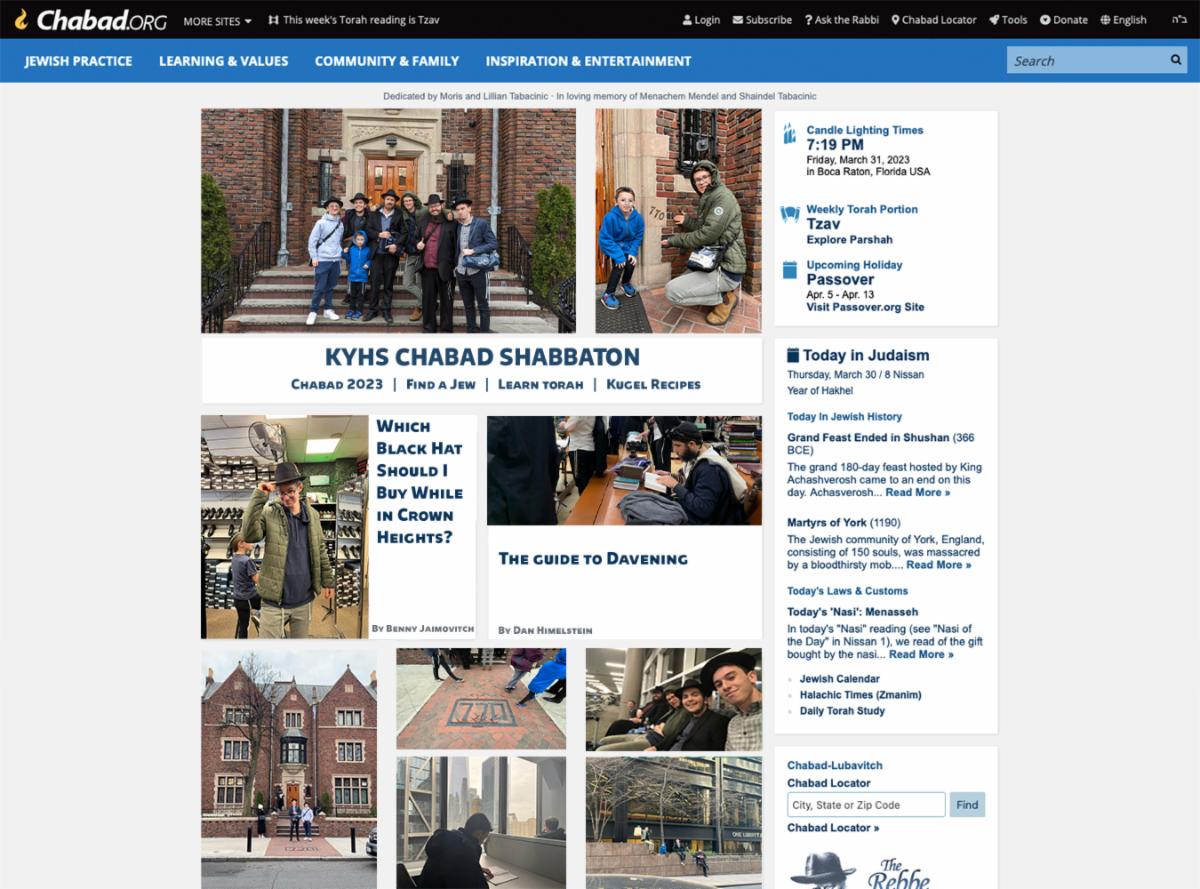
This past week a few students from Katz Yeshiva High School traveled to New York to attend a Chabad Shabbaton. Accompanying them was KYHS’s resident Chabad minyan leader, Dr. Yosef Wolf. Everyone had an amazing time and Aaron Rosenhouse ('25) shared more with us in this fascinating interview.
Gabriella: Thank you so much for joining me for this interview.
Aaron: It is my pleasure. No problem.
Gabriella: Ok, let’s get started. What was the Shabbaton called and where was it?
A: It was the Chassidus Club Shabbaton in Crown Heights, Brooklyn, New York.
G: What did this Chabad Shabbaton entail?
A: The goal was to visit – some again, some for the first time – Crown Heights. We davened in various places including 770, the shul where the Lubavitcher Rebbe would daven, give out dollars, give out brachos, give inspirational speeches, and learn and teach Chassidus/Torah, Ohelei Torah (a Yeshiva in Brooklyn), and the Men’s Kollel. We toured Manhattan and visited the burial center of both the Lubavitcher Rebbe (Menachem Mendel Schneersohn) and the Frierdiker Rebbe (Yosef Yitzchak Schneersohn)—there we davened Shacharis, wrote letters to the Lubavitcher Rebbe asking for brachos, and said Tehillim by their resting place.
G: Why do you feel connected to Chabad?
A: Being Chabad enhances my view of Judaism. Learning Chassidus helps you understand the deeper meaning of both life and Torah—not everything is 100% physical or 100% perfect, but there are things in the world that are meant for us not to understand. Chassidus teaches that perhaps we do not exist… maybe we are being recreated by Hashem every moment. Our mission as Jewish people is to go out spreading light and sharing Torah.
G: How is the Chabad davening different from other types of davening?
A: According to my father, Nusach Ari davening is like a combination of Ashkenazi and Sephardic davening. The words are more similar to Sephardic words, but the tunes are more like Ashkenazi tunes. Really, if you are a Jew you’re a Jew, and the nusach in which you daven is not as important as actually davening. For example, Shemoneh Esrei has quite a few differences between Nusach Ari and Ashkenazi Nusach, but whether you are using a Tehillat Hashem Siddur or an Artscroll Siddur, you are 100% yotzei of having prayed.
G: Why do you appreciate davening in the structure of Chabad everyday at school?
A: When I started my journey as a student in KYHS, I was encouraged by Dr. Wolf to assist in setting up a Nusach Ari-Chabad minyan. Since then, both my davening and my mindset have improved. I enjoy being part of a minyan where the people around me are saying the same words and are saying them with passion.
G: How has being Chabad impacted your life?
A: Prior to my freshman year I never could have believed that one day I would say that “I am Chabad.”, but since I joined the minyan I have grown in my confidence and my Yiddishkeit. I am proud that I am part of the minyan, I am proud that I am capable of leading davening with passion, and I am simply proud to be a Jew! As I briefly mentioned earlier, whether you are Chabad or Ashkenazi or Sephardic does not matter as much as it does that we are Jews, and we have one ULTIMATE goal. We must take pride in who we are as we set the path for Mashiach to come and take us all out from galus!
Gabriella: Thank you so much for taking time out of your day to have this interview.
Aaron: You're welcome. This was great.
Interview by Gabriella Asher ('25)
|