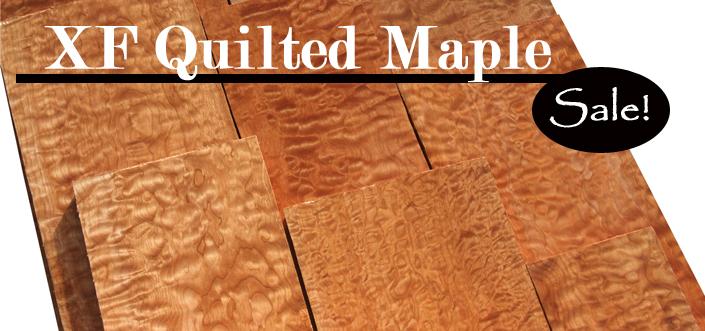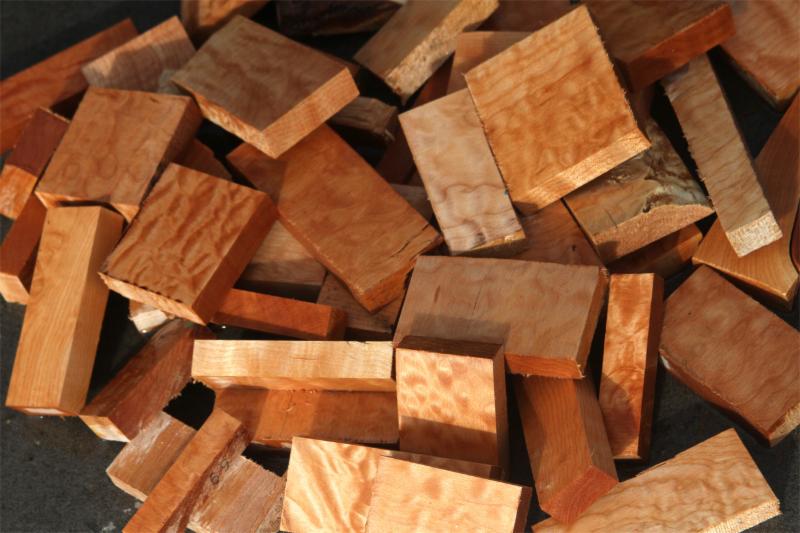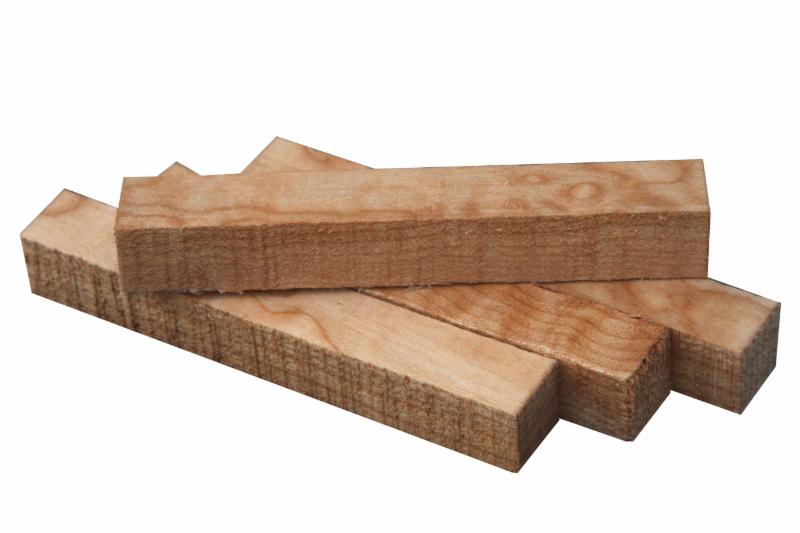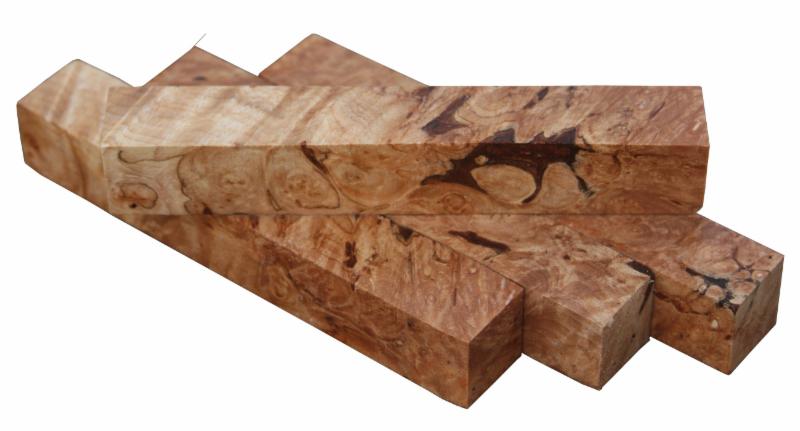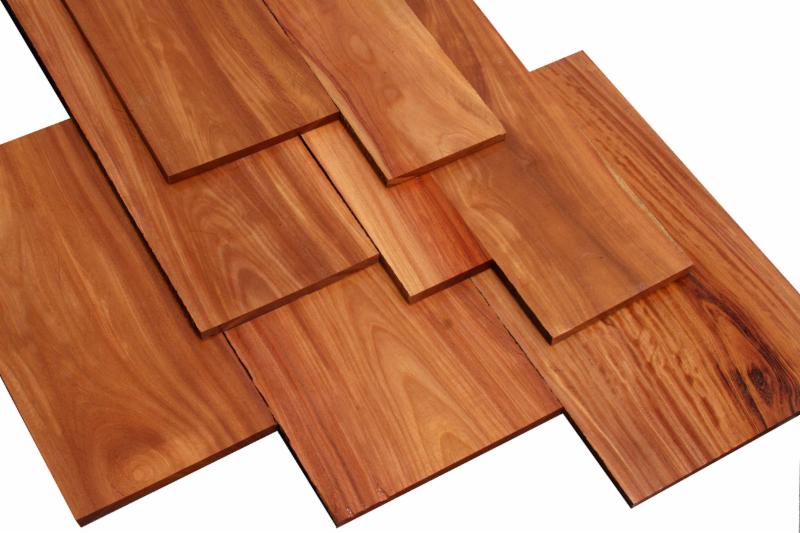
Oregon Big Leaf Maple is slightly coarser than European or Eastern Hard Rock Maple and as so is somewhat harder to work. Despite this, the beauty of the wood easily overcomes any difficulties in working. Maple is a wonderful wood for those who seek a creative flare in their projects. T hese pieces have been kiln dried and sanded with 150 grit on two sides. A slight 1/16" bow may be present in boards longer than 3 ft.
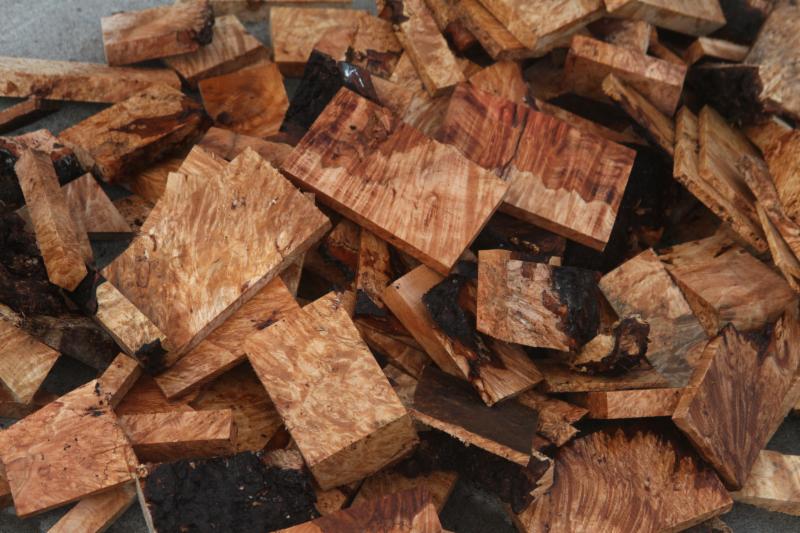
Oregon Big Leaf Maple is slightly coarser than European or Eastern Hard Rock Maple and as so is somewhat harder to work. Despite this, the beauty of the wood easily overcomes any difficulties in working. Maple is a wonderful wood for those who seek a creative flare in their projects.  These pieces have been kiln dried and surfaced on two sides. Most have irregular edges, planer skip, and incursions/voids as seen in pictures. A slight 1/16" bow/cup may be present on a few pieces. If spalting is present, please note that there may be areas that are soft. These are outstanding quality burl!


Only $23.99


as low as  $0.99
 
Ring in the New Year with these beautiful  squares!

12 x 1-1/2 x 1-1/2" (Regular $13.99)  SALE $11.99  
12 x 2 x 2" (Regular $23.99)  SALE $19.99
18 x 1-1/2" x 1-1/2" (Regular $19.99)  SALE $16.99

Available Through Sunday!
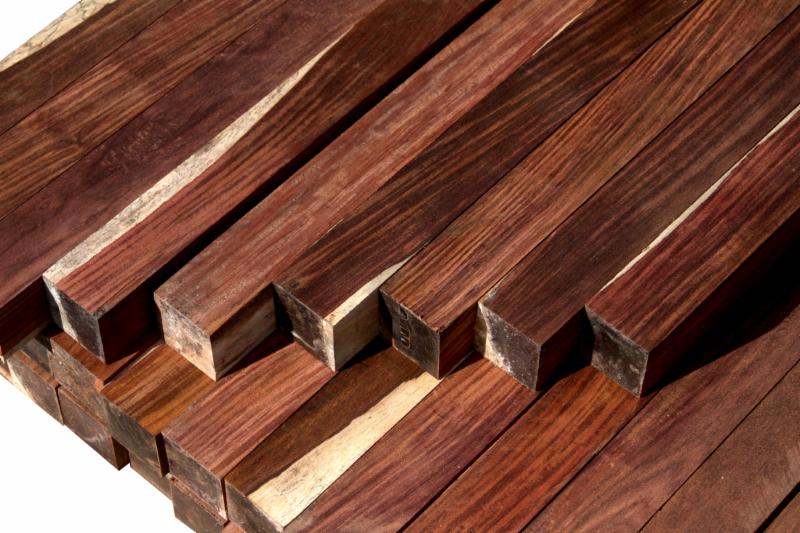
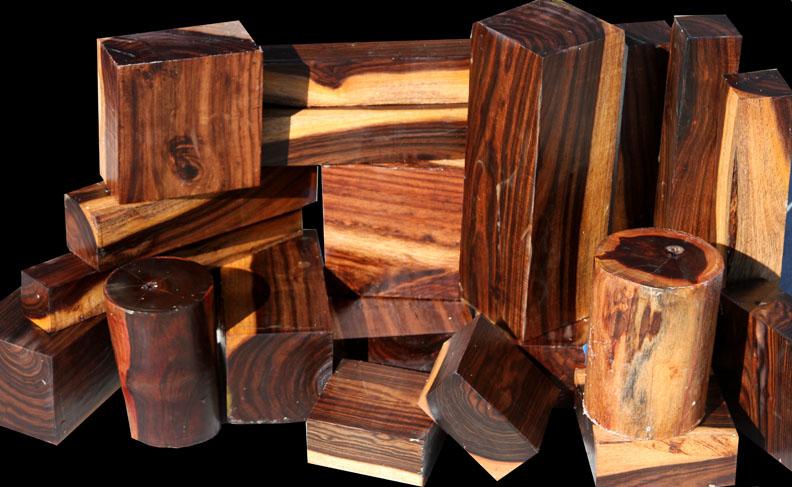
Cocobolo 12 x 2 x 2"
(Regular $28.99)
Great quality Costa Rican hardwood.
High natural polish!
Cocobolo 24 x 2 x 2"
(Regular $57.99)
Great quality Costa Rican hardwood.
High natural polish!

Available Through Sunday!

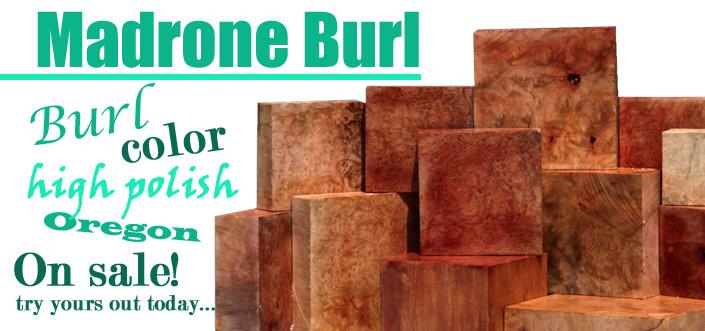
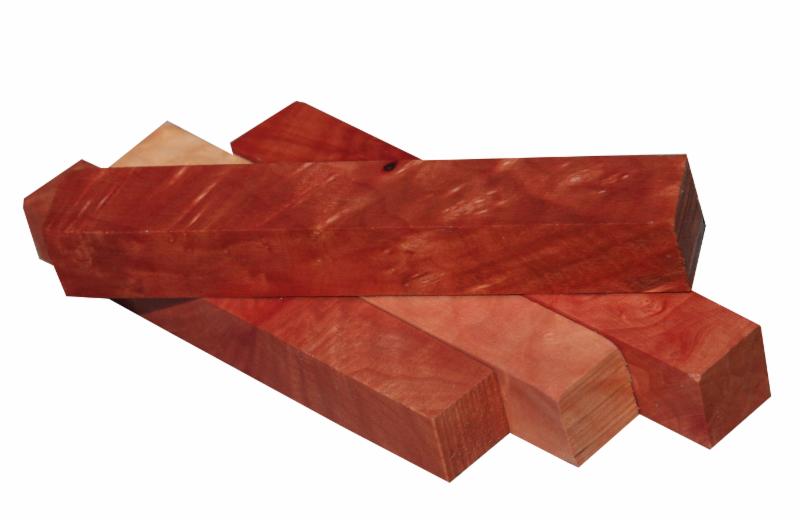
Madrone is known as Strawberry tree, Madrona, or Madrone burl. This is a unique Pacific hardwood that has pink  & tan colors with an occasional red streak. Our Madrone blanks are highly burled & figured. Through our proprietary process, the wood has been pressure cooked to relieve tension and then partially air dried. These pieces are ideal for gallery grade projects and high end woodworking as well as Bass and Electric guitars. Slabs 1-2" thick have been air dried and are ready to use. Turning Blanks have been pressure cooked to relieve tension and prevent degrading; however, they  do contain residual moisture. Wood is stable but needs some time to dry completely. Many blanks have checks, please see photos. Some turn away, some will not. A very small incursion or bug holes may be present. Boards/ Slabs longer than 16" may have up to 1/8" bow (most have 1/16" or less). 


Only $23.99


as low as  $0.89
 
Be sure to check back on Tuesday for  our most exotic Turning Special of 2017! 

Hawaiian Ko'u

Ko'u, pronounced (ko-oo), is a rare hardwood that grows in the coastal regions of the Hawaiian Islands. Almost totally destroyed by a moth in the 1800's, it is one of the rarest woods from Hawaii. Ko'u was prized by Hawaiian royalty for food use: poi bowls, calabashes and utensils as Ko'u does not impart a taste to food.


Brazil Nut lumber is from the same tree that produces the "Brazil Nut" (Bertholletia excelsa). Up to 20,000 tons of Brazil Nuts are gathered and sold every year.  Many trees were planted in the 70's and 80's to increase production and ease of gathering the nuts; and yet wild trees produce more nuts than those that have been plantation grown. Trees grow to a height of 160 ft. and diameters of 3-6 ft.  These are some of the largest trees in the Amazon, living for 500 to 1,000 years.  Trunks are smooth with grayish bark and straight for up to half of the trees' height. The large crown towers over the sub canopy trees with long branches surrounding the other trees.  The heavy, coconut shaped seed pods are 5-6" in diameter and contain a small hole at one end, which enables large rodents like the Agouti to gnaw it open. They then eat some of the nuts inside while burying others for later use; some of these are able to germinate into new Brazil nut trees. Most of the seeds are "planted" by the Agoutis in shady places. The young saplings may have to wait years in a state of dormancy for a tree to fall and sunlight to reach them before they start growing again. Brazil Nut wood is extremely dense and can be used for a variety of projects from furniture, boxes, instruments to flooring and more!  It is moderately smooth grained and can take a smooth natural polish. 
WOOD FAQS:
Facts about Burls

A burl results from a tree undergoing some form of stress. It may be caused by an injury, virus or fungus. Most burls grow beneath the ground, attached to the roots as a type of malignancy that is generally not discovered until the tree dies or falls over. Such burls sometimes appear as groups of bulbous protrusions connected by a system of rope-like roots. Almost all burl wood is covered by bark, even if it is underground. Insect infestation and certain types of mold infestation are the most common causes of this condition.  In some tree species, burls can grow to great size. The largest, at 26 ft (7.9 m), occur in coast redwoods (Sequoia sempervirens) and can encircle the entire trunk; when moisture is present, these burls can grow new redwood trees. The world's second-largest burls can be found in Port McNeill, British Columbia. One of the largest burls known was found around 1984 in the small town of Tamworth, New South Wales. It stands 6.4 ft (2.0 m) tall, with an odd shape resembling a trombone. In January 2009, this burl was controversially removed from its original location, and relocated to a public school in the central New South Wales city of Dubbo.