|
What can the 21st-century church learn from a long-overlooked daughter, wife and mother of pastors who died more than six decades ago?
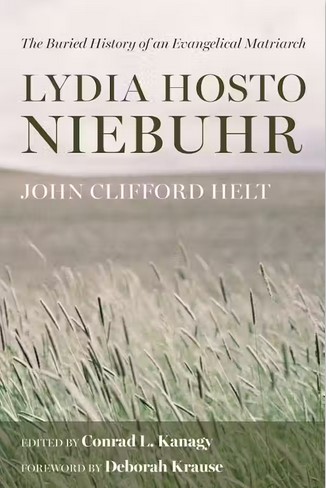
Plenty, says the Rev. John Helt, retired UCC pastor and author of the recently published “Lydia Hosto Niebuhr: The Buried History of an Evangelical Matriarch.” The book argues persuasively that Lydia’s role within her family and in the congregations they served was essential to the Niebuhrs’ legacy as the first family of American theology. It also explores the spirit of German Pietism, the tradition that shaped the family.
Lydia was the topic of John’s dissertation at Northwestern University, where it sat on the shelf for 30 years until a chance encounter with Elizabethtown College sociology professor Conrad Kanagy, who saw its potential and agreed to edit it. John is well known around the Wisconsin Conference, where he is co-chair of the Creation Care Team, coaches pastors, and is active in other Conference initiatives. He talked about his book with Wisconsin Conference Life.
This interview has been edited for length and clarity.
Learn more and order the book
You root Lydia in the liberal theology of the German Evangelical Synod. What did “liberal” mean in her context?
I think it follows from the Reformation-era Evangelical motto: In essentials, unity. In non-essentials, liberty. In all things, charity. The emphasis of the Evangelical Synod was on the liberty side. There was an ecumenical spirit.
How do you contrast her faith with evangelicalism as we think of it today?
Hers has its roots in German Pietism, and German Pietism was a religion of the heart. Fine points of doctrine didn’t matter. What mattered was that you had Jesus in your heart. Doctrine wasn’t something to die over. There was an openness to difference and to society. Embracing the culture around you was what made the “evangelical” part of the Evangelical Synod so different from the evangelicalism of today, which rejects the culture.
Who is the audience for the book?
My editor convinced me that the story itself has a natural audience in this time of deep political and religious polarization, that this story of an irenic – that is, peace-seeking – tradition is of interest. My thinking is that the genius of the Evangelical Synod naturally led to the UCC in that it was always seeking understanding, always seeking unity. Where catechisms differ, you turn to conscience and the Holy Spirit. It was an embrace of others and a melding of traditions. That history could inform our present discussions of right and left, red and blue.
How can the church use the book?
It’s my attempt to fill in a forgotten aspect of our UCC history, namely the E of our E&R. We come from the Evangelical, Reformed and Congregational traditions. The Evangelical Synod last a century. The E&R lasted 25 years. The Evangelical Synod had such an important role in the formation of the UCC, but we don’t talk about it anymore. I’m hoping the richness of the past can be mined for use today.
If Lydia had been born 50 or 100 years later, what would she have become?
It’s hard to say, but I think she would have gone as far as she could go. I can imagine her as co-pastor with her husband rather than an unpaid assistant.
Want to learn more or book John for a speaking engagement? Email him at johncliffordhelt@gmail.com.
|