|
I am often asked which is my favorite wine region; the answer is easy - Burgundy.
The French wine region of Burgundy or Bourgogne has all the elements you look for in a wine region: delicious wines, bucolic landscape, small charming villages, great food and welcoming people. Pre-Covid, I would make it a point to visit Burgundy at least once a year.
Burgundy is small in size, but its influence is huge in the world of wine.
What is it about Burgundy and its wines that make it so popular? It starts in the glass with a delicate and mineral elixir that is never over the top – you have to “listen” to the wine for it to reveal its fruit, its soil and its history.
There are only two principal grapes, Chardonnay and Pinot Noir. Burgundy provides the ultimate expression of both. It is also the birthplace for these two grapes.
Both white and red Burgundy offer a purity of fruit, with an elegance, perfume and intrigue which is hard to match. There are no hiding flaws behind blends. Both of these grapes are among the best in reflecting the character of the soils in which they are grown, which is why Burgundy, in my opinion, is also among the most complex regions. This complexity can cast fear into the heart of even a seasoned wine pro, but fear not – the region need only be as complicated as you want it to be.
About 200 million years ago, the region was part of a vast, tropical sea. Time transformed the seabed into limestone soils. These soils are the secret behind the zesty minerality that’s the hallmark of Burgundy wines. If you venture into the vineyards, you can find chunks of limestone or marl (limestone mixed with clay), that contain fascinating fossilized sea creatures.
Winemaking goes back to the Romans in the 1st century AD, but it was the Catholic monks that really established the vineyards in the Middle Ages. They grew the grapes for the church and the aristocracy. The monks kept meticulous records of each parcel; over the centuries they identified which grapes grew best on each soil and identified the best plots. These records formed the basis of the modern vineyard classification system; it is so complex that Burgundy has over 700 appellations despite its small size; Bordeaux which is four times the size of Burgundy has fewer than 40 appellations.
For White Burgundy (Chardonnay), the region provides us with two benchmark styles, the steel and minerals that soften into the honeycomb of great Chablis, and the balanced power and elegance of a Côte d’Or white from any number of vineyards, but perhaps Montrachet above all others.
With Red Burgundy (Pinot Noir) the story is similar. There are many great vineyards scattered along the Côte d’Or yielding a multiplicity of nuanced styles, and the wines of great grand cru vineyards such as La Romanée, Chambertin, Clos de Beze and Musigny have inspired thousands of winemakers and drinkers alike. The Côte d’Or is home to some of the most expensive wines in the known universe, but there are also tasty and affordable wines.
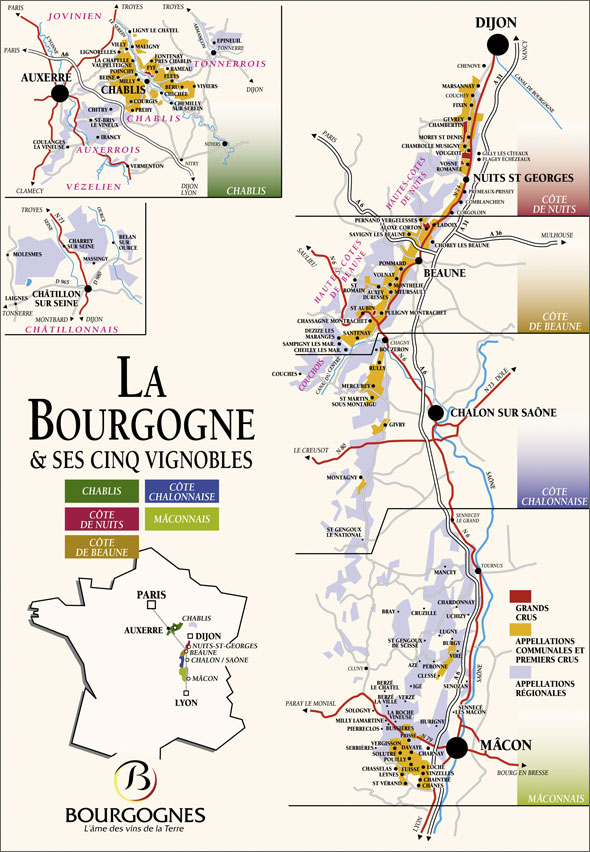
Located in the east-central part of France, Burgundy has 5 primary wine growing areas:
-
Chablis – “shab-lee” (mostly Chardonnay)
-
Côte de Nuits – the night slope (home to be most famous red Burgundies)
-
Côte de Beaune – the slope of Beaune (home to the famous Montrachet vineyard that produces one of the most electric chardonnays in the world
-
Côte Chalonnaise – the Chalon slope (produces both red and white Burgundy)
-
Mâconnais – the region of Mâcon (produces mostly white burgundy – source of great Burgundy values)
You can find better quality Pinot Noir and Chardonnay from Burgundy by understanding how the wines are classified. There are over 700 “appellations,” or approved wine growing areas, and these are divided into 4 levels of quality.
-
Grand Cru (1% of the production) e.g. Clos Vougeot, Echézeaux, Montrachet, etc) Wines from Burgundy’s top vineyards. There are 33 Grand Crus in the Côte d’Or and about 60% of the production is dedicated to Pinot Noir. Bottles start around $300 to over $10,000.
-
Premier Cru (10%) (e.g. Vosne Romanée 1er Cru) Wines from exceptional parcels in Burgundy. There are 640 Premier Cru plots in Burgundy. ($80 - $300/bottle)
-
Village Wines (37%) Wines from a village or commune of Burgundy. There are 44 villages including Chablis, Nuits-St-Georges, and Mâcon-Villages. ($40-100/bottle)
-
Regional Wines (52%) (e.g. Crémant de Bourgogne, Bourgogne Rouge, etc) Wines from overarching Bourgogne appellations. ($25-$60/bottle)
White and Red Burgundy are great for pairing with foods because of their high acidity. The following is a quick guide on how to pair them with your favorite dishes.
White Burgundy/Regional Bourgogne: Great with chicken, middle-weight pastas, or random Thursday nights on the couch.
White Burgundy from Mâconnais /Côte Chalonnaise: Great with any sort of middle-weight dishes. Cured pork products
White Burgundy from Chablis: Oysters and anything from the raw bar are the classic pairings of Chablis. With high acidity and no oak, it is an ideal choice for mixed company. Pairs with everything? Maybe.
White Burgundy from Cote de Beaune: Many of the best wines from the Côte de Beaune are a visceral, meditative experience that you could savor without food. However, richer fish dishes, pork, chicken and anything in a cream sauce or with fungi are highly recommended. It is a perfect match for lobster and scallops, but it also marries well with veal, poultry and cheese.
Red Burgundy works well with duck, game birds, mushroom dishes, pork and poultry. Given its generally softer tannic structure, it can even work with fish and vegetable courses, and the wine can pull a whole table of different entrées together with a reasonable degree of success.
A fabulous bottle of Burgundy can provide the most haunting experience with memories which may last a lifetime.
Don’t be afraid to sample the different appellations as your budget allows and be transported to Burgundy, its wines and its history
|