|
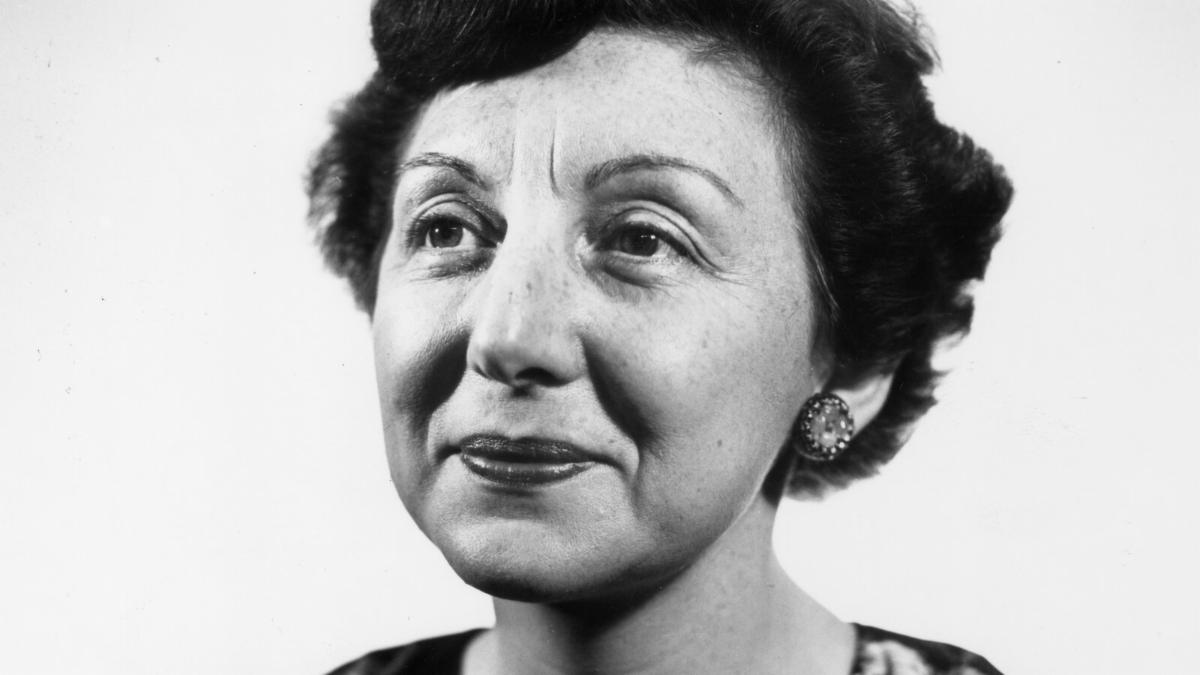
Minnie Lurye Matheson
(1909-1992)
Union Organizer, Union Leader and Activist
Northeast Pennsylvania
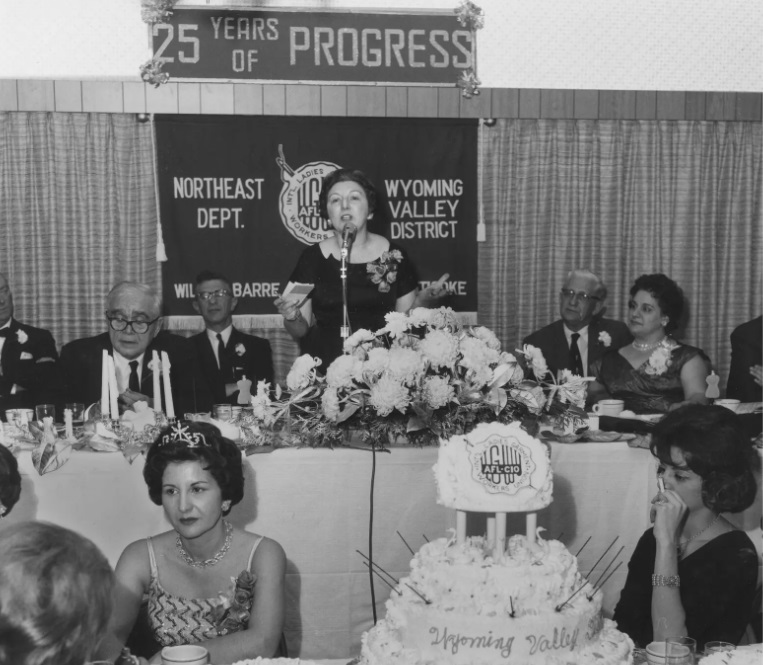
As the charismatic director of the Wyoming Valley District of the International Ladies' Garment Workers (ILGWU), Min Matheson was an immensely popular and effective union leader. Her dedication to organized labor derived from family and personal experiences in Chicago, Paterson, New York, and the Wyoming Valley (Pa.), most of which she shared with her husband and union partner, William Matheson.
The narrative of Min Matheson's life reveals that “solidarity unionism” and its reliance on local control and community support formed the basis of her organizing philosophy, an approach that often clashed with the centralizing propensities of ILGWU’s officers in New York.
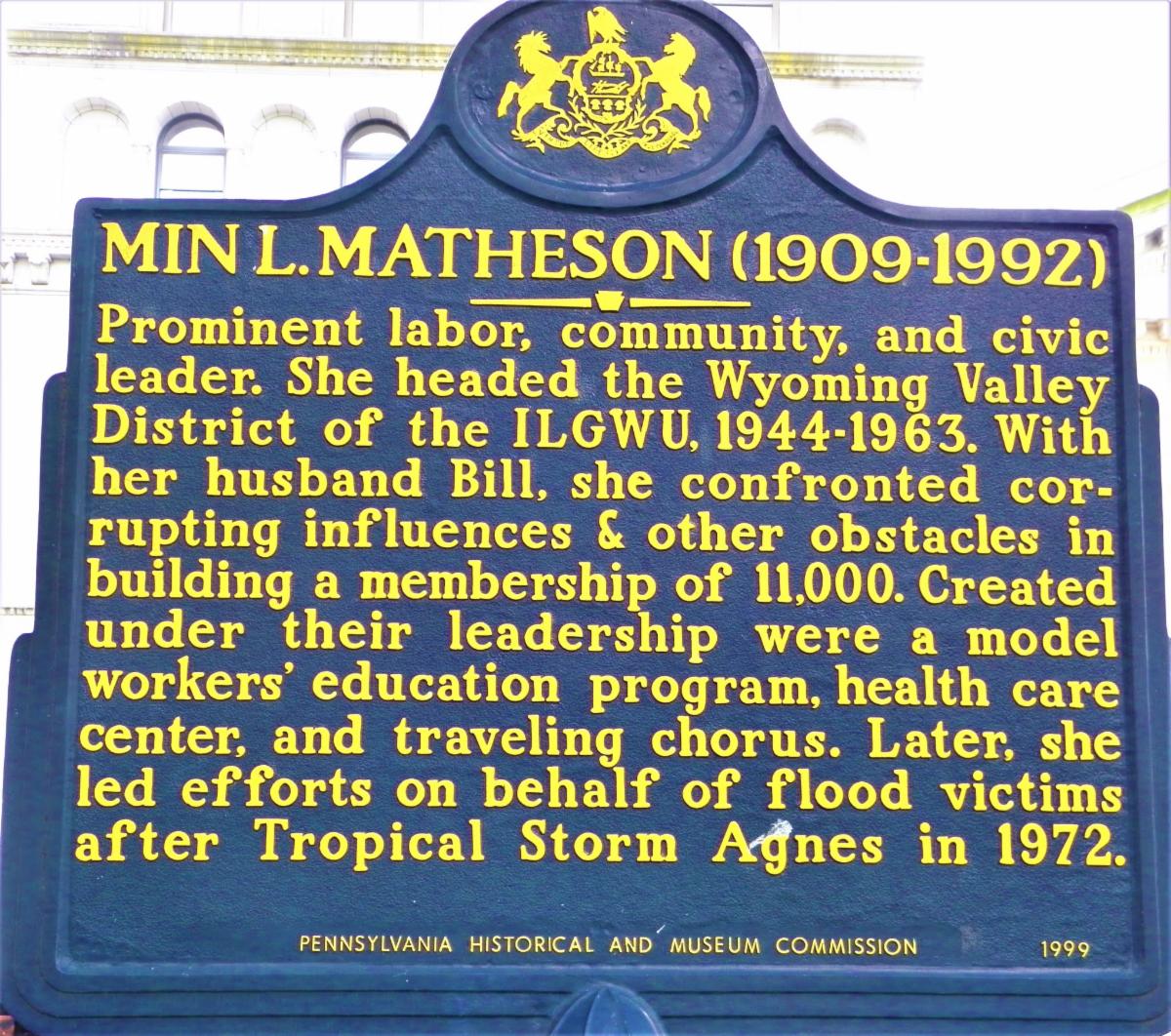
In building and maintaining the union movement, she showed a belief that “people and community resources” facilitated strikes, walkouts, demonstrations, mass meetings, radio broadcasts, and political rallies. Her family’s violent history with organized crime in Chicago and New York greatly influenced her dedication and approach to organizing in the Wyoming Valley. In 1999, the Pennsylvania Historical and Museum Commission dedicated an historical marker on public square Wilkes-Barre acknowledging the work of Min Matheson.
From: Robert Wolensky. Sewn in Coal Country : an oral history of the ladies' garment industry in northeastern Pennsylvania, 1945-1995. University Park, Pa. : Pennsylvania State University Press, 2020.
| |
- Born in Chicago in 1909 to parents who were Jewish immigrants from Russia. Her father was a cigar industry worker and a prominent labor leader. Her mother raised Min and her seven siblings, one of whom died as a baby. All of the children attended Socialist Sunday School.
- Min dropped out of school in the ninth grade and took a job as a secretary. At age 19 she met Bill Matheson, her husband-to-be, at a Chicago Federation of Labor meeting. In 1930 Min left Chicago to participate in a textile workers' strike in Paterson, New Jersey.
- She moved to New York where she worked for several years as a garment worker and, in 1935, was elected "chairlady" of ILGWU Local 22 with its 32,000 members. Bill also landed a job with the garment workers union.
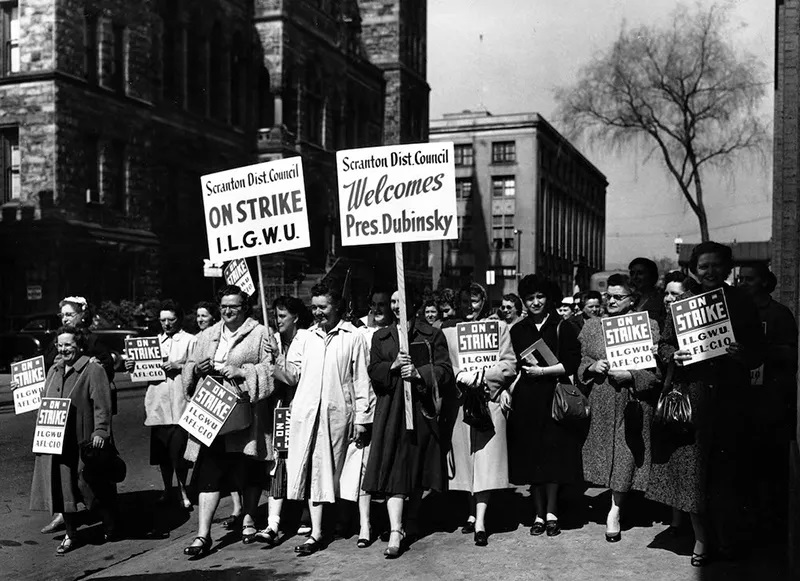
- Min had two daughters and, in 1944, the Matheson's moved to Kingston, in northeastern Pennsylvania. ILGWU national president David Dubinsky asked Min to move to the anthracite coal region to lead an organizing campaign. This was an area where "runaway" factories - from New York City - set up shop in mining towns where labor was plentiful and unions scarce.
| |
|
Pennsylvania's Women Garment Workers
"The atmosphere in the town [Pittstown] was controlled and the women had no say at all. They did all the sewing and the cooking and took care of the lunches and got the children out to school and the husbands out to work in the mines. This was their life." -- Min Matheson
| |
- Organizing the women who worked in runaway shops meant having to confront organized crime bosses who used garment factories as fronts for various illegal activities.
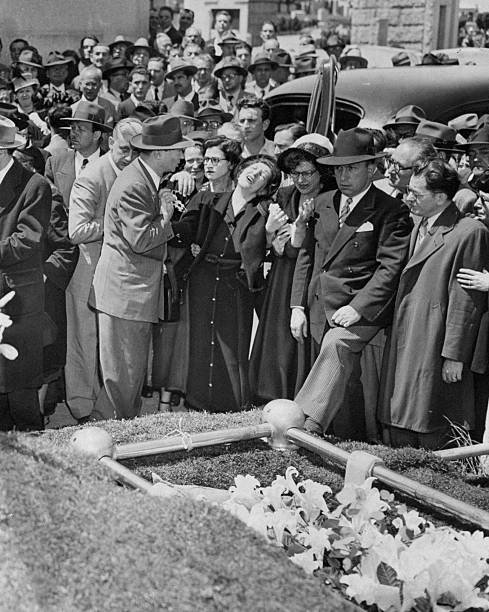
- Min's struggle against mob influence in the labor movement was deeply personal. In 1927 her father, Max Lurye, survived a shooting by a Chicago gangster affiliated with Al Capone. In 1949 her brother William Lurye, also an ILGWU organizer, was stabbed to death by a mob assassin in a phone booth in New York's Garment District. Thirty-five years old and a father of four, William was murdered for trying to organize several mob-affiliated factories. He died a union hero and his funeral possession attracted over 100,000 people.
- A few days after the funeral Mins' deeply distressed father died; the family said it was because of a broken heart. Min was devastated by her brother's murder and suffered a breakdown, of which she recovered.
(Kenneth C. Wolensky, Nicole H. Wolensky & Robert P. Wolensky. Fighting for the Union Label. University Park, Pa. : Pennsylvania State University Press, c.2002)
| |
|
Wife of William Lurye breaks down at his funeral in Queens. She is supported by Charles Zimmerman, ILGWU Vice President, 1949.
. (Photo: George Torrie/NY Daily News Archive via Getty Images)
| |
- Min Matheson repeatedly faced down mobsters in her fight for fair wages and safe conditions for women garment workers. According to Steven Greenhouse, labor journalist and writer, "her fight involved impassioned speeches and tireless dedication; many mornings she left home for picket lines before her daughters woke up."
- A mobster once approached her while she was picketing and told her to bring her husband around so she could "see how long he would last." Min replied that she didn't need to because "I'm twice the man you'll ever be."
(Steven Greenhouse. "Overlooked no more : Min Matheson, labor leader who faced down mobsters." New York Times, updated 5/4/2024.)
| |
|
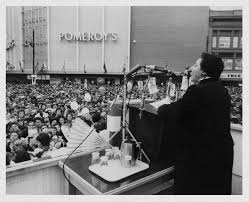
Matheson speaking at a rally for John F Kenndy's presidential campaign, 1960.
Photos: Kheel Center for Labor-Management Documentation and Archives, Cornell University Library
| |
|
- With her husband serving as the union's education director, Matheson's ILGWU organization built strong community ties. The Northeast District organized charity drives, established a labor chorus, a newsletter and a radio show. Union members joined school boards and participated in local Democratic Party politics.
| |
- "The Northeast District grew from 404 members in 1944 to 11,000 by the late 1950s, with more than 250 union factories."
(Catherine Rios & David Witwer. "The True Story of Min Matheson, the Labor Leader who Fought the Mob at the Polls." 10/22/2020)
| |
|
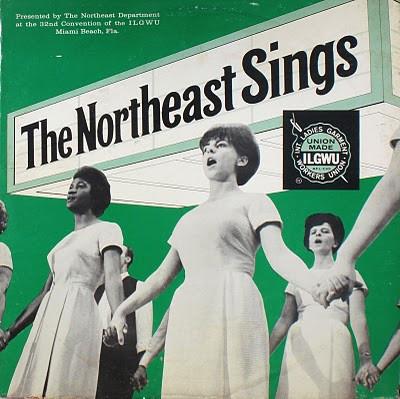
The Northeast Department Chorus was popular in the union and the community. The group performed for local ethnic and civic clubs, churches, political events and garment factory parties. Through its music the chorus was able to promote the union's progressive political agenda. From 1947 to 1965 they performed in 65 cities and towns.
(Kenneth C. Wolensky. "We're Singin' for the Union : the ILGWU chorus in Pennsylvania coal country, 1947-2000) in Chorus and Community, Karen Ahlquist, ed., Urbana, University of Illinois Press.
| |
-
In 1963 Dubinsky transferred Min to New York to head the Union Label Department which urged consumers to "look for the union label." Her department developed the song for the popular commercial.
-
Min was one of the founding members of the National Organization for Women (NOW). In 1971, upon her retirement, she and her husband returned to northeastern Pennsylvania one year before the catastrophic flood of the Susquehanna River devastated the area. Min helped to organize the Flood Victims Action Council which worked to secure funding from the Federal government to aid the reconstruction of the Wyoming Valley (Wikipedia)
- Min Matheson died on Dec. 8, 1992, at age 83, in Wilkes-Barre.
| |
Sources: I am grateful for the research of Robert Wolensky and the journalism of Steven Greenhouse, cited above. These, and the other aforementioned published works, are the sources from which I summarized, paraphrased or quoted directly. Readers who are interested in the tradition of choral singing of the ILGWU, click here for The Uprising of the Twenty Thousand. | |
|
"Many of the hospitals in Gaza are no longer operational
because of Israeli raids ..." (Wash. Post, 7/4/2024)
Civilian hospitals organized to give care to the wounded and sick, the infirm and maternity cases, may in no circumstances be the object of attack, but shall at all times be respected and protected by the Parties to the conflict.
-- Article 18, Geneva Convention
| | | | |