|
Fame, like the river, is narrowest where it is bred, and broadest afar off.
(William Davenant, 17th century British poet)
| |
|
Celebrate the start of spring at Spring into Springtime! A fun-filled evening fundraiser to support the educational and community programs of the Needham History Center & Museum. Under a tent on our beautiful lawn, enjoy fabulous food from local food trucks, scrumptious desserts, bid on spectacular gift baskets, and dance to the sounds of the upbeat local band The Tear Downs. Spring into Springtime is our largest fundraiser this year. We hope you can join us and be a part of this exciting event in support of the Needham History Center. Tickets and information HERE.
And this year we have a special treat – we are raffling a PAIR OF TICKETS to the TAYLOR SWIFT concert at Gillette Stadium! The concert date is Friday May 19, 2023 at 6:30 pm; the seats are in Section 109, Row 28, Seats 7 and 8. The raffle tickets cost $25 each, and are limited to a total of 500 chances sold. The raffle prize is the pair of TS tickets. The winning ticket will be drawn on the evening of the Gala, and you do not have to be present to win. (Sale of Taylor Swift raffle tickets begins on February 24th)
| |
|
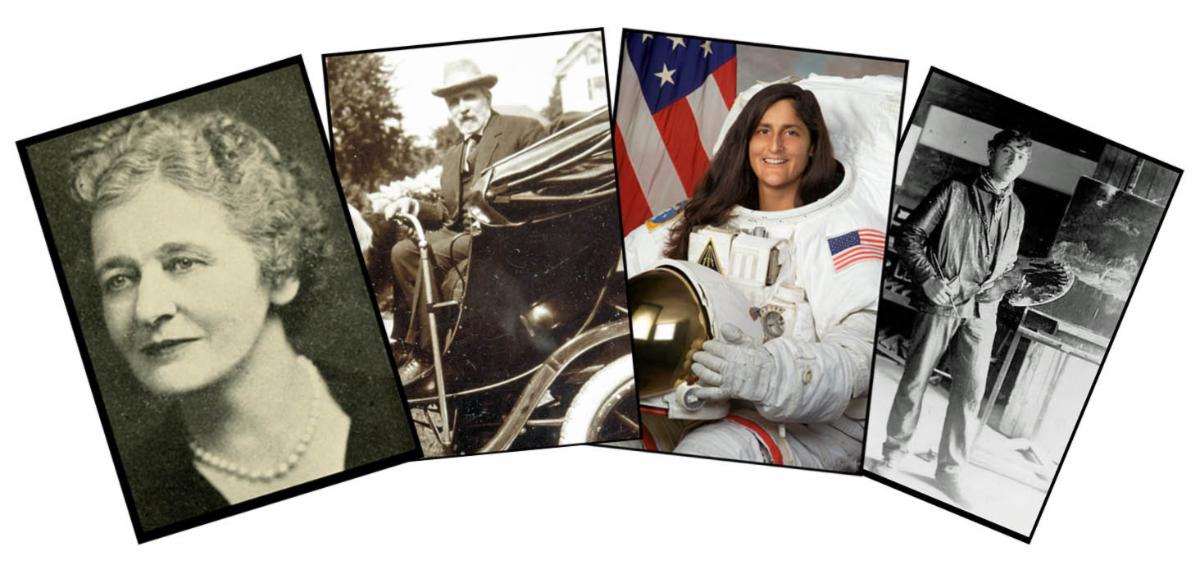
Famous Needhamites Leslie Cutler, William Carter, Sunita Williams, and NC Wyeth.
Who Are These People?
Emery Grover – William Nehoiden – Leslie Cutler – Derwood Newman?? You see their names on our streets and buildings, but do you know who they are or why the town has honored them? Needham has been the home of many accomplished – even world-famous – people, whose efforts and accomplishments have shaped our town and our world. So, these are things that are worth remembering. The people I will mention shaped our town by their hard work and their service. We commemorate their contributions because we are grateful for what they did in their time, and what they have done for us.
Trying to make a list of famous and important Needhamites is not particularly easy. Fame can be fleeting, or at least time-sensitive. So how do you define Famous – Famous now? Famous then? Famous Here, or Famous Out There? What about Not Famous but Important Anyway? And how to judge relative Famousness?
Needham, in its 310 and counting years, has been fortunate, so I had a lot of names to choose from. My initial list ran to three pages, so some serious choices had to be made. In the end, I decided to leave out the people who lived here, but whose primary contributions were made elsewhere – people like Thomas Huckle Weller, who helped to develop the polio vaccine. Anada Coomaraswamy, mystic and curator at the MFA who introduced West Asian art to America and Europe. Or William T.G. Morton who pioneered the use of ether in surgery.
I opted instead for locality – the names we see every day. Even so, there are many names missing here whose contributions to our town were important, and who might well have been included. So here follows - an entirely subjective and definitely NOT all-inclusive list of Famous Needhamites.
It Goes Without Saying…
OK, there are some names that come up so often, and in so many contexts, that there was not much question that they would be included. These were the people who ticked all of the boxes – Famous both Here and There, Now and Then, and still important to our history and beyond. In no particular order:
Nehoiden (William Nahaton/Ahaton), c.1635-1717. William Nehoiden (more correctly, Nahaton) was a member of Rev. John Eliot’s Native American convert community in Natick, known then as the Praying Indians. Nehoiden’s family converted when he was a small child, and he was taught to read his Bible in English and he became a preacher and schoolmaster in his home of Ponkapoag. Eliot, however, whose mind was broader than most in his day, sought to translate the Bible into Algonkian, the language family of the Native Americans in this area. Nehoiden was one of the men who worked with him to create a grammar book and an alphabet for their language, and then worked with him to translate the Bible. Nehoiden was also a negotiator sent by Eliot to try, unsuccessfully, to defuse the tensions that led to King Philips War, and who later assisted Eliot with running provisions and supplies to the internment camps at Deer Island during the war. After the war, Nehoiden acted as a representative for several of the remaining Praying Indians in land deeds and in lawsuits before the General Court, including the deed in 1680 that sold Nehoiden’s own land to the Town of Dedham, now the land on which Needham and Wellesley are located. This is the event depicted in Needham’s Town Seal.
William Carter (1830-1918). William Carter was a knitter, and the founder of the William Carter Company. He pioneered the union suit, and small children are still wearing Carter’s footie pajamas, but to Needham Carter was not only a business owner, but also a philanthropist and politician. William Carter came to the United States in 1856, having left his home in Alfreton, Derbyshire, England to find a better life. He had been one of the many hand-loom knitters in the English midlands who were thrown out of their livelihood by the industrialization of the British textile industry. In Needham, he set up his hand-loom in his home and began a new business. It was successful enough that in 1864 he was able to go into partnership with his friends Mark and John Lee, and built his first factory, on the corner of West Street and Highland Avenue. The factory expanded rapidly, and expanded over time to seven factories overall. Carter also spent a great deal of his money on Needham. And he had a great deal to spend; unlike some of the older Yankee families in Needham, who were wealthy in land, Carter has a retail business and was wealthy in actual cash – arguably the wealthiest man in Needham. He donated the first public library, the land for the current public library, land for the Methodist Church and its parsonage, and assisted the Episcopal Church in its foundation, among others. He served on the School committee for 11 years, Selectman for 3 years, Water Commissioner, and Library Trustee. The Carter family owned the company until 1990, when they sold it to a public corporation. It has continued to grow, purchasing OshKosh in 2005, and is now the largest manufacturer of children’s’ clothing in the world.
| 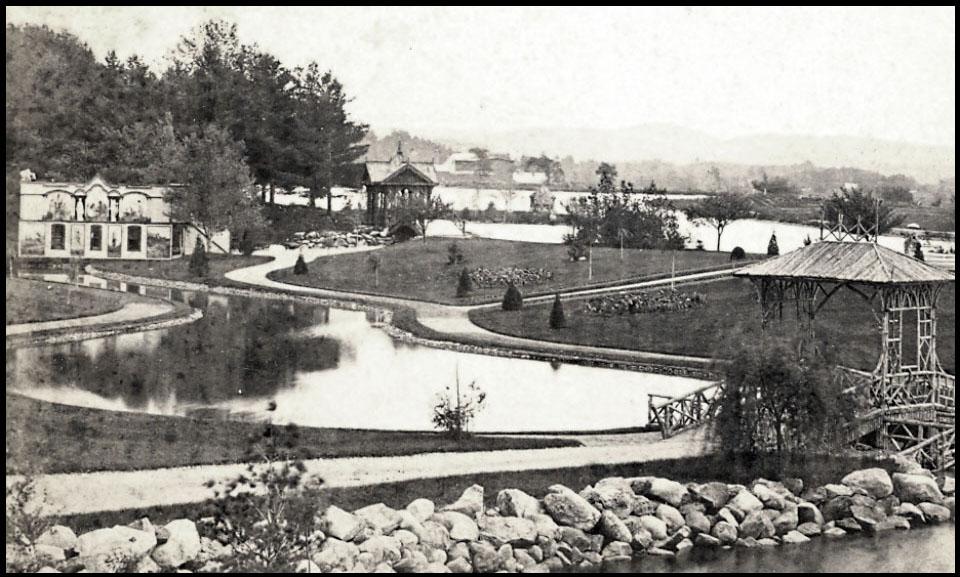 | |
Elm Tree Pond on the Baker Estate, showing the covered bridges, TriPont Island, and the Boathouse.
William Emerson Baker (1828-1888). William Emerson Baker was born in Roxbury. Without the money for much schooling, Baker went out to work at a young age. He was clever, mechanically-minded, and very entrepreneurial (as we would say these days), and parlayed his low-end job into a pretty decent earning prospect. After a few years, his took his earnings and invested them in a partnership with a local tailor named William Grover to form the Grover and Baker Sewing Machine Company. With their clever marketing and the sharing of patent agreements between the other growing companies such as Singer, Baker became extremely rich, and at the age of forty, he retired to pursue his other interests. He bought 800 acres in the SW corner of Needham, and built out a summer estate that became legendary for its innovation, variety, and pure eccentricity. But it was not all fun and games. Baker was interested in mechanics, in history, in metaphysics, in politics, and he supported many public and scientific causes. His primary cause was public health, and he espoused the then-radical notion that preventing infection and disease in livestock would reduce the incidents of disease in the humans eating the livestock. In his later years, he tried to secede his estate from Needham and create a tax-free hygienic village called Hygeria to pursue these ideas. Needham (led by his nemesis, Selectman William Carter) turned down his proposal. Baker was furious, and threatened to sell up and move to a more congenial location, but he died of a heart attack shortly afterward at the age of 60.
Leslie Cutler (1890-1971). Leslie Bradley Cutler was a one-woman engine of the Twentieth Century – suffragist, community activist, Selectman, State Representative and Senator, aviator – and a public servant in the most generous sense. She was a crusader for mental and public health, an activist in the woman’s suffrage movement, and an outspoken champion of welfare and penal reform, juvenile needs, education and aviation. She began her 44 years of public service in 1924, only four years after women won the right to vote. Cutler was born in 1890 in Boston; she graduated from Radcliffe College and studied biology and public health at MIT. After moving to Needham, she ran for Selectman, her first public office, in 1924, and was elected with the support of newly registered women voters; she was Needham’s first female selectman, and only the second female selectman in the Commonwealth. Two years later, she was also elected to the town’s Board of Health, on which she served in for 41 years. She was elected to the MA House of Representatives in 1938. Ten years later, she ran for the State Senate, and won, becoming only the second woman in state history to occupy a Senate seat. One of her most substantial accomplishments was her pivotal role in passing a bill to permit women to serve on juries. Senator Cutler also fought passionately to establish community mental health centers, and for the funding to transform Logan Airport into the major terminal that it is today (she also had a pilot’s license). Leslie Cutler was president of the Needham Community Council for 28 years, the director of the Needham Red Cross, and a member of the Needham Republican Town Committee; she founded local chapters of the YMCA and Freedom House in Needham and helped start the Needham Council on Aging. In 2000, she was named “Needham’s Outstanding Person of the 20th Century” by the Needham Historical Society.
N.C. Wyeth (1882-1945). Newell Convers Wyeth was born on October 22, 1882, at the family’s home on South Street. His grandfather, Denys Zirngiebel, was a botanist and the inventor of the Giant Swiss Pansy – Needham’s Pansy King and the reason we celebrate Pansy Day every year. Wyeth showed artistic talent at an early age, and went to arts high schools in Boston. In 1902, he left Needham, accepting an invitation to study with the great illustrator, Howard Pyle, in Wilmington, DE. Wyeth married Carolyn Bockius of Wilmington in 1906, and they settled in nearby Chadds Ford, PA. They had five children, three of whom (notably, their son Andrew) became artists as well. Wyeth’s career as an illustrator took off, with significant commissions for magazines, books, public murals, and the famous series of illustrated classics published by Scribner’s in the 1920s. He became one of the most successful and recognizable illustrators in America. Wyeth died in 1945 at the age of 63, when the car he was driving stalled on a train crossing near his home. In his life, he painted over 3000 pictures and illustrated 112 books. He created some of the most iconic and well-loved images in American illustration, and launched the artistic careers of three of his children, founding a true dynasty of American painters.
Sunita Williams (born 1965). Sunita Williams was born in Ohio, but that’s OK because she moved to Needham as a child and considers it her hometown. She was already interested in math and science when she attended the Hillside School, and excelled in those studies at Needham High School, where she graduated in the Class of 1983. She also studied Russian, which turned out to be very useful in the long run. After graduating from the U.S. Naval Academy in 1987, Williams trained as a Naval Aviator deployed with Helicopter Combat Support Squadrons, including deployments for Op Desert Shield and Op Provide Comfort, and later to Florida for Hurricane Andrew relief. She was selected for the US Naval Test Pilot School in 1993, and for NASA’s astronaut training program in 1998. She joined the crew of the International Space Station for her first space assignment from December 2006 to June 2007 – at the time, a record for spaceflight for a woman. She had a second tour on the Space Station from July to November 2012, serving as the Station’s commander. In September 2015, Sunita Williams became one of the first members of the Commercial Crew Development program, a NASA-administered partnership with SpaceX and Boeing to develop private commercial transportation vehicles for the Space Station. In August 2018, she was assigned to the first mission flight of Boeing’s CST-100 Starliner, and a third stay on the Space Station. She is headed for space again for SpaceX any day now. Over the years, Sunita Williams has stayed in touch with Needham, and especially with the schools, even communicating with Needham students during her first space station tour. As an explorer, scientist, and alumna of the Needham schools, she inspires our children to pursue their ambitions, and reach – literally – for the stars.
Next time… Arts & Leisure, Innovators & Scientists, Town Fathers, and some Cameo Appearances.
Gloria Polizzotti Greis is the Executive Director of the Needham History Center & Museum. For more information, please see our website at www.needhamhistory.org.
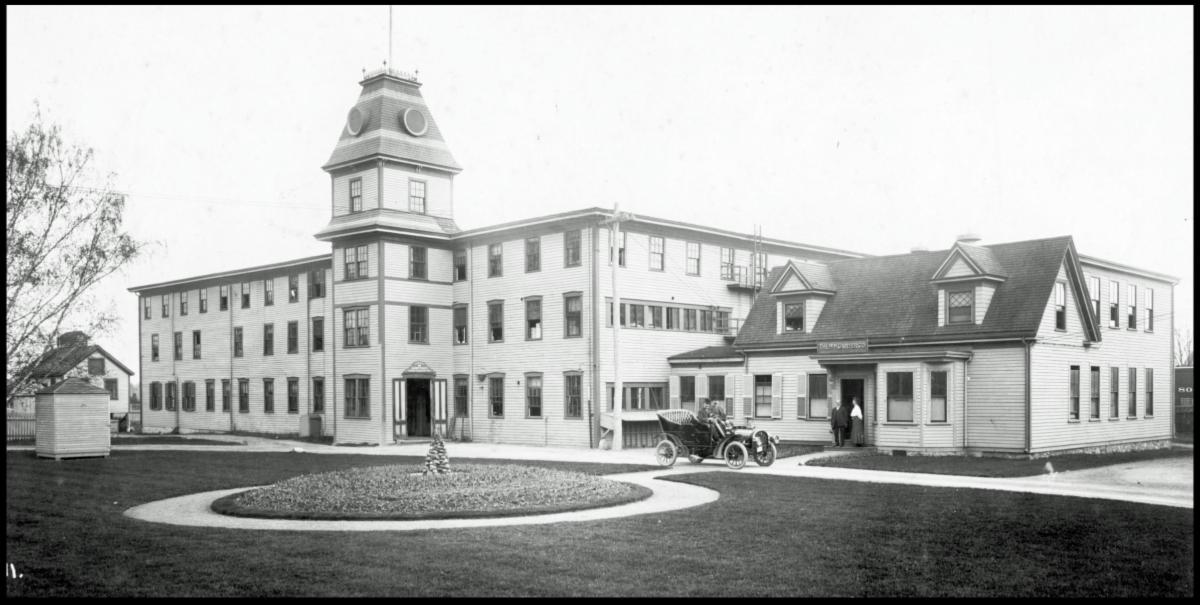
William Carter's orignal knitting mill, on the corner of Highland Avenue and West Street. It is shown here circa 1910. The short man in the dark suit in the office doorway is Carter, and his electric runabout is parked in the driveway.
| |
The Needham History Center Receives MCC Funding | |
|
I am very pleased to announce that the Needham History Center has received a Cultural Sector Recovery Grant from the MA Cultural Council. This grant program was an historic investment of $51M in state COVID relief funds, that will support 1000s of cultural organizations and creative individuals living and working in Massachusetts. The MCC is an independent state arts agency that is charged with bolstering the Commonwealth’s creative and cultural sector. The MCC’s efforts advance economic vitality, support transformational change; and celebrate, preserve, and inspire creativity across all Massachusetts communities.
| |
|
Thank You, Needham League of Women Voters!
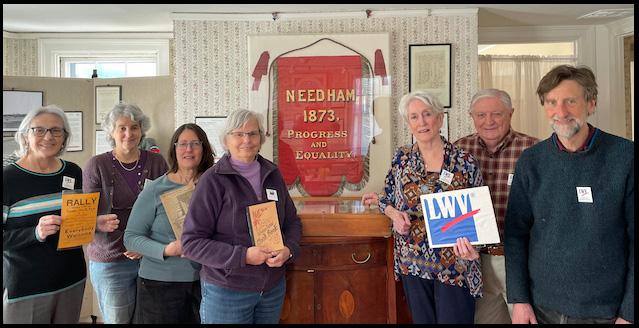
League members volunteered to help out at the History Center for their annual Day of Action on February 14. They transcribed the many newspaper articles and documents in our files about the fight for women's suffrage in Needham in the late 19th and early 20th centuries.
Now we have the information complied into a single digital file. Although we have hard copies in the files, by creating digital copies the volunteers have made it so much easier to share the information, and to search for names and events. Also, they're just plain easier to read - 19th century newsprint is not the most legible!
Many thanks to Carol Patey, Karen Price, Elizabeth Handler, Sally Toran, Joe McCabe, Penny Kirk, Ed Schiedeler, Elin Soderholm, Allison Cocuzzo, Cathy Freedberg, and Jane Evans.
| |
|
Calendar and Events
Visit our Calendar for all our event listings
| |
|
History Book Group - All who enjoy reading books based on history are welcome!
We meet at the Needham History Center. More information HERE.
-
February 28 – reader’s choice - reader either or both: The Book Woman of Troublesome Creek (Kim Michele Richardson) and/or its sequel, The Book Woman’s Daughter (Kim Michele Richardson)
-
March 28 – Say Nothing: A True Story of Murder and Memory in Northern Ireland (Patrick Keefe)
"Remember Me to All the Friends": Civil War Letters from George W. Harwood, Massachusetts 36th. March 29 (Wednesday), 12 pm. A lunch and book talk with author Janet M. Drake. In 1862, George W. Harwood of North Brookfield enlisted for three years with the 36th Regiment of Massachusetts Volunteers. This book is the collection of letters he wrote home. His regiment travelled with the 9th Corps under General Ambrose E. Burnside, participating in several major battles. Harwood provided an excellent description of the war and the land from a soldier’s perspective. Jan Drake grew up in Needham, and graduated from Needham High School. She went to Hobart & William Smith College in New York where she majored in Chemistry, and then went on to Simmons College in Boston for a master’s degree in Library Science. Jan as just retired from a long and productive career in libraries, most in Wellesley. George Hargrove was Jan’s great-uncle, and his letters are in Jan’s keeping.
The lunch and talk will take place at the Needham History Center, 1147 Central Avenue. The event is free, but seating is limited so reservations are required. To reserve, email Gloria at greis@needhamhistory.org.
| |
|
The Thursday News is posted every week on our website, www.needhamhistory.org (scroll down). An archive of previous weeks' stories is there as well.
| |
You can help our local restaurants and our community!
As part of the “Love Local” campaign this year the Charles River Chamber's Dining Collaborative is organizing a clothing drive. Collections will benefit Circle of Hope, a Needham-based nonprofit that provides homeless children, women, and men in Boston and Metro West with clothing and necessities. They are collecting NEW sweatshirts, sweatpants and t-shirts at participating restaurant locations throughout all 4 communities throughout the month of February. You can also support the initiative by making an online donation or via the QR code at all collection sites. View HERE for more information, participating restaurants, drop off locations, or to make an online donation.
| |
|
Community Events
Other events of interest, from around town and beyond
| |
|
Ruthie Foster at the Great Hall! Saturday, March 4 at 8:00 pm, at Powers Hall. Presented by The Needham Bank Great Hall Concert Series. Grammy-nominated singer-songwriter Ruthie Foster brings her unique blend of Texas blues, pop, and R&B to Needham! Ruthie's powerful voice and stunning artistry have brought her a world-wide audience, numerous awards for performance, and induction into the Texas Musicians Hall of Fame. Tickets and information at greathallperformance.org.
Route 9: A Journey through Time. Sunday, March 5 at 3:00 pm, on Zoom. Presented by our friends at Historic Newton, the Wellesley Historical Society, the Natick Historical Society, & the Framingham History Center. From its start in 1810 as a toll road from Brookline to Worcester, Route 9 has undergone many transformations to become the bustling roadway that we know today. Follow along as local history experts from Newton, Wellesley, Natick, and Framingham take you through its development, from toll houses and street cars to shopping malls and roadside entertainment. Learn about the evolution of transportation and commerce, and the political forces that helped shape the east-west road that remains essential to our communities. Click HERE for reservations and Zoom link.
| |
|
Are you reading this article on Facebook?
Was it forwarded to you by someone?
If you enjoy these articles, you can get them every week in your Inbox by signing up for our mailing list. We don't spam you, and you can opt out at any time.
| |
|
We thank our Corporate Sponsors
for their generous and ongoing support!
.
Lead Sponsor - The Needham Bank
Exhibits Sponsor - Beth Israel Deaconess - Needham
Program Sponsor - North Hill
Gold Sponsor - NC Wyeth Foundation and Reading Libraries
The Dedham Inst. for Savings . The Middlesex Bank
Louise Condon Realty . Petrini Corporation . The Vita Needle Company
The Needham Women's Club . JC Timmerman, Inc.
| |
|
The Needham History Center & Museum
781-455-8860 / www.needhamhistory.org
| | | | |