|
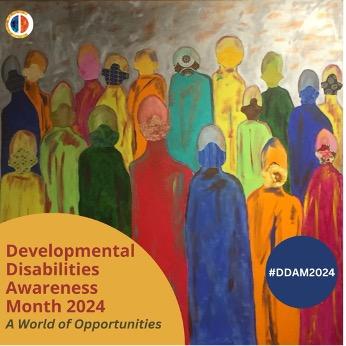
March is Developmental Disabilities Awareness Month and the 2024 theme is “A World of Opportunities.” The goal is to continue to build a society that's committed to creating a world where everyone can do well and succeed.
For several years there has been a commitment in the education, training, and employment community to provide access to meaningful/gainful employment for people with disabilities. Unfortunately, locally, there is no consistent reporting by organizations clearly documenting the employment status of people with disabilities. What follows is an attempt to describe what we do know.
National Labor Market Figures about People with Disabilities
Let’s begin at the national level. The latest Bureau of Labor Statistics News Release dated February 22, 2024 features the Persons with a Disability: Labor Force Characteristics for 2023.
“In 2023, 22.5 percent of people with a disability were employed—the highest recorded ratio since comparable data were first collected in 2008. This rate increased by 1.2 percentage points from the prior year, the U.S. Bureau of Labor Statistics reported today. Similarly, the employment-population ratio for those without a disability, at 65.8 percent, increased by 0.4 percentage point in 2023. The unemployment rate for people with a disability (7.2 percent) was little changed in 2023, while the rate for those without a disability was unchanged over the year at 3.5 percent. (p 1)."
"People with a disability accounted for about 13 percent of the population in 2023. Those with a disability tend to be older than people with no disability, reflecting the increased incidence of disability with age. In 2023, 50 percent of people with a disability were age 65 and over, compared with 18 percent of those with no disability. (p 2)."
Because of this we will focus on people with disabilities, ages 16 to 64, who are more likely to be working.
Let’s review these figures to understand more what is being reported using Table A (p 4) and Table 2
(p 1) of the release. In 2023 there were:
- 267 million people living in the US were over 16 years of age;
- 209 million people were 16 to 64 in their prime work age;
- 16.7 million of the 209 million (8%) were people with disabilities;
- 10 million (60%) of people with disabilities were not in the workforce, meaning that they are not considered actively seeking employment. This is very high as compared to the 23.3% people without disabilities being out of the workforce.
- Of the 6.7 million people with disabilities that were seeking employment 93% were employed but 25% of those employed were working part time.
Labor Market Figures about People with Disabilities in Nevada, Placer, and Sacramento Counties
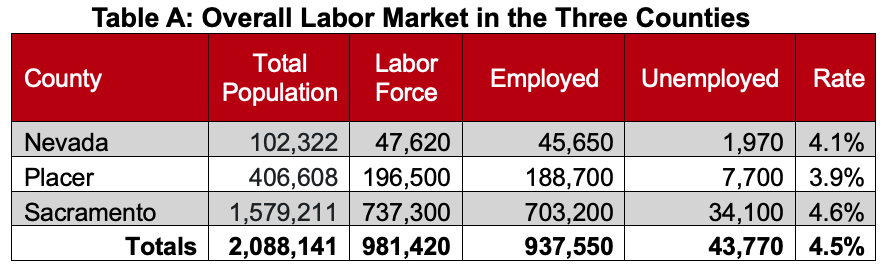
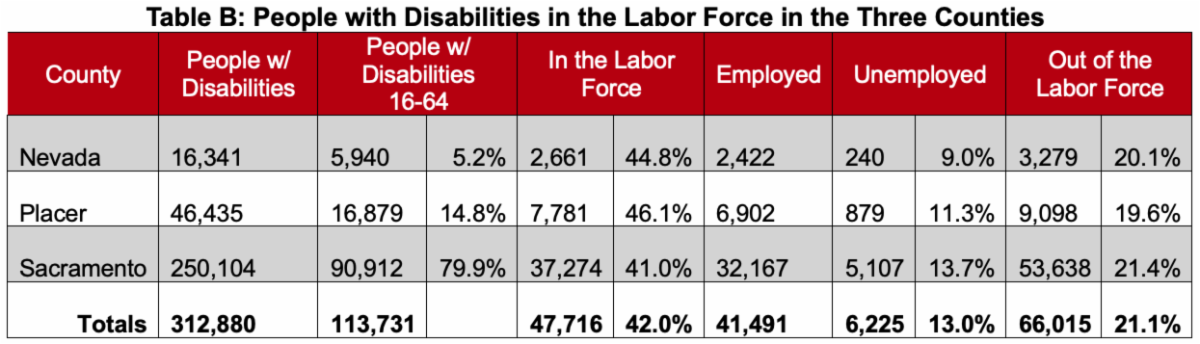
Locally, we are interested in what is happening in Nevada, Placer, and Sacramento counties. The following information contained in Tables A & B was provided by Cara Welsh, an Employment Development Department (EDD) Labor Market Consultant, using extrapolated US Census Bureau estimates based on 2020 data.
- 13% of the people seeking employment in the three counties were unemployed which is higher than the national average of 7%.
- People with disabilities represent 15% of the total population. 42% (113,731) of people with disabilities are 16 to 64 years of age.
- 42% (47,716) of these people are actively seeking employment which is a bit higher than the national average of 40%.
- 13% of the people seeking employment in the three counties were unemployed which is higher than the national average of 7%.
|