It wouldn't be so serious if it didn't happen all the time. Yet, almost every day without fail, people attend Bodywise Health with such poor initial or no management of their injuries that in effect, their problem has been made worse.
Stories such as applying "Deep Heat" or "Dencorub" immediately after muscle tears or joint sprains is not uncommon with the resultant bruising taking weeks and sometimes months to dissipate.
Even hospitals are not immune to poor initial management of musculoskeletal injuries. A frequent occurrence is of people arriving at Bodywise Health using the wrong crutches or using crutches incorrectly.
Additionally, it is our experience that many people are often given inadequate, incomplete or sometimes downright wrong self-care instructions. Advice such as "just keep moving" or "work through the pain" can do more harm than good.
"The most important time in the treatment of acute soft tissue injuries is in the 24 hours immediately following injury".1
When you injure soft tissues, the blood vessels are also often damaged. Blood then pools around the injured tissues causing swelling which stops oxygen exchange, leading to further tissue damage. This bleeding phase may last from just a couple of hours for less vascular tissues such as ligaments up to 24 hours from crush injuries (corked) to muscle.
Consequently, the most important thing that you can do at this stage is to reduce bleeding and swelling at the site of injury.
The best way to do this is summarised in the letters PRICER and HARM:
Protection
Ice
Compression
Elevation
Referral
Protection
Protection of the painful or injured body part is essential to prevent re-injury. This can be best achieved through unloading or at least partially immobilizing the injured area through the use of taping, braces, slings, cam walkers and crutches. Even supporting your injured arm with the uninjured arm can work.
Rest
Following injury, you should cease activity to limit bleeding and swelling to reduce the size of the scar in injured soft tissue.
2
Ice
Ice or cold treatment is used to slow cellular activity.
3 It has been proven to reduce bleeding, inflammation and tissue death as well as accelerate early muscle regeneration.
2,4,5
It has been our experience at Bodywise Health, that most people don't achieve optimal results because the ice/cold pack are not cold enough.
For best results, place an ice or frozen gel pack in a damp tea towel and strap it in place with moderate compression. Check your skin every five minutes to ensure that there are no adverse reactions such as whiteness or crispiness of the skin. Remove the cold pack immediately if this occurs.
The most effective method for reducing pain immediately following an injury (ankle sprain) has been found with Intermittent ice (cold) application.
6 This involves 10 minutes of ice, 10 minutes of rest and then 10 minutes of ice every two hours over the initial 24 to 48 hours.
At Bodywise Health however, we have achieved excellent results with applying ice for 15 minutes every one to two hours for two to five days post injury or at least until the severe pain and inflammation (signs-heat, redness swelling) have settled down.
Please note, ice should not be applied if you have impaired circulation or if you suffer from an allergy to cold. In addition, you must take care when applying ice as prolonged applications can cause ice burns and nerve damage.
8
Compression
Compression not only supports injured tissue, it also reduces bleeding, swelling and scarring and aids healing by improving circulation.
It should be applied during and after ice application from the time of injury for perhaps up to two to three weeks post injury. The compression bandage must be firm but comfortable and begun a hands breadth below the injury extending to a hands breath above the injury with each layer overlapping the previous layer by one half.
Elevation
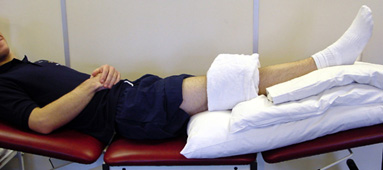
Lifting (elevating) your injury above your heart is also minimizes bleeding and swelling.
2
Elevating arm injuries is best achieved using a sling or even the opposite arm. Likewise, leg injuries should be elevated above the pelvis by lying down and using a chair, pillow or bucket to raise the leg.
Referral
The greatest impact for limiting tissue damage and optimizing injury outcomes lies in the first three to five days following an injury. At Bodywise Health, we have found that the sooner we can assess and effectively treat an injury (i.e. same and / or next day), the better the repair, the faster the recovery and the better the outcome that people achieve, without exception.
In the first 72 hours after being injured, you must also avoid HARM-ful factors. These include:
Heat packs, heat rubs and hot baths (showers) as these will increase bleeding, swelling, tissue destruction and inflammation at the injured site.
Alcohol as it may mask pain, reduce muscle function and impede recovery.9
Running/moderate activity will cause further damage
Massage/vigorous soft tissue therapy as this will also cause further swelling and bleeding.
There is no doubt that immediate, effective treatment is the best way for you to limit the financial, time, stress and opportunity cost of an injury. So if you want to save money, if you want to save time and if you want to get your life back as quickly as possible, make the most of this time. It could save you weeks and months of treatment.
If you are injured and would like to know what is the best and fastest way to get better, please call 1 300 BODYWISE (263 994) for your FREE assessment and advice.
I hope that this helps.
Kind regards,
Michael Hall
Director
Bodywise Health
References
1. Brukner and Khan and Colleagues. Clinical Sports Medicine. McCraw Medical. 4th Edition, 2012.
2. Jarvinen TAH, Jarvinen TLN, et al. Muscle Injuries: optimizing recovery. Best Prac Res Clinis Rheumatol 2007;21(2):317-31.
3. Bleakley C, McDonough S, MacAuley D. The use of ice in the treatment of acute soft tissue injury. Am J Sports Med 2004;3(1)251-61.
4. Bleakley CM, O'Connor S, Tully MA et al. The PRICE study (Protection, Rest, Ice, Elevation): design of a randomized controlled trial comparing standard versus cryokinetic ice applications in the management of acute ankle sprain(ISRCTN13903946) BMC 2005;33(5).745-64
5. Jarvinen TAH, Jarvinen TLN, et al. Muscle Injuries biology and treatment. Am J Sports Med 2005;33(5)745-64.
6. Bleakley C, McDonough S, MacAuley D. Crotherapy for acute ankle sprains: a randomized control study of two different icing protocols. Br J Sports Med 2006;40(8):700-5
7. MacAuley D. Ice therapy: how good is the evidence? Int J Sports Med 2001;22(5):379-84
8. Moeller JL, Monroe J, McKeag D. Cryotherapy-induced common peroneal nerve palsy. Clin J Sport Med 1997;7(3):212-16
9. Suter PM, Schultz Y. The effect of exercise, alcohol or both combined on health and physical performance. Int J Obes 2008;32(S6):S48-52.