I
recently observed a group of preschoolers, and I was amazed at how long they stayed at a task. What was so engaging? They were making something rather ordinary and kind of "old-fashioned"--paper chains.
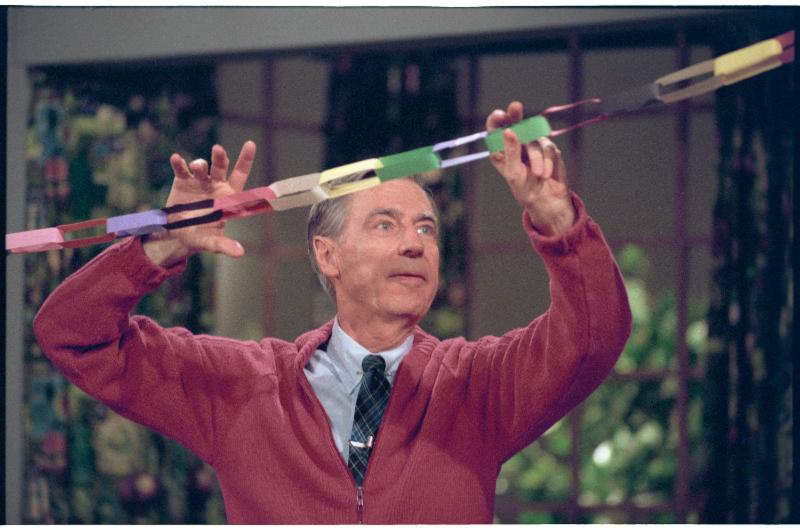
I could see why they were so involved. They wanted to make a chain that would go all the way across the floor. Anything so big has real power to it...and real fascination for young children. There's even more power to it when you think about how much the children might be learning--about math, language arts, motor skills, and social-emotional skills.
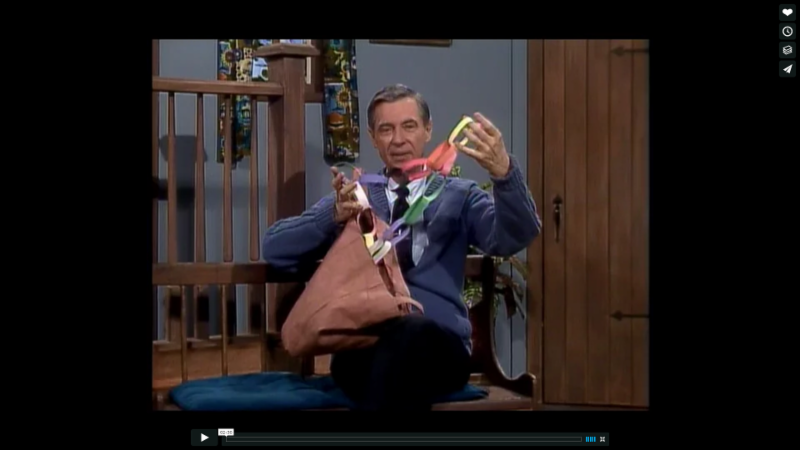
Fred knew the power of everyday crafts. All through the Neighborhood series he used simple materials like construction paper, scissors and tape to encourage children to create things that were fun and meaningful.
Watch how many skills are involved in this Neighborhood episode when Fred worked on a paper chain. When you think about it, it takes fine motor skills, focus and controlled work to cut with scissors, place each strip into the loop of the previous one, cut tape, and put the tape on just right so it holds. Listen, too, for Fred's thoughts on "differentiating" the activity for children who can't yet cut with scissors.
Here are some other ideas I've learned from teachers who use paper chains to link to different kinds of learning:
Patterning
Paper chains give children a fun way to work with patterns, which is a basic math concept. You can give children the idea of patterning by offering strips of two colors, for example red and blue. Start them with a simple pattern like red, blue, red, blue, etc. It helps to show children three repetitions of a pattern so they can follow it more easily. Then let them continue the pattern. When you feel they're ready, you can encourage more sophisticated patterns (two red, three blue, two red, three blue, etc.) or have the children make up their own patterns.
Measurement
Measuring is another math concept that naturally comes into play with paper chains. After children add loops, they often ask, "Is it taller than me yet?" And they learn how to hold the chain to measure it. Or they ask, "Can we make it long enough to go across the whole room?" They're using important spatial-relations words, like tall, long, across.
Language Arts
As you're teaching children the names of the colors, select those colors for the paper chains--and write the name of the color on its strip. Even if children can't read, they sense there's something important in the words we write--and that's a great motivator for learning to read.
A Spanish teacher used the chains in a similar way. She wrote the Spanish names for the color on each strip. When the children took the chains home, their families were able to reinforce the learning by reading the names of the colors for their children.
Social-emotional Skills
You can sense a feeling of power and pride when children have made something much longer than themselves. And I've watched children keep working on the chain until it was long enough to reach across the room. That's persistence! They learn to deal with frustration with the tape or mistakes in the pattern because the problems can be easily fixed. You might also see children working together and cooperating, sharing the tape dispenser or connecting their chains together to make them longer. With all of those social-emotional benefits, you'll probably see less challenging behaviors when children are working on an activity like this.
**********
I know that teachers are always looking for "special" projects. But it seems that what makes a project "special" doesn't need new, fancy or expensive materials. In fact, haven't you found that even the simplest projects are the most engaging? That should be a clue to us that there's a lot of important learning going on - on all levels. Engagement, meaningful play, and a rich learning experience--what a powerful combination!