|
I am on Facebook! Are you?
My Legislative page is frequently updated with the latest news throughout the state and the district.
Like me on Facebook and be the first to know.
Update on Previous Issues:
Florida House Mobile App:
Follow Me:
.
|
|
| |
As we approach the midpoint of the 2016 Legislative Session, the Florida House of Representatives has been preparing a budget for the 2017-2018 year. In the coming weeks, historic investments in Florida's education system as well as providing relief to Floridians and their small businesses will be at the forefront of discussions in Tallahassee. With that in mind, I wanted to take this opportunity to provide you with critical information on Florida's Budget Process. Currently, we are in the fourth step of the process and I hope that you find the information below to be of use to you during the upcoming budget discussions between the House and Senate.
In addition to information about the appropriations process, I have included information on the proposed House Tax Package currently being considered by the Finance & Tax Committee. Their meeting this week considered a variety of tax cuts and tax holidays, including a reduction in the sales tax on commercial leases, that I believe would alleviate the some of the regulations Florida's business are subject to that other states do not impose.
Your Friend and Neighbor,
Greg Steube
Proudly Serving Manatee and Sarasota Counties
|
| The 6 Steps Taken to Craft Florida's Budget |
Below, you will find the steps taken each year to craft our state's budget.
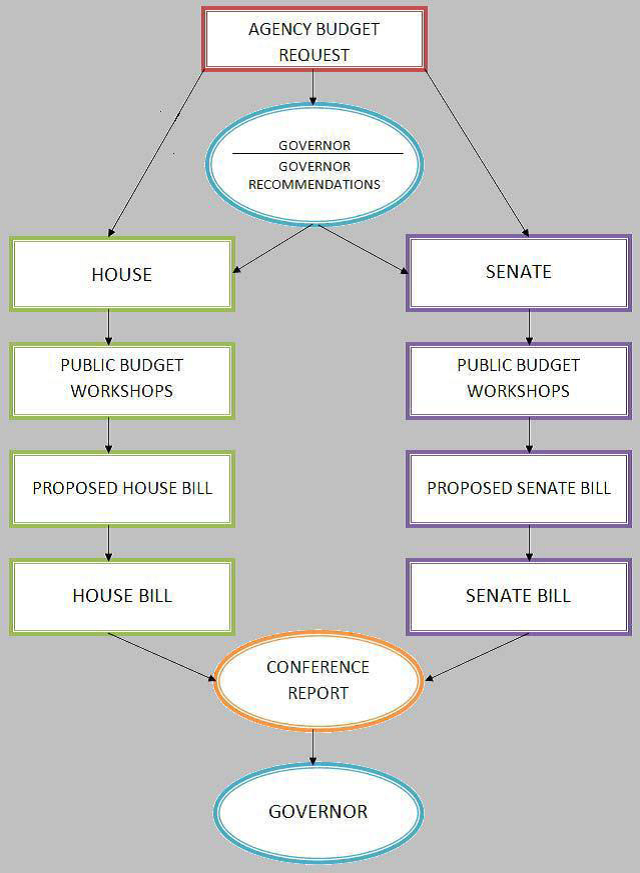
1. The first step is the creation of the state budget, a process that begins each fall with the development of the Long Range Financial Outlook. The Long Range Financial Outlook is a constitutionally required report that is approved by the Legislative Budget Commission each September. The Outlook provides a three-year picture of the state's fiscal position by lining up the estimated budget needs with the estimated revenues. 2. Shortly after the outlook is produced, Florida's state agencies submit a detailed list of their budget needs. This is called a Legislative Budget Request. 3. As required by law, thirty days prior to the start of the Legislative Session the Governor presents his budget recommendations to the Legislature.
4. At this time, we are in the fourth step of the process. It occurs during the Legislative Session when both the House and Senate work to pass their own appropriations bills within their respective chambers. I have listed and linked the House and Senate documents below. 5. Next, the Speaker of the House and President of the Senate appoint members from each chamber to participate in a process called the Budget Conference. The conferees are responsible for resolving any differences in the separate House and Senate budgets in order to create a single budget. During conference, they must determine not only the items that will receive funding, but also how much funding will be allocated for each item. I expect for budget conferees to be announced once a start date has been set for the beginning of the formal conference.
6. Finally, following a successful conference, the two bodies produce a single conference report, called the General Appropriations Act (GAA). The GAA is then sent to the Governor, who has line-item veto authority over items within the document, for passage.
|
| Important Facts on Florida's Budget |
Florida's Fiscal Year
July 1st - June 30th
Florida's Top 6 Spending Areas in the Budget
Healthcare
PreK-12 Education
Transportation & Economic Development
Higher Education
Justice
Florida's 3 Major Categories of Funding
The General Revenue Fund
State Trust Funds
Federal funds
|
Florida House of Representatives Budget
|
|
I hope you will use the links and information, closed below, as you review Florida's General Appropriations Act and implementing bills. As you review the documents, keep in mind that an easy way to access the search feature of the documents, linked below, is to hit your "Ctrl" key and the "F" key at the same time
or "Find/ Command+F" on a Mac. This will open the "Find" function at the top of the document.
- Using this method, you can search for terms that are important to you and your family.
- Just click on the pictures below to access budget documents.
House Budget Highlights
|
|
| 2016 Appropriations Documents |
The House's budget proposal is responsibly balanced and focused on the priorities of Florida's families. It includes $1 billion in tax cuts, record per student education spending, significant funding to protect our critical environmental resources and over $3 billion in reserves.
|
|
| Video Archive of Appropriations Committee |
Education Projects Important to Our Community
In an effort to honor our veterans, $1.5 million has been provided for the Workforce Training Grant for grants to target industry businesses of up to $8,000 per veteran trainee and the Veteran's Entrepreneur Training Grant to create a network of Florida universities to offer entrepreneurial training opportunities to veterans.
Other Important Funds:
- Auditory-Oral Education Grant Funding - $750,000, an increase of $200,000
- Autism Program - $9,400,000, an increase of $400,000
- Florida School for the Deaf and the Blind - $51,449,603, an increase of $1,260,668
- Take Stock in Children - $6,225,000, an increase of $100,000
- Teach for America, Inc. - Florida - $500,000
- Florida Student Assistance Grants (FSAG)-$6.1 million increase
- $5.3 million to increase funding and provide a 2 to 1 match for First Generation in College scholarships.
K-12 Education
The proposed PreK-12 Education budget contains the highest amount of state funds ever, totaling $14.2 billion, which is
an increase over the prior year budget of $75.5 million.
We have continued
our commitment to providing a quality education for Florida's students by increasing K-12 per student funding to its highest level ever.
The FY 2016-17 House Budget increases the funds per student by 1.75% for a total of $7,231.57, which is a $124.24 per student increase.
Higher Education
The Higher Education overall proposed budget totals
$7.3 billion, which is also an increase from last year.
Our budget includes:
- $20 million for Preeminent State Universities
- $10 million for Emerging Preeminent State Universities
- $120 million in additional State University Performance and State Colleges Performance Funding
Protecting Our Environment
Amendment 1 allocates 33% of net revenues from the current excise tax on documents to be deposited
into the existing Land Acquisition Trust Fund (LATF).
The House budget allocates additional funds from the LATF to a broad range of environmental programs encompassed by the amendment for the benefit of natural systems throughout the state, including:
- $80.2 million to Florida Forever
- $27.7 million for additional land acquisition across Florida
- $60.3 million for additional/increased land management
- $31.9 million for springs restoration, protection, and preservation around the stat
- $10.1 million for beach and dune restoration.
- $198 million from the LATF is provided for Everglades Restoration to preserve its beauty and protect this vital environmental resource for future generations
This year's budget provides $50 million for water projects across the state.
Florida's Health Care
Our health care budget is focused on providing critical services to our most vulnerable citizens.
- The House budget fully funds the Florida Kid Care Program to serve approximately 193,773 children.
- $7 million has been allocated to support the Florida Pregnancy Support Services Program's network of pregnancy centers providing services to women and their families.
- This year's budget provides funding to serve an additional 700 "critical needs" clients with services through the Agency for Persons with Disabilities Medicaid Waiver Program.
- We have also provided funding to reduce the waitlist for clients for the Medicaid Elderly Long Term Care Waiver, which will serve approximately 664 additional people.
Cancer and Alzheimer Research
Cancer Registry Enhancements - $0.7 M GR - Enhances Florida's Cancer Registry by incorporating laboratory reports into the registry, providing data input training, and providing automated web based data requests.
Alzheimer's Research - $2 M GR - Provides additional funding for Alzheimer's research grants allocated through the Ed and Ethel Moore Alzheimer's Research Program. Total program funding is $5 million.
Promoting Family First
- The House budget provides $38.9 million for child welfare and family safety enhancements, including $3.5 million for the Adoption Incentive Award program.
- We have also provided $6.7 million in additional funding for an anticipated increase of 3,200 new adoptions.
- $3.1 million for the continued expansion of training activities for the Office of Child Welfare and Office of Court Improvement.
- $22.9 million for additional CBC core service functions and implementation of the safety management methodology to prevent out-of-home placement.
- $2.0 million to expand the Healthy Families program.
- $1.1 million for community initiatives providing domestic violence treatment, adoption promotion, and services to sexually exploited youth.
Mental Health and Substance Abuse Initiatives
- $32.0 million for community-based services throughout the state.
- $6.1 million to expand the Criminal Justice, Mental Health and Substance Abuse Matching Grant program throughout the state for an estimated total of 18 grants.
- $2.8 million to expand Family Intensive Treatment (FIT) teams in six regions. The expansion will serve the following areas: Brevard, Duval, Hillsborough, Manatee, Pinellas, and Seminole.
- $3.5 million for transition vouchers for individuals to purchase services as they transition from acute, restrictive care to community based care.
Justice
- Sexual Assault Kit Backlog Reduction - Provides $2.4 million in general revenue for contractual services in FDLE crime lab to expedite testing of untested sexual assault kits that are currently unsubmitted by local law enforcement.
- Guardian Ad Litem Staffing - Provides $1.1 million in general revenue and 19 positions to allow the Guardian Ad Litem program to provide representation for all out of home children in the dependency system.
Arts and Culture
- Cultural and Museum funding $18.3 M
- Cultural Facilities Program $13.9 M
- Historic Preservation Grants $1.8 M
- Restoration of Historic Properties $13.5 M
- State Aid to Libraries $22.3 M
- Library Construction Grants $2.0 M
- Library Cooperatives $2.0 M
Tax Cuts
By returning nearly
$1 billion to Floridians
, we are providing relief for individuals and small businesses, while also infusing more money directly into our economy. This tax package will not only help Florida's businesses create jobs, but make Florida a more affordable state to live and raise a family.
|
|
| House Finance & Tax Documents |
The tax cuts will benefit nearly every Floridian, including small business owners, college students, elementary school students, families, and veterans and their surviving spouses.
|
|
| Video Archive of Finance & Tax Committee |
|
With the final passage of Campus Carry in the Florida House of Representatives, I would like to thank Representative Michelle Rehwinkel Vasilinda for being a tireless leader who withstood the urging of her political party to withdraw her support. She has worked tirelessly to allow all women the right to defend themselves in whichever manner they choose. As a professor and a victim of a violent attack, she has dedicated her public service to the empowerment of the powerless. Thank you Representative Rehwinkel Vasilinda for walking beside me and standing next to me in support of the Second Amendment. I am forever grateful for your selfless public service and your support of House Bill 4001.
Please use the video links, noted below, to watch the passage of HB 4001:
|
Contact Me:
Sarasota Office: Tallahassee Office:
722 Apex Rd 204 House Office Building
Unit A 402 South Monroe Street
Sarasota FL 34240 Tallahassee, Florida 32399
(941) 341-3117
(850) 717-5073
|
|
| |
|