"The child perceives, without conscious reasoning, patterns of relationships: things to things, things to people, people to people... The mathematical mind is a power to organize, classify and quantify within the context of our life experience." - M. Shannon Helfrich, from The Mathematical Mind.
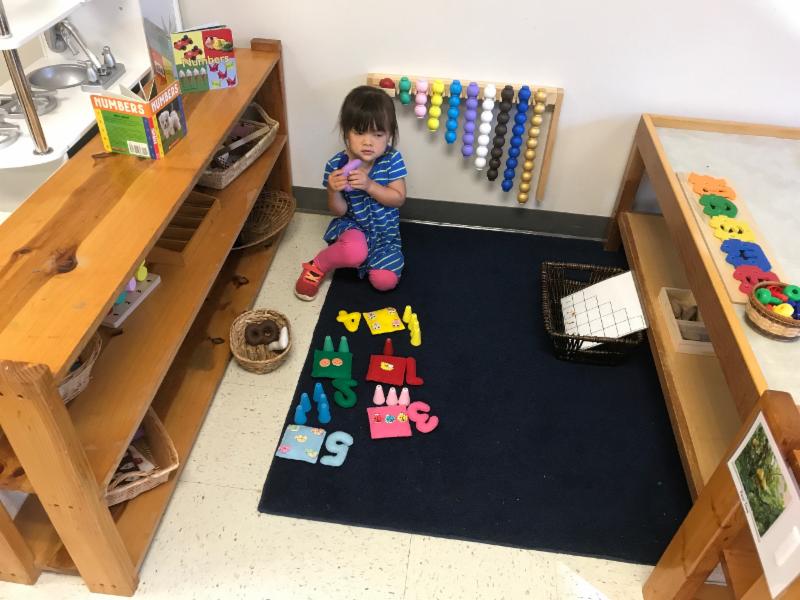 Maria Montessori believed children are born with an aptitude for mathematics. She also understood that if mathematical learning is not part of a child's early experiences, the numerical part of the mind goes underdeveloped and learning math becomes more difficult. Therefore, the mathematical mind should be stimulated and developed as early as possible.
Before a child is ready to construct number concepts in her head, she needs to understand fundamental mathematical concepts such as conservation, reversibility and one-to-one correspondence. In the toddler classroom, this begins with Practical Life and Sensorial activities.
Practical Life exercises help children develop concentration, a sense of competence and an understanding of logical reasoning.
As children develop skills to takeover care for themselves, such as dressing, eating and toileting, they build the competence needed to explore their world and take on responsibilities in their immediate community.
Learning these routines helps establish the foundation for understanding logical relationships and sequences. Children establish the concepts of conservation and reversibility through the repetition of exercises such as spooning and pouring.
By transferring liquids or solids between the same- or different-sized containers, children learn that two equal things remain equal even if their appearance is altered or spatial arrangement changed, as long as nothing is added or taken away. Additionally, this process can be undone, or done in the opposite direction. Activities such as setting the table, putting on shoes and matching and pairing items introduces the idea that everything has a specific place, which fosters the idea of one-to-one correspondence.
"There is nothing in the intellect which was not first in some way in the senses." - Maria Montessori
Through touching, stacking, sorting and handling the Sensorial materials, a child creates concrete sensory impressions of basic mathematical concepts, such as
color, shape, texture, sound, size, temperature and weight.
These explorations draw a child's attention to similarities and differences, and
she can use these observations to develop an understanding of sequencing, comparisons and classifications. Additionally, children begin to learn mathematical vocabulary, such as the correct names of shapes and colors and other descriptive and comparative terms.
When the child is ready, she is introduced to a series of sequential didactic mathematical materials, which may include spindle boxes, sandpaper numbers and other items she may use to gain visual and muscular impressions of quantity and order. These materials are introduced in a concrete form before the abstract symbol. The child learns what the quantities of 1, 2, 3, ...etc. look like before learning the symbols of 1, 2, 3, ...etc. Readiness for these materials is assessed once a child demonstrates an understanding of the "concept of one." Children demonstrate this skill by correctly responding to requests to give or take one item. Once children have a solid understanding of the "concept of one," they are introduced to materials that encourage frequent counting practice and establish a firm understanding of one-to-one correspondence. Numerals are then introduced to label quantities. At this stage, a child starts to make comparisons of more or less. She starts to recognize that one is smaller than three and five is larger than two. Although a young child may be able to recite a succession of numbers, a true understanding of ordinary numerals is established only after a child gains an understanding of
cardinality -
that the last number used represents the total number of items counted.
Presenting mathematical concepts in this logical sequence helps children build a strong mathematical foundation. They use this foundation to build future understanding of mathematical processes, as well as geometric and algebraic thought. Maria Montessori said, "As cement is to brick so is the sensorial apparatus to mathematics." If these basic ideas are not solid, more advanced concepts will be more difficult to understand.





















 The Wednesday Weekly shares WMS news and events that are relevant to the families in our community.


