|
IDMA Weekly News Collection
of April 14, 2017
|
Dear IDMA Members, Industry Colleagues and Friends,
It's Easter this weekend and after the weekend, Passover will conclude. I genuinely hope that those celebrating these holidays have taken off - and will take off - some time to reflect on the core values of human freedom and personal sacrifice!
At the same time, recent research has shown that readers of this type of email usually are more likely to read it over the weekend than during the work week.
|
|
|
|
Philippe Roolant, IDMA Vice President and Vice President of the Thai Diamond Manufacturers Association.
|
|
Obviously, in our 24/7 economy, the news beast never stops.....and we don't stop consuming its products.
As such, few of us will have missed the videos documenting the forceful removal of a doctor from a domestic UNITED flight earlier this week. With the law on its side, UNITED, by means of its security staff, did the unthinkable: they created a public relations disaster of major proportion that reportedly caused UNITED stock to drop more than half a billion dollars in value - and counting.
Fortunately - or is it unfortunately? - our industry does not catch as much attention in the general media as it did at the time of the conflict diamonds crisis, but the recent upheaval around Martin Rapaport's derogatory remarks and derision of the KP had the potential of creating yet another crisis in our industry. I propose you read the reaction of the past KP chair, brought to you below. Fact is that we have an obligation to protect our industry, and at the same time to advance it. Mr. Rapaport, please take note!
The topic of advancing our industry was high on the agenda of the recent Special IDMA Presidents' Forum. We will be reporting on that in the next issue of WINC!
Wishing you all an excellent long weekend.
Chokdee Khrap!
(Good luck - in the Thai language)
Phillppe Roolant, Vice President IDMA
|
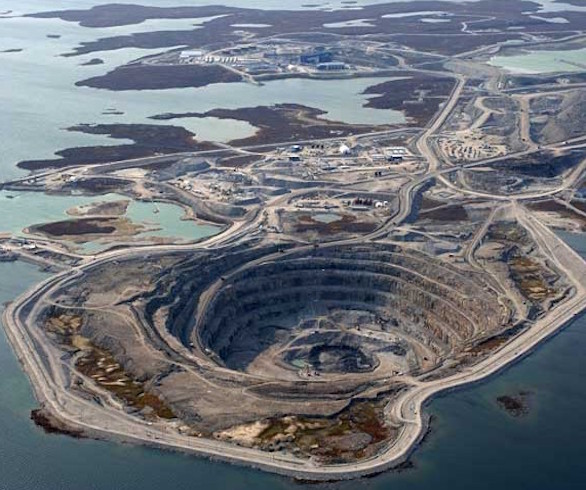
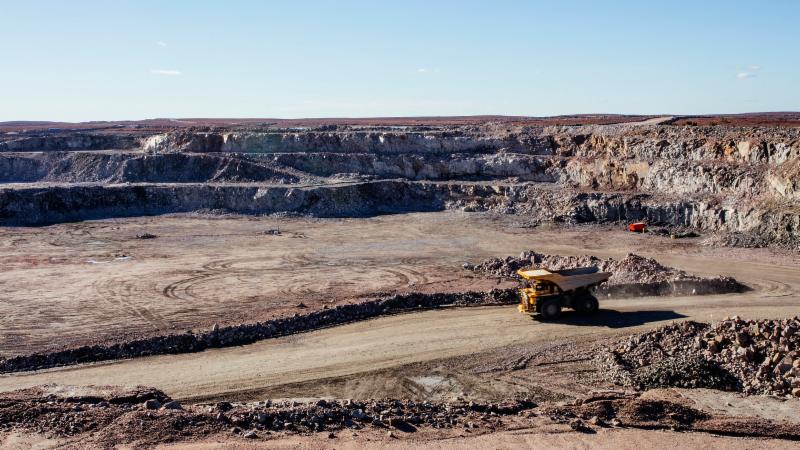
Dominion Diamond breathes more life into Diavik mine Dominion Diamond Corporation has announced that its jointly-owned Diavik mine will have its life span extended by two years. At this time, the mining company has also hiked its estimate of the project's future production. According to Dominion, the deposit will now last until 2025, compared with a March 2015 projection of 2023. Because of
this, the mine's new estimated output from now until its closure has risen 16 per cent to 46 million carats. The revenue forecast has also gone up 22 per cent to $9 billion for the eight-year period. These new estimates are based on a technical report showing figures from January 31, which reflects the mine's A-21 extension, set to begin production in 2018. Jim Gowans, chairman of Domionion, says the updated plan for Diavik "extends the mine life, increases carat production, and grows future revenues and cash flows, while maintaining operating costs and capital expenditures at levels that are consistent with earlier forecasts." Read more
|
Indian ambassador urges value-addition of diamonds
Zimbabwe should partner with other countries to establish a diamond cutting and polishing centre if the country is to benefit from value-addition of its gemstones, Indian ambassador to Zimbabwe, Rungsung Masakui has said. The Indian envoy made the
remarks at a public lecture titled Unlocking Zimbabwe's Gemstone Wealth: Lessons from India, which he presented at Midlands State University last Friday. This came amid reports by mining experts that the country was losing millions of dollars in potential revenue due to lack of a minerals benneficiation policy. "Structural deficiencies affecting gemstone mining and processing in Zimbabwe is due to the fact that the country has not yet established a gemstone cutting and processing centre," Masakui said. "In this light, it is imperative for Zimbabwe to partner with friendly countries in order to establish a gemstone cutting and processing centre, while also embarking on innovative marketing of lesser-known gemstones."
Read more
|
The KP Is vital - act on existing proposals to bring needed reform
As former KP Chair 2016, I was quite surprised to read several negative articles in the media on the work of the Kimberley Process as well as positive
remarks from
Vinod Kuriyan, WFDB President
Ernie Blom and last week, DDI Chairman
Ian Smillie. What
struck me most were the condemning comments from the leading American price list and media person Martin Rapaport (whose diamond auctions we host every month in our Almas Tower), and afterwards from the former US State Department Special Advisor for Diamonds
Brad Brooks-Rubin. Both called the KP a defunct organisation, while Rapaport referred to it as 'BS' - a word which we normally don't use describing the activities of important international organisations. Brooks-Rubin even went so far to say that the KP is not needed anymore because all certificates that are circulating between participating countries are beyond any doubt valid and does not address the real supply chain problems.
Read more
|
Security raids and abrupt exit of chief fail to derail Alrosa
The abrupt departure of its chief executive, the appointment of the son of one of
Russian president Vladimir Putin's closest aides to replace him and a raid this month by the security services. That would be enough to worry even the boldest investor. Yet the corporate success story of
Alrosa does not look like it is fading. Only last month, the world's biggest diamond producer by volume reported a
fourfold increase in profits and a 41 per cent surge in year-on-year revenue. The strong results of the Russian state-run company have been helped by last year's global recovery in diamond prices following a decline in 2015 as the group generated net cash flow to pay liabilities and dividends.
Alrosa said it would pay 75 per cent of profit for 2016 in dividends, a rarity for a Russian state company, many of whom avoid paying the government-mandated figure of 50 per cent. "We see continuously growing diamond jewellery demand in the US, and gradually recovering demand in China and in commodities driven economies," says Dmitry Glushakov, an analyst at VTB Capital.
Read more
|
Russia's top diamond producer Alrosa
sold $554.2 mln worth raw diamonds in March
Alrosa sold $554.2 mln worth raw diamonds this March and sales of cut diamonds
amounted to $12.4 mln in value terms, the Russian diamond miner reported on Monday. Total sales of raw and cut diamonds in March amounted to $566.6 mln, up 1% year-on-year, Alrosa said. "We continue observing stable demand in almost all categories of raw diamonds. This confirms optimism of market participants demonstrated during the jewelry exhibition in Hong Kong," the company's press service said citing Alrosa Vice President Yuri Okoemov. Company's sales in value terms totaled $4.4 bln in 2016.
Read more
|
Diamcor Mining provides update on operational expansions
Diamcor Mining Inc. is pleased to announce that further to the installation of significant additional operational items and expansions completed as announced on
January 18,
2017, the testing, commissioning and calibration of these new facilities at the Company's Krone-Endora at Venetia Project (the "Project") continues to progress in a positive manner. The Company expects the finalization of these efforts to be completed by
April 30, 2017. These efforts, initially targeted for completion in the prior fiscal quarter ended
March 31st, were delayed due to operational and product delivery issues. However, with the testing, commissioning, and calibration work now substantially completed, the facilities have very recently begun demonstrating an ability to achieve the desired goals of: increased processing volumes; the crushing and treatment of material up to 45mm in size; the processing of material through a dedicated ultra-coarse large diamond recovery circuit; and, an increase in the overall capacity of the Project's final recovery and sorting facilities.
Read more
|
Gahcho Kué: De Beers' sub-Arctic bet on diamond demand deficit
ABOUT 280km north-east of Yellowknife, the largest town of Canada's North West Territories (NWT), is Gahcho Kué - a Chipewyan name for 'the big rabbit' - although
caribou are also native to the region. So are diamonds. It's here, above the treeline and only 400km south of the Arctic Circle, that De Beers in joint venture with Mountain Province Mining, sank C$1bn (R9.5bn) building Canada's latest diamond mine, and its first in eight years. It's a hostile environment and underpins the difficulty of finding fresh sources of diamonds. The often quoted data still has the power to amaze: of some 7,000 kimberlite pipes that have been sampled through time, only 60 have contained enough diamonds to justify a mine - about 1% of the total. For Gahcho Kué, production of about 54 million carats is forecast over its 12-year life from now until 2028. But there are hopes for an extension project: "There's some work that may come to fruition to see if we can get beyond the current 12 years," says Tom Ormsby, head of external and corporate affairs for De Beers Canada in an interview with Miningmx.
Read more
|
De Beers rigs Botswana sales contract negotiations
The De Beers Group has scored a major coup against (DTCB) Diamond Trading Company Botswana, rigging the odds against Botswana as the country prepares to
re-negotiate the Diamond Sales Agreement which lapses in 2020 and reversing achievements of the De Beers relocation from London to Gaborone. Sunday Standard can reveal that against all advice from his technical team, the Managing Director of DTCB, Tabake Kobedi has taken sides with De Beers to relocate the Information Technology Systems of DTCB from Gaborone to Johannesburg. Professionals at DTCB have railed at what they perceive as continued "capture" of DTCB by De Beers. "This capture of DTCB leadership by De Beers brings to question DTCB independence regarding the valuing of diamonds," Botswana based professionals at DTCB state in a confidential report. Other than usurping the power and influence of Botswana based professionals in determining the price of diamonds sales, the new development effectively reverses by many years, the achievements that Botswana had slowly and painstakingly achieved to take ultimate control of the country's diamond operations from the mine to the market. It is feared that the De Beers apparent fancy footwork which has caused a major rift
Read more
|
Diamond industry's famous hungry crocodile doesn't cut it
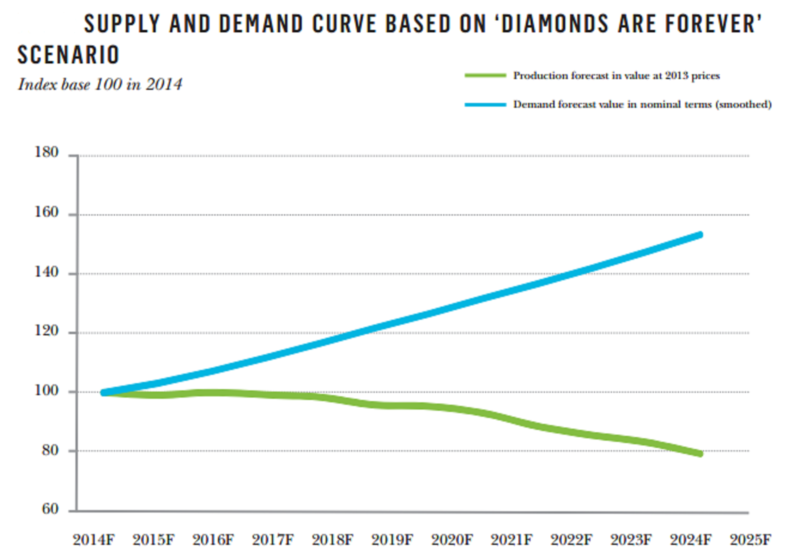
The diamond industry's most famous chart is the
hungry crocodile, the ancient reptile's jaws wide open, reflecting both a predicted shortage of gems and the inevitable price rises that will come with it. Not only has this chart, which has been an industry staple
for more than a decade and promoted by big miners like
BHP Billiton Ltd.,
Rio Tinto Group and De Beers, never materialized, it oversimplifies the fact that the industry's 15,000 different categories of diamonds are performing in very different ways. That divergent trend has accelerated in the past year. Last month, a mine producing lower quality stones was shut due to a dip in prices, while top producer
De Beers has been forced to offer unprecedented concessions to its customers. Both events show the chart is less relevant today than ever before. "Miners have all used the open crocodile graph to justify their business case," said Anish Aggarwal, a partner at Gemdax in Antwerp. "A greater degree of granularity is needed now to look at what the demand and supply looks like for each particular project."
Read more
|
Diamond Miner ends large gem drought with 114-carat find
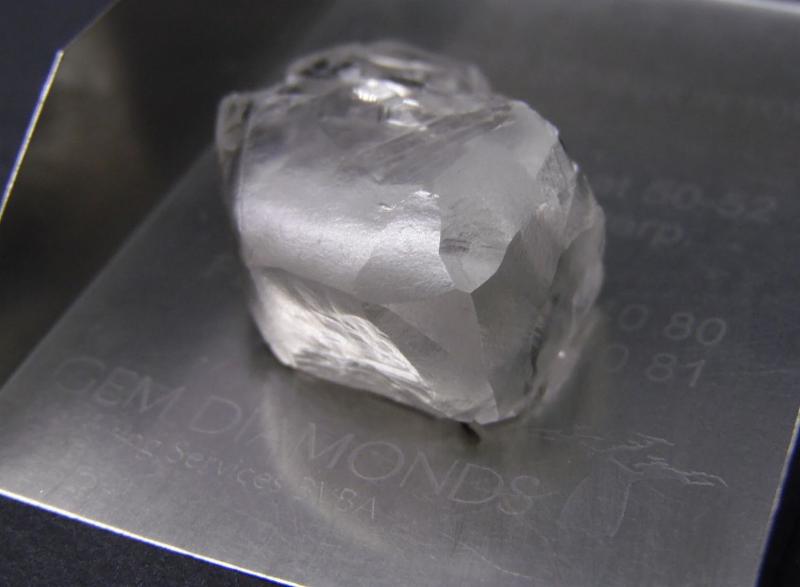
Gem Diamonds said it unearthed a 114-carat diamond at its Lesotho mine in southern Africa, helping to ease concerns about a dearth of large finds. The stone is a D color Type II diamond of exceptional quality, Gem Diamonds said in a
statement Friday. It
was the second Lesotho diamond discovery bigger than 100 carats announced this week, after a rival miner
said Wednesday it had unearthed its first stone of that size. The company's Letseng mine is renowned for the size and quality of its stones with its diamonds selling at an average price of almost $2,000 a carat, the highest in the industry. In comparison the global average is about $120 a carat. Still, the company has suffered recently from a lack of big finds, with the miner discovering just five stones bigger than 100 carats last year, less than half as many as it found in 2015. "Given the paucity of large, high-value recoveries in recent months, we believe this recovery can precede a return to form for Gem," Kieron Hodgson, an analyst at Panmure Gordon & Co. in London, said in a note Friday.
Read more
|
Diamantaires bracing up for reduced supply of roughs from De Beers
Indian diamantaires may get reduced supply of
rough diamonds from the world's largest
diamond mining company, De Beers. The company, according to the US-based
Rapaport Group, has reduced the supply of rough diamonds by over 20 per cent under the intention to offer (ITO) filed by its clients, majority of who are Gujarati diamantaires from India, Antwerp and Dubai. The reason being that De Beers had signed an agreement with Namibian Government last year, committing to allocate 15 per cent of its Namibia production to state-owned company Namdia, to support diamond manufacturing. The De Beers has been supplying rough diamonds on contract basis to its clients through ITO-an indication from the clients on how much rough diamonds will be required for the coming year. The company has about 80 core clients at its international sights, which take place 10 times a year in Botswana. As a part of its beneficiation programme, it also supplies roughs in separate sights to 11 local sightholders in Namibia, 20 in Botswana and seven in South Africa.
Read more
|
Antwerp diamond industry 'demands solution for banking issue'
In reaction to media reports regarding access to bank accounts, the Antwerp World Diamond Centre (AWDC) said it is "indisputable that Belgian banks discriminate
against the entire Antwerp diamond industry". "Based on testimonials, companies' correspondence with banks and information banks themselves have published, the AWDC can prove that banks are systematically refusing customers with any connection to the diamond industry, both for personal and professional banking affairs, before they even submit a detailed request. Banks often refer to the so-called 'risk factor' involved to justify their refusal. Claiming the industry is not sufficiently aware of this problem makes no sense. First of all, the diamond trade in our country is controlled strictly by a series of legal obligations. By law, only officially registered diamond companies are allowed to engage in trade, and very stringent anti-money laundering (AML) legislation is applied. Moreover, all international financial transactions are closely monitored, and within the Diamond Office, all exports and imports are 100 percent verified.
Read more
|
92 ct diamond found at Lulo;
total weight of special diamonds recovered crosses 10,000 cts
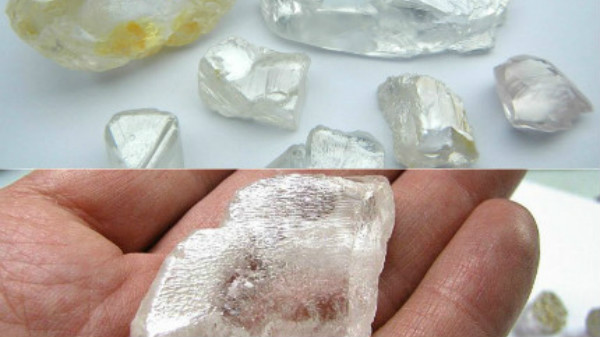
Lucapa Diamond Company said that it had recently recovered another premium-value diamond, weighing 92 carat, from new Mining Block 28 at the Lulo diamond project in Angola, taking the total of all Special diamonds (>10.8 cts) recovered from the project past the 10,000 ct mark. Lucapa is one of the partners at the Lulo project along with
Empresa Nacional de Diamantes (Endiama) and Rosas & Petalas. The 92 ct stone, which has been recorded as a D-colour Type I diamond on the Yehuda colorimeter was recovered from the same block that yielded the 227 ct gem sold last month, the Company said. The Company also said that kimberlite exploration activity at the project site was now ready to commence with the commissioning of its New Hanjin D&B track-mounted drilling rig. The Rosanstroi drill crew have also recommenced drilling work at the site after a short break during which a new contract was finalised. After the monsoon season ends in late April, three rigs will be conducting drilling at the site. The drilling operations are part of the kimberlite exploration programme, which aims to identify the kimberlite source or sources of the high-value alluvial diamonds being recovered through current mining at Lulo.
Read more
|
Exit Interview With Cecilia Gardner,
President and CEO of the Jewelers Vigilance Committee
Cecilia Gardner stepped down
last month after 18 years as president and CEO of the Jewelers Vigilance Committee. (She also served, for over a decade, as general
counsel for the World Diamond Council, which represents the industry in front of the Kimberley Process.) She will now offer
legal and consulting services for the industry. In a candid talk at the American Gem Society Conclave in Los Angeles, Gardner addresses her future plans, her views on women in the industry, and, of course, the Kimberley Process.JCK
Gardner
:
Yes. The World Diamond Council has for years taken a position that the expansion of the definition is necessary for the continued viability of the Kimberley Process.
Read more
|
The real reason Chinese Millennials are super consumers
Early in March, more than 4,000 people gathered at the "Millennial 20/20 Summit" in New York to discuss the power of the millennial generation and how they will affect the future of retail. Chinese millennials, numbering more than 400 million, are a force to be
reckoned with. While many have recognized them as ultra-connected consumers, few have realized that this has been caused by their place in history as
the only-child generation. This alone sets them apart from other millennials in a most fundamental way. Starting from 1979, China implemented the "One-Child Policy" in an effort to control its population growth. The policy lasted for almost 40 years and
was only ended recently. During this period, each family in urban China was allowed to have only one child. Chinese millennials, aged 19 to 35, were all born during the "One-Child Policy" period. These "little emperors" and "little empresses," as they are often known because of their singular importance within a family unit, were at the center of their universe when they grew up. They are privileged, entitled and enjoy a good life
Read more
|
China's Diamond Market Returns to the Spotlight
with Record-Breaking 'Pink Star' Sale to Chow Tai Fook
Hong Kong jeweler Chow Tai Fook now lays claim to a rare diamond that's getting global attention after its US$71.2 million sale broke records this week at a Sotheby's Magnificent Jewels and Jadeite auction. The 59.6 carat 'Pink Star' diamond is now the most expensive sale at auction for a diamond or jewel in the world, more than doubling the bid for the 'Unique Pink' diamond at a Sotheby's auction in Geneva last year. The auction was a major achievement for the auction house in Hong Kong as the diamond was also the "most valuable item ever sold in Asia," Sotheby's CEO Tad Smith said in a press statement. Its success as Art Basel winds down suggests contemporary art is not the only market making major strides in China right now-jewelry is seeing a potential growing market as well.
Despite a lag in the number of Chinese mainland tourists to Hong Kong and Xi Jinping's anti-graft campaign, there is hope among industry experts that
Chinese millennials will give the struggling diamond industry the boost it needs. A December 2016 Bain and Company report said this generation brought jewelry makers "
a compelling opportunity," and Chow Tai Fook has been quick in recent years to take advantage of it. The company bought Hearts on Fire Co. in 2014 and has opened a new accessible luxury brand called Monologue in the mainland to give its younger shoppers a greater selection of pieces they'll like at
lower price points.
Read more
|
|
SPECIAL FEATURE
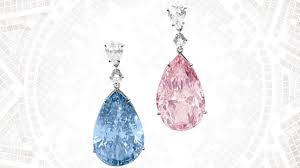
Apollo' and 'Artemis' could sell for $68M at Sotheby's
Two non-matching pear-shaped diamond earrings will be up for auction next month, but interested parties will have to pay attention to the bidding on two lots instead of just one. The "Apollo Blue" and "Artemis Pink" diamonds will hit the auction block at the Magnificent Jewels and Noble Jewels sale at Sotheby's Geneva on May 16, where they will be sold separately. Sotheby's did not respond by press time when asked why the two diamonds, which are paired as earrings, are being sold separately.
The Apollo Blue is a fancy vivid blue diamond that weighs 14.54 carats. The internally flawless, Type IIb stone could sell for between $38 and $50 million. It has been cut and polished into an unmodified pear shape to bring out its color. The Artemis Pink, meanwhile, is a 16-carat fancy intense Type IIa pink diamond of VVS2 clarity. It's expected to sell in the range of $12.5 to $18 million. The pink diamond also has been cut into a pear shape.
Read more
|
|
|
|
|
|