|
My husband Robert and I have been married 33 years (37 together) and he was diagnosed seven years ago with a variant of Parkinson’s; the Veterans Administration now speculates he doesn’t have Parkinson’s, but Multiple Symptom Atrophy, so testing continues. He has an 80% hearing loss from his service in the Army, and his symptoms have progressed to speech aphasia, loss of Executive Function, and significant dementia. He is basically dependent on most of his self-care.
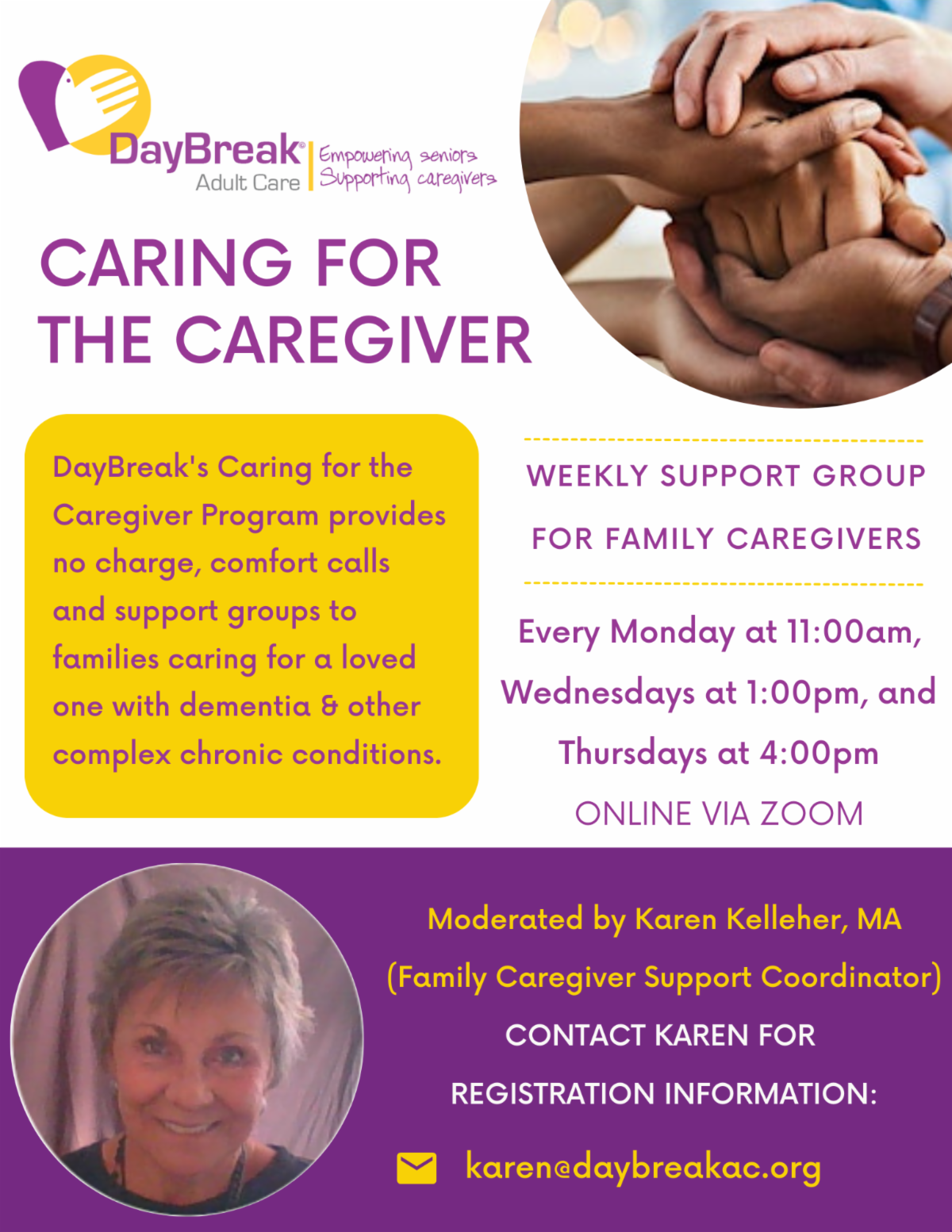
I came to DayBreak’s Caring for the Caregiver program in 2019, three years into this disease process. I was desperate for help and I thought I could learn how to make caregiving easy because I was still in denial about his decline. What I I learned, instead, was a lot about myself, and I also learned a lot about how “to handle this.” Here are two big lessons I want to share with you:
Durable Power of Attorney (POA) for Economic Decisions and also Durable Power of Attorney for Healthcare: The important and simple message I learned just in time: Your loved one with a progressive disease that may involve dementia must appoint someone to represent their wishes for finances and healthcare — to speak for them when the time comes that they cannot do that for themselves (for whatever reason). Actually, everyone needs to do this, no matter your current health because your circumstances can change very quickly due to an accident, disease, etc.
If the care-receiver is not considered competent by an attorney, this process is not easy and is more expensive and involves the court to appoint a guardian, or a second attorney to ensure the care-receiver’s interests are protected.
With a Power of Attorney for Economic Decisions and a Power of Attorney for Healthcare, doors open and you can speak for your loved one, make all the financial decisions, and make all major decisions for them when they can’t speak for themselves. As POA you can close bank accounts, make a reverse mortgage, or sell a home all without your loved one’s signature. If your loved one has dementia and you have joint accounts and titles on property, these financial decisions are impossible to execute without a POA. You’ll have to go to court and go through a more expensive and arduous process with an attorney to get these documents in place.
If you have property, you’ll also need a Living Trust for your heirs to avoid probate. A living trust, drawn up by an attorney, can include POAs, a will, and healthcare directives. When looking for a trust attorney, shop around. The documents the attorneys use are all the same and some attorneys charge significantly more than others.
Also, it’s a good idea to put cremation or burial decisions in place, sooner than later. These processes will most likely be harder to handle when your loved one passes. It’s also less expensive to buy these packages while still living.
I am very fortunate to have the support of the VA as my husband receives benefits for a disability resulting from his service. No one wants to experience a disability when serving in the military but the VA takes care of their veterans injured during their period of service. I advise you to find out about and utilize all the benefits available to you through yours and your loved one’s insurance, Medicare, Medi-Cal, county agencies, etc. A support group is a great place to get this information and social workers are well informed as to what may be available to you.
Reframing: Eventually, I realized that somehow, some way, I had to think about this on-going and worsening crisis differently. This is another place where the support group that I am in helped me immeasurably.
I observed how some other caregivers were more at peace about their role with their loved ones but I didn’t quite understand how to achieve that. I was working on the thought process of reframing when, last year, my best friend of 40 years passed away from an auto-immune disease. We didn’t expect to lose her and it was a shock to everyone who knew her. After about six months I realized I had experienced some of the classic stages of grief – shock, denial, depression, sadness and, finally, acceptance. * I then realized for probably two years I had been grieving the loss of my marriage, because I had been feeling many of the same emotions.
I came to see that I could no longer share anything with my husband, that I was making every decision that had to be made. My workload increased as I handled all the things that he used to help me with. The person I knew all those years was not really there anymore, and my marriage for so many reasons was never going to be the same. I decided to reframe my role to that of his nurse because it hurt so much less in that role, than to feel resentment and anger at the disease, or feel sadness as his condition continues to deteriorate. I felt a measure of peace, knowing I now care for the broken vessel that holds his soul. This reframing has relieved me of any guilt for going on a much-needed respite vacation without him, enjoy time with my friends, or continuing to live my own life through my self-care, hobbies, and interests.
Something Karen Kelleher said to me really helped me when I was feeling especially overwhelmed, while trying to cement this new role I had identified for myself. She said, “You are in it, but you are not of it.” Yes, I am a caregiver and I am deeply involved in the process of caring for my husband, but it doesn’t have to define me or change who I am. I can still have my life, set goals for myself, enjoy respite time away, and enjoy my hobbies, and my friends. My life is as important as my husband’s and I won’t throw away these years giving everything and settling for nothing for myself.
Over these past four years, participating with DayBreak’s Caregiver support group, I have learned to ask for help and to keep an open mind. It has made it possible for me to hear the advice and receive the support. Caregiving is still challenging, but these days I have more happy moments than sad ones and I could not have achieved that milestone without the support of Karen Kelleher, Susan Musicant, and my fellow caregivers.
* https://www.healthline.com/health/stages-of-grief
|