|
|
 |
 |
|
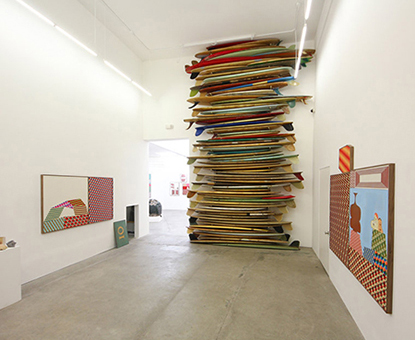
| Barry McGee, "China Boo," 2015, installation view |
|
 |
| Weekly Recommendations |
|
Barry McGee
Ratio 3 |
|
"One Cannot Look: Graphic Wars"
MCASD |
|
Todd Christensen
ART.i.factory |
|
Thomas Gardiner
Blue Sky |
|
Kelley Divine
Esperson |
|
Alexander Yulish
ACE |
|
| We're taking a one week break for
the holiday. We'll be back with you December 4th. |
|
| |
|
| Barry McGee
Ratio 3, San Francisco, California
by Cherie Louise Turner |
|
| Continuing through December 19, 2015 |
|
| Spend time viewing Barry McGee's newest work and you'll likely have two reactions: This is insane! And, what's going on? The latter especially is by design: no surprise there! As to the former, McGee has, once again, gone big and wild with color and pattern. The impact is manic, joyful, socially relevant, formally engaging, and endlessly fresh. There is so much going into and so many elements to many of the pieces, even after a lot of looking you're bound to see something you've missed, or a juxtaposition of pattern and form that you hadn't fully absorbed. The show is pretty firmly divided into two categories. First, work McGee created (or assembled) — this takes over the first two galleries of this high-ceilinged space; some pieces pushing… READ MORE |
|
| Editors' Roundtable
by James Yood Warning! What follows isn't a paragraph as arrogant or an example of vanity run amok as it might seem; and I'll try to justify its aspiration and ambition in my conclusion.
Oh, how about a holiday column about yours truly? Jim Yood's art criticism may just possibly put him among that small group of major critics and pundits who today occupy a solid position of distinction within our art community. Month by month, column by column, artist by artist, Yood's writing displays brilliant and succinct command in its analysis of stylistic and visual aspirations from a surprisingly broad group of artists, with a profound and thoughtful grasp of art history and a rich and rhythmic vocabulary that carry him toward conclusions and insights that just sound right, skillfully uniting form and function in his writing. Though VAS is lucky in all of its columnists — all truly thoughtful wordsmiths of skill and wisdom — Yood has a kind of gift for writing about his actual local physical turf, Chicago and Illinois particularly, but also art doings from Wisconsin, Indiana, Michigan, Missouri, Iowa, Kansas, Ohio, Arkansas (Canada too, strong on Toronto, Ottawa and Calgary) and platforms of art such as painting, drawing, printmaking, glass and photography. His thinking about Pop, Minimalism, Cubism, Dada, Land Art, Chicago Imagism, and, too, his ongoing Jungian psychoanalytical study on various cultural positions of artists such as Andy Warhol, Pablo Picasso, Donald Judd, Sandro Chia, Titian, Wassily Kandinsky, Frida Kahlo, Ivan Albright, Sarah Lucas, John Currin, Grant Wood, Oskar Kokoschka, Jim Nutt, Van Gogh, Salvador Dali, Jackson Pollock, Gladys Nilsson and Paul Gauguin has had broad scholarly impact on both psychiatry and art history. Yood's forthcoming book, "In Poussin's Shadow: Musings on Rococo Painting by Fragonard, Chardin, and Oudry" will go to print this coming July.
Now, some of you have undoubtedly figured out that this previous paragraph is an example of a lipogram, which is defined as a constrained writing or word game often pursued by writers. The paragraph (and the lead above it) is comprised of exactly 299 words in which I told remarkably little truth, and did not in a single instance use the letter "e," the letter most often employed in the English language. Lipograms in all their variety are good writers' games, as they force one to be a walking thesaurus, as well as clever enough to come up with alternatives that will still at least somewhat work. If you want to use the word "conceptual" as in the e-challenged exercise above, well, you can't. So your mind starts reeling around ways you can parallel the forbidden e-laden word (you know, "On Kawara sought an art from his brain, not from his wrist, placing his thinking far in front of his doing or making.").
It might not be the absolute best or most precise way to think about writing, but it does make you attentive to options, it makes word choice about parsing things very carefully, weighing each decision. I've long had the secret wish to submit an entire exhibition review for publication without using an "e", you know, "Nancy Holt's post-minimalism is cold and aloof, and, as shown at Gagosian this month, it can also still hint at making a maximum out of a minimum of visual stuff." (By the way, if I wrote and submitted such a review without my editor's permission and it somehow snuck into publication, I might very well be dismissed if my little game were subsequently discovered; writers are not generally allowed to toy about in such a manner.)
For a while I thought I had invented a word game from those that involve typing. At odd moments — for instance, on long airplane flights — I've tried to think of 8-letter words that you would type, following standard keyboard formats, using each digit exactly once (excluding thumbs of course, in standard usage thumbs don't type letters). A word such as 'captions' does it, as does 'pleasing' and 'pralines' (seems you're stuck with a 'p' every time), but I came up with about a dozen words that fulfilled it, and it's hard, off-hand, for me to remember a greater moment of personal joy than when I got 'pralines' on a redeye flight from San Diego to Chicago. Then I googled this exercise and eventually found that others had tried it as well, and indeed had come up with more than I had. There are many such exercises, more than I had ever imagined.
The brain is a restless organ, and letters and words are the ultimate tools of a writer's craft. Sometimes, I think, even more so than ideas, which often change (did you ever hear the writer's creed? "Give me this day my daily idea, and forgive me for the idea I had yesterday.").
One last e-challenged note — Happy Thanksgiving to all of you from all of us at VAS, and hoping you and your family can wait a fortnight until VAS picks up its torch again! [The Editor's Roundtable is a column of commentary by our own editors and guest columnists from around the region. Their opinions do not necessarily reflect that of Visual Art Source or its affiliates.] |
|
|
 |
|
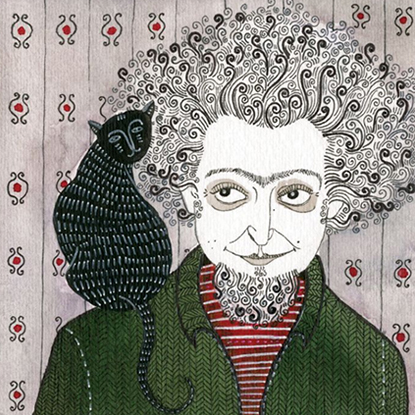
Yelena Bryksenkova, "La Chat Noir," 2009, drawing of Georges Perec (1937-1982), French author and master of the lipogram. See James Yood's column, left. |
|
|
 |
|
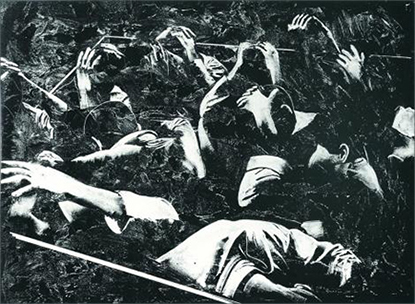
| Rafael Canogar, "Los prisioneros," 1969, color lithograph, 30 x 22"
© Rafael Canogar |
|
| “One Cannot Look: Graphic Wars”
Museum of Contemporary Art San Diego,
La Jolla, California
by G. James Daichendt |
|
| Continuing through November 29, 2015 |
|
| The intense graphic work of Spanish masters Francisco de Goya (1746-1828) and Rafael Canogar (b. 1935) collectively provoke feelings of loss, despair, and grief through depictions of past conflicts and wars in "One Cannot Look: Graphic Wars." Goya's iconic "Disasters of War" series was published long after his death, but its staying power since has diminished none of its impact. The confrontational works illustrate the consequences of bloodshed between Spain and Napoleon's France during the Peninsular War of 1808-14. These pieces show human limbs that are hung from trees and acts of violence so egregious it will cause… READ MORE |
|
 |
|
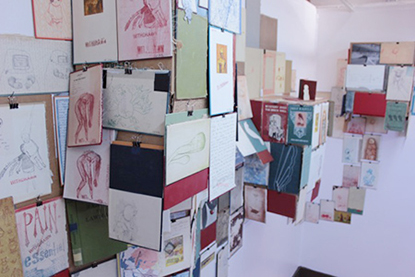
| Todd Christensen, "Observing the Withdrawn" (detail) 2015, installation |
|
| Todd Christensen
ART.i.factory Gallery, Santa Fe, New Mexico
by Jordan Eddy |
|
| Continuing through January 4, 2016 |
|
| "I've been forgetting a lot lately," writes Todd Christensen in a note scrawled on an old book cover. At the bottom of the makeshift diary page, some long-dead librarian has stamped the word WITHDRAWN in blood red ink. What Christensen lacks in his hippocampus, he makes up for in his actual attic. His new exhibition "Observing the Withdrawn" is spillover from his extensive collection of printed ephemera that is nailed together on the wall in an undulating flow. These books are jetsam from libraries and flotsam from rummage sales and thrift… READ MORE |
|
 |
|
| Thomas Gardiner
Blue Sky, Portland, Oregon
by Richard Speer |
|
| Continuing through November 29, 2015 |
|
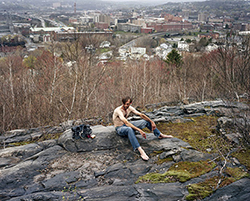
| It's hard to visualize how Americans and Canadians are seen by people in other parts of the world, but Thomas Gardiner's photographs come closer than most to giving us an idea. The works in two of the British Columbia-based artist's series, "Untitled USA" and "Western Canada," depict rapturous landscapes and David Lynchian small towns inhabited by everymen and eccentrics. Using 4x5 and 8x10 cameras, Gardiner traversed his native Saskatchewan and the… READ MORE |
|
| Left: Thomas Gardiner, "Untitled," 2008-11, inkjet print, 32 x 40"
© Thomas Gardiner |
|
 |
|
| Kelley Divine
Esperson Gallery, Houston, Texas
by Donna Tennant |
|
| Continuing through December 12, 2015 |
|
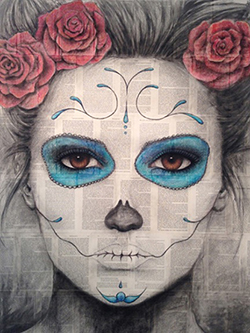
| Kelley Devine paints what she knows, so she often paints herself or people familiar to her. Most of the 28 pieces in the show are close-ups of faces using acrylic on canvas or charcoal over a ground created by affixing book pages to the surface. The pages are taken from a wide variety of texts, including "Guns, Germs and Steel," "Love and Survival" and "The Complete Stories of Flannery O'Connor." The words give the images an extra dimension, as though the subject's inner thoughts are visible. In most cases, the figure looks directly at us somewhat… READ MORE |
|
| Left: Kelley Divine, "Mirabella Memento en Color," charcoal, pastels on canvas with pages from How We Die by Sherwin B. Nuland |
|
 |
|
| Alexander Yulish
ACE Gallery, Beverly Hills, California
by Simone Kussatz |
|
| Continuing through November 29, 2015 |
|
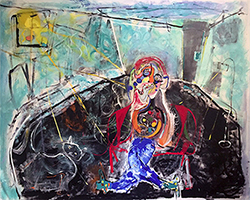
| Visiting Alexander Yulish's show "Immovable Thoughts" can be an overwhelming experience, but in a positive sense. People's inner lives as revealed in a public space is all too frequently trivial in focus or expression. The New York-born artist says, "Art is about intimacy. I use the brush like a blowtorch to melt away the surface and express what lies below," and he backs it up. Inspired by people and… READ MORE |
|
| Left: Alexander Yulish, "The Red Chair," 2015, acrylic on canvas, 96 x 120" |
|
| Visual Art Source (VAS) is the comprehensive online resource of critical discourse and information exclusively devoted to the contemporary and fine art world of the Western and Midwestern United States. ABOUT US. |
|
|
|
|
|