|
What Sales Can Tell You About Your Company's Health
 |
|
|
Kevin and Rita in Santa Cruz on assignment
|
In understanding where your company stands, sales may seem to be an obvious indicator. More sales means you are doing great, right?
Well... maybe. A solid grasp of where your sales are can tell you a lot about your company, but it requires a deeper dive than just looking at volume.
As the business leader, your most fundamental role is to build the value of the business, and value is increased in three areas as it relates to sales: new, renewal, and growth. At Arc, we divide revenue types into these three categories, and often recommend further tracking within each type by major customer category (such as large v. small, public v. private, and so on). This allows you to better see how effective sales channels are in each category, compare them to your plan, and identify areas may need investment or modification.
So what exactly do we mean by these categories?
-
Renewal
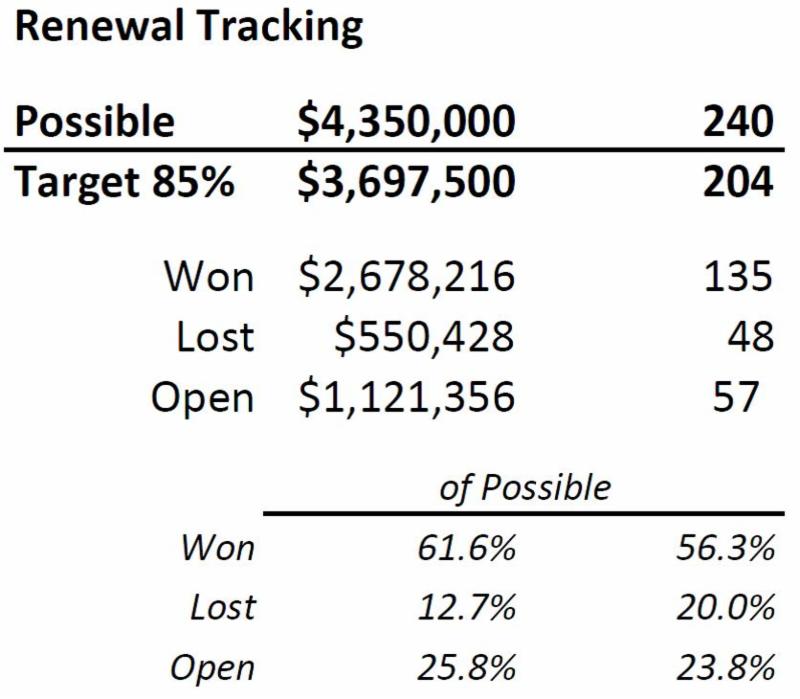
covers current customers renewing a contract. Here, you should measure percent of dollar volume AND number of deals against the potential of both numbers. It's completely fine to renew only 75 percent of your clients if they account for 90 percent of your revenue, as this shows your most valuable customers are renewing. The reverse ratio, however, would be cause for concern. In looking at potential, start with 100 percent of all clients, then deduct any that have pre-paid. What's left is your universe. As investors, we aren't looking for 100 percent renewal - we understand that sites close, personnel change, and things happen - but we do want to see that you know what happened to the ones that are lost. You can keep track of renewals in a simple chart like this:
-
Growth
covers current customers who are increasing their commitments, either through new sites or new product purchases. In addition to measuring total dollar volume and number of deals, also look at the potential for further growth, both in number of customers that grew, and in the average amount that accounts grew over the previous years. For example, if 20 of your 50 customers grew from $20k to $22k annually, that would be a 40% count and 10% average size increase.
Potential can also be tracked by account - by examining what percentage of sites are purchasing, and how much. For example, if an account has 50 sites that could each purchase $20k for a total potential of $1 million, and 10 sites are maxed out at $20k with another 10 purchasing at a $10k level, then you have reached 30 percent of potential. Accounts that fall in the 10 to 80 percent range of their potential are usually worthy of concentrated sales efforts.
By delving into your numbers a little further and categorizing them intelligently, looking at your sales offers you significant insight into the health of your business. If you're looking for more ways to understand where you're at, contact Arc to see how we can help.
|
|
|
|
Rita at the Drexel
Start-Up Fest with students |
Government Relations Update
The Clock is Ticking
Congress must come up with a government funding mechanism by December 8, and must also raise the debt ceiling.
DeVos Calls for 'Major Shift' in Higher Education
At the Wall Street Journal CEO Council in November, Secretary DeVos spoke of her support of a shift in higher education, away from an emphasis on four-year degrees to a greater focus on apprenticeships and other workforce training programs, as reported by
U.S. News & World Report
.
DeVos' Top K-12 Deputy Tells Chiefs to Innovate, But Comply With ESSA
Speaking at the Council of Chief State School officers annual policy conference in November, Jason Botel, the DOE's acting assistant secretary for elementary and secondary education, told state education chiefs the department intends to "strike a balance of encouraging innovation and assuring compliance with the letter of the law," according to EdWeek's
Politics K-12 blog
.
Education is a regulated industry. If you are selling at the federal or state level, you need to intimately understand the dynamics at work to be effective. For more on how Arc can help you navigate government relations at every level, contact
Rita@arccd.com
.
|
What We're Reading
|
|
|
Kevin at the Tippy Talk Investors Conference in Ireland (at the pub) |
Should Founders Be CEOs?
Investor Dinesh Moorjani explores
some of the reasons
it can be so hard for company founders to make the successful transition to being the CEO.
(Note: Must be logged into LinkedIn for article to load.)
Reach Capital Edtech Outlook 2017 Jennifer Carolan and Chian Gong share Reach Capital's Edtech Outlook, inventorying the trends from 2017 that are shaping edtech and showing what innovations may be on the horizon.
|
|
Upcoming Events
December
-
12/3: Education Entrepreneur Capstone Course at Penn Graduate School of Education, Philadelphia (Rita)
-
-
-
12/6-10: Company site visits, Limerick, Ireland (Kevin)
-
12/8-9: Kathy Hurley Christmas Retreat, Ft. Myers, FL (Rita)
-
12/18-19: Client workshop, Boston (Rita & Kevin)
|
|
What Arc is Looking for Now
Arc is looking to work with a few select growing education technology companies in an advisory, board or coaching role. More than 80 percent of the companies that have worked with Arc received an external capital infusion or acquisition offers within a year. Arc will also consider a few investment opportunities. If you know of a company positioned for strategic growth, please let us know.
Finally, because education is a regulated industry, education companies need to incorporate a government relations plan in order to optimize revenue. Arc's strong government and grassroots relationships, education industry expertise and business acumen allow for successful advocacy at both the federal and state levels. Check out our Web site at
www.arccd.com or e-mail us at
info@arccd.com.
|
|
|