|
Highlights of the study:
- This study establishes the ability to create mice with a humanized immune system on either an NSG, IL15 NSG or SGM3 NSG background.
- Mice from the IL15 NSG background can generate mice with differentiated and active natural killer cells.
- Mice from the SGM3 NSG background can generate differentiated and active cells of the myeloid lineage, but at low abundance.
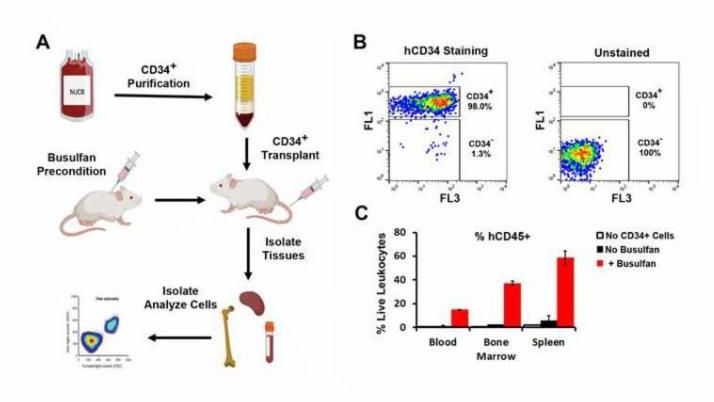
Humanized mouse models have improved biomedical research by providing a tractable system with which to perform in vivo experiments on human tissues. Use of irradiators is the standard method for establishing high levels of stem cell engraftment, however not all institutes have access to this instrumentation in the animal facility. The use of busulfan has been successfully used to precondition for stem cell engraftment on a limited number of mouse backgrounds. In this report we further test the utility of busulfan to successfully engraft hIL15-Tg-NSG and SGM3-NSG mouse stains which are capable of establishing the innate NK cell and myeloid immune compartments. Results from our studies show that busulfan can successfully precondition hIL15-Tg-NSG mice but not SGM3-NSG mice for high levels of human immune cell engraftment. SGM3-NSG mice preconditioned with busulfan exhibited only 10-20% human CD45 cells in the bone marrow or spleen, where as NSG and hIL15-Tg-NSG mice routinely achieved ∼80%. Busulfan preconditioned SGM3-NSG mice showed elevated levels of granulocytic MDSC, and cDC1 and cDC2 myeloid populations. This is in contrast with hIL15-TG-NSG which showed robust reconstitution of mature CD16 expressing NK cells. We conclude from our studies that busulfan is an effective means to precondition mice for CD34+ stem cell engraftment, but it may have limitations when used to precondition the SGM3-NSG model.
This work was supported by seed money from VCU OVPRI, Massey Cancer Center and the VCU SOM (JWL).
Publication:
Alhawiti O, Hu B, Koblinski J, Guo C, Landry J.W. (2022) Limitations of Busulfan to Create Humanize Mice with an Innate Immune System. BioRxIV, doi: https://doi.org/10.1101/2022.07.15.500220
https://www.biorxiv.org/content/10.1101/2022.07.15.500220v1
Funding:
The technology of humanized mice at VCU was recently used to generate several preliminary data sets which were used in several grant applications to the DoD, and NIH. As a result of these efforts several grants were recently scored in the fundable range and are awaiting funding from the NIH.
Title: Development of Mouse and Humanized Models to Study Sex Disparities in NSCLC Tumor Progression and Treatment
Sponsor: NIH/NCI – R21
Title: Enhancing Tumor Cell Immunogenicity using Improved Molecules Targeting Chromatin Remodeling
Sponsor: NIH/NCI – R21
Title: Modulating growth, progression and metastasis in breast cancer by inhibiting MDA-9.
Sponsor: NIH/NCI – R01
About the Investigators: Joseph W. Landry is an associate professor in the Department of Human and Molecular Genetics, a full member of the Massey Comprehensive Cancer Center and the VIMM. Chunqing Guo is an assistant professor in the Department of Human and Molecular Genetics, a member of the Massey Cancer Center and the VIMM. Bin Hu is core manager of the Cancer Mouse Models Shared Resource of the Massey Comprehensive Cancer Center. Jennifer Koblinski is an associate professor in the Department of Pathology, Full Member of the Massey Cancer Center, Director Cancer Mouse Models Core, and Co-Director Tissue and Data Acquisition and Analysis Core.
|