|
|
We are proud that this is our most diverse newsletter yet! Disciplines of beef, equine, small ruminant, dairy, poultry, and Ag Economics have been incorporated. We will continue to broaden the scope and subject matter of the newsletter as needed or requested. As such, feel free to contact any of the authors for more information or to suggest a column for a future newsletter!
|
|
Announcements
National Mastitis Council Meeting
Boise ID
July 19-20, 2017
The current NMC statement regarding the upcoming summer meeting in Boise
:
"Milk quality experts from the Northwest invite you to attend this year's National Mastitis Council (NMC) Regional Meeting July 19-20 at The Grove Hotel in Boise, Idaho. July 19 features a variety of interactive short courses and dairy farm and meat packing plant tours. On July 20 during the general session, presenters will address milk quality as it relates to parlor throughput, automatic milking systems, organic dairy production, contagious mastitis and beef carcass quality.
'The overall aim of the regional meeting is to help dairy producers produce and market higher quality milk,' said Allan Britten of Udder Health Systems, Meridian, ID, and chair of this year's regional meeting.
This year's regional meeting program is targeted toward mastitis/milk quality specialists, dairy producers and their employees, veterinarians, researchers, extension specialists and students who have an interest in high quality milk production. NMC is a Registry of Approved Continuing Education (RACE) provider. Thus, veterinarians attending the meeting can earn continuing education (CE) credits. Additionally, conference attendees can earn American Registry of Professional Animal Scientists (ARPAS) CE credits."
Hopefully many members of our dairy industry can attend this meeting, especially considering that it is so relatively close in our part of the country. Mark your calendars now.
Text Link
|
Beef Species
Is a More Expensive Bull Always a Better Bull?
Dr. Matthew Garcia
matthew.garcia@usu.edu
435-797-2144
Why do Some Bulls Cost More than Others?
There has always been a question if bull sale price is directly correlated to bull quality and the answer is.........possibly. There are many reasons that bulls sell at various prices at various auctions. Factors such as number of buyers at an auction, time of year when buying bulls and number of bulls available. However, a major factor that has historically contributed to bull price is the reputation of the breeder. A breeder with a proven track record of producing bulls that are productive, and produce highly productive offspring will usually fetch a higher price for their bulls. Another factor that can contribute to a high selling bull price is that the bull has performance characteristics that are extremely good and widely applicable. Typically these types of bulls have such a high sale price because potential buyers recognized that particular bull had the ability to make dramatic improvements to multiple populations and he has a future as an AI sire. The buyers in this situation are most likely betting on their ability to recoup the sales cost through the sale of semen and breeding stock from that individual. However, that does not mean that particular bull has the same perceived value across the industry. Due to the extreme diversity of the beef industry there may be producers that would never use that bull in their herds and do not see the same value as the individuals that paid and exorbitant amount for that bull.
Factors to Consider when Determining Bull Value
A bulls value and acceptable purchase price to the average cowman/woman should be dictated by a number of factors. The first factor is how compatible to your genetic base is the bull. This is a major factor as the bulls compatibility is going to be directly correlated to the types of calves that are produced and subsequent improvement in your herd. Furthermore, the bulls ability to produce calves that improve your herd also allows the producer to recoup the cost of purchasing the bull through produced calves and increased performance. A second factor is how available and what is the demand for the type of bull you believe is optimal for your operation? This factor is variable as there is always competition at auctions for bulls, but there are ways you can assist yourself in identifying the bull you need in these situations as will be discussed later in this article. The last major factor is when you are buying the bull. This may seem minor as most bull sales are pretty concentrated around a specific time of year. However, if you are desperate for a bull and you're at the last auction of the year, you are most likely not the only one needing a bull. As such you may be competing with others that HAVE to get a bull and you may end up paying more for a bull that you don't necessarily value that highly.
Summary
So back to the original question does sale price correlate to quality or does a producer need to pay a lot more than they anticipated to get a bull that will improve their herds? Once again the answer is maybe. There are a number good buying strategies for producers to employ in order to decrease the probability of paying more than anticipated for a bull. The first is to identify a number of sales that are marketing bulls that have ALL the characteristics that are needed for a bull to produce optimal calves in your operation. The second is identify and rank multiple bulls from each sale that have ALL the traits that are important to your operation. This strategy allows a producer some flexibility to identify multiple bulls that would fit and to critically evaluate the market for that type of bull so that they have a better idea of what it would cost to purchase a bull of that quality. Essentially, if you identify multiple bulls from multiple sales that fit your production scheme, can improve your herd, you increase the probability of purchasing a bull that is compatible with both your pocketbook and your production goals.
|
|
Equine Species
Equine Disease Prevention
Dr. Karl Hoopes
karl.hoopes@usu.edu
435-535-5140
Equine vaccinations have been and are one step we have to prevent disease in our horses. Remember to always consult with your veterinarian and strictly follow label direction before administering any vaccination.
First, when is the best time to vaccinate horses? The answer can vary depending on what diseases we are vaccinating against and how they spread from horse to horse. Typically, it takes 3 - 4 weeks for a horse to mount a good immune response after a vaccination booster. If it is the horse's first vaccination, depending on age, one or two boosters must follow the initial dose at 4 - 6 week intervals to provide an appropriate immune response. We also must think about when our horse is most likely to be exposed to the diseases in question.
With that in mind, the American Association of Equine Practitioners has listed the following vaccines as core vaccines that all horses should receive on a yearly basis: Tetanus, Eastern and Western Equine Encephalitis (EEE/WEE), West Nile Virus(WNV), and Rabies (for public health aspect). Vaccines for EEE/WEE and WNV should be administer 3 - 4 weeks before the onset of mosquito season for previously vaccinated horses, or 6 - 8 weeks if it is the horse's first time being vaccinated and a booster is required. Tetanus and Rabies are not spread by mosquitos but can be given at the same time to provide continuity. Many of these vaccines can be administered in a combination shot to prevent making horses needle shy with too many shots. Brood mares should be vaccinated about 6 - 8 weeks prior to foaling to allow for protective antibodies to be put in the colostrum for foals.
Risk-based vaccines are also important. These vaccines are used depending on your horse's likelihood of coming into contact with the causative agent. They consist of Equine Herpesvirus (Equine Rhinopneumonitis), Equine Influenza, Equine Viral Arteritis, Strangles, Potomac Horse Fever, Rattle Snake, and others. Please contact your veterinarian to discuss your horses needs and when to vaccinate. If your horses stay in their own group and never mix or come into contact with other horses, then the risk of being exposed to the diseases is small. If you are going to shows, rodeos, 4-H, or other events where horses are co-mingled, then the risk being exposed to the diseases is higher. Vaccination should be given 3 - 4 weeks before the event to allow for a good immune response to occur.
In addition to vaccinating our horses, good biosecurity practices will also help prevent disease spread. Recently we have seen Strangles outbreaks occurring in our neighboring states of Nevada and Colorado. Strangles is an upper respiratory infection that leads to swollen lymph nodes in the horse's throat area or near the ears. As we attend equine events we should keep in mind a few important practices. Never take a sick horse to an event. If they have snotty noses, coughing, fever, or off feed leave them and any stable mates at home. Do not allow horses to come into direct contact with other horses. Avoid indirect contact by not sharing tack, feed equipment, water buckets, tie rails, or allowing individuals to pet your horse. Hand sanitizers and disinfectant wipes work well against these bacteria and greatly help in lowering the bacterial load. And finally, if new horses are brought into the herd, quarantine them for about 14 days.
The old adage "an ounce of protection with worth a pound of cure" is extremely accurate when preventing equine disease. Vaccinations and good biosecurity go a long way in securing the health of our horses.
|
Applied Ag Economics
Monitoring Asset Values in 2017
Dr. Ryan Larsen
ryan.larsen@usu.edu
435-535-0784
The farm crisis of the 1980's forced lending practices to change. Prior to the farm crisis, lender's relied heavily on asset values to justify granting credit. The drastic reduction in farmland values highlighted the danger of relying solely on assets. After the farm crisis, lenders began using cash flow based financial measures to justify loan decisions. Although lenders rely upon cash flow measures to justify loans, they also rely heavily upon the balance sheet, specifically agricultural assets to provide security and strength to loan decisions.
Agricultural related assets complicate the standard accounting definitions. Traditionally assets are grouped into two categories: current and long term assets. The categorization of assets is based on how quickly an asset can be converted to cash. Crop inventory and market livestock for example are current assets because they can be sold and converted to cash quickly. Land on the other hand, would take some time to convert to cash so logically it is considered to be a long term asset. Many agricultural assets fall in between these two types so a third type, intermediate assets, is often used. Intermediate assets are considered to be those assets that have a life of 3-10 years. Machinery, breeding stock, and other equipment are placed in this category.
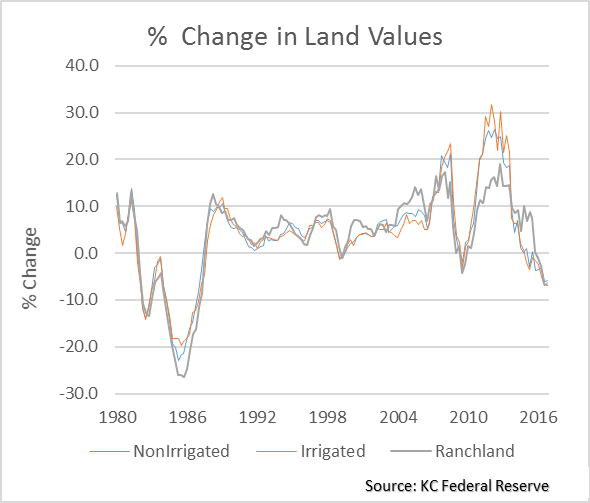
The recent boom in land values and subsequent drop in commodity prices have many worried about the impacts of falling farmland values. Land value data coming from the Kansas City Federal Reserve show that land prices have leveled off in 2013-2014 and recently are showing a slight reduction in price. Many farmers and lenders are concerned about duplicating the 1980's farm crisis because of potential declines in farmland values. Perhaps we should be just as concerned with the impact of falling intermediate asset prices.
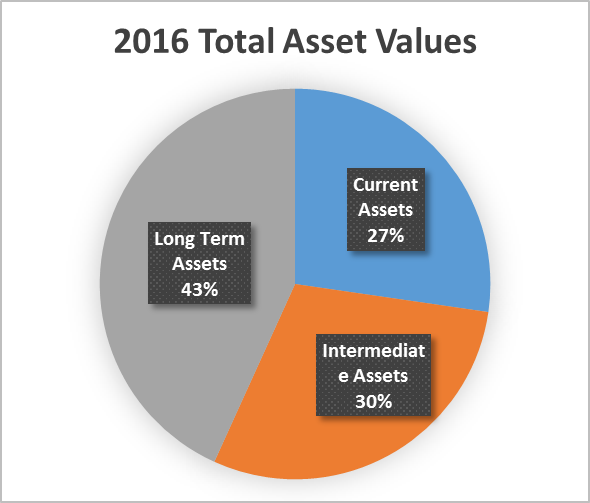
Intermediate assets make up roughly 30% of total asset values. Intermediate assets have grown from $335,576 in 2007 to $603,917 in 2016. This is a change of close to 80%. Recent machinery sales data reveals that on average there has been a 16% reduction in sales price of farm machinery over the past year. Recent reports show that this may be a conservative estimate of the reduction in machinery values. The reduction in cattle prices reduces the value of breeding stock and causes more downward pressure on intermediate asset values.
Farmers, ranchers, and lenders must monitor farmland, current asset values such as crop inventory and market livestock, value of breeding stock, and machinery values in 2017. Low commodity prices are going to make it difficult for many farmers to have a positive cash flow in 2017. Lenders are going to have to use the strength of the farmer's balance sheet to help support the loan justification. Throughout 2017, if necessary, the balance sheet should be adjusted to capture the most recent asset values and provide a more accurate picture of the strength of the balance sheet.
|
|
|
|
Small Ruminant
"RingWomb"
Dr. Lyle McNeal
lyle.mcneal@usu.edu
435-797-2140
As the spring lambing season approaches a higher intensity for our Utah and Regional commercial range sheep operations, the lambing crews must also be on the watch for a primary genetic problem that hasn't gone away yet. That being a serious dystocia problem caused by a condition called 'ringwomb'.
Cause:
Ringwomb is a situation where the cervix fails to dilate normally during the birthing process. It is much more common in sheep than it is in goats. This problem is considered to be a genetic defect, and all animals that experience this problem should be culled. Sometimes a ringwomb situation can occur if a fetus fails to enter the birth canal and stimulate the cervix to dilate.
Diagnosis:
This problem is often suspected when a ewe is in obvious labor, but no progress is made. A diagnosis is made by inserting a lubricated, sterile, gloved hand, when possible, into the vagina and finding a tight ring of cervical tissue that has failed to dilate.
Treatment and Prevention:
There are three primary ways to deal with a ringwomb problem:
1. Try to manually stimulate the cervix to dilate. This can sometimes be accomplished by inserting ones fingers into the animal's cervix. Always use a sterile, gloved hand and plenty of lubrication. Then insert more and more of the hand and fist. It can also help to pull one or both of the feet of the lamb/kid into the cervix. This can be tried for the first 45 minutes, while a veterinarian is on his/her way. If no progress is made, then options #2 and 3 must be considered. When recommended by a veterinarian or when experience dictates, oxytocin is sometimes given to help the ewe/doe have good uterine contractions that can help dilate the cervix. Extreme care should be exercised when using oxytocin; because of the added strength it gives to the contractions, tearing and rupture of the uterus and undilated cervix can result.
2. Ideally, a Cesarean section is the best and safest procedure for the lamb/kid and mother. This should be done early in the progression of the problem, when the lambs/kids are still alive and have the best chance for survival.
3. A third option is to cut part of the thick band that restricts the cervix. This is normally done at either the 12 o'clock or 6 o'clock position with the ewe/doe standing. To do this, snip the tight band at the dorsal midline (top, middle) area of cervix, or rupture it manually with a finger (this can be difficult). Only rupture enough so that the cervix relaxes and expands enough to give birth. In some cases, a large portion of the band may need to be cut. The ewe/doe will bleed and is very susceptible to infection and other problems. In many cases, it is best to euthanize the ewe/doe after this procedure. If the ewe/doe can be humanely kept alive, treatment with antibiotics and tetanus boosters or antitoxin (in animals that have not been vaccinated) is a must. This procedure should be reserved as a "last ditch effort" to save any viable lambs/kids.
As mentioned previously, the most common method of preventing this problem in the future is to cull all animals (mothers and offspring) involved with the ringwomb problem, regardless of age. Ringwomb is a highly heritable genetic fault, and can be transmitted to offspring. I sincerely hope that this problem can be reduced via artificial selection, especially with our ram and billy producers. Reducing the incidence of ringwomb will also help our lambing percentages increase over the current USDA National figures of 1.02 lambs per ewe.
|
|
|
Poultry Species
Reading a Poultry Feed Tag
Dr. David Frame
david.frame.usu.edu
435-851-2233
Being able to read and understand what is on a feed tag is helpful in interpreting how to use the product. Poultry feed now comes in a myriad of brightly colored bags and containers to attract the attention of would-be buyers. No matter how convincing the packaging, keep in mind that what's actually in the bag is the important thing.
Feed tags typically come with the following information:
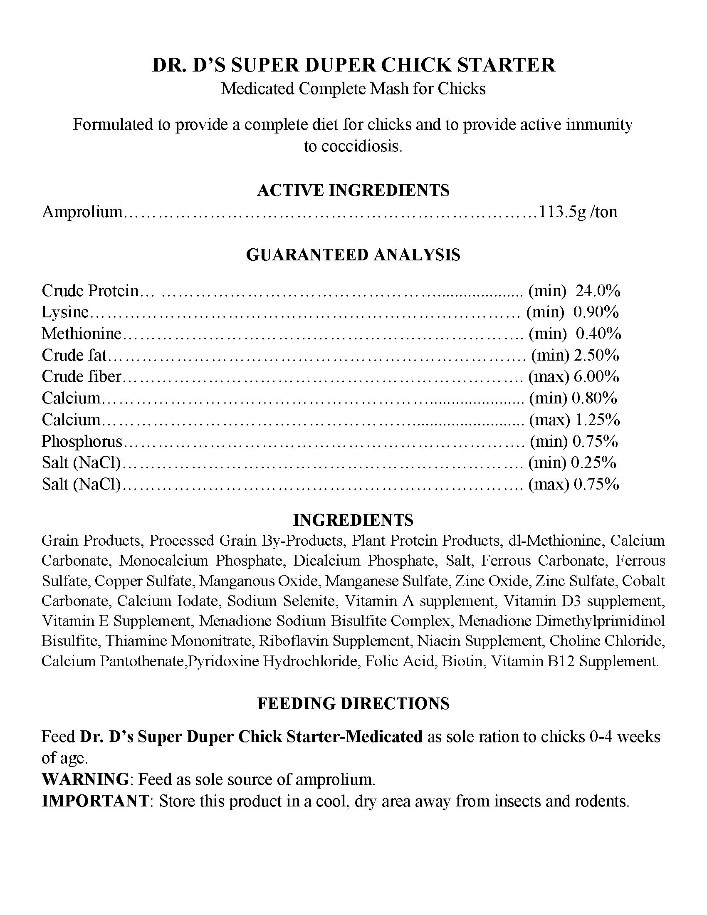
1. Name of product (e.g., in Figure 1, "Dr. D's Super Duper Chick Starter")
2. Statement of purpose (i.e., what is its intended use?)
3. Active ingredients, if any. These are typically antibiotics and/or coccidiostats.
4.
Guaranteed analysis. This section gives information of minimum and/or maximum levels of key nutritional components. Although percent total protein will sometimes suggest the class of poultry for which Figure 1. Example of a poultry feed tag.
the feed is intended, it does not give the total story. It is especially useful if the tag contains information on the methionine and lysine content, as these are crucial indispensable amino acid protein building blocks necessary for optimal growth and performance. The amount of calcium contained in the feed is important in determining if it should be fed only to hens in active egg production.
5.
Ingredients. This section lists the specific ingredients or class of ingredients used in formulating the feed. In some respects, it is somewhat "vague," but this gives the manufacturer the leeway to mix to specific formulations and least-cost depending on availability of ingredients.
6. Feeding directions
. This information should be strictly followed for both lawful and optimal performance.
7.
Warnings and other important information. This section contains information on how to use, or not to use, this product.
8
. Manufacture's contact information is included somewhere on the tag - often at the bottom.
In summary, information on the feed tag will allow you to better understand how the product in the bag is to be properly used. Following those directions will help ensure happy and healthy chickens. Although no intention has been made in this brief article to explain the implications of information on a tag, it is suggested you visit with your county agent or Extension poultry specialist if you have questions about specific interpretation.
Text Link
|
|
|
|
Dairy Species
Paying Attention to Heat Stress in Dry Cows
Dr. Allen Young
allen.young@usu.edu
435-797-3763
After having gone through a hard winter, seeing the sun is a welcome relief. However, it won't be long until the sun will start to have negative effects on dairy cows. Everyone knows about heat stress in lactating dairy cows; decreased dry matter intake and milk production are just two of the problems. However, they aren't the only group of animals on the dairy that have problems with heat stress. The one group that probably needs it the most, but seldom is considered, are the dry cows. Over the past several years, a large amount of research has been devoted to determining the impact of heat stress on dry cows. The results may surprise you.
First, dry cows that are heat stressed (THI greater than 68) have decreased milk production of 8 to 10 lb milk/day in the subsequent lactation compared with those that were cooled during this same time period (Florida data). At $18/cwt milk, that amounts to over $500/cow. You are probably thinking that it doesn't happen here in Utah. Researchers from Florida estimated the impact of heat stress in dry cows for the top 25 dairy-producing states. Utah was 5th from the bottom in terms of potential heat stress, but they still estimated that the impact was over 600 lb milk loss per cow (almost $10 million state-wide). This decreased production compared with cooled cows continued over the whole lactation and never caught-up. These animals also had decreased immune function and were more susceptible to disease. Reproductive performance was impaired and cows required more services per pregnancy and, subsequently, longer days to pregnancy. In short, heat abatement pays in this group of animals.
Dry cows are dry because they are pregnant. What effect does heat stress have on the calf born to those cows? Again, the research is very clear that calves born to heat stressed dams weigh less than calves born to cows cooled during the dry period. This decreased weight remained through at least 12 months of age, and probably longer. These calves absorb fewer immunoglobulins from the same milk compared with calves from cooled dams. They also got sick more often and fewer completed a first lactation. Those heat stressed calves that had a lactation produced less milk (10 lb/d; Florida data). In short, the effects are long-lasting.
How do you know if your cows are heat stressed? The simplest way is to count the respiration rate for a small group of cows. If it is over 60 breaths per minute, then they are heat stressed. Should you invest in heat abatement for this group? Absolutely. It makes economic sense. For our area, shade, fans and misters/soakers would be the best investment. Shade alone doesn't seem to cool these cows enough. Finally, don't overstock dry cow pens.
This overlooked group of heat stressed animals can have large economic consequences on your dairy. It is money well-spent to provide additional comfort during this time period.
Text Link
|
|
Copyright
© 2016. All rights reserved. Utah State University Extension.
Utah State University is an affirmative action/equal opportunity institution.
|
|
|
|
|
|