 |
|
|
|
|
The Economist
Publishes Major Piece
Reprinted with Permission from the State Legislators' Article V Caucus Newsletter- Edition 57, October 2017
|
|
|
Reporters from the London-based
The Economist magazine were in Phoenix during the recent Phoenix Convention. Surprisingly this primarily-financial foreign publication has taken more serious interest in Article V than most major US media.
On September 30
Economist.com published an extensive piece on the entire Article V movement in the US. While the second paragraph was a bit jumbled (initially implying that founding Father George Mason did not like the two-option approach to Constitutional amendment... the approach he actually proposed and which was unanimously adopted), the detailed article is a mostly accurate overview of Article V.
Toward the end of the article it unfortunately repeats the misinformation about the 1787 Philadelphia convention... suggesting that the Constitutional framers were working under the authority of the original Articles of Confederation, and (without authority) changed the requirements for ratification. Using that example the story says,
"Delegates could simply declare a new, lower threshold for ratification."
As most serious Constitutional scholars know, the framers were not working under the Articles of Confederation, but were complying with the direction of the state legislatures which called the Philadelphia convention... producing a new governing document for a totally new national government.
Within the context of this misrepresentation of the origins of America's 1787 Constitution, the Economist quoted Larry Greenley of the John Birch Society, saying of an Article V convention,
"This is a convention that creates constitutions. It's a level above state legislatures, and can't be limited. We really believe that any Article V convention would have the ability to change the ratification process."
Of course there is no provision in Article V for re-writing or "creating" a new Constitution... only to propose amendments. Period. Read the Economist article
HERE .
The entire newsletter from which the above article was reprinted can be found
HERE.
|
|
|
Robert Natelson Responds to Economist Article With Letter to the Editor
|
|
The Economist | Letters to the Editor
October 14, 2017
Checks and balances
I read your briefing on the possibility of calling a convention for proposing constitutional amendments in America ("
Conventional follies", September 30th). A "convention for proposing amendments", as prescribed by the constitution, is neither a "constitutional convention", nor is it dangerous. It is a limited-purpose, temporary assembly with no governmental authority. It is subject to law and judicial review. The amendment procedure, including the convention for proposing amendments, is in Article V of the constitution. A long line of legal cases, from 1798 into the 21st century, has fixed the legal principles governing Article V. In general, those principles derived from historical practice governing legislatures and conventions.
The assertion that "there is absolutely no force that can override what the convention does" is nonsense on stilts. The interpretation you cited of Coleman v Miller in 1939 has been rejected repeatedly by state and federal courts.
In addition to judicial review, a convention is subject to further constraint. As a convention of the states, its delegations are subject to state legislative instruction and recall. If the convention makes an unauthorised proposal, Congress can refuse to select a "mode of ratification" for it.
Your characterisation of the 1787 constitutional convention was also partly inaccurate. It was not bound by the Articles of Confederation, because it was called by Virginia and held under the states' reserved powers. By contrast, a convention for proposing amendments would be held, as James Madison observed, "pursuant to the forms of the constitution" and therefore subject to constitutional constraints.
Peddling imaginary fears to persuade Americans to ignore a crucial check on power is like telling the president not to veto an obnoxious bill because his pen might explode.
ROBERT NATELSON
Director
Article V Information Centre
Denver
|
|
|
The Unbroken Streak- Sixty Years of Increasing the National Debt
By Mae James
|
|
|
The last sixty years of American politics have produced a wide-ranging and interesting cast of characters. Conservatives, moderates, and progressives have all seen their standard-bearers behind the bully pulpit. However, whether the president was JFK inspiring the country to unimagined heights, or Ronald Reagan ushering in a new "morning in America," every administration since Dwight Eisenhower has produced a common legacy: an increasing national debt.
"The last fiscal year in which the federal debt declined was fiscal 1957. In that year, according to the Treasury, the total federal debt dropped from $272,750,813,649.32 at the close of fiscal 1956 to $270,527,171,896.43 at the close of fiscal 1957. But, in fiscal 1958, the debt climbed to $276,343,217,745.81-and in every fiscal since then, it has finished each fiscal year higher than it started that fiscal year."
To their credit, President Clinton and the Republican-controlled Congress did pass balanced budgets which created surpluses from fiscal 1998 through 2001. However, this did not result in a single year of decrease in the national debt. According to Rick Manning in an
article in NetRightDaily, "The reason for the confusion is that the reported budget deficit/surplus does not take into account new debt being incurred by the Social Security and Medicare Trust Funds and other government loan programs. So, when the budget appeared to have gone down by $69 billion in 1998, the national debt increased by $109 billion..."
For sixty years, neither Democratic nor Republican leadership has been able to push back against the monstrous growth of public debt in Washington. During the Obama administration alone, the debt grew "by about $9 trillion, or an increase of 86%," according to
Bob Bryan in Business Insider, and President Trump shows no sign of reversing the pattern of increasing deficits and debt. It is safe to conclude, after this lifetime of overspending, that Washington will not restrain itself.
Under Article V of the Constitution, however, the collective states do have a mechanism to propose a balanced budget amendment which could rein in future deficit spending. Requirements for the use of this method are so strenuous that it has never been successfully implemented, but never in American history has the danger of the unchecked power of the purse been so great. After 60 uninterrupted years of escalating debt, it is time for the states to play their constitutional role as a check on this federal abuse of power.
Mae James is the Director of Communications for the Balanced Budget Amendment Task Force.
|
Let's Make the Article V BBA a Reality!
The time has come for an Article V BBA. Common sense dictates this solution, the Constitution provides the means, and responsible leadership from the states support it. However, the opposition is determined to fight our efforts by playing on the fears of those unfamiliar with the legitimacy, precedent and protections inherent in the Article V convention process. We need your partnership in fighting the misinformation and in demonstrating support for an Article V BBA. Thank you for considering taking part in this important work to restore America's economic future.
DONATE TODAY
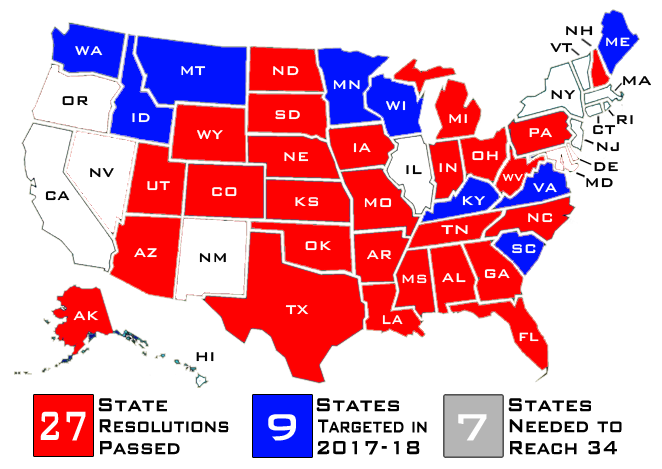
The BBA Task Force, a 501(c)(4) non-profit, non-  partisan organization, was founded to help facilitate the proposal and ratification of a balanced budget amendment to the U.S. Constitution. We have 27 of the 34 state resolutions necessary to call an Article V Convention for the limited purpose of proposing a Balanced Budget Amendment. We also have legislative sponsors in 9 additional states, which puts us within striking range of the needed 34!
To help us with a financial gift, please click on the donate button to contribute online, or mail your donation to: Balanced Budget Amendment Task Force, 2740 SW Martin Downs Blvd. #235, Palm City, FL 34990. (Donations are not tax-deductible.)
VOLUNTEER TODAY 
To help us by donating your time and effort, please click on the volunteer button. We need grassroots activists in our target states to call, email, and visit their state legislators. If you live in one of the 9 blue states below or would be willing to lobby in a target state, we would love to have your help.
|
|
|
|