Upcoming CEILS Programming - Join us! | | |
|
Are you a UCLA Early Career Faculty in the Sciences? We invite you to join our
Learning Community on Teaching at UCLA
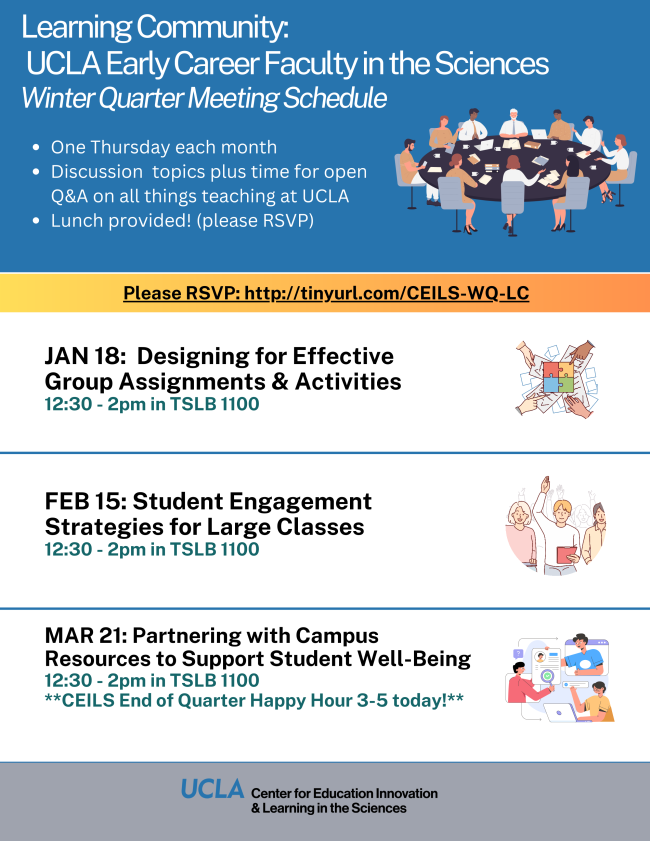
The CEILS team invites you to carve out a little time - one lunch each month - to gather in community and get support from each other on all things related to teaching here at UCLA. This community is designed to support early career faculty across disciplines in the sciences who have joined UCLA within the past 5 years.
All meetings take place on Thursdays, in Terasaki Life Sciences Building 1100 from 12:30 - 2pm. Lunch will be provided. Based on the feedback and discussion from the end of fall quarter, the topics this winter will include:
- January 18: Designing for Effective Group Assignments & Activities
- February 15: Student Engagement Strategies for Large Classes
- March 21: Partnering with Campus Resources to Support Student Well-Being
Please kindly RSVP to let us know which sessions you will be able to attend (so we can order the right amount of food - yum!). Contact jessgregg@ceils.ucla.edu with any questions. Hope you can join!
| |
|
Save the Dates for Winter Quarter
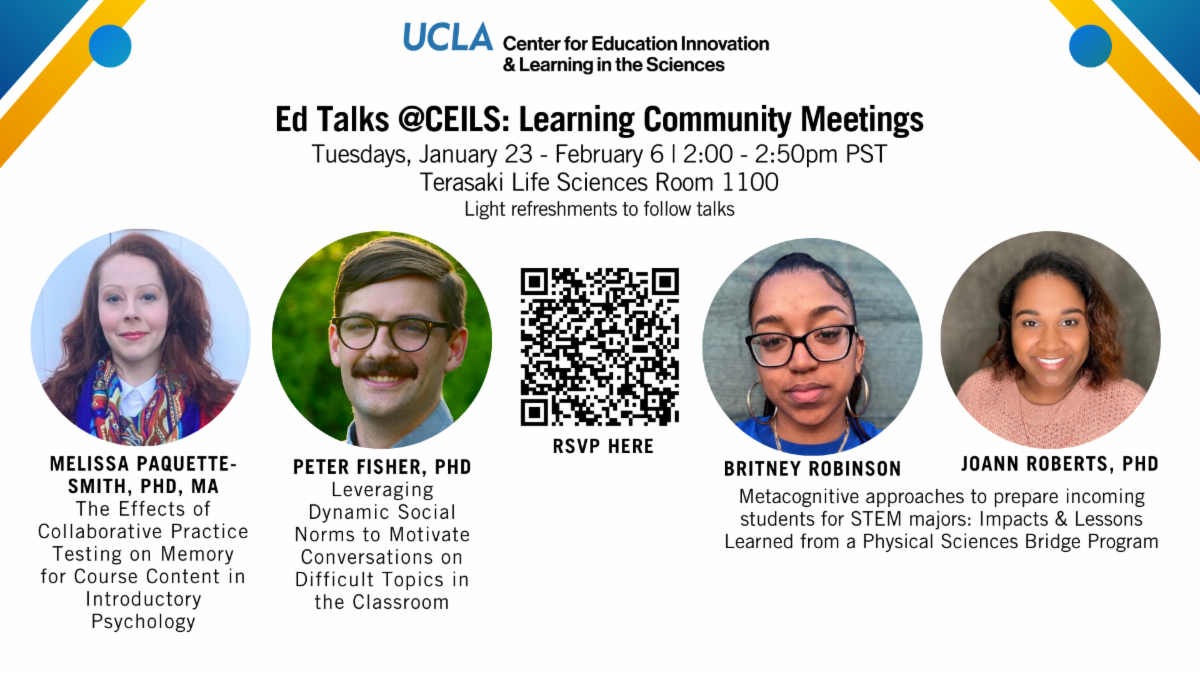
Ed Talks @CEILS: Learning Community Meetings!
| |
-
Jan 23: Melissa Paquette-Smith, Assistant Teaching Professor, UCLA Department of Psychology: The Effects of Collaborative Practice Testing on Memory for Course Content in Introductory Psychology
-
Jan 30: Peter Fisher, PhD graduate, Social Psychology, UCLA: Leveraging Dynamic Social Norms to Motivate Conversations on Difficult Topics in the Classroom
-
Feb 6: Britney Robinson (Diversity, Equity, and Inclusion Coordinator, UCLA Physical Sciences Division) & JoAnn Roberts (Associate Director for JEDI in Teaching, CEILS): Metacognitive approaches to prepare incoming students for STEM majors: Impacts & Lessons Learned from a Physical Sciences Bridge Program
| |
|
Annual Winter BAAE Conversation Series
The CEILS Becoming an Anti-racist Educator (B.A.A.E) Conversations encourages honest and vulnerable dialogue with faculty, postdocs, and graduate students around the unpracticed conversations about race and racism. These in-person conversations create space for discussion of one’s own racial identity development, understanding the implications of our racial identities and other social identities in our academic learning environments (e.g., classroom, clinic/laboratory, meetings etc.), and action planning. Overall, the goal is to cultivate an environment and practice that celebrates identity and culture while still identifying and working together against inequitable systems.
The series will be on the following Tuesdays from 12:30 - 1:30 pm: February 6, 13, and 20. We will have light refreshments, but please feel free to bring your lunch!
The topics for each session are as follows. Please visit our website for more information.
-
Session 1: Exploring Identity, Privilege, & Culture
-
Session 2: Taking Anti-racist Action: Interrupting Microaggressions
-
Session 3: Taking Anti-racist Action: From Inclusive to Anti-racist pedagogy
IMPORTANT: Session 1 participation is required to attend either Session 2 or 3.
| |
|
January 16th - National Day of Racial Healing
CEILS invites you to participate in a National Day of Racial Healing on Tuesday, January 16th, 2024 by engaging in a Conocimiento (translation=knowledge/”to get to know”), a two- or three-person conversation with a question prompt that helps folks get to know each other. It’s a conversation about people, about humanity, about us!
The National Day of Racial Healing was launched in 2017 by the W.K. Kellogg Foundation as part of its Truth, Racial Healing and Transformation (TRHT) effort, a national and community-based process to plan for, and bring about, transformational and sustainable change.
How can you participate?
Keep it simple, but intentional. With your lab group, department, action committee, workout group, happy hour etc., share a meal (brown bag or sponsored) and be in community using conversation prompts you can find at the link below, along with a few additional resources you can explore.
Click HERE for conversation prompts and more information.
| |
Featured Resources: Teaching in the Era of AI | | |
|
UCLA Guidance on Generative AI in Teaching and Learning: Students and instructors are embracing artificial intelligence (AI) technologies across disciplines for different learning goals. There is no one-size-fits-all best practice for their use. This document is meant as a guideline for instructors on what to consider as these tools evolve. We will provide strategies for adopting AI technologies in a responsible, ethical manner, and innovating within each discipline, major, and course. Exploring and communicating about the opportunities and limitations to using these tools will allow instructors and students to critically think about how knowledge is created.
| |
Example Syllabi Language and Activity Ideas: View this collaborative Google Doc: AI Examples and Resources to see examples and resources curated by UCLA’s teaching and learning community. This includes syllabus language, assignment ideas, and other strategies shared by instructors from UCLA and across the US. | |
|
Resource: ACUE's 10 Tips on Teaching with AI in Higher Education by Stephanie Speicher, Digital Fluency Faculty in Residence, from Weber State University. The 10 points in this informative blog post contain a question and answer, an example, and a human-centered tip to help you put the concepts into practice in your class.
| |
Change theory has increasingly become an area of scholarship in STEM education. While this area has traditionally been a topic for organizational psychology, business management, communication studies, and higher education, STEM education researchers are increasingly aware of the need to use formal theories to guide change efforts and research. | |
Active learning approaches to biology teaching, including simulation-based activities, are known to enhance student learning, especially of higher-order skills; nonetheless, there are still many open questions about what features of an activity promote optimal learning. | |
|
NSF Issues Notice on Generative AI Usage in Proposals
NSF has released its policy on generative AI usage in proposal preparation and peer review processes. Proposers are encouraged to indicate in the project description the extent to which, if any, generative AI technology was used and how it was used to develop their proposal. NSF reviewers are prohibited from uploading any content from proposals, review information and related records to non-approved generative AI tools.
| |
|
NASA Releases Open Science 101 Curriculum
On December 6, NASA released its new Open Science 101 curriculum (OS101), aimed at empowering researchers, early career scientists, and underrepresented communities with the knowledge and tools necessary to embrace open science practices.
| |
Upcoming Partner Announcements | | |
|
Bruin Learn Workshops
Join the BruinLearn Center of Excellence and register for the upcoming training events:
- Group Member Evaluation Using FeedbackFruits
- Developing Student Video Assignments
- Maximizing Quiz Creation: Tips for Effective Preparation in Bruin Learn!
- Teaching Smarter, Not Harder: Practical Tips for Effortless Assignments, Discussions, and Grading in Bruin Learn!
- Tracking student progress and understanding results in Peerceptiv
| |
|
CSU Symposium on Teaching and Learning: 2024 RECONNECT
February 23-24, 2024 (in-person)
March 1, 2024 (virtual)
California State University, San Bernardino
Register Here
California State University, San Bernardino (CSUSB) is excited to RECONNECT faculty and staff across the CSU and surrounding community colleges by hosting the 22nd Annual Symposium on Teaching and Learning this winter! Sponsored by CSU Innovative Teaching and Learning Programs and the CSU Faculty Development Council, the CSU Symposium on Teaching and Learning convenes educators from all 23 CSU campuses -- and those who collaborate with them -- to share research findings, pedagogical innovations, and evidence-based, culturally sustaining practices for reaching and teaching our diverse student body.
| |
|
For more information about CEILS events and resources, including a list of STEM education events from previous mailers, please visit the CEILS website at www.ceils.ucla.edu or stop by our CEILS office in 222 Hershey Hall. If you wish to be added to the CEILS mailing list for future newsletters and special announcements, please send your request to media@ceils.ucla.edu.
Please note, this monthly newsletter is circulated through many departmental listservs. Most other CEILS correspondence, including special event announcements and reminders, are sent to CEILS mailing list recipients only. If you have questions or have difficulty reading this newsletter, please email us at media@ceils.ucla.edu.
| | | | |