We ensure quality care through
Interim Management, Skilled Monitoring, and Reinvention
|
|
Greetings!
We start this week quoting from the lead sentence from “The Lost Americans,” The Sunday New York Times’ cover story: “Nearly one million people have died from Covid in the United States. Many of the loved ones they left behind are grieving in a nation that wants to move on.” We link you to that story, as well as “The One Million,” the companion podcast from the New York Times The Daily.
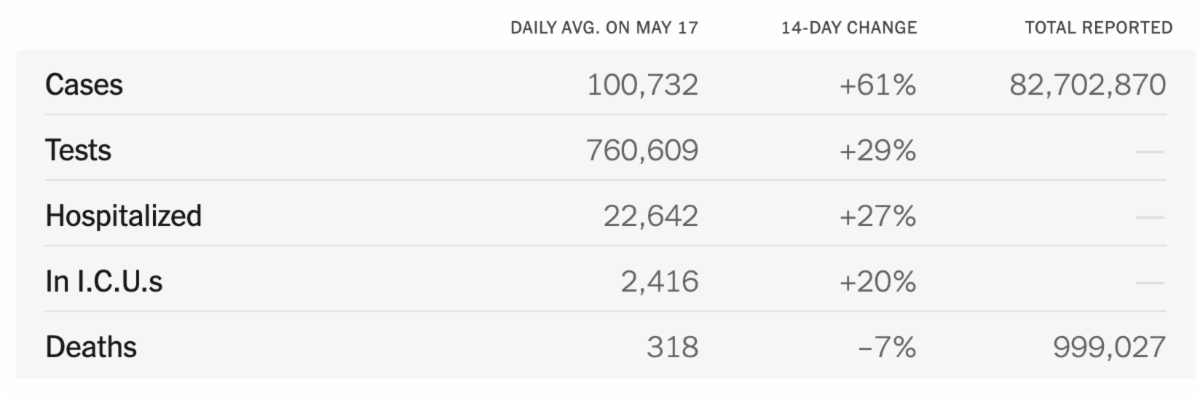
- The virus continues to spread at an alarming pace nationwide, with daily reports of new cases increasing threefold since the start of April.
- Cases are rising in nearly every U.S. state, but the Northeast and Midwest have been especially hard hit. In much of those two regions, daily case reports are higher today than they were at the peak of last summer's Delta surge.
-
The full impact of this surge is believed to be even greater than these numbers suggest. Since many infections go uncounted in official case reports, the cases currently announced each day likely capture only a portion of the true toll.
- Hospitalizations are also increasing, though more modestly than known cases. The number of patients in American hospitals with coronavirus has risen by 20 percent in the past two weeks, but it remains at just over 20,000 nationwide — far lower than the levels seen in any prior surge.
-
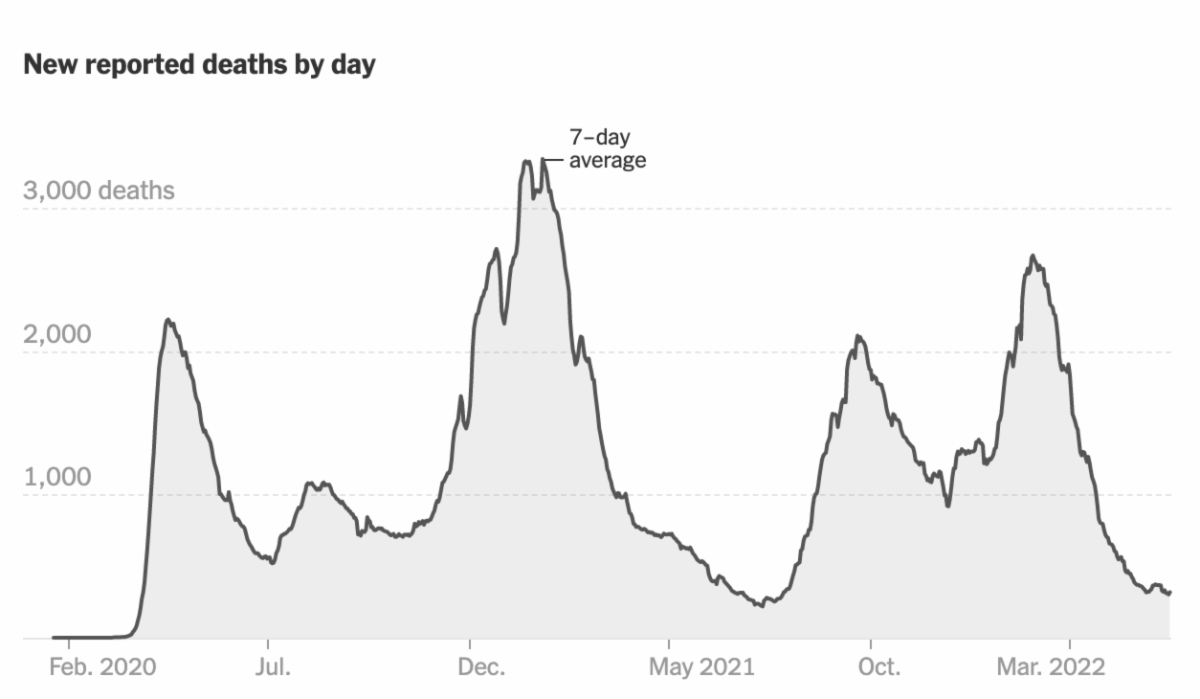
The coronavirus has claimed nearly one million lives in the U.S. since the start of the pandemic, a once-unimaginable loss. More than 300 deaths are being announced each day on average, far fewer than at the height of the Omicron surge several months ago, when more than 2,600 deaths were being reported daily.
|
|
We stay at The New York Times for “How Australia Saved Thousands of Lives While Covid Killed a Million Americans.” The Times reports that “The United States and Australia share similar demographics, but their pandemic death rates point to very different cultures of trust.” A summary of today’s data for Australia, Canada, and the U.K. follows:
- An average of 52,534 cases per day were reported in Australia in the last week. cases have increased by 33 percent from the average two weeks ago. Deaths have increased by 7 percent.
- An average of 4,319 cases per day were reported in Canada in the last week. Cases have decreased by 37 percent from the average two weeks ago. Deaths remained at about the same level.
- An average of 8,453 cases per day were reported in United Kingdom in the last week. Cases have decreased by 25 percent from the average two weeks ago. Deaths have decreased by 16 percent.
The Atlantic’s Ed Yong just published “What Covid hospitalization numbers are missing.” Yong reports “As Covid numbers tick up, hospitals are supposed to be ready to jump in as needed. Only, they never really had a reprieve.” Please hit the link to this most important, must-read article.
The Conversation (we believe a must-subscribe) offers us "Just how accurate are rapid antigen tests? Two testing experts explain the latest data."
Having written on the “Federal Funds Spigot” support for Long Term care and Hospitals, we could not resist posting from StatNews “Turn off the spigot for hospitals; Covid-19 relief funding.” StatNews argues that “Many industries are facing labor shortages, supply chain issues, and inflationary costs. Hospitals no longer deserve special treatment with Covid-19 relief funding.”
Our China East Asia curators promotion of the impact of Covid on China’s economy and political structure grabbed our attention this week, which resulted in our closing article and our Podcast of the week. First from Foreign Affairs is “The collateral damage in China’s Covid War.” The podcast explainer of the week comes from The New Yorker Podcast where China expert Evan Osmos interviews Peter Hessler, who has “been in and out of China for 25 years. He recently returned from two years of teaching and writing in Sichuan Province.” Hessler’s reporting from China has been among our favorite posts, we think you will very much enjoy this podcast.
Counting the days to the end of school, bringing Rebecca’s rest from her most arduous and rewarding teaching duties, as well as the far more vain Seersucker and Linen return to Jerry’s wardrobe, this is Revitalize for May 19, 2022:
|
|
Revitalize: The week in health-care news you need
|
|
The Lost Americans: Nearly one million people have died from Covid in the United States. Many of the loved ones they left behind are grieving in a nation that wants to move on.
One Million: The number of known deaths from Covid-19 in the United States will soon reach one million. Listeners reflect on the lives lost.
How Australia saved thousands of lives while Covid killed a million Americans. The United States and Australia share similar demographics, but their pandemic death rates point to very different cultures of trust.
What Covid hospitalization numbers are missing. As COVID numbers tick up, hospitals are supposed to be ready to jump in as needed. Only, they never really had a reprieve.
Just how accurate are rapid antigen tests? Two testing experts explain the latest data.
Turn off the spigot for hospitals; Covid-19 relief funding. Many industries are facing labor shortages, supply chain issues, and inflationary costs. Hospitals no longer deserve special treatment with Covid-19 relief funding.
|
|
The collateral damage in China’s Covid war.
How Covid strengthened authoritarianism in China. China’s “zero covid” strategy has brought the bustling metropolis of Shanghai to a standstill, with many of its twenty-five million residents sealed in their homes. These exceptionally strict measures are being met with some public resistance, but Xi Jinping’s government has largely doubled down on its approach. Peter Hessler has been in and out of China for twenty-five years. He recently returned from two years of teaching and writing in Sichuan Province. His experience led him to a conclusion that may surprise some Americans: that, for many young people in China, the experience of the pandemic has reinforced “a general idea that the benefits of the Chinese system greatly outweigh its flaws.” And, even if people resent heavy-handed government control, they also bristle when outsiders criticize it.
|
|
Jerry Seelig, CEO
Fax: 310-841-2842
|
|
|
|
|
|
|
|