In
2012, Donald Trump said, "the Electoral College is a disaster for a democracy"
and called it "a total sham and a travesty." In
2000
, Hillary Clinton said, "W
e should ... move to the popular election of our president."
Donald Trump won the Presidency without winning the national popular vote because of s
tate winner-take-all laws (i.e., awarding all of a state's electoral votes to the candidate receiving the most popular votes in each separate state).
If these state laws are not changed, there will likely be more presidential elections in which the loser of the national popular vote wins the Electoral College. We
are in an era of close presidential elections in which the average margin in the national popular vote since 1988 was only 5%.
Winner-take-all laws create another problem in every election.
The vast majority of voters get ignored because c
andidates only campaign in states where they have something to gain or something to lose. Because of winner-take-all, candidates write off
states where they are hopelessly behind, and they take for granted states where they are safely ahead
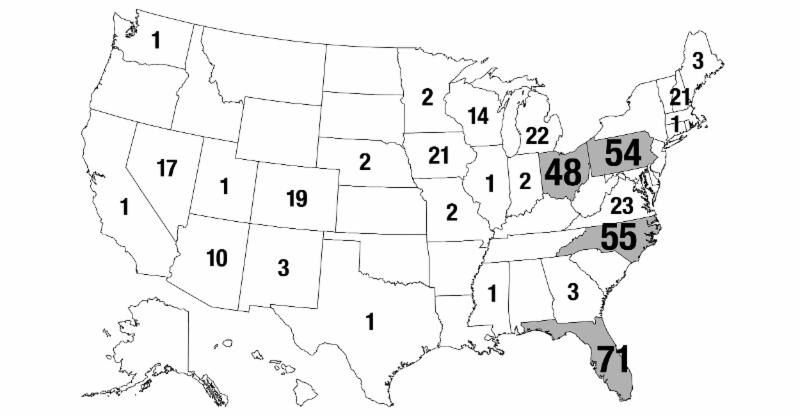
. In the 2016 general-election campaign:
- Over half (57%) of the campaign events were held in just 4 closely divided "battleground states" (Florida, North Carolina, Pennsylvania, and Ohio).
- Virtually all (94%) of the campaign events were in just 12 states (containing only 30% of the country's population). Similarly, in 2012, 100% of the campaign events were in just 12 states. As presidential candidate Scott Walker (R) pointedly observed, "The nation as a whole is not going to elect the next president. Twelve states are." Video Details.
Former presidential spokesman Ari Fleischer said, "If people don't like it, they can move from a safe state to a swing state." Fortunately, the Founders provided us with an easier fix. The U.S. Constitution already contains a built-in mechanism empowering the state legislatures to change the method of awarding electoral votes. Article II says,
"Each State shall appoint, in such Manner as the Legislature thereof may direct, a Number of Electors...."
The "winner-take-all" method of awarding electoral votes is not in the U.S. Constitution. It was not debated by the Constitutional Convention. It was never mentioned in the
Federalist Papers
. Only 3 states used winner-take-all in our nation's first presidential election in 1789 (and all of them repealed it by 1800). It was not until 1880 that winner-take-all became the predominant method of awarding electoral votes.
State winner-take-all laws may be repealed in the same way they were originally enacted -- namely by passage of a new state law. The U.S. Supreme Court has ruled that the states have
"exclusive" and "plenary" power to choose the method of awarding their electoral votes.
The National Popular Vote bill would guarantee the Presidency to the candidate receiving the most popular votes in all 50 states and DC.
It would make every vote equal throughout the United States. It would
ensure that
every
voter, in
every
state, will be politically relevant in
every
presidential election.
Here are 14 videos answering questions about National Popular Vote:
A national popular vote for President is achievable in time for the 2020 election. The
bill has already been enacted into law in 11 states possessing 165 electoral votes. It will take effect when enacted by states possessing a majority of the electoral votes -- that is, enough to elect a President (270 of 538). Thus, it will take effect when enacted by additional states having 105 electoral votes.
The bill has previously passed one chamber in 12 states with 96 electoral votes. It was approved earlier this year by unanimous bipartisan committee votes in 2 states with an additional 26 electoral votes.
A total of 2,794 state legislators have endorsed it.
Recently, t
he National Popular Vote bill
received bipartisan support in
- 40-16 vote in the Republican-controlled Arizona House
- 28-18 vote in the Republican-controlled Oklahoma Senate
- 57-4 vote in the Republican-controlled New York Senate
- 37-21 vote in the Democratic-controlled Oregon House
Under the National Popular Vote bill, the winner will be the candidate receiving the most popular votes in all 50 states (and DC). When the Electoral College meets in mid-December, the national popular vote winner will receive all of the electoral votes of the enacting states. The national popular vote winner will become President because the enacting states represent at least 270 electoral votes. The Electoral College will thus represent the will of the voters in all 50 states (and DC).
For additional information, see our book
Every Vote Equal: A State-Based Plan for Electing the President by National Popular Vote
(readable or downloadable for free at
www.NationalPopularVote.com
).
Thank you.
National Popular Vote
|