|
Trump Administration Trade Policy Review Misses the Big Picture
By Robert E. Scott, Economic Policy Institute
The Trump Administration announced last month that it would sign
two executive actions to launch a review of U.S. trade policy. A review of trade policy and its potential to harm U.S. workers is welcome and long overdue. However, the specifics of the review offered by President Trump mean that it is likely to fail to provide any help to American workers, in part because it asks the wrong questions.
The president's first order requires Secretary of Commerce Wilbur Ross and White House Trade Council to "identify every form of trade abuse and every nonreciprocal practice that contributes to the U.S. trade deficit," according to the commerce secretary. The report is to be completed within 90 days, with an analysis of the detailed cause of the deficit "by country and major product." But the trade deficit is not a "product by product" or a "country by country" problem. We know what it is caused by and what should be done about it.
The trade deficit is not a bilateral problem between the United States and individual countries. The U.S. trade deficit is a result of
global
trade imbalances. There are ten to twenty countries that have developed large, persistent, structural trade
surpluses
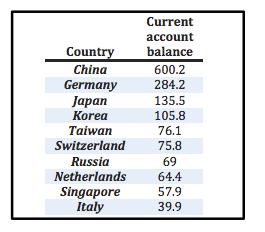
that are distorting trade flows worldwide. The top ten surplus countries are shown in Figure A below. In 2015, these countries, led by China, Germany, Japan, Korea, and Taiwan, had a collective trade surplus of approximately $1.5 trillion. (The figures reported are current account balances, the broadest measure of trade in goods, services and income.)
The United States' current account deficit of $463 billion in 2015 accounted for less than one third of the total surplus accumulated by the big surplus traders. Other countries have also suffered from persistent, structural trade deficits, job losses, and downward pressure on wages, including Great Britain, Brazil, Australia, and Mexico. Attacking the root causes of global trade imbalances will benefit all deficit countries, and not just the United States.
It is also important to note that Mexico is not a country that has maintained large, global trade surpluses. In fact, it has had significant current account deficits in every year since
2000. This analysis shows why bilateral trade data are a poor guide to trade policy development. Measures of each country's overall trade balance with the world provide a much more accurate and effective basis for identifying global distortions in trade flows.
The causes of global trade imbalances
are also well known. While dumping, subsidies, and massive amounts of excess production capacity in some industries (e.g. steel, aluminum) and some countries (e.g., China, Korea, Japan) are an important cause of the problem, the single most important cause is currency undervaluation. Countries with larger, persistent trade surpluses have undervalued currencies. Rebalancing of major currencies, last achieved following the 1985 Plaza Accord
, is the single most effective way to rebalance global trade flows.
Such an agreement is needed to increase (realign) the exchange rates of the major surplus countries shown below relative to the U.S. dollar, which is heavily overvalued.
Countries with the 10 largest current account Balances in 2015 (billions of US dollars)
Source:
International Monetary Fund, World Economic Outlook Database, October 2016
The president's executive orders on trade also "reflected a marked softening
" from the heated trade rhetoric used by Trump on the campaign trail in 2016. The announcement also seems to reflect a search for small, specific, trade actions that could yield "tweetable" trade victories. For example, the president's second order calls for "enhanced collection" of anti-dumping and countervailing duties, to address the "under-collection" of such duties. Why House National Trade Council Director Peter Navarro said
that $2.8 billion in such duties were uncollected between 2001 and the end of 2016, or approximately $175 million per year. When compared with the U.S. goods trade deficit, which reached $749.9 billion in 2017, such duty "under-collections," were small potatoes indeed. While recouping these "missing" duties would be good for injured workers and companies, and would create
opportunities for regular announcements of trade "victories," they will have no
significant
impact on the overall U.S. balance nor on trade related job losses.
Small victories on unfair trade, while welcome, will not bring about the currency realignments needed to rebalance trade flows. Voters, Congress, and manufacturers should settle for nothing less.
Tax Reform Should Not Allow Corporations to Pay a Lower Tax than Individuals, Except Manufacturers
By Joel D. Joseph, Chairman
Made in the USA Foundation
President Trump is proposing a 15% tax rate for corporations across the board, with the individual tax rate up to 35%. Why should a corporation pay a lower rate of income tax than its employees? The corporate tax rate is now 35% and the maximum individual tax rate is 39%. The Supreme Court has ruled that corporations are people and entitled to the same constitutional rights as people. So shouldn't people be entitled to the same rights as corporations?
President Trump's tax proposal will bury the federal government in red ink by lowering corporate taxes across the board. My proposal is revenue neutral and targets tax incentives aimed directly at manufacturing corporations that we want to keep in the United States or bring back to the U.S.
Mr. Trump claims that the U.S. has the highest corporate tax rate in the world. This is not quite accurate since that although the nominal corporate rate is 35% the actual, real world corporate tax rate is closer to 15%. According to Americans for Tax Fairness,
General Electric, Boeing, Verizon and 23 other profitable Fortune 500 firms paid no federal income taxes
from 2008 to 2012. The organization also found that 288 big and profitable Fortune 500 corporations paid an average effective federal tax rate of just and that
profitable corporations paid U.S. income taxes amounting to just 12.6% of worldwide income
in 2010.
Concerning corporate taxes, I propose the elimination of loopholes and a corporate tax rate of 28% with a zero tax rate for manufacturing companies. I also propose a 14% tax rate for income earned overseas to bring home $2.6 trillion of profits sitting in corporate accounts offshore. I would also cap personal taxes at 28% as well, with no deductions, except the personal deduction.
Loopholes
Many corporations use every tax loophole to avoid paying taxes. As a part of tax reform all of these loopholes should be closed. All income should be treated the same, with one exception. The exception is income from manufacturing. Manufacturing is the industry that has moved offshore, for cheap labor and for low tax rates. Your local restaurant, dry cleaner and retail store cannot move offshore and does not need special lower tax rates: they cannot move offshore. The President's industry, real estate investment, is built on loopholes, including depreciation. Real property does not depreciate; Depreciation is a myth. Improvements and repairs to real estate should be deductible, but depreciation should not be deductible from income.
Tax Amnesty for Reshoring Profits
There are also more than $2.6 trillion stashed overseas by major American corporations, including Microsoft, Apple and Google. We should allow these dollars to be repatriated at a reduced rate.
Under my tax proposal, companies could bring home this $2.6 trillion pie, invest this money in new factories and businesses, and the U.S. Treasury would reap a $360 billion bonus. This should cover the costs of the manufacturing tax of zero and then some.
Manufacturing Tax of Zero
I propose a 28 percent corporate tax rate, with a zero percent tax rate for manufacturing companies, and a onetime amnesty rate to repatriate earnings held offshore at a 14 percent rate.
Overall, the corporate taxes now contribute only about 10 percent of total federal revenues. Under my proposal, corporations will pay more money to the federal treasury and thus create more jobs. On total federal tax revenues of $3 trillion a year, corporations now contribute only about $300 billion.
Individual citizens pay the bulk of federal tax revenues.
Manufacturing is the primary area where the United States has lost jobs over the past 20 years. Manufacturing also creates more jobs than other businesses because it creates jobs with suppliers and service providers as well as necessary buildings and equipment.
If we lower the corporate tax rate to 28 percent and eliminate all loopholes (no investment tax credits, no oil depletion allowance, etc.,) we can institute a tax on manufacturers of zero percent. This would be based on the amount of U.S. content in the products manufactured. This zero tax rate would apply only to products made with 100 percent U.S. content. For example, if a manufacturer assembles a product in the United States with 50 percent U.S. content, the manufacturer would pay an income tax of 50 percent of the 28 percent rate, or 14 percent. However, if the manufacturer has 100 percent U.S. content, its tax rate would be zero.
This new tax rate would serve to incentivize manufacturers to make their products in the United States. It would help to create millions of American jobs by bringing manufacturing back to New York, Illinois, California, Ohio, Michigan and every other state.
Individual Income Taxes
Our current income tax structure exacerbates income inequality. Capital gains should be taxed at the same rate as salaries. Taxes should be simplified. General Electric and other profitable companies must pay their fair share of income taxes. The author proposes simplifying and rationalizing income taxes, getting rid of loopholes and deductions, and having three levels of income tax: 10%, 20% and 28%, with corporations making over $1 million paying 28% as well.
Social Security Taxes
I propose exempting the first $25,000 in income from both income taxes and social security taxes. At the same time, I would lift the cap on Social Security taxes. Now employees earning more than $118,500 pay no further social security tax. If we lift the cap, it will pay for the exemption at the bottom. At the same time I am proposing that corporations do not have to pay their share of social security taxes for those earning under $25,000. This will encourage employers to hire more workers.
The manufacturing tax of zero and the $25,000 exception for Social Security payments will significantly increase jobs and job growth in the United States. These focused tax incentives will create more jobs, at a lower cost to the budget, than President Trump's across-the-board tax grab for the rich.
|