Industry Updates for Clients & Friends of Boyd Group International

June 14, 2024


In This T&G:


Special Review: The Elliott Plan For Southwest - Unvarnished.

Big Bearing On USA Airport Planning

T&G Sponsor

______________________________________________________________________


The Elliott Proposal To Completely Change Southwest. Some Straight Observations.


Getting to The Bottom Line. And It's Not All That Pleasant.


Summary: The proposal by major shareholder Elliot Management to sack management, replace the board of directors, and completely revise the airline's product has revealed a lot more than just info on Southwest. It has put a spotlight on how uninformed a lot of aviation sectors are in regard to airline dynamics.


The basics of the Elliott move are clear.


At its bottom line, Elliott is telling the world that the future of Southwest is to completely drop its current operating model and be like other carriers.


You know, have a premium cabin, charge for bags, have pre-selected seats, do a bare basic fare level, and all that. Complexity.


They assume that this will generate lots of new revenue. They assume that this will have no effect on the carrier’s customer base and won’t affect the airline’s market competitiveness.


There is no discussion of building on the foundation of the current model’s strength. Just dump it. It’s an easy conclusion.


This is from a firm that, as close as I can tell from their website and media issuances, has no experience in the airline industry. But they’re trying to dictate how Southwest should operate.


Shareholder Scrutiny - Even Hostile Scrutiny - Is Inherently Positive. Efforts to get a company’s share prices up by prodding management are honorable and good business.


But it also brings the responsibility to understand the business the company is in, and to assure that any demands made are consistent with reality and hard, demonstrable research.


The Elliott efforts miss the mark on both counts.


Yup, I know they have over 25 years and a track record in the financial gig. Yup, I understand (at least as reported in the Wall Street Journal) they’ve studied Southwest for a year and a half. There is no question, at least as reported, that these people know their financial stuff.


And that makes no nevermind to the facts at hand.


After looking over the 50+ page presentation deck issued by the financial institution there is only one hard conclusion: Elliott looks a bit foolish.


WN Has Problems? Yes. This Veneer Solution? Not So Fast. Naturally, there are the people who now join in and agree that Southwest is long overdue for a management overhaul. That may or may not be the case.


But that doesn’t mean that a missive put out by some financial firm – one that simply claims that differences in product strategy are the secret to jacking up share prices – should be blindly accepted as if Moses just dropped it off on his way home from Mt. Sinai.


USA Airports: You Do Have A Dog In This Fight. What is going on is of great concern. For those airports and communities now served by Southwest, or are working to recruit it in the future, this Elliott hoedown does bear on the future.The changes this shareholder is demanding will fundamentally shift Southwest's future route system.


Elliott is proposing to fundamentally change how WN operates. It intends to change how the carrier strategizes its route system. That will affect where the carrier operates.


The Real Message From The Elliott Missive. But what has been smoked out in the last week is not necessarily new revelations about the supposed poor performance at the airline.


What it has really illuminated is the lack of hard thinking and basic industry knowledge in a whole range of aviation sectors, from the just-repeat-it-as-issued aviation media, on up to several supposed financial analyst entities who have climbed on this jihad to cleanse Southwest of myopic management.


Do a search of the eager comments from people who until last week had never even heard of this company, let alone had any insight on the airline itself. Sudden devotees. Regardless, they read the 51-page Elliott deck, and get all excited that it’s right on the money.


Industry Credentials, Please. Anybody Want To Ask Questions? Put Southwest aside for a minute. Did anybody really do any investigation into Elliott? What are their credentials – specifically in regard to what they are demanding at Southwest?


Like, what experience and qualifications does Elliott have to propose a complete rebuild of Southwest?


Oh, yeah. I forgot. The media has generally just repeated the success stories about Elliott turning around other companies. Impressive, but in completely different industries.

The Usual Media Suspects Are On Board. Sloppy. The Wall Street Journal made the trendy comment that Elliott is right in demanding that WN should charge for bags, simply because passengers on other low fare carriers pay.


Putting WN in the “low fare airline” category shows insight rooted in the 1980s. WN has data to support the lack of bag fees attract more passengers.


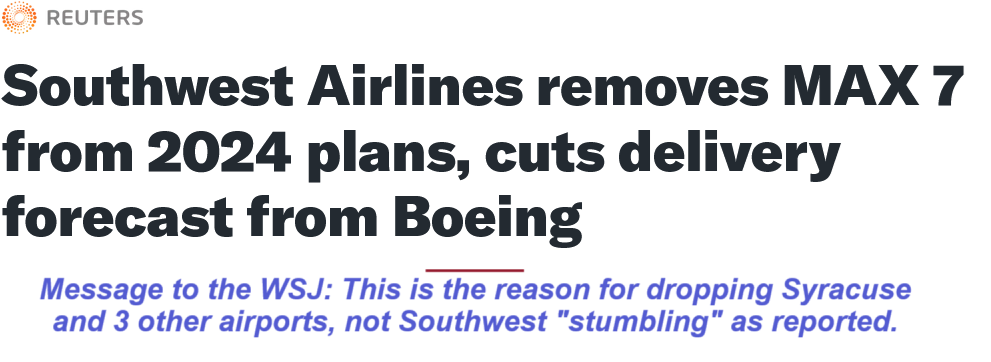
But it gets deeper.The Journal’s shallow end coverage of the Elliott proposal noted how Southwest’s expansion strategy has “stumbled,” using deletions of Syracuse and Cancun to mislead the reader into thinking their planning is off.


Message to the Journal: get a grip beyond the surface. Southwest in 2020-2022 opened 18 additional airports, with a clear plan based on fleet arrivals to tie them together in the following years. The Boeing 737-7 delay fiasco torpedoed that, and they made decisions regarding the highest and best use of their resources. So SYR and CUN got 86'd.


Oh, yeah. A couple of facts. For the year ending March 2024, Syracuse load factors were higher than the carrier’s average. But the lost traffic can partially be retained with diversion to WN flights along the I-90 corridor at Albany and Rochester. A sound move.


And Cancun? Like, an 88.9% load factor. Looking at fares, too, Syracuse and Cancun were not underperforming. It was a solid business fleet decision to move resources, not a stumble. Veneer reporting.


Some Financial Institutions Are Asking Questions. About Elliott. The good news is that we do have folks with the temerity to ask questions. We have a refreshing comment from Helene Becker, respected analyst at TD Cowan.


“Many investors we spoke with felt that the presentation showed a naivete about the airline industry and lacked a realistic plan to drive the targeted margin expansion. The airline is already working to implement much of what Elliott is proposing.”


“Naivete” is the operative term here. Let’s summarize what we see in Elliott’s 51-sheet magnum opus:


There are a range of metrics where the case is made that Southwest’s financial performance has lagged when compared to other operators of scheduled passenger service. Note, I did not say airlines. That’s because, apparently unbeknownst to Elliott, there are fundamental model and strategic differences between such entities. It’s not the fact that share prices have supposedly varied from other airlines. It’s whether the causes claimed by Elliott are germane to the issue.


The current senior management has mis-managed the airline, as “proven” by the data provided in the deck. The “data” being mostly surface references to “commercial strategy” without any investigation of the effects on consumer loyalty or market realities.


Share price at WN has performed poorly compared to other scheduled passenger operators. So, that implies, according to Elliott, if Southwest can be more like other airlines, wow! investors will reap a stock price win. 


The commercial strategy at Southwest needs to change. Yup, if something hasn’t changed, the report trumpets, the airline is doomed. No discussion of what those changes would represent or deliver to the bottom line.


Cleverly, the document tosses in a full-slide quote (probably out of context) from Herb Kelleher years ago, regarding the need to change-or-die. Like, it demonstrates Herb’s support for Elliott from the great beyond. Somehow, this might not necessarily represent how Mr. Kelleher would entertain the investor's proposal.


Bottom Line: Simplistic Analyses As Proof For Management Change. But here’s the reality: these data points, spread over a couple dozen slides, are essentially the kind of numbers any high school kid could compile from existing sources on a simple spreadsheet. 


BTW, Just Who Has The Real Lack Of Airline Expertise? What’s a real hoot is Elliott’s blanket demands that senior management and the entire board of directors be escorted out of the building. Elliot demands they then be replaced by experienced airline people who know the business.


Which, it seems, is exactly what Elliott isn’t.


Yet they’ve done the “research” and concluded that more airline knowledge and experience – which Elliott itself doesn’t have - is needed.


Sure, they have reportedly a search firm to recruit a dream messiah management team. Sounds great.


The fly in the ointment is that any such team will probably be 100% beholden to Elliott’s version of what the airline business should be.


Yeahbutt, We Looked At AA, DL, UA. Southwest Is A Scofflaw. It’s clear that Elliott’s research has found that since other carriers charge bag fees, Southwest is leaving money on the table. By not having a more complex product, such as maybe different classes of service, Southwest is not with the program.


Great veneer conclusions. They see other airlines getting ancillary seat fees, and in their non-airline expertise wisdom have concluded that not having them represents inept management.


‘Course, they have no discussion or analysis of any consumer and strategic advantages the Southwest product represents. Yes, it can and may be modified. The key point is Ellott wants this done simply because other airlines are doing it. Not a compelling reason, especially when the authors have limited if any expertise in air transportation and airline dynamics.


Point: Southwest has market strengths, and that would be a solid foundation to build on. That development could be a more complex product. The issue is that assuming that WN can be remade in the image and likeness of other carriers isn’t necessarily a sound strategy.


Summarizing. Elliott has mostly looked at the products and consumer strategies at other carriers and assumed that these are the required “norms.”


So, since WN has a different product approach, Elliott has concluded that it’s the main reason the share price isn’t performing, concluding that the airline is losing market share.


Bottom Line: Publishing Numbers Is Easy. Understanding Them Is Not. This is not to say that there are no issues that need to be addressed at WN – and at all airlines to one degree or another.


The issue here is that an entity with very low expertise in the air transportation industry has unilaterally told the world that Southwest’s product needs to be dumped.


I would caution about that conclusion.


(Story continues below.)

What They're Proposing Was Tried Before – Long Ago, But Clearly Instructive. Southwest has a specific product, and there is at least one constituency that likes it. One that Elliott does not consider:


The WN passenger base. It’s called the consumer.


It’s very dangerous to assume that consumers aren’t really a factor in commercial strategy planning. However, an attempt at a complete airline product rebuild has been done before, with disastrous results.


Back in 1980, we had Braniff International. Two years of big-time losses due to over expansion. Not due to its product, which for the time was at or above the quality of the competition. Lots of debt. Loss of strategic market direction. A new CEO – from inside the airline – took over.


John Casey got concessions from lenders. Pulled back on a number of international expansions. Concessions from unions. By early 1981, Braniff was actually making quarterly operating profits. (A tidbit of history not often noted.) Small, and not all-up, but it stood out well from other airlines at a very difficult economic time. Braniff was still in trouble but working to leverage its strengths.


Unfortunately, the board of directors got impatient, and yes! they engaged a new messiah team to come in. They tossed out the far more capable Casey, and moved toward doing what Elliott is proposing at WN. The whiz kids went right to work completely gutting Braniff’s product.

Paradoxically, back then the goal was to transform full-service Braniff into a bare-bones Southwest look-alike


Yessir, they eliminated first-class, which zapped the revenue from a strong business following, and made the airline far less competitive with American and Delta and United and TWA, etc. The first-class clientele went elsewhere.


Don’t need those people, see. Braniff was going bare bones. Another immediate outcome was Alaska Airlines cancelling a lucrative through-service deal over Seattle. That was another revenue stream gone. Skedaddled over to American.


They tucked more seats into the now all-coach cabin. In a bogus swing to convince lenders, they then increased flight schedules on short-haul routes, thereby tossing more ASMs over the fixed cost. ‘Course, there weren’t more tushies in the seats.


It got so silly that at one point there were three 727s leaving SAT for DFW in a mid-morning, low demand 45-minute period. Lotsa ASMs to dilute the reported costs.


They chopped fares into two simple low categories, to show that Braniff was now the low-fare leader, a perception entirely new to the public and to its regular passenger base.


Naturally, American countered by opening a bucket with maybe just ten even lower-fare seats, to demonstrate that it was the fare-leader.


The new wunderkinds even put a big red sticker on the fuselage of some 727s with the word “New.” Indeed, it was – to the airline’s core passenger base.


The brick wall was that the dream team missed the point that this product change also meant alienating or confusing much of the clientele traditionally flying Braniff. It meant taking an airline and trying to force it into a completely different operating system, different product and different market niche for which it wasn’t fully designed.


This bears directly on what we’re seeing right now with the Elliott demands.


It took just six months and Braniff made headlines by going out of business. The dream team didn’t even attempt to fly the carrier through “Chapter.” They didn’t bother.


(As a sidebar, there’s a lot of silly lore out there costuming this Braniff misfire to look like the airline version of the heroic defense of Wake Island. Those of us who were there in the management and operational trenches watching this inept gong show experienced an amateur act that was anything but heroic.)


The truth is it was a sloppy attempt to change its product that was the proximate cause of the cratering of a once-great airline. Other stuff came into play, but it was the strategy of the “experienced” management messiahs to “transform” the airline that guided Braniff to point of impact.


Just a cautionary tale: it is the customer base that ultimately determines if an airline succeeds. Mess with the product and ignore the potential strengths of the product – particularly when it makes wholesale changes based on observations, not hard data – and bad things can happen.


That’s the danger of what this Elliott suggestion is all about.


Final Point: This is not to whitewash any legitimate problems at Southwest. It’s just to point out that what’s on the table from Elliott, as Ms. Becker points out, represents naivete, not solutions.

___________

___________


Get Your Airport or Organization In Front of Hundreds of Aviation Leaders Every Week!


Now! Subscriptions available for weekly banner ads and full sponsorships at the industry's most incisive trend and research vision letter.


We are excited regarding the reaction to Boyd Group International's Touch & Go banner ad opportunities!


It gets your organization front and center with the decision-makers in aviation. Your message is right there for the over 500 leaders who receive the letter every week. No other channel is as incisive or as cost-effective.


Because the Touch & Go is a vehicle that looks beyond the surface of aviation issues, it is welcomed every weekend by the people shaping the future.


This includes C-level executives, planning managers, financial entities as well as key media.


UNTIL JULY 1, TAKE ADVANTAGE OF INTRODUCTORY RATES.


Click here for more information and subscription information. Space is limited.


We’re moving the forum of aviation discussion to a new level, and we’d be excited to have you along!

_________________________

_________________________

Thanks for joining us!

Be sure to log on to our other aviation intelligence portals