FEBRUARY 2024


SAFETY FOR INDUSTRIAL AND COLLABORATIVE ROBOTS


Since their introduction, robots have changed the industrial landscape by providing a means to reach manufacturing potentials otherwise unachievable due to human limitations. Such substantial industrial advancements, however, does not come without substantial risks to humans. Robots are often utilized to handle large and/or hazardous payloads and provide faster processing times. Humans working near robot systems must be protected against direct contact with the robot and its payloads as this may be several hundred pounds and moving at speeds faster than the human reaction speeds. This requirement of providing a safe working environment with robots also includes those activities where there is direct contact with the robot such as during a teach process where the robot parameters are being configured.


The safety standard ANSI/RIA R15.06 was created to provide guidance on implementing safety requirements for Industrial robots and robot systems. Like many current safety standards, ANSI/RIA 15.06 has been harmonized to an international standard to provide better alignment for safety across international borders. In this case, ANSI/RIA R15.06 is harmonized with ISO 10218-1 and ISO 10218-2.


Some basic safety requirements referenced and discussed within ANS/RIA 15.06 and ISO 10218 include the emergency stop function (and its mechanical requirements); three-positioned enabling devices when interacting with the robot; fixed hard guarding (e.g. fencing systems); safety light curtains; safety interlocking (with and without locking); and means to prevent persons from being trapped within a robot cell.


These standards also reference collaborative robot applications, which is where a robot may work in the same working envelop as a human operator. However, the safety requirements for this is covered in more detail within ISO/TS 15066. The main difference here is the robot which can be used, as robots for collaborative use are designed to be inherently safe and are limited to their payload and speed capabilities. Also worth highlighting, is that the use of a collaborative robot does not automatically mean that the collaborate application is safe. Consideration must be given to the environment, auxiliary equipment, end-effectors, materials in use, etc.


Whether it is a traditional industrial robot or a more recently industry accepted Cobot, their general purpose is the same which is to make a specific task easier and more efficient. Both also require the same responsibility of ensuring they are safe to use for personnel working directly with or around them. ANSI/RIA 15.06, ISO 10218 and ISO/TS 15066 provide guidance on safety, and all require a formal safety risk assessment to be completed to ensure a safe working environment.


SCHMERSAL PRODUCT SPOTLIGHT

Safety devices and machine controls for robotics applications

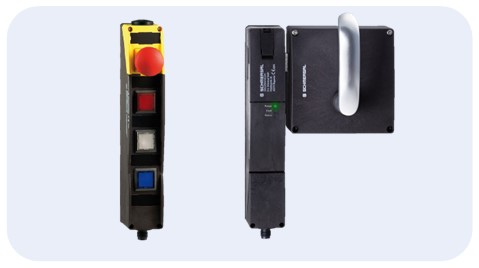
RIA R15.06 compliant door lock and controls

AZM201 and BDF200


The ANSI/RIA R15.06 standard provides safety requirements for industrial robots and robot systems. The AZM201 electronic solenoid interlock switch and BDF200 control station can be used together to fulfill the necessary ANSI/RIA R15.06 requirements for machine controls with E-Stop and emergency exit for guard locks. They are similar housings and can be mounted side by side.


Tech Brief

Online product catalog: AZM201

Online product catalog: BDF200

Brochure: AZM201

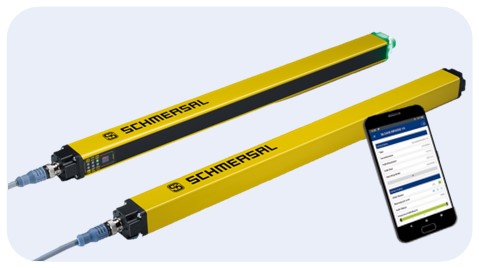
Safety Light Curtains

SLC440COM, SLC440, SLC445


Safety light curtains are used as perimeter guards or at point of operation. Our Safety Light Curtains have extruded aluminum tube housings for durability and LED end caps provide visible operational status. SLC440COM and SLC440 also feature a Bluetooth interface to provide real time data transfer to smartphones or tablets. The SLC440 has multiple integrated functions such as blanking, beam coding and double reset. The SLC445 includes a muting function to allow materials to pass while still preventing workers access to the hazardous area.

Online product catalog

Optoelectrical Brochure

Tech Brief: SLC440COM / SLC440 / SLC445

Video: Bluetooth interface

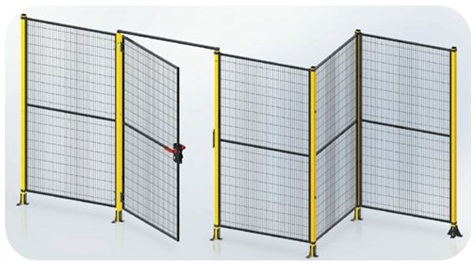
Modular perimeter guarding systems

SATECH


This perimeter guarding solution is constructed of steel for durability and impact resistance around robot cells. Guards are customized design layouts from standard panels and connection systems. The standard mesh panel is 3 mm steel wire in a 22 x 100 mm vertical grid, with 20 x 20 mm frame. Green Fast footers, Basic posts (40 x 40 mm) or Strong posts (60 x 60 mm) provide the connections and supports. This fencing system installs quickly and easily with bolts or captive fastening clips.


For more information

Tech Brief

Brochure

Video: Product animations

Safety laser scanner

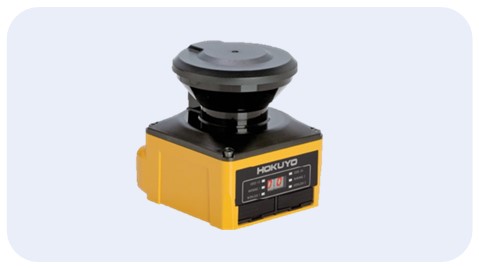
HOKUYO UAM


Safety Laser Scanners are presence sensing devices. They are commonly used to safely monitor mobile applications such as autonomous mobile robots (AMR) and automated guided vehicles and carts (AGV, AGC). In stationary applications they can detect workers entering robot cells or unsafe areas around palletizers, or be set up for point of operation protection. The Hokuyo UAM scanner uses a 2D LiDAR system to monitor a 5 meter protection zone, with up to 20 meter warning area, and has a 270° field-of-view.


For more information

Tech Brief

Brochure

Video: Product animation

RESOURCES

Here is a collection of reference documents on the topic of robot safety

PODCAST:

DO COLLABORATIVE ROBOTS NEED SAFETY RISK ASSESSMENTS?


In October 2023, Devin Murray appeared on the “Automation World Gets Your Questions Answered” podcast . In this episode Devin defined what a collaborative robot (cobot) is, current standards for cobot safety, the hazards around cobots, the need for risk assessment of the cobot application, and several methods to make cobots safer.


Stream the podcast
AWpodcast_VideoCover_2Cobot image
Article_FAQ image

ARTICLE 

FAQ: Robot Safety


More and more robots are being introduced and utilized for industrial automation. From the traditional industrial robot to modern technology with collaborative robots, learn more about how to properly safeguard robots and robot cells in this Frequently Asked Questions (FAQ) article.

Download the FAQ
Article_IndRobot image

ARTICLE

Future of Industrial Robots


Robots which work “hand in hand” with humans have now found their place safely on to the factory floor. This article discusses the growing acceptance of cobots, their safety requirements, and how it might affect the use of traditional industrial robots.


Download the article
Cover_RobotSafety2023 image

ARTICLE

Safeguarding Robots 

And Robot Cells

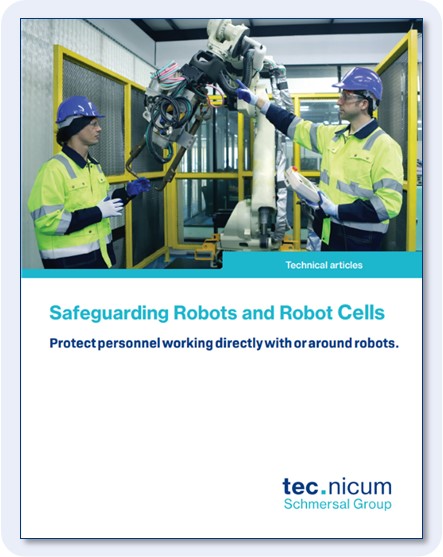
Protect personnel working directly with or around robots. Learn which standards are relevant for robot applications, understand robot functionality and limitations and how they affect typical methods of safe guarding robots, and review Collaborative Robot safety.


Download the article
ENGINEERING SERVICES

tec.nicum Engineering Services can provide assistance with robot safety

Flyer-CobotRisk image
ENGINEERING SERVICE
Cobot Risk Analysis

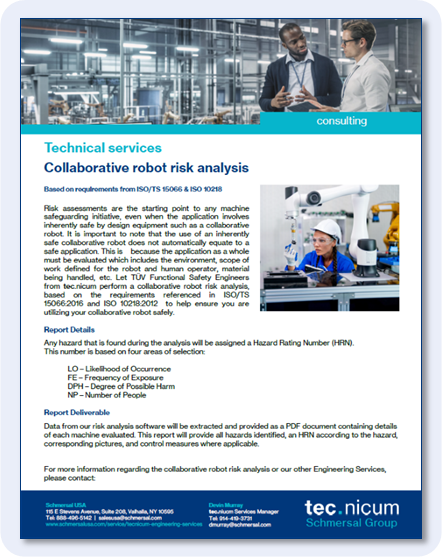
Risk assessments are the starting point to any machine safeguarding initiative, even when the application involves inherently safe by design equipment such as a collaborative robot. Our Engineering Services group can perform collaborative robot risk analysis, based on the requirements referenced in ISO/TS 15066:2016 and ISO 10218:2012.
Learn more
Flyer-PFL image

ENGINEERING SERVICE

Pressure & Force Limit Analysis

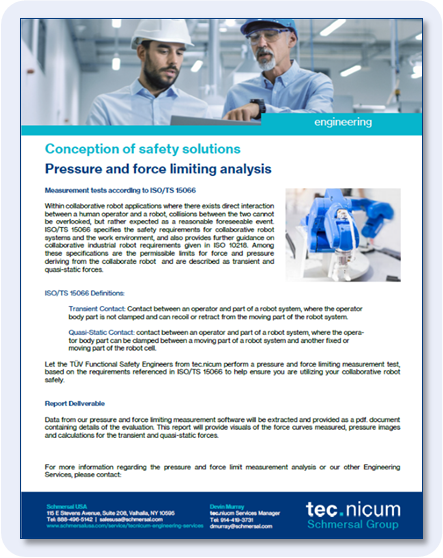
Collisions can be expected when workers interact with collaborative robots. ISO/TS 15066 specifies the safety requirements for collaborative robot systems and the work environment. Our Engineering Services group can preform the necessary pressure and force limit measurements and provide analysis on collaborative robots.


Learn more
Cover_tecnicum2023 image

BROCHURE

Engineering Services


Beside the Cobot Risk Analysis and the Pressure & Force Limit Analysis, tec.nicum offers a variety of engineering services. Primary among them are machine safety training courses. We also offer the OSHA Outreach Training for General Industry (10 hour or 30 hour). Learn more in our 12 page brochure.


Download the brochure

UPCOMING WEBINAR

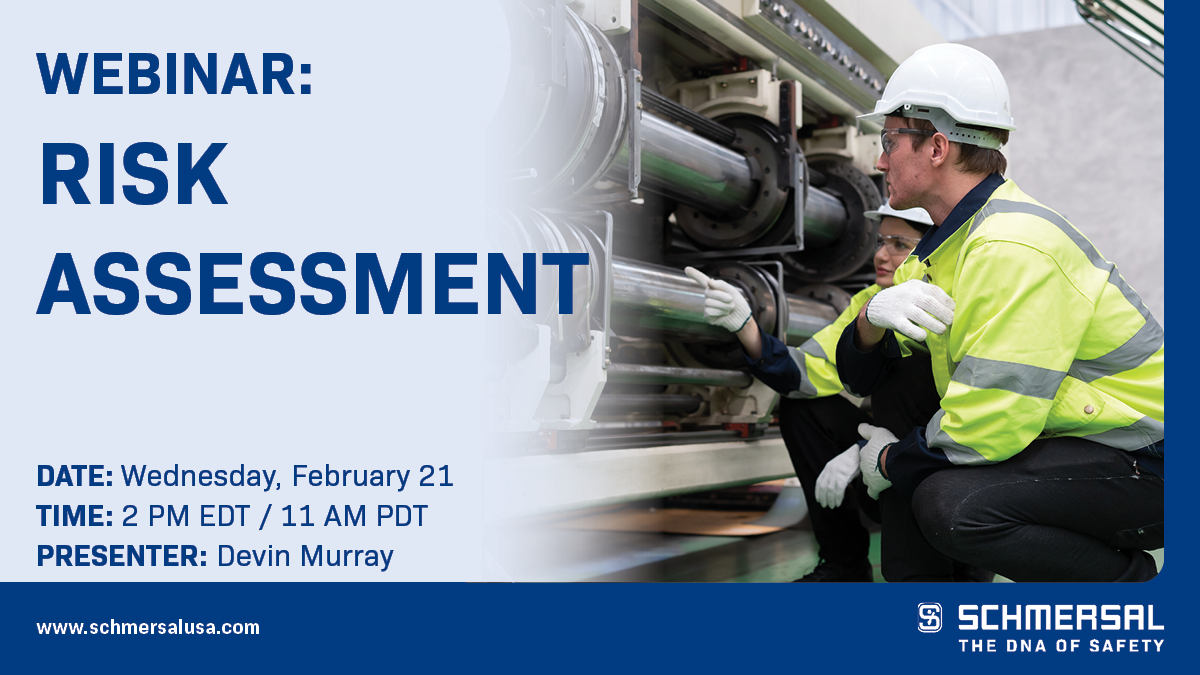
Risk Assessment

A machine safety risk assessment is a crucial step for safeguarding industrial equipment. On February 21st, Devin Murray will discuss the basic needs, requirements, and processes for an effective and efficient risk assessment procedure. This includes hazard identification, risk estimation, and risk reduction as defined by various consensus standards and regulations.


DATE: 02/21/24 | TIME: 2 PM Eastern

Register for the webinar
RiskAssess_022124_1200x675 image
ASK THE EXPERT

Devin Murray


TUV Functional Safety Engineer

ID-No. 4274/11

Question: Is a Pressure and Force Limiting (PFL) analysis required for a collaborative robot application?


Answer:

ISO/TS 15066 specifies the safety requirements for collaborative robot systems. This standard calls out 4 methods to achieve safe collaborative robot operations, each with its own requirements and considerations.


The pressure and forces exhibited by the Cobot must be acceptable for applications that allow operators and Cobots to work in the same envelope concurrently, with the desire of not using physical safety devices. A PFL analysis is used to compare and validate these pressures and forces to that of the allowable thresholds called out within ISO./TS 15066.


Have more questions? Ask Devin: dmurray@schmersal.com

www.schmersalusa.com | 914-347-4775 | salesusa@schmersal.com

Join our mailing list | Read back issues

LinkedIn  Facebook  X  YouTube  Instagram