|
The black type pedigree page of the Kingsley clan
They’re hoping for a home-field advantage at Saturday’s Carolina Cup
| |
|
Studies on home-field advantage in sports point to a science-based reality: Harvard and Sports Illustrated have published numerous papers and articles about it. Theories on why it works range from insider knowledge of the playing field to the benefit of not having to travel.
Whatever the case, Camden, South Carolina-based trainer Arch Kingsley Jr. believes in it.
The trainer proves home-field advantage most years at the Carolina Cup Races, since he set up shop near the Springdale racecourse almost 20 years ago saddling dozens of winners at his local meet.
Saturday he has four runners, including Cibolian for owner Hudson River Farms and rider-daughter Taylor in the card-closing training turf race.
“All I can tell you is … I don’t have a formula,” Arch told thisishorseracing.com in a 2017 interview. “I don’t have a science, I just pour my energy into doing well on this day because I love this town, I love the people here and I know how much the …. races mean to the history of steeplechasing.”
For her part, Taylor is excited and happy to be making her first start in front of her home crowd. A graduating senior at Camden High School, she expects a bunch of her classmates will be on the sidelines. “I just love Springdale,” Taylor says.
To understand the Kingsley connection to the historic Carolina Cup – first run in 1930, to Camden and to racing itself, study the pedigree page of this steeplechase clan.
Arch’s father, mother and brother all claimed multiple Virginia point-to-point titles. Arch Jr. himself was two-time National Steeplechase Association champion rider. His aunt and uncle are directly tied to this year’s early Kentucky Derby favorite, and his wife is pretty much responsible for the footwear-of-choice for half the thoroughbred horsemen in America. In short, they're tied tight to thoroughbred racing.
A Kingsley catalog page would be filled with black type.
It always pointed to steeplechase.
| |
|
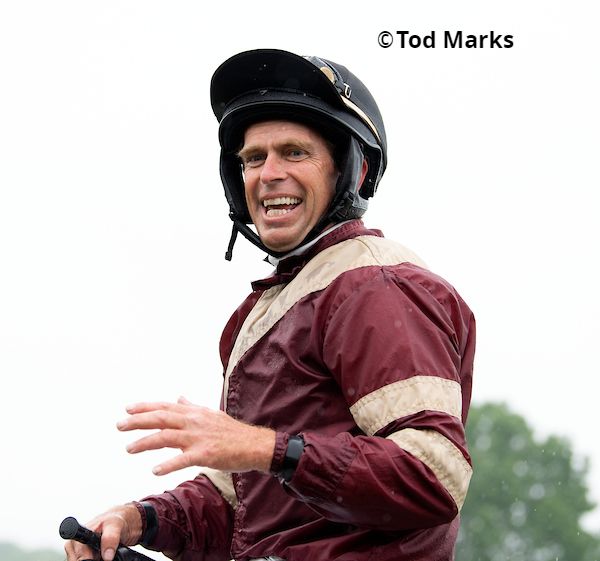
🏇 NSA champion rider in 1997 and 1999, Arch Kingsley Jr. rode his first race in 1993 – Chati’s Key for mother Kassie, getting his first winner at Potomac point-to-point in 1994 – Awesome Tan for Tim Hansen. His first winner under rules was Come On Gerald that fall for Pete Aylor. He’s ridden 147 winners (point-to-point and NSA) from 825 mounts to date. (Tod Marks photo from 2021)
As a trainer, Kingsley has saddled 97 winners from 531 starters, including three Carolina Cup stakes winners, most recently Show Court in 2017.
He learned a lot about training horses when he worked for Hall of Famers Jonathan Sheppard and Bill Mott before setting up his training business in Camden in 2005.
| |
|
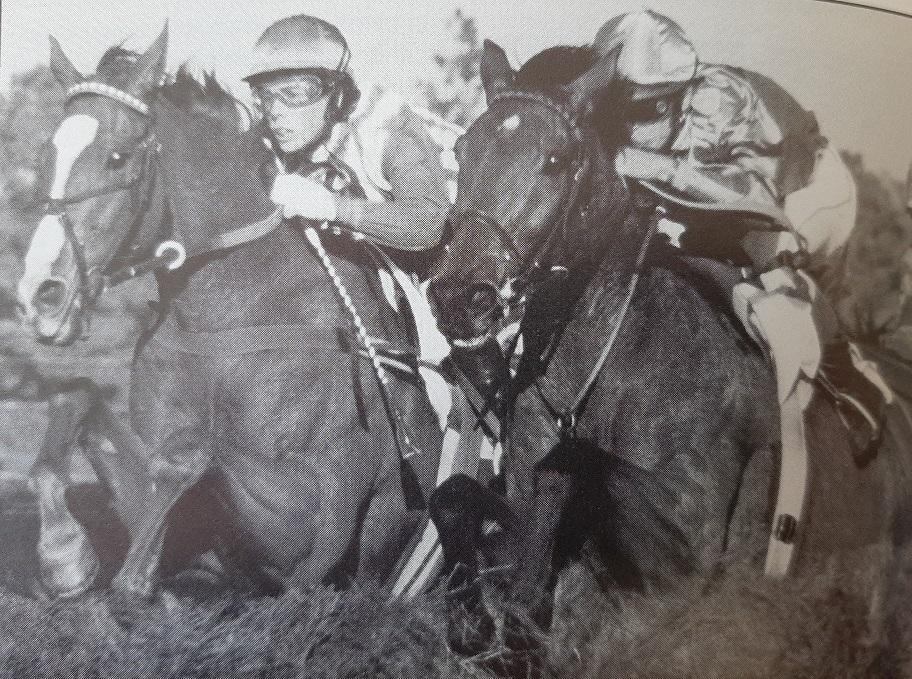
Arch felt an affinity to the South Carolina town he credits to his headline wins there (the 1998 Carolina Cup on Master McGrath, the 1999 Colonial Cup with Ninepins, the Carolina Cup in 2000 with Invest West and the Colonial Cup in 2000 on Romantic) and to a tangential link from his father Arch Kingsley, who’d ridden his legendary point-to-point champion Lenoso in the Carolina Cup when it was a timber race in the early ‘60s. (NSA archives photo of Lonesome Glory and Blythe Miller (left) and Master McGrath and Arch Kingsley in the 1997 Colonial Cup. Lonesome Glory was victorious, Master McGrath was third)
Arch says he’s thrilled to be giving a leg up to a third generation of Kingsleys at the Cup on Saturday. Though as much as he’s eager for Taylor to find her path as a race rider, Arch has cultivated a kind of insightful Zen patience in the process.
He wants her to be in it for the long haul, like the rest of the Kingsleys, he says.
“When you live this life, if you take care of yourself, honestly, you can ride ‘til your 30s, 40s, and way beyond,” Arch notes. “Look at Paddy Neilson – he’s a perfect example, so stylish and good as a rider into his 60s. To me, people like Charlie Fenwick and Paddy Neilson set the bar for how long you can do this and do it well.”
Arch also credits Taylor’s mother, Wendy, for adding a unique degree of mental coaching that he believes ensures their daughter’s growing ardor for race riding.
“I was lucky to have Wendy help me when I was riding,” Arch says. “She’s the daughter of professional, all-but-Olympic level skiers, and she brought a level of sports psychology that helped me see through the fog and focus on re-centering myself, power through the distractions.
“I never would have enjoyed the success I did without her help.
“Wendy would talk me through the high highs and the low lows. You realize, okay, there’s more at play here than some of these more immediate fears and problems. If you felt like you’re losing your way, you focus on (the things) you know that you know how to do, and that you do well. I know how to breathe, I know how to balance on the back of a horse, I know how to make a horse happy, I know how to help a horse relax.
“It’s helpful to have someone there to remind you to put one foot in front of the other. Wendy did it for me, and now she’s doing it for Taylor.”
| |
|
🏇 Wendy Fletcher Kingsley, who turned 52 this week, learned her way around sports psychology growing up with ski coach parents in New London, New Hampshire, near what she calls a “brown-bagger ski area” – a smaller mountain than resort towns Killington or Stowe. Both parents were elite level downhill skiers and coaches.
She’d taken up riding around age 10 when three dry winters in New England left the Fletcher kids without much skiing to keep them fully occupied.
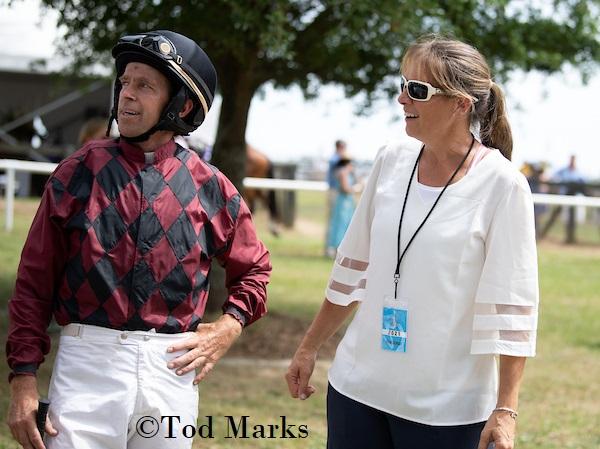
She filled the gap with horses. (Tod Marks photo of Arch and Wendy at the 2021 Carolina Cup races)
Wendy embraced her “new” sport – eventing, hooked up with the national Young Riders program and moved to Virginia in 1988 to train with Olympian David O’Connor.
She competed to the advanced level and won the Markham Trophy as highest-placing young rider at the Fair Hill 3*. She was long-listed by the U.S. Equestrian Team.
While in Middleburg, Wendy galloped at the training center for Don Yovanovich and others, and she met Arch Kingsley, who eventually became her husband.
When the couple moved to Camden, she got a job breaking young horses for Mickey Preger; one of her most “famous” mounts turned out to be eventual multiple graded stakes winner and sire Distorted Humor. “I’d love to take credit for everything he went on to do,” Wendy says with a laugh, “but he was just ‘that 2-year-old I rode in the fifth set,’ nothing else stood out about him back then.”
Wendy and Arch married in 2000.
In addition to riding, Wendy worked at the National Steeplechase Museum in Camden and as marketing director for the Carolina Cup.
| |
|
Her family’s Fletcher Ltd. was a shoe importer and sales company in New Hampshire; in the mid-1990s, Wendy helped spearhead their becoming sole U.S. distributors for Blundstone boots out of Australia.
With daughter Taylor riding races now, Wendy says she’s been able to bring out her sports psychology buzzwords once again.
“I’d always found it bizarre that there’s no such thing as a “coach” for a jockey. Dressage riders, show riders, barrel racers have coaches. Tennis players, every other major sport. But not jockeys.
“I think it would help a lot of people a whole lot to have a coach to discuss their performance, to help them be mentally fit” as much as they are physically fit.
“It’s always situational, discussing what happened,” whether in a race, or a training hiccup, or something interpersonal. “Sometimes it's just getting out of your own head. Someone is telling me about this thing that went wrong, this thing they did wrong. I try to help re-focus them to relax and tell me all the things that went right.
“About all those tiny choices that made everything else go right.
“Sometimes you just need to consider the fact that you’re actually very good at this sport. It’s human nature to focus on the negative. Shift the focus away from that ‘should’a been but wasn’t’ to ‘that was an overall good performance’ and you help the situation.”
| |
|
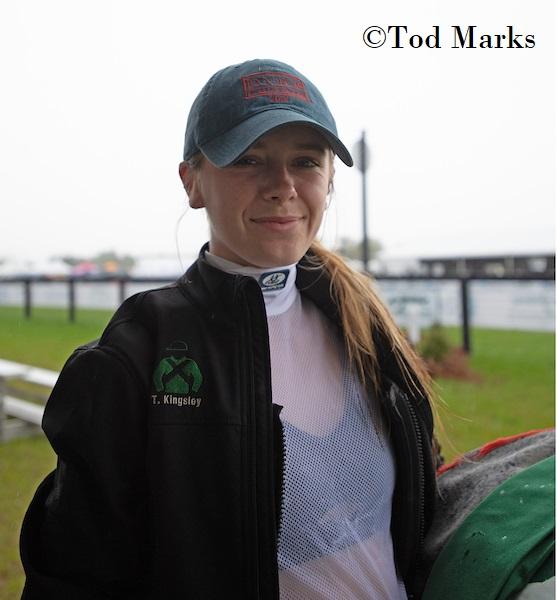
🏇 Taylor Kingsley, 17, is a senior at Camden High. She’s been earning dual high school and college credits this year. This term, she is able to complete her final class – U.S. History 1877-Present, online, managing her schedule to be able to ride out for her father in the mornings. It also allowed her to take a six-week working holiday, part of a TGSF-sponsored training trip to Ireland riding and schooling with trainer Shark Hanlon.
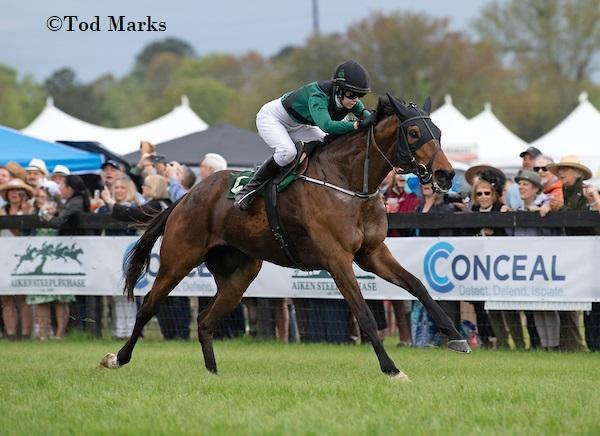
Taylor has won two training flat races under rules – last fall at Charleston and last week at Aiken. (Tod Marks photo from Aiken)
She expects to race over fences soon, though at 115, she’s thinking she might stay light enough to ride on the flat. Several steeplechase riders and trusted advisors have told her that this would be a great way to gain experience and strength.
“It comes down to your fundamentals. Arch says you should be prepared enough that you can ‘just reach into your tool box and pull out the right tool’ because you’ve done your homework. You can call on your basics, because that’s the most important thing.”
| | |
|
Taylor Kingsley riding Cainudothetwist to victory in the Training Flat at Aiken last week.
©Tod Marks
| |
|
|
🏇 George Kingsley rode 25 winners from 150 starters 1995-2002, his first winner, point-to-point and sanctioned, was Mordane for Tim Hansen. In 1998, George won both the owner-rider hurdle and owner-rider timber titles in Virginia – with Murray’s Ruler and Awesome Tan.
His wife, Karen Nutt was an “A” pony clubber, event rider and rode a handful of runners on the flat, over hurdles and over timber in the late 1990s. Today, Karen operates a busy hunt, training and sales barn near Middleburg, Virginia. In addition to working with Karen, George manages a large estate near The Plains focused on conservation and renewing native habitat. He formerly managed the Oak Spring estate developed by the late Paul Mellon.
| |
|
🏇 Archibald Johnston “Arch” Kingsley died in 2015 at age 87.
He was the owner and trainer of Virginia point-to-point Horse of the Year Lenoso in 1964, 1968 and 1969.
He won the Seven Corners Owner-Rider series in 1964 and was 1976 Virginia Point-to-Point leading rider. He trained 1976 champion hurdler Bull Run Draft.
Arch senior rode races 1966-1977.
He was born in Bethlehem, Pennsylvania in 1927. After high school, Arch senior enlisted in the U.S. Navy, graduated from Hobart in 1950, then worked as a commercial pilot for 34 years, flying DC-3s for Capital Airlines and DC-10s for United Airlines.
He was joint-master of the Middleburg Hunt in the mid-1960s.
| |
|
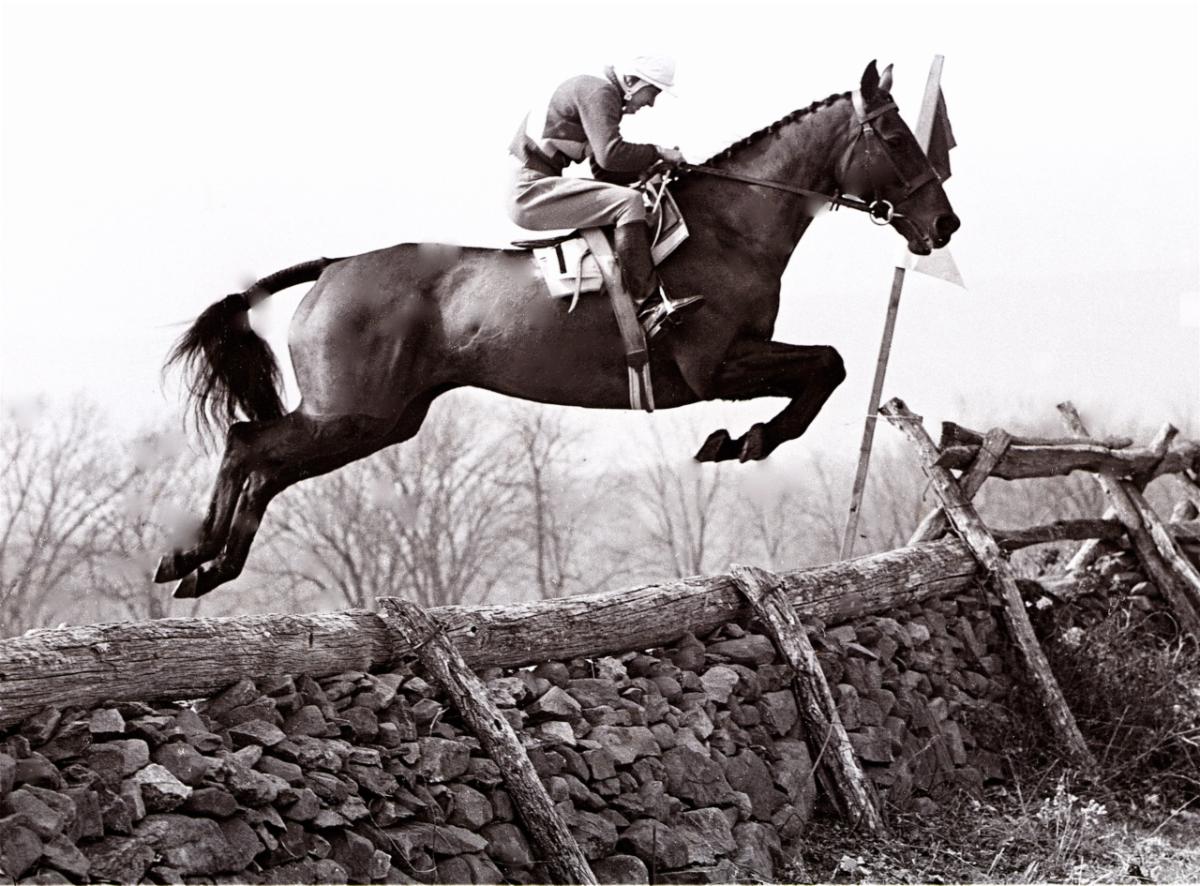
🏇 Kassie Chatfield Taylor Kingsley rode on the Virginia circuit 1967 to 1976, earning ladies’ timber titles in 1968 and ‘69. (Douglas Lees photo of Kassie Kingsley on Ballguy at the Piedmont Point to Point)
She’d grown up in the farm country around Purcellville and Waterford in Loudoun County, Virginia. Her grandfather, Moncure Lyon, was credited with delivering the first residential and widescale commercial electricity to the region through his Loudoun Light and Power Company.
Kassie earned her “A” rating from the Loudoun Hunt Pony Club, After high school, she taught riding at Maryland’s Garrison Forest 1961-’67, then moved back to Virginia where she developed into one of the circuit’s top lady riders.
In 1969, Kassie became part of history – it was the first time women were allowed to ride under rules over fences, and Kassie was first, riding over timber at the Middleburg Spring Races.
Kassie says it was a literal breakthrough. “One day I remember Arch and George were telling Blythe Miller (NSA champ in 1994 and ‘95) that ‘you know, mom made this possible for you.’
“They were sorta joking. But, back then, it was no joke. Women literally weren’t allowed to ride under rules until that year.
“People don’t remember that, but it’s true.”
| |
|
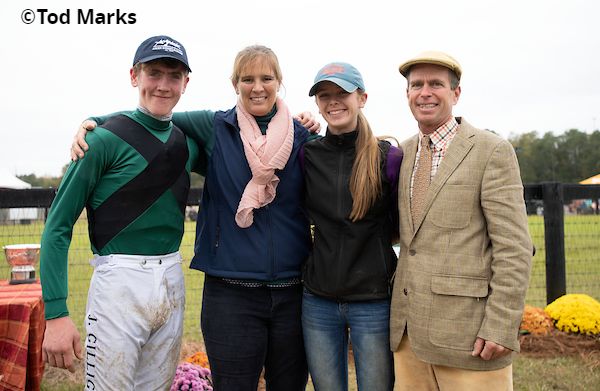
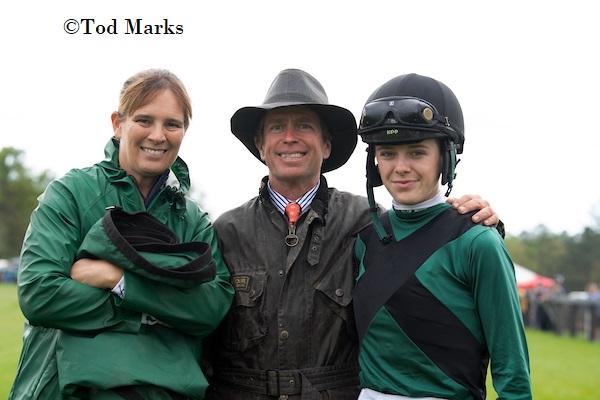
Wendy, Arch and Taylor Kingsley last week at Aiken.
©Tod Marks
| | | | |