Balanced Budget Amendment 
Campaign Update

October 30, 2017
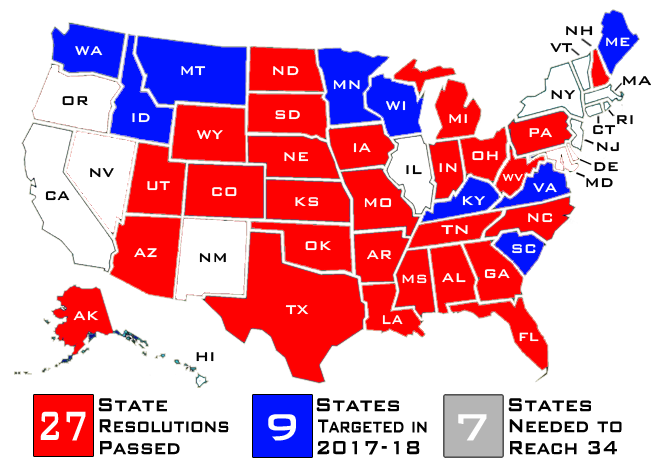
This bi-weekly newsletter provides important information on how to stop America's slide into deeper federal debt through an Article V Balanced Budget Amendment.   Article V establishes the state convention method of amending the U.S. Constitution.  Twenty-seven of the thirty-four states required to call an Article V convention have already agreed to do so.  Please join us in working toward a sustainable economic future for America through an Article V balanced budget amendment.
In this Issue:
Quick Links:
Resource Links:
Addressing False Claims-
Five Myths
About an Article V BBA

By Mark Guyer


Twenty-seven states have passed legislation calling for an Article V convention of the states, solely to draft a federal balanced budget constitutional amendment.  The Congressional Budget Office observes that balancing the federal budget and eliminating the national debt would eliminate our huge interest burden of $400 billion.  That annual interest payment will soon triple as interest rates return to normal and more debt is added.

The C.B.O. also reports that the economic effects of a debt free America would be a tremendous increase in our economic strength and our standard of living.  Balancing the budget make sense.  Let me briefly correct five inaccurate statements about a balanced budget amendment convention.

The Convention might "runaway."
A group of political leaders already has the power of a constitutional convention.  For over 200 years Congress has been able to propose any amendment to the constitution at any time.  Have you ever lost sleep worrying about that?  State legislatures can propose changes to their state constitutions.  Is it too dangerous to allow state legislatures to meet?  A convention of the states cannot change one word of the U.S. Constitution.  This convention can only draft a proposed amendment, which is only effective if later ratified by 38 states.  State legislators calling for the convention voted on the record to consider just a balanced budget amendment at the convention.  These legislators were focused on a critical and fast-growing problem:  $20,000,000,000,000 of federal debt.

The 1787 Constitutional Convention
was a "runaway" convention.
This special convention was more than 200 years ago.  It did not run away.  Historical records show the delegates did what they were asked to do by their states.  As proof, the Confederation Congress voted unanimously to send the proposed Constitution to the states for approval, where each and every state ratified it.  A few misinformed persons call the convention a mistake.  Most Americans believe the convention is one of the greatest achievements in our nation's history.

A balanced budget amendment means
the federal budget will become inflexible.
The need for flexibility has been universally recognized.  For example, all amendments offered in Congress allow deficit spending to cope with problems such as wars, recessions, or national disasters.  With federal revenue increasing on average by 5% a year during the last forty years, no spending cuts or tax increases are necessary.  Reasonable government growth would balance the budget.  National polls consistently show that 75% of voters want a balanced budget amendment.

The wealthy are the ones who will benefit
from a balanced budget amendment.
In a government debt crisis, the poor, the young, and the elderly will be hurt the most.  They depend on government programs.  The Social Security Trust Fund has already been emptied to pay for other government expenses.  The children of America, including your own children, will inherit our massive federal debt.  Shifting our debt problem onto them has been called generational theft.  Do we want our young people to grow up in a bankrupt America?

Balanced budgets are not needed.
Our federal government is the largest debtor in the history of the world.  The debt is now more than twenty trillion dollars.  Government debt in Greece recently caused a stock market crash, 25% unemployment, and riots in the streets.  Debts which cannot be paid always lead to a crisis.  A U.S. debt crisis will be a nightmare for all the people of our country.  The crisis will become the next Great Depression.

Add together enormous government debts, enormous interest payments, banks holding huge amounts of unpayable federal debt, and an ageing population requiring much more spending. This perfect storm leads to a bankrupt government, a financial system meltdown, and economic disaster.  Officials in Washington have, year after year, run up astronomical debts.  What, other than a constitutional amendment, can stop out of control debt and a national crisis?


Mark Guyer is a supporter of the Balanced Budget Amendment Task Force. He believes that organization is doing more than any other to protect our nation from a federal debt crisis.


Delegates in Phoenix
Modeled Convention
Faithful to its Call

by Mae James


Despite the triple digits of a mid-September heat wave, a group of Americans left their daily responsibilities to make a statement.  They gathered in protest just outside the capitol in Phoenix, some in stifling colonial garb and sweaty wigs.  They did that because the Constitution matters.  Protecting the foundational document that has established a uniquely free society in this country for the last 230 years matters not only to politicians, but to every patriot.

 Inside the Arizona State Capitol, another group of Americans gathered for the same reason.  They had also put the constraints of their responsibilities on hold to travel to Phoenix in defense of the Constitution.  In the four days these delegates spent at the Arizona BBA Planning Convention, they both prepared for a future Article V convention and demonstrated that a convention of states could be conducted without threat to the U. S. Constitution.

The sticking point between these two groups was a simple question, and it's one that echoes in statehouses around the country.  Would a convention of states under Article V constrain itself to the scope of its call, or would it "run away?"  Because a national convention of the states had not taken place in over 150 years, arguments on this subject had been largely theoretical or based on precedents set by historical conventions long out of the public memory.  But in Phoenix, the 72 delegates from 19 states provided a tangible demonstration of how legislators would conduct a convention and, crucially, whether or not they would reach beyond the authorization of their call.

In a September 15th article in azcentral.com (part of the USA Today network), Alia Beard Rau summarized the resolution produced by the Arizona BBA Planning Convention.  She wrote:

"There was no formal discussion of exact wording for an amendment.  That would be the purview of the actual Article V convention.  This group in its resolution did restrict the subject of the convention to 'proposing an amendment to the Constitution of the United States regarding balancing the federal budget' and stated that 'the convention and these delegates have no authority to propose an amendment or amendments on any other subject.'  Later in the rules document, it requires approval from a majority of states in attendance at an Article V convention to propose any constitutional amendment.  Each state gets one vote."  

But these conclusions were not arrived at without challenge.  Alia Beard Rau elaborated:

"There was a proposal to allow a convention to change its scope with the approval of two-thirds of the states.  It was withdrawn after heated debate.  [Steve] Smith [R-Maricopa], who opposed the proposal, said it would have allowed, for example, California to propose eliminating the Second Amendment and the convention running with that as long as it had approval from enough other states...  'This is the most important thing we're discussing here this entire week,' Smith said.

"Oklahoma delegate and state representative John Bennett called the proposal a 'poisoned pill.'  'We came here to make sure we didn't go outside the scope of what we're looking at, a balanced budget,' he said.  'If we go outside that scope, it will be a disservice and disingenuous to our constituents.'"

Not only would a violation of the limits of the convention call be disingenuous, it would, according to Robert Natelson in his "Article V Handbook," also render the delegate subject to recall by the state they were meant to represent.  And in the unlikely event that enough delegates would agree to an unauthorized amendment proposal, Congress would have the obligation to disregard that proposed amendment and not select a mode of ratification.  If Congress irresponsibly colluded with the convention in passing the amendment on as legitimate, it is highly unlikely that a three-fourths majority of state legislatures or conventions would ratify that amendment.

Even if this incredible scenario were to occur, the courts could appropriately consider the amendment void.  There are several  firewalls of protection between a convention to propose amendments and a ratified constitutional amendment.  However, the first of its protections is in the faithfulness of its delegates, as demonstrated in Phoenix.

Concluding her review of the convention's limited focus, Beard Rau quoted convention secretary, David Guldenschuh, who said:
"The political and legal realities of a convention of states assure its deliberations will be limited to the scope of its cause.  A runaway convention is a fantasy, a myth, a diversionary argument used by naysayers to keep us from exercising our rights."

There are loyal Americans on both sides of the Article V question.  The country benefits from a thorough discussion of the related cautions and concerns.   However, the planning convention in Phoenix moved the argument from predictions to precedent.  Delegates provided a clear model for the protection of the Constitution (including Article V) in the way they conducted themselves at the Arizona BBA planning convention.

They refused to be intimidated into mothballing the very mechanism that allows them to check federal abuses through an amendment proposal process, and they also refused to expand the purview of the convention, adhering to their instructions and guarding against abuse of power within their own body.

Read Alia Beard Rau's complete article entitled  Phoenix constitutional convention gives 'rebirth to a new nation,' planners say   HERE.

Mae James is the Director of Communications for the Balanced Budget Amendment Task Force.

 
Let's Make the Article V  BBA a Reality!

The time has come for an Article V BBA.  Common sense dictates this solution, the Constitution provides the means, and responsible leadership from the states support it.  However, the opposition is determined to fight our efforts by playing on the fears of those unfamiliar with the legitimacy, precedent and protections inherent in the Article V convention process.  We need your partnership in fighting the misinformation and in demonstrating support for an Article V BBA.  Thank you for considering taking part in this important work to restore America's economic future.
 
DONATE TODAY

The BBA Task Force, a 501(c)(4) non-profit, non- partisan organization, was founded to help facilitate the proposal and ratification of a balanced budget amendment to the U.S. Constitution. We have 27 of the 34 state resolutions necessary to call an Article V Convention for the limited purpose of proposing a Balanced Budget Amendment. We also have legislative sponsors in 9 additional states, which puts us within striking range of the needed 34! 
To help us with a financial gift, please click on the donate button to contribute online, or mail your donation to: Balanced Budget Amendment Task Force, 2740 SW Martin Downs Blvd. #235, Palm City, FL 34990. (Donations are not tax-deductible.)
 
VOLUNTEER TODAY
To help us by donating your time and effort, please click on the volunteer button.  We need grassroots activists in our target states to call, email, and visit their state legislators. If you live in one of the 9 blue states below or would be willing to lobby in a target state, we would love to have your help.