Santa Maria in Domnica, the Navicella Fountain, and the Sphinx of the Caelian, San Stefano Rotondo | |
|
Today we finish our walk on the Caelian Hill with visits to the Navicella Fountain, Santa Maria in Domnica, and San Stefano in Rotondo, known as the Sphinx of the Caelian.
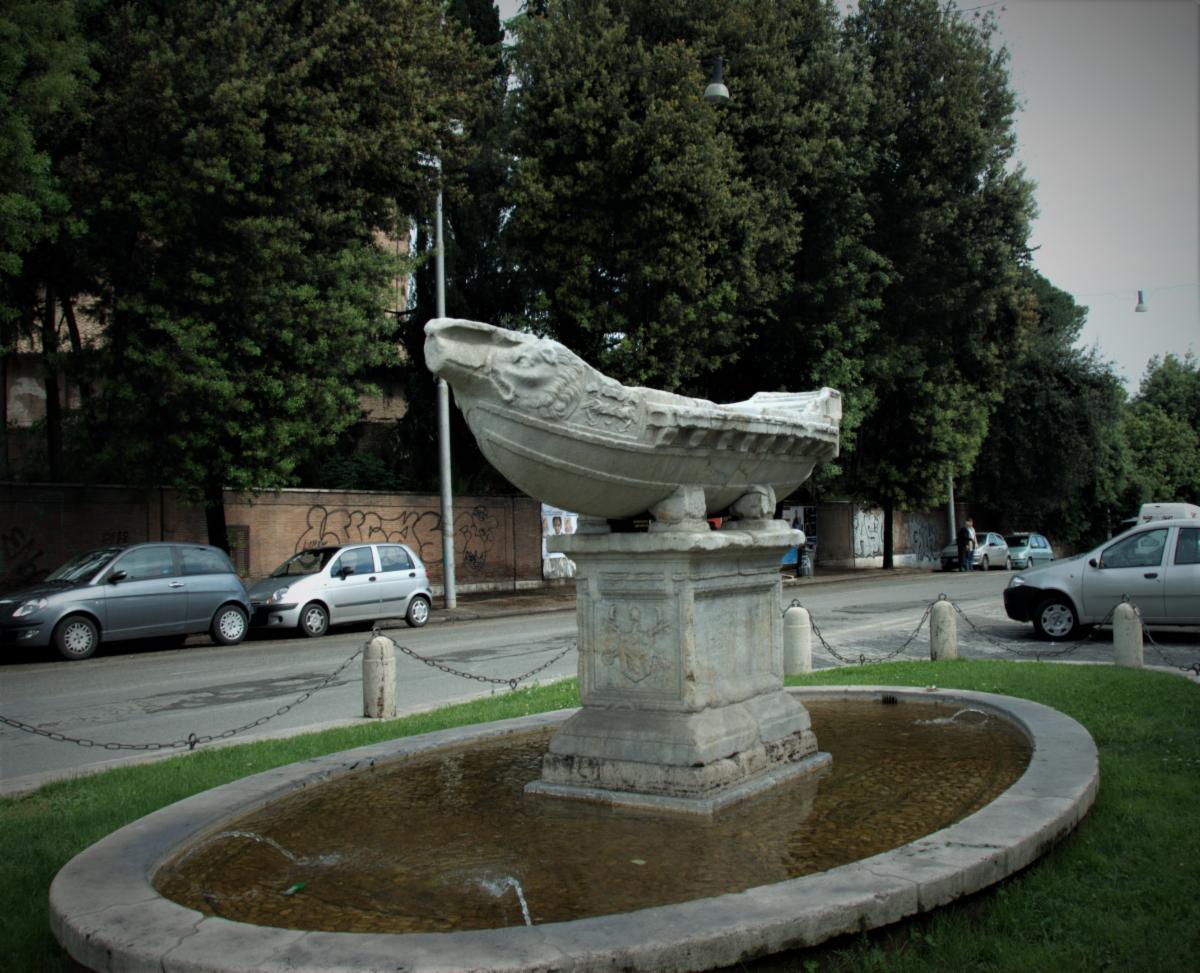
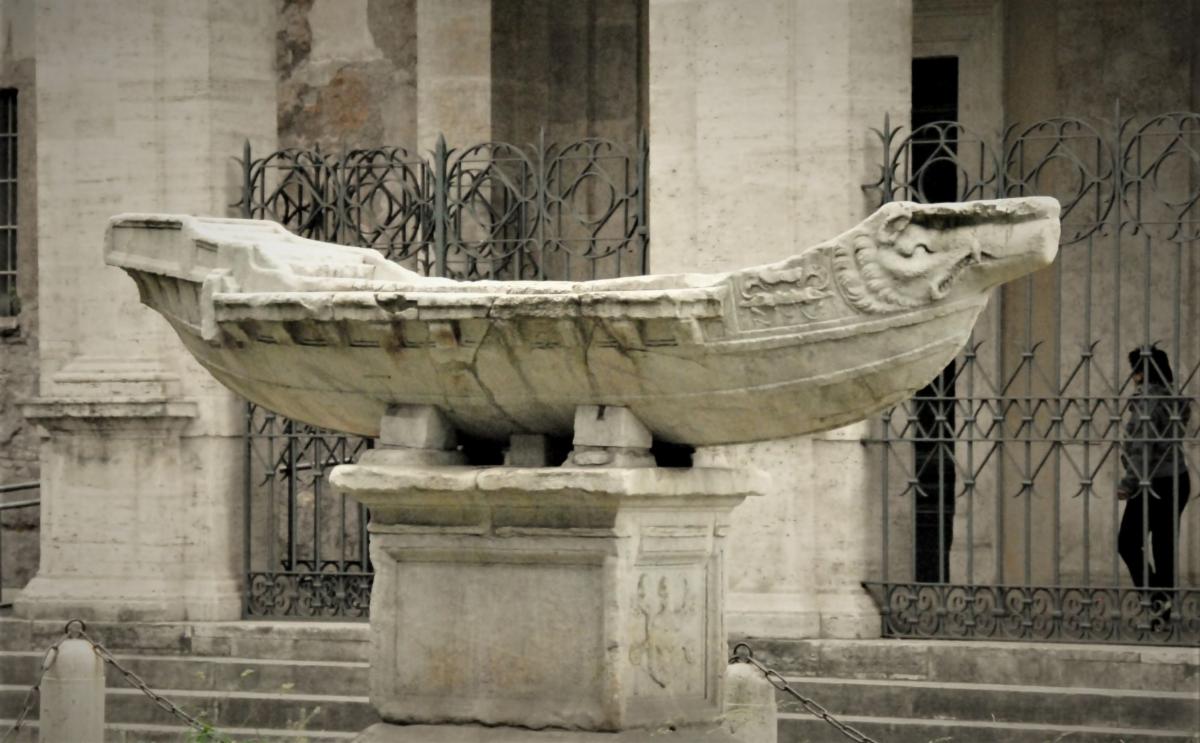
The Navicella Fountain is named of course for the statue of the Navicella, which anchors both the street and piazza of the same name. The fountain was put up by Cardinal Giuliano Medici, just before he was elected Pope Leo X Medici (1513-1521). Models of ancient Roman ships had been discovered during excavations in the gardens of the Villa Celimontana. These models were ex voto, or offerings of sailors who had returned safely after hazardous voyages. The headquarters of the navy corps that tended to the velarium or collapsible sail roof over the Colosseo was near here. Many in the corps were adherents of the cult of the Egyptian goddess Isis, who was protectress of ships at sea (Isis Pelagia, or “Isis of the Sea"), and she was a favorite of the Flavian emperors. The corps dedicated a replica of a ship in her honor and placed it at their quarters. Others say the votive offering was to Jupiter Redux, who had a temple nearby. Still others say the ship was found in the ruins of the Castra Peregrina, the barracks for soldiers assigned to Rome to guard the corn supply.
| |
|
Pope Sixtus IV della Rovere (1471-1484) had one of these original model ships put up in the piazza in front of the Domnica Basilica. That one somehow went missing, and so Pope Leo commissioned Andrea Sansovino1467-1529) in 1513 to make a faithful replica (not sure how he was able to accomplish that when the original was missing!). We can see the Medici palle on the rectangular pedestal.
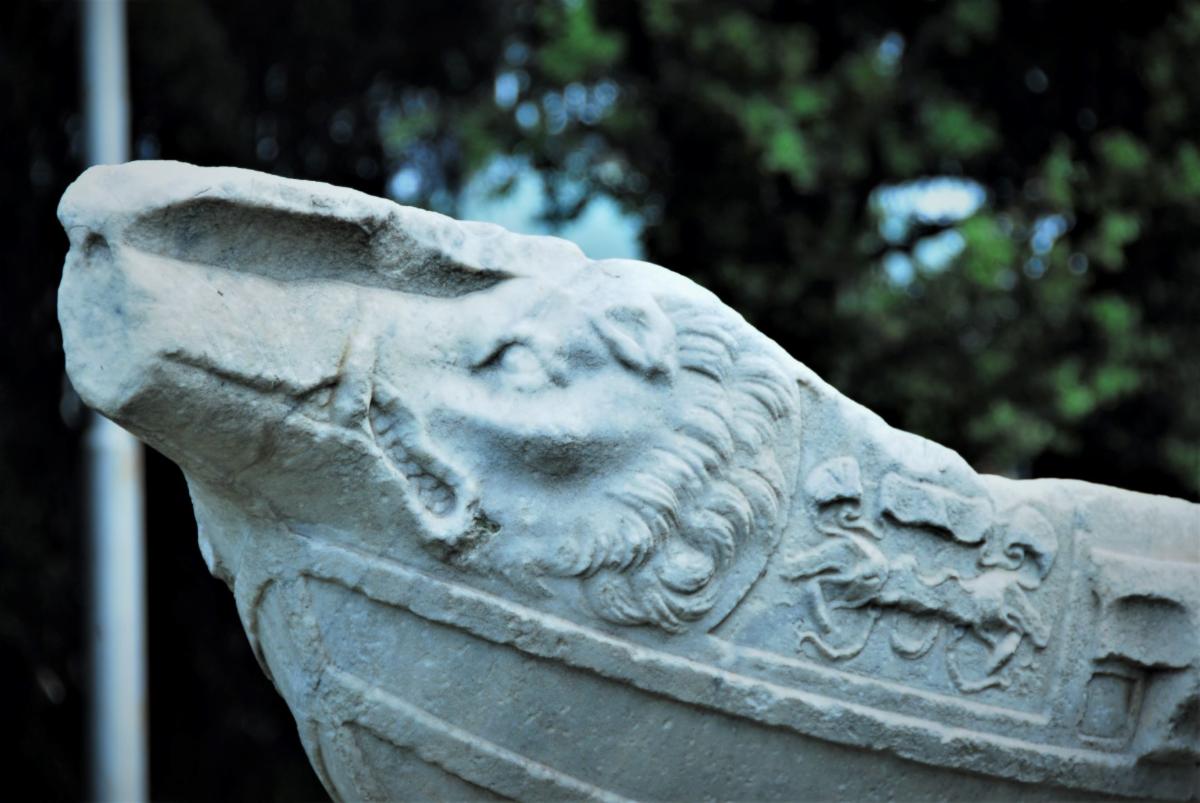
The prow is in the form of a boar’s head. Historians have learned quite a lot about the structure of Roman ships from the replica. When the Navicella was first put up, this area was “dry” with no surviving aqueduct to provide water for a fountain. When the Aqua Felice was built by Sixtus V (1585-1590), water was probably here, but it may not have arrived until the Felice ducts were extended in the twentieth century. The circular basin came at the same time as the water. Not much flows today, as you can see.
| |
Santa Maria in Dominica may owe its name to the Byzantine family that had a branch in Rome, or it may just be a derivation of the Latin name for church, “domnicum.” The Roman Latinist Tyler Lansford thinks it comes from "dominica praedia" or "on Imperial property." But I like to think it is named for Saint Cyriaca, who was known as Domnica, “of the Lord.” She was a Christian Roman widow, patroness of Saint Lawrence the Deacon. Lawrence used Cyriaca’s home on the Caelian to distribute alms to the poor, a diaconia. It was Cyriaca who buried Lawrence on her family’s property in the catacombs at what was to become San Lorenzo fuori le mura. Cyriaca was martyred too, and she was buried at Lorenzo as well, and now the catacombs there are named for her. The Church is home to the relics of Santa Balbina, according to the venerable Augustus Hare, which seems odd as Balbina has her own church on the Aventine. | |
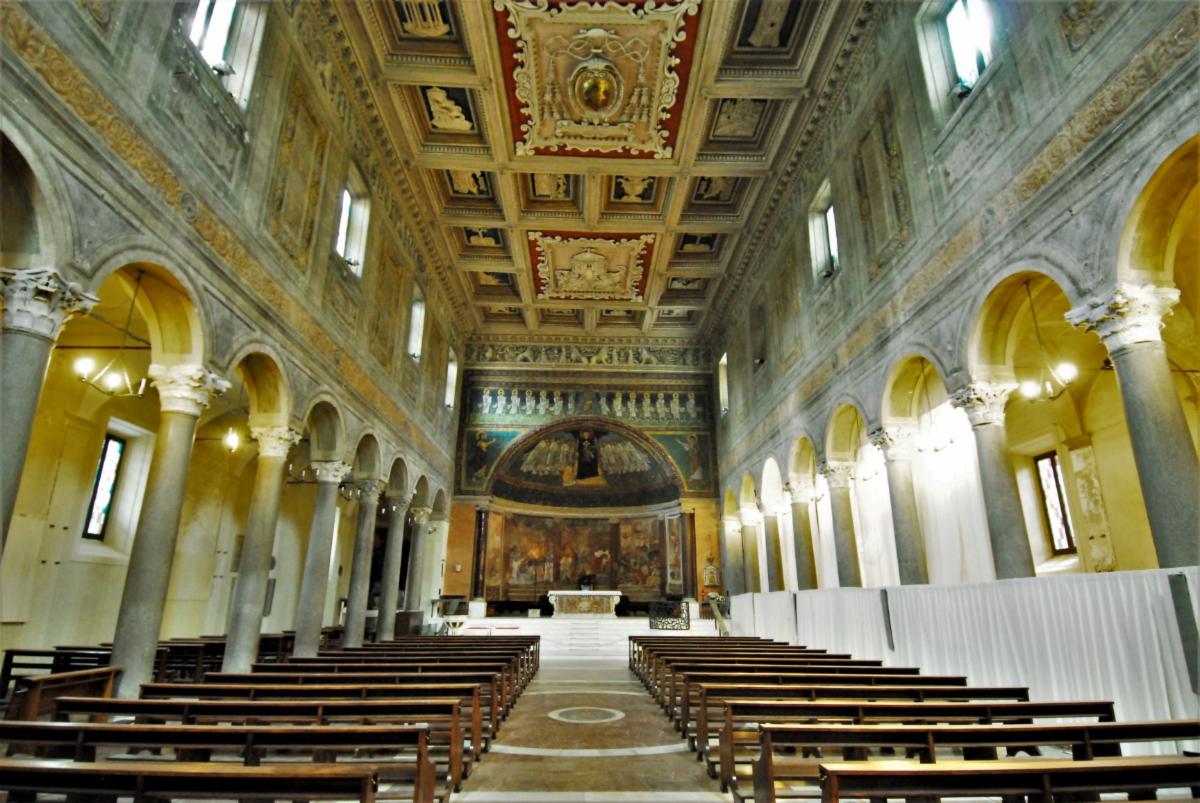
The earliest church at the Domnica was built in the fourth century over or within Cyriaca’s home. It was a diaconia, or a building—sometimes with a place of worship--as a distribution center for the poor, and so an archdeacon had his residence here. Paschal I (817-824), basking in the sunshine and revival brought by Charlemagne, built or rebuilt three churches—Cecilia, Prassede and the Domnica, and gave each an apse and triumphal arch adorned with beautiful sparkling mosaics. Here at Domnica Paschal rebuilt the original church, retaining the eighteen granite columns of the original, which were probably spoila taken from a Caelian palace or temple. He modified the sanctuary by adding a small apse at the end of each aisle, a “Syrian arrangement.” Emile Male. Paschal brought the mosaicists from Constantinople, or perhaps the Greek enclave at Ravenna, and it may be they were iconoclast exiles living in the Greek quarter in Rome, the Schola Graeca. The mosaics have unmistakable Byzantine attributes. We find Paschal's name next to Mary's close to the end of the apse inscription--VIRGO MARIA. | 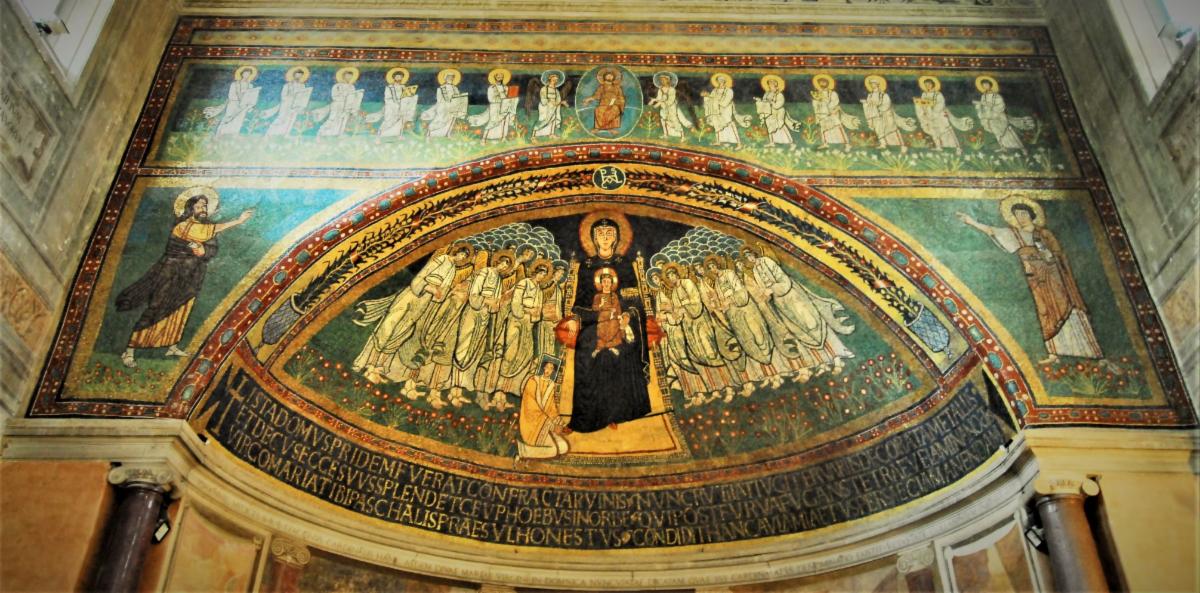 | |
|
Walter Oakeshott gives the mosaics of the Domnica high praise. “The design is original, and unlike anything else in Rome, while the colour is enchanting.” The restorations c1950 left the tesserae almost completely in place but increased immensely the brilliance of the many colors. The individual tessera are now “clean and vivid,” replacing the “uniformly drab effect” of the original. The backgrounds are of different colors: the Triumphal Arch has a frame of gold against two shades of green, then additional bands of blue and green. In the apse we have deep blue above and green below.
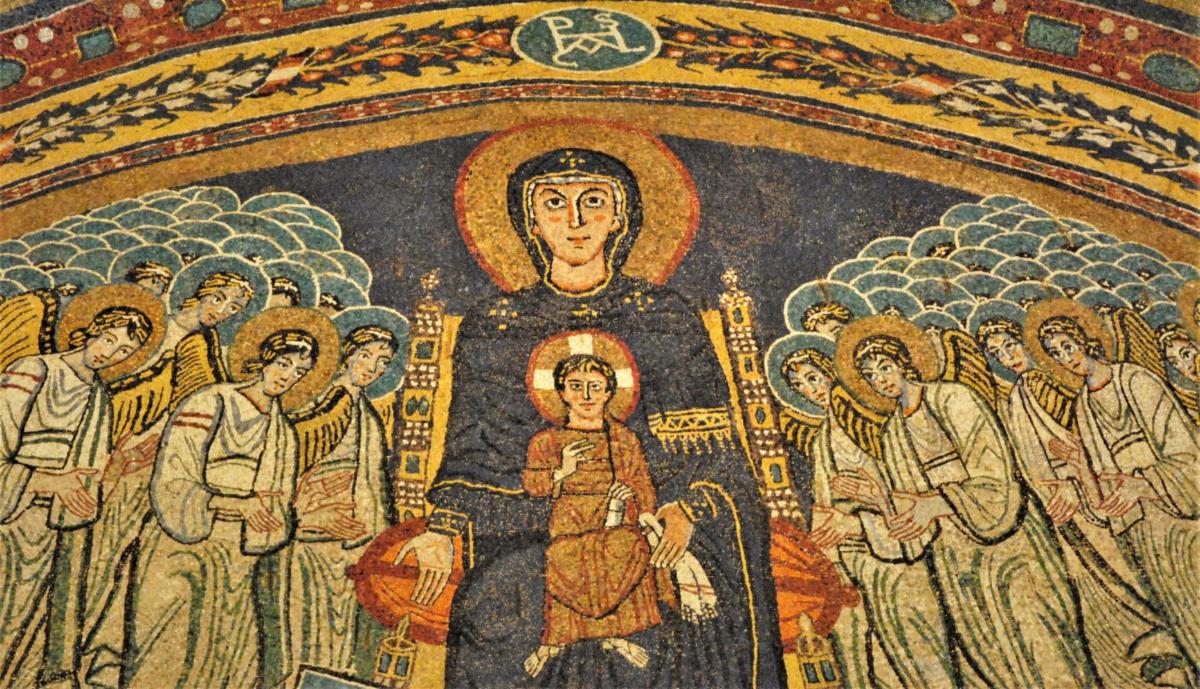
In the apse mosaic, Mary and Jesus are seated on a throne, glorified by a throng of angels, stacked one upon another, seemingly into infinity. The white-robed angels form a guard of honor on each side, giving the impression of “an army in deep formation.” Male. The device of superimposed haloes is a completely eastern device. The Byzantine’s had forgotten the Greek science of perspective, and so they substituted placing figures one on top of another to create depth in their pictures. Notice that the center does not recede as it should but rises up. This “return to the child-like art of past ages was a fortunate error” at the Domnica, creating for every visitor a lasting impression of the army of angels protecting the Virgin and Child.
| |
|
The throned Mary is purely Byzantine and looks almost identical to the Mary at Santa Sophia at Salonica. She sits on a red cushion, clothed in a deep blue, another shade of blue behind. This is the first occasion in Roman mosaics in which Mary occupies the place of honor. Mary holds the elegant mappa, the “fringed handkerchief of a Byzantine court lady.” Georgina Masson. Theodora’s lady in waiting holds one of these mappa in the mosaic in Ravenna. Male. The pope, wearing the square nimbus showing us he was still alive, is kneeling, and in Byzantine supplicant fashion, grasps the Virgin’s foot. Also note the poppies in the garden, with red spots which “allude to the blood shed by martyrs.” Elizabeth Lev.
The Triumphal Arch has Jesus with His Apostles. He sits in a mandorla on a rainbow, taken from Ezechiel where the prophet compares the light of heaven to a rainbow. The Apostles march with their books toward the Lord, careful to veil their book with a napkin, again an eastern device. The artist shows us his skill with his very finely drawn folds in the Apostles’ tunics. The Greek influence can also be seen in the form of blessing-- Jesus and the Apostles assume the Greek form, their thumbs pressed against the third and fourth fingers. The two fourth century porphyry columns of the Arch are some of the best we will see in Rome.
| |
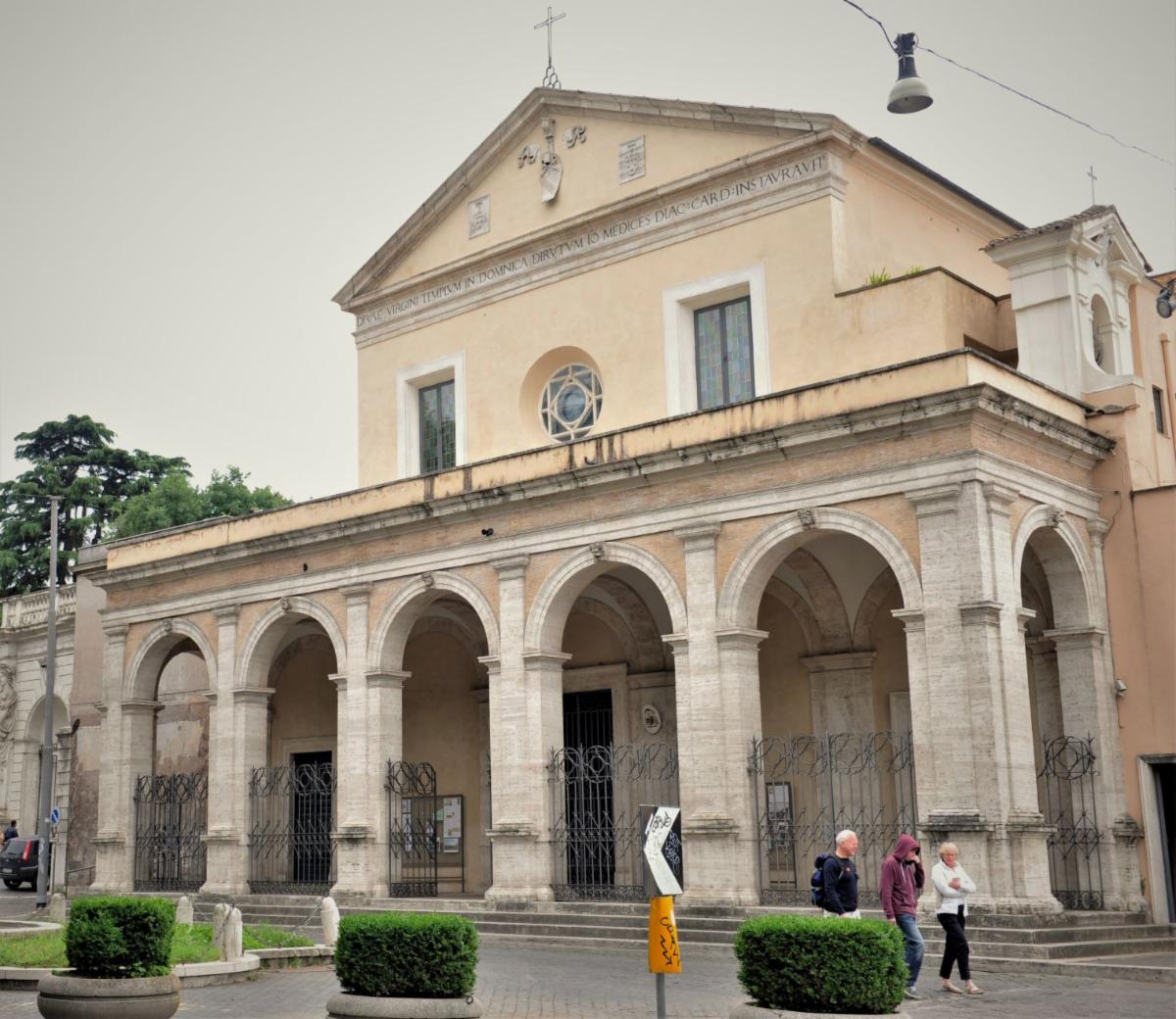
The Typanum has the crests of the Cibo Pope Innocent and the Medici Cardinals, and the inscription records the restoration under the Medici Diaconate Cardinal | |
|
Leo, whose family held the titular here, brought Andrea Sansovino to the Domnica to restore the porch and make a new façade (and also for the Navicella ship). The five arches with travertine Tuscan pilasters, and the two square and one round window give us a good example of classical architecture with its graceful proportions (some mistakenly ascribe the porch to Raphael). The arms of Innocent VIII Cibo (1484-1492) (who appointed the Medici Leo as Cardinal at age 13) and in whose reign the renovations began, are in the tympanum, while the arms of Giovanni and Ferdinando Medici are at the sides.
Leo also had Perino del Vaga (1501-1547) fresco around the tribune, giving us lions (for “Leo”) in a trompe-l’oeil, and undistinguished bands of garlands.
The Domnica is the station church for the second Sunday in Lent.
| |
|
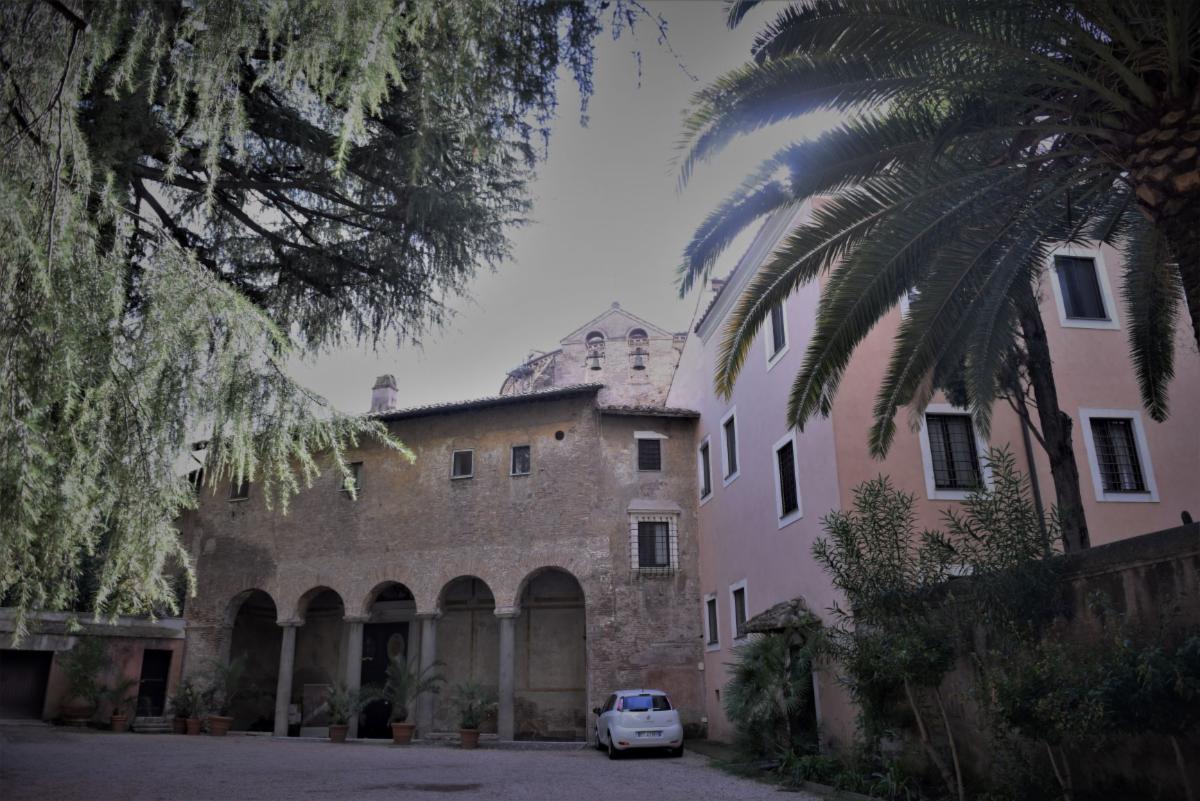
Now we cross over the Piazza Celimontana (I call it the Piazza Navicella) and the somewhat dangerous Via della Navicella, to the Via di Stefano Rotondo, the church a little way down on the right. We turn at the sign for the church, looking down a rundown driveway at the end of which is a plain brick arcade. This is all that we will see of this wonderful church from the outside. Inside it is an absolutely stunning treasure. We see off to the right of the driveway behind the barricade a spacious and lush garden. No entry I am afraid.
The church was originally thought to be on the site of the Marcellum Magnum, or the great marketplace of Nero. Excavations c 1960 however found no trace of a Marcellum and date the building to the fifth century and Pope Simplicius (468-483), who reigned in the final days of the Western Empire. Perhaps the sack of the Goth Alaric in 410 razed the Marcellum to such an extent that even its supporting substructures were destroyed or had to be removed.
The Empress Placidia, daughter of the Western Emperor Valentinian III, and granddaughter of the grand dame Galla Placidia (daughter of Theodosius), had been taken prisoner to Africa by the Vandals after their sack of Rome in 455. She was ransomed by the Eastern Emperor Leo I in 461, dying in Constantinople in 484. Pope Simplicius asked the Empress for the site the church now occupies, perhaps because it was Imperial property and the site of the Roman Marcellum; the pope intending to construct a church there. The Empress conceded the title on condition that the church be dedicated to the protomartyr Stephen, to whom she was greatly attached. We presume Placidia sent Simplicius relics of the Saint for the altar of the church.
| |
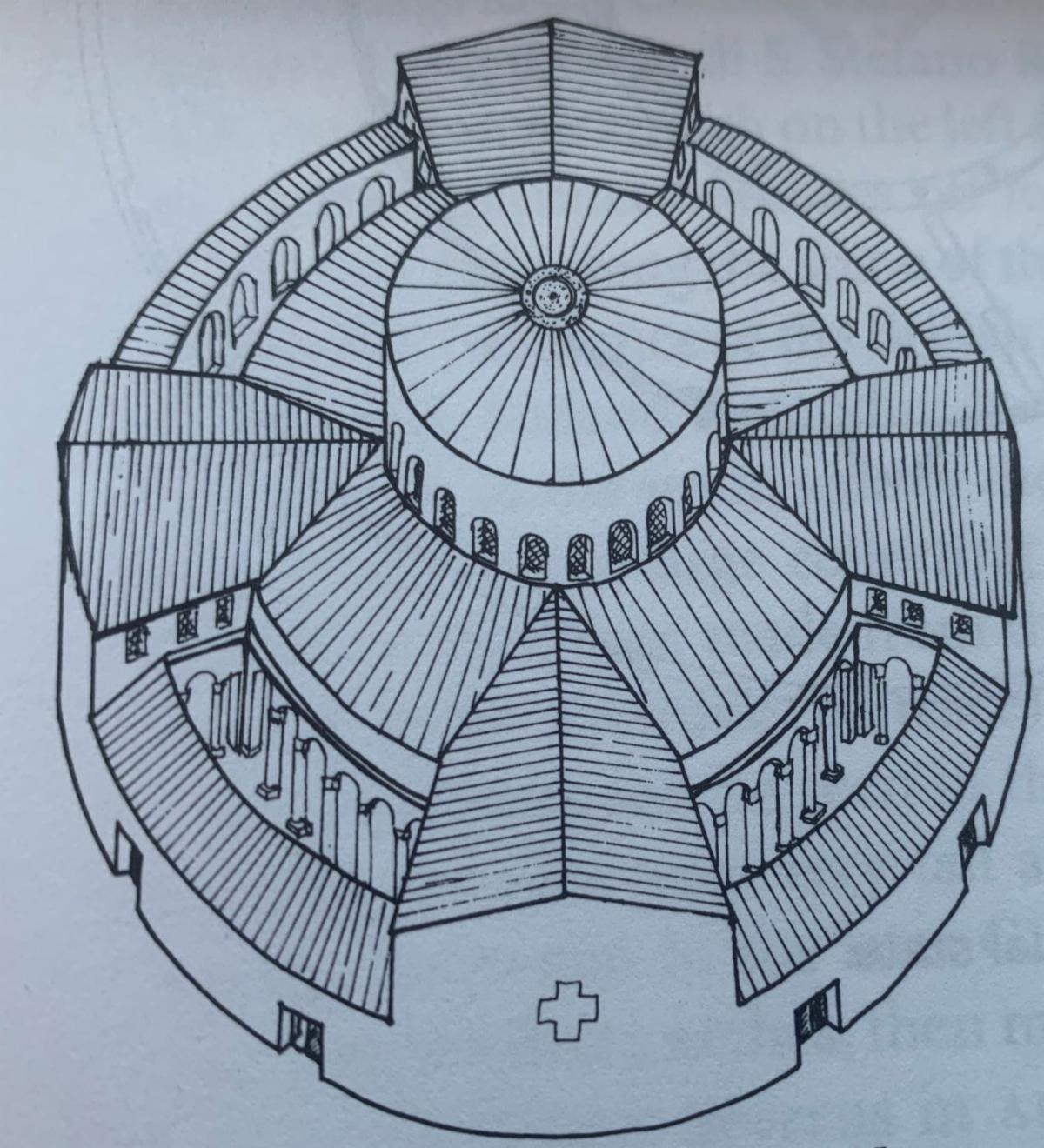
Simplicius' 5th century Basilica. This would certainly be one of Rome's most unique churches if it could be completely restored. Most of what we see in this drawing is still here, but all is hidden behind trees and other buildings. The third outer ring is no longer with us, with its excedras and courtyards, and pools and fountains. This diagram is from Amanda Clardge's incredible book on Rome's Archeology. Richard Krautheimer has what seems the same diagram, attributed to Spencer Corbett. | |
The Liber Pontificalis tells us that Pope Simplicius built and dedicated the church we see today, a remarkable feat in the tumultuous times of the barbarians Ricimer and Odoacer, who took turns ravaging the city until its final fall in 476. Emile Male beliweves the pope was copying the Basilica of the Holy Sepulchre in Jersusalem.
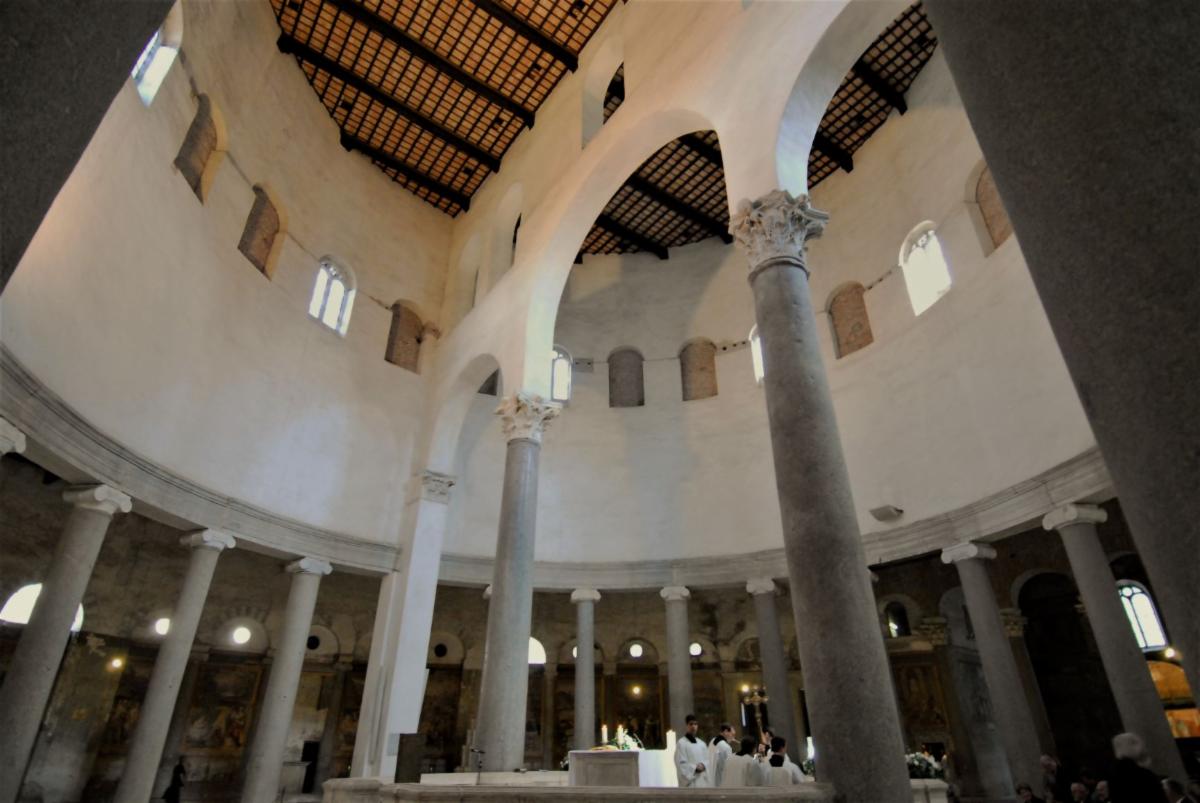
Because of its unusual structure the church was called from the outset the “Sphinx of the Caelian.” It has a large central tower-like drum with twenty-two windows (originally glazed with colored alabaster), supported on twenty-two spolia columns of grey granite with 5C Ionic capitals and travertine plinths. There would have been a dome, probably made of cane. Richard Krautheimer.
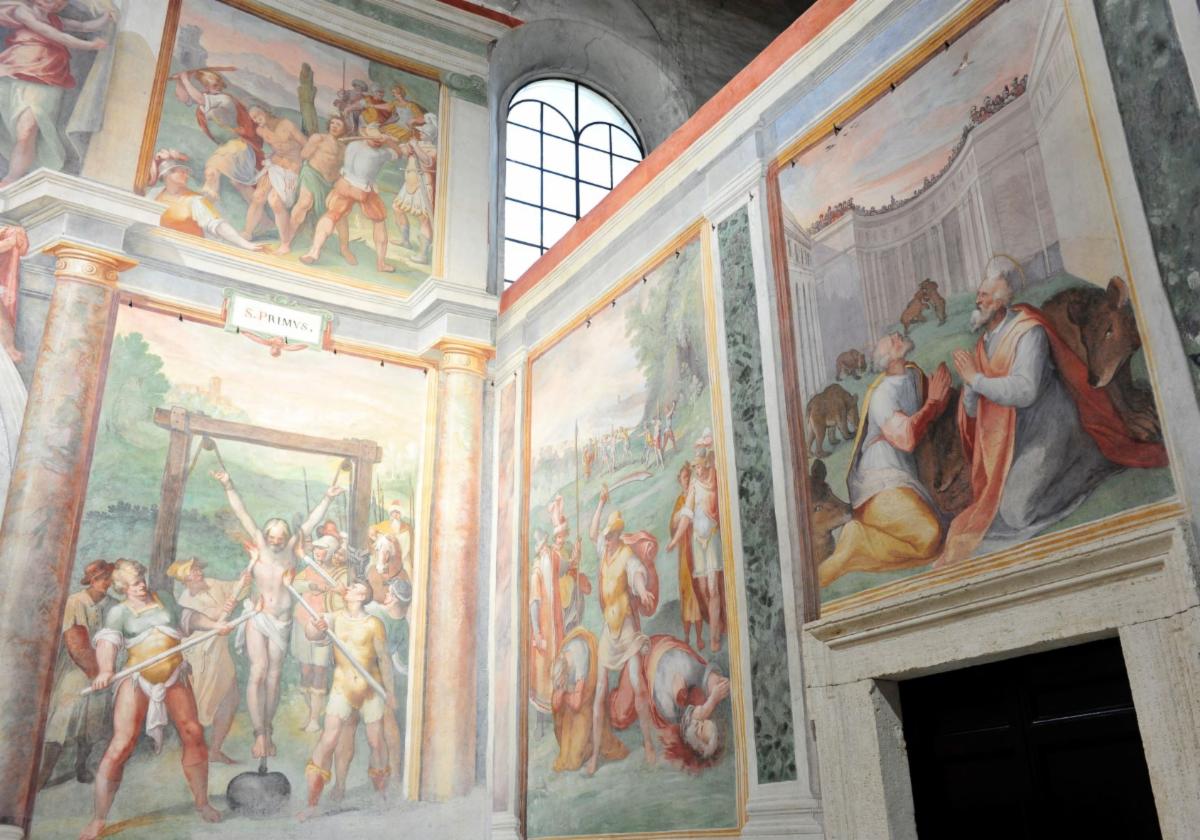
Outside the central hall is the Ambulatory, bordered by a second concentric cylinder (where we now see the ghoulish sixteenth century frescoes of martyred saints), which in Simplicius’ construction had forty-four open arcades which stood on eight masonry piers and thirty-six columns. Beyond the Ambulatory was yet a third ring, with the space divided into eight parts-- “four exedras on the cross axes” and “open courts on the diagonal axes.” Amanda Claridge. The Northeast exedra is the only one left standing, it is now the Chapel of Primus and Felicianus.
The open courtyards between the exedras were filled with fountains and pools and entrance corridors. The outer ring would have been enclosed and paved in concrete.
The decoration was probably not completed until the sixth century. It was splendid, an amazing achievement in the midst of the collapse of the Empire and the Gothic Wars. The nave had marble revetment, as did the exedras/chapels, with painted plaster above that, and alternating marble and mosaic pavements, and “elegant stucco profiles on the archivolts between ambulatory and courtyards.” Krautheimer. Regrettably all of this has been lost through the ages. But the main structure has survived almost intact, save for the exedras and the courtyards, which were demolished, leaving an outer perimeter wall of about 6m in height.
Innocent II (1130-1143) put in transverse arches (pink Aswan granite) in the central drum in order to reinforce the sagging vault. The choir is a later addition too. Either Innocent or 1453 Nicolas V (1447-1455) walled in the Ambulatory by filling in the arcades, leaving us today the central drum, Ambulatory, chapel, and entry.
In the modern entrance, we take in the four columns of the arcade. There is a little statue of Stephen holding the stones of his martyrdom above the interior door to the nave, and below this is an inscription of Nicolas V of 1453 recording his restoration.
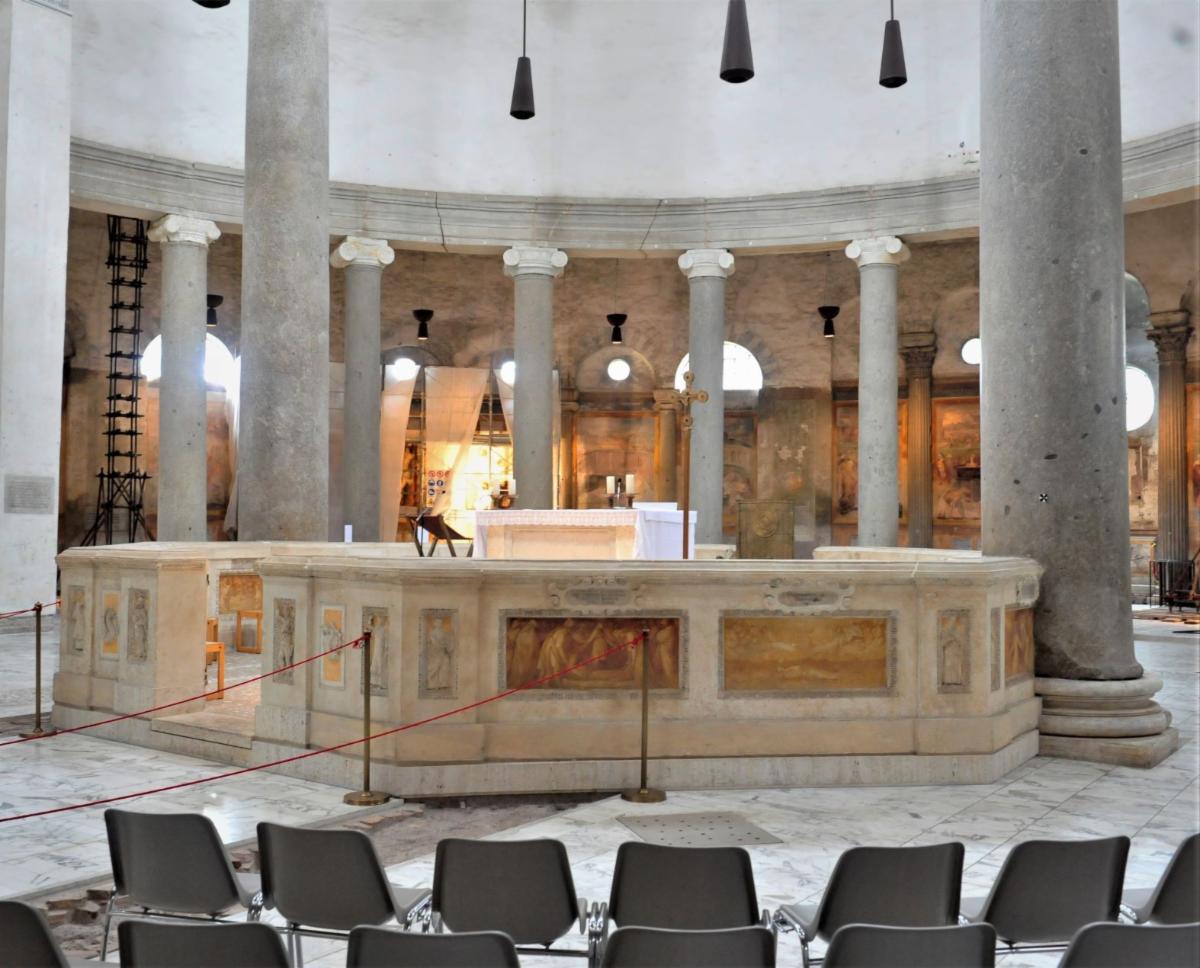
As we come into the ambulatory, we encounter an all-encompassing whiteness. The new white marble floor draws us to the gleaming white central drum For several decades the church was closed, reopened in 2007 (I was lucky to visit during the inaugural mass). The restoration replaced the roof, the floors, and restored the Chapel of Primus and Felicianus.
|  | 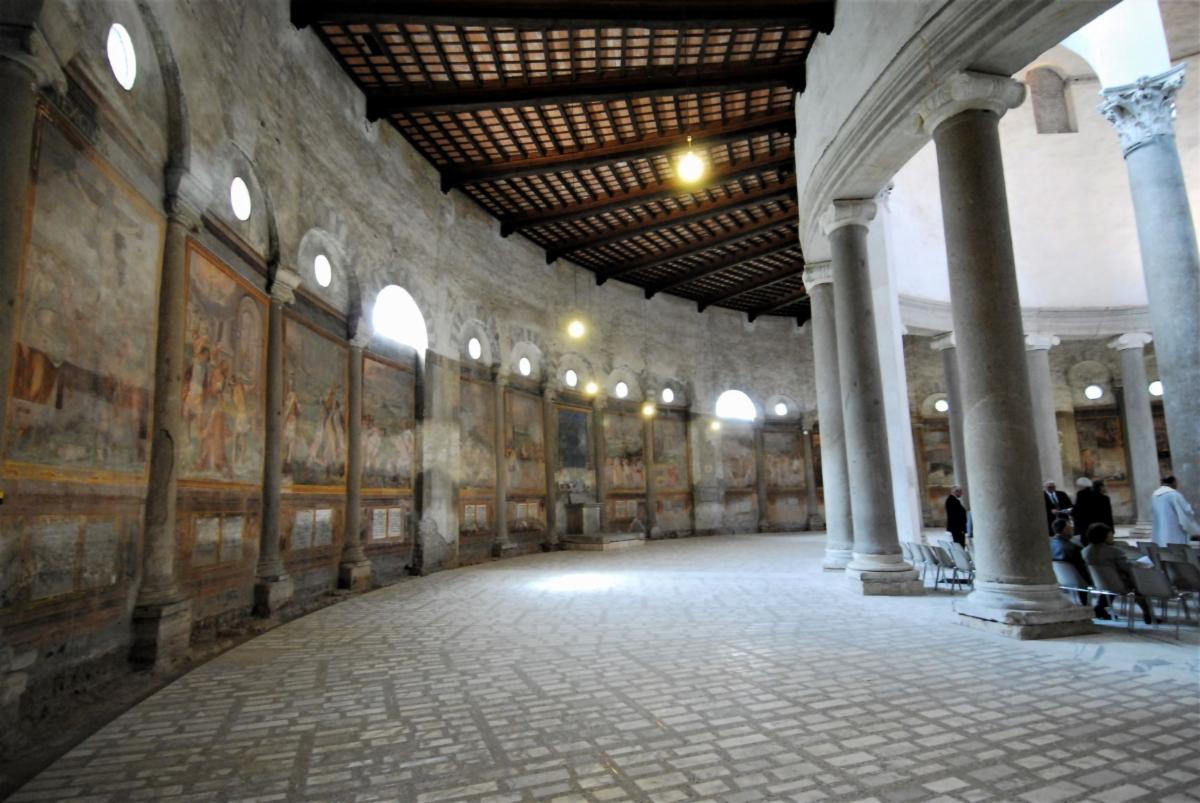 | The Ambulatory with the restored floor. You can see the walled up arcade. If only it could be opened again! The walls are now filled with gruesome scenes of martyrdom. Still Rome's best Ambulatory! | The buttressing of the twelfth century. You can see that not many of the clerestory windows are open. | The choir is a later addition | 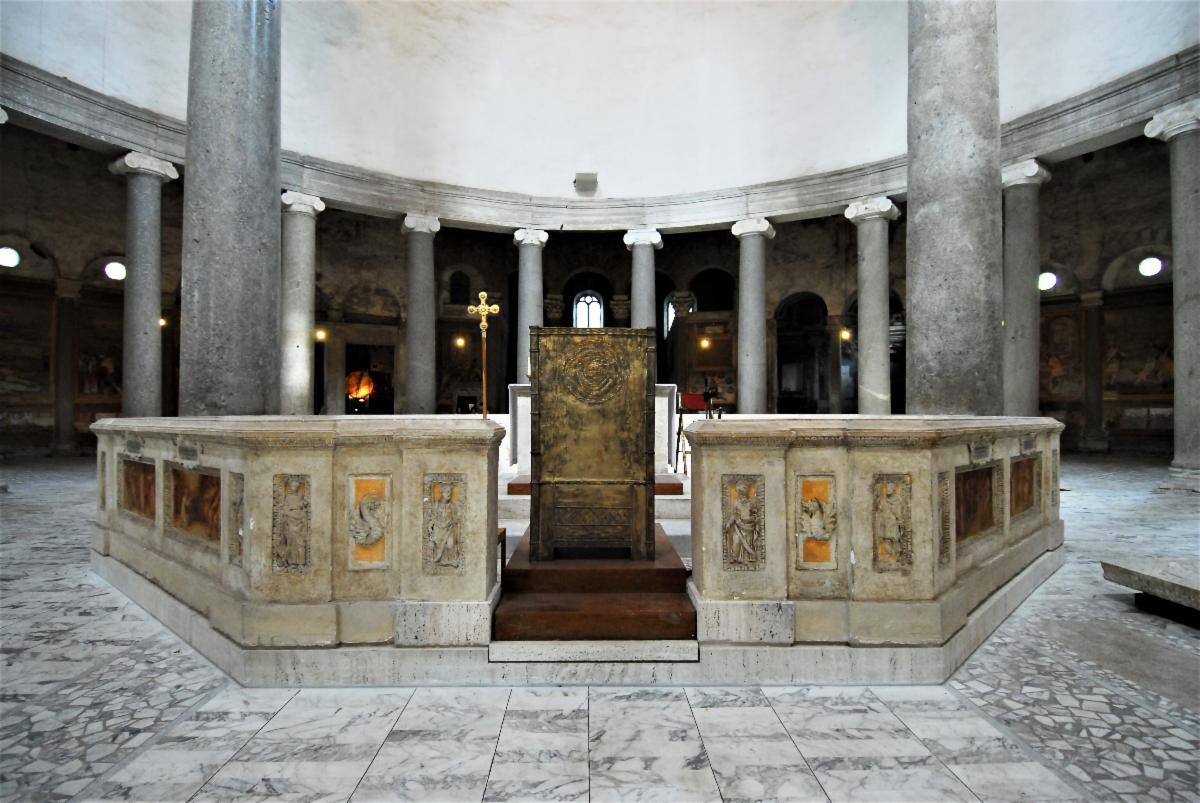 | |
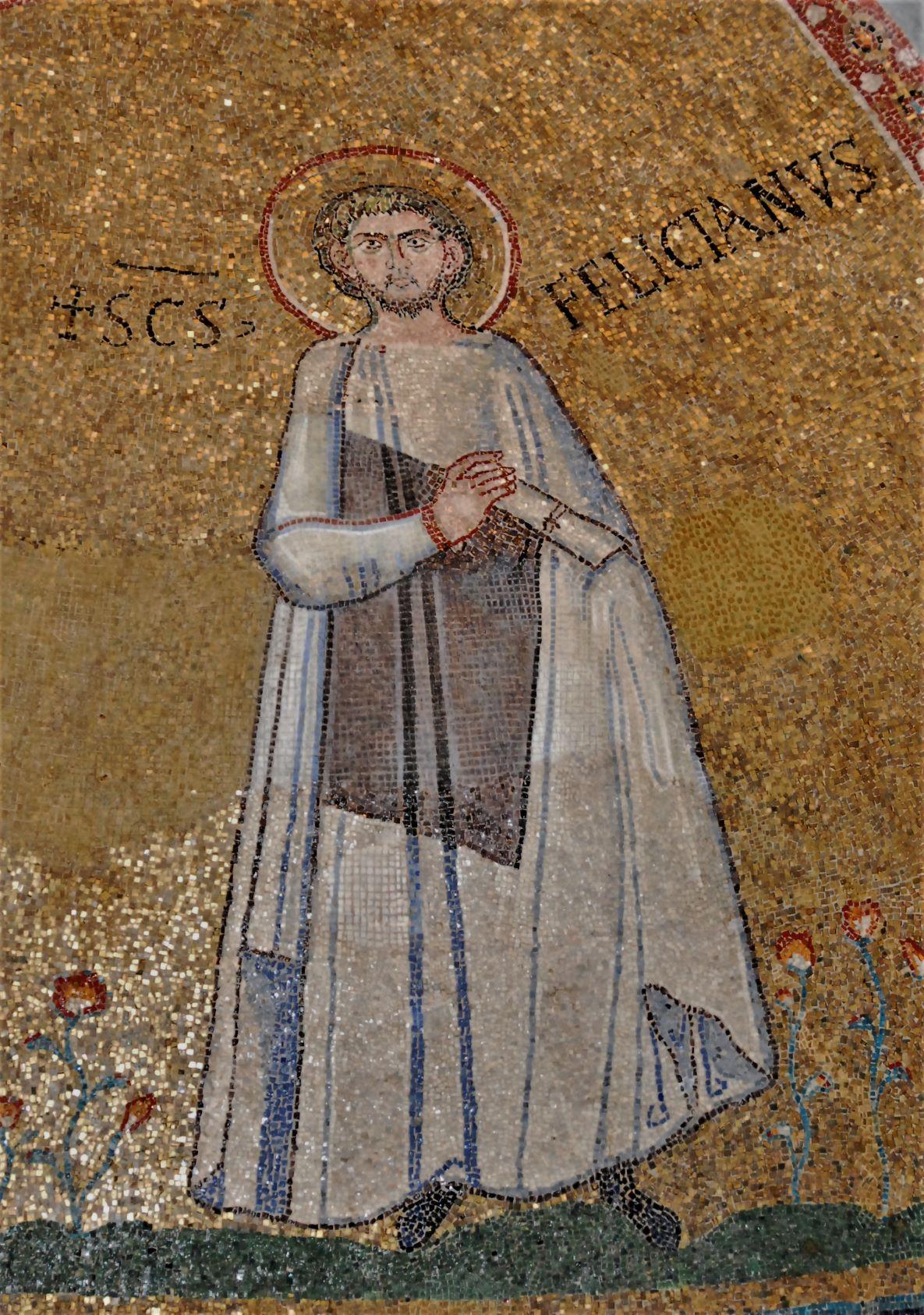
The Chapel of Primus and Felicianu is sometimes called the Chapel of the Holy Cross of Golgotha. The two saints were martyred under Diocletian and Maximian in 297. The Syrian Greek Pope Theodore (642-649) had their relics translated from the catacombs of Sant’Agnese on the Via Nomentana, the earliest recorded translation of martyr relics from the catacombs.
Theodore’s father had been the bishop of Jerusalem, he himself was perhaps born there. He fled to Rome ahead of the Muslim jihad, was appointed a cardinal deacon c640 and a full cardinal by Pope John IV (640-642). He was elected pope in 642 with the support of the Greek Exarch in Ravenna.
During the thirty years prior to Theodore’s pontificate, Jerusalem had been savaged, first by the Persians under Chosroes in 614, who destroyed Constantine’s Anastasis, Martyrium, and the great Cross of Golgotha with its mammoth canopy. Chosroes carried off the sheathed True Cross to Persia. The Eastern Emperor Heraclius (575-641) succeeded in defeating Chosroes and the Persians in 628, and he retook Jerusalem and recovered the True Cross, which he returned to Jerusalem. The Rotondo of the Anastasis rose again, as did the basilica of the Martyrium and the Cross on Golgotha, though they were on a reduced scale.
| 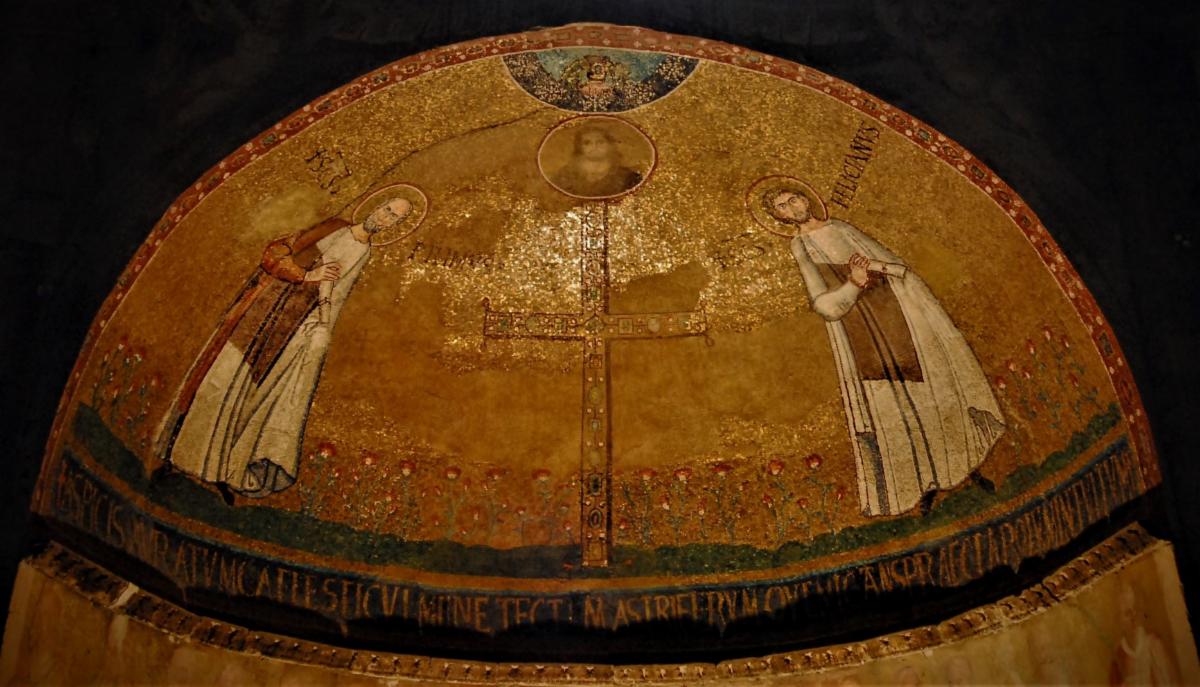 |  | The figures of Primus and Felicianus are “marvelously fine,” the heads and hands are of stone versus the glass of the tesserae in the rest of the mosaic. The heads of the saints are “highly individualized.” The two saints are in original condition and of “superb quality.” Oakeshott. The two saints' heads in this mosaic hold an important place in the historical march of the Christian mosaics, perhaps the last that bear the classical stamp until the early Renaissance. | Later day frescoes of the lives of the two saints and their martyrdom in the Colosseo | |
Three years later a fresh invasion came to the Holy Land—the jihad of Mohammed. Heraclius returned to Jerusalem and carried off the True Cross to the safety of Constantinople. In 638 the Khalif Omar sacked the city, and the crosses of the Christians came down again.
Theodore would have known of all these calamities, and of the “humiliation of the Cross.” Emile Male. The papacy was “wounded to the heart.” The Cross of Golgotha had many traditions and legends associated with it: it rose in the very center of the Earth, the mid-point of the Universe itself, with the sun and the planets revolving around it (Dante recounted the tradition in his Purgatorio, Canto II, 1-6). The Cross was sunk into the earth at precisely the spot where Adam had been buried, and the Altar that Abraham had set up for the sacrifice of his son was here as well.
The Cross in the apse mosaic that Theodore made for the Chapel of Primus and Felicianus replicates the Cross at Golgotha. The Golgotha Cross was of gold, with precious stones set within it. It was protected by a canopy, which had a cupola decorated in gold and mosaic, with a bust of Christ above the Cross. All of this Theodore reproduced in his mosaic.
| 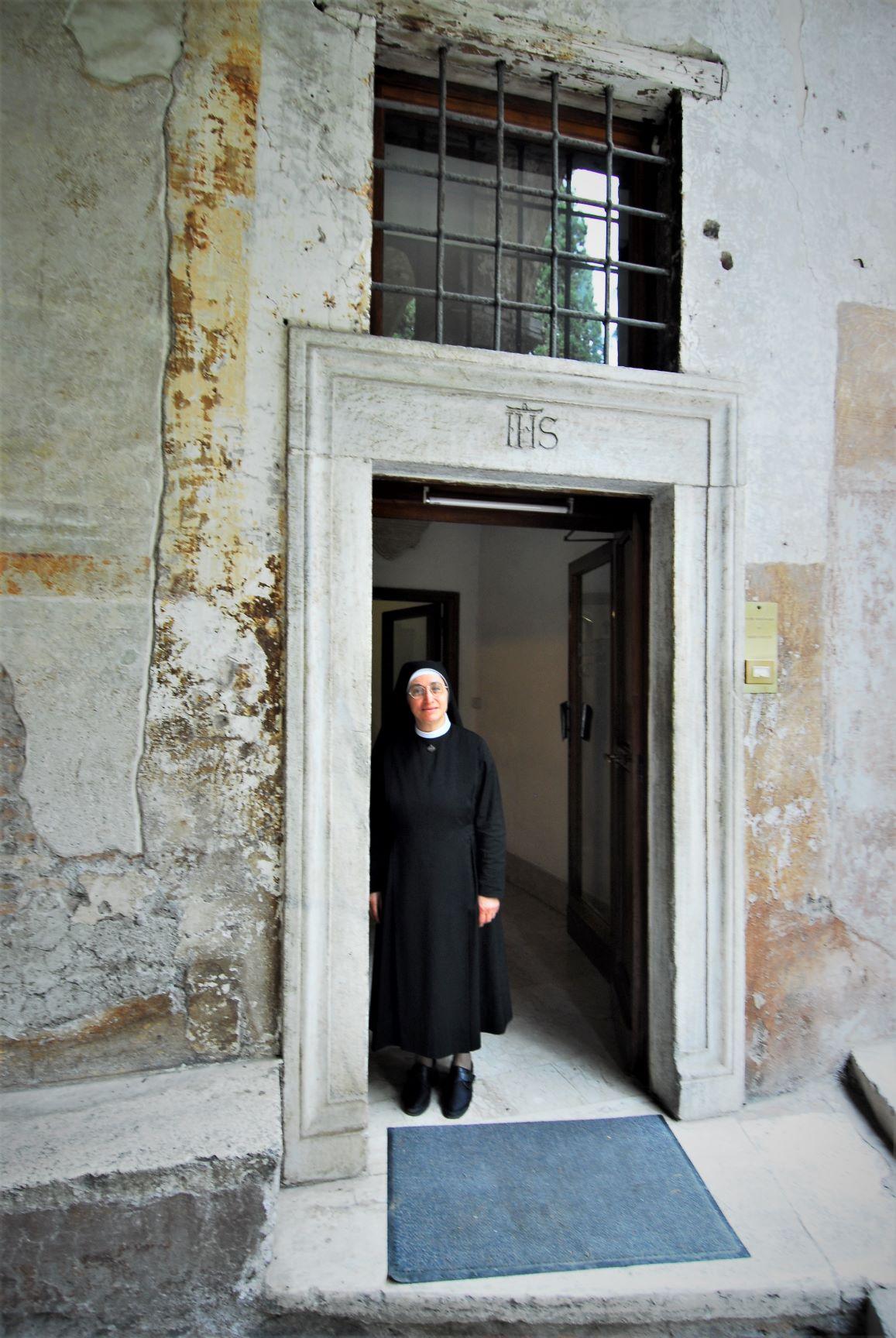 | |
As we leave the church, see if you can visit with the Sisters in the adjoining convent!
Our next walk takes us to the new exhibit at Santa Maria Antiqua in the Roman Forum. The modern day Romans have created a fantastic recreation of the frescoes in this Greek Church which succumbed to earthquakes and landslides from the Palatine, resulting in the preservation of centuries of frescoes, or enough of them for the experts to recreate them in wall projections. Stunning.
Copyright Greg Pulles 2023 All rights reserved
| | | | |