|
THE MCRN'S MISSION - EXPLAINED
1. To conduct innovative Phase I and II clinical trials and translational research in a collaborative manner to improve patient outcomes in myeloma
What this means:
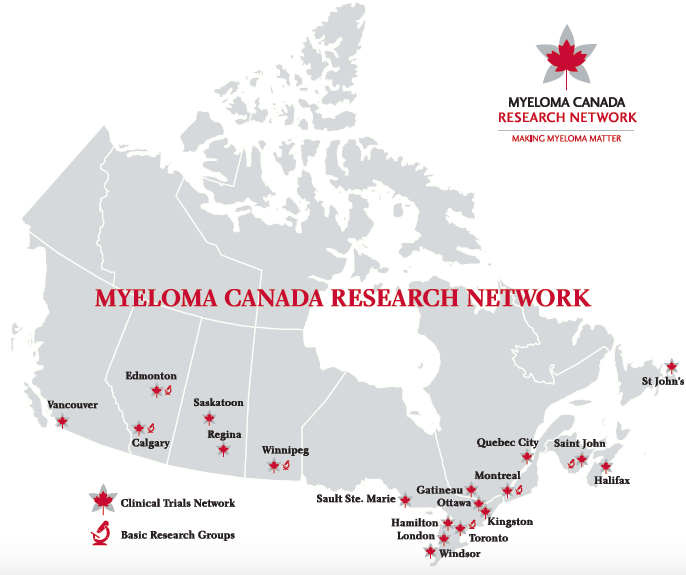
The MCRN brings innovative Canadian-designed clinical trials to hundreds of patients in over 20 centres, in 9 provinces, in order to study the efficacy of new treatments that are not yet approved by Health Canada or new treatment combinations. Furthermore, the collaboration amongst the centres allows the network of researchers to leverage expertise and share findings and knowledge amongst all of the members across the country.
To highlight some of the expertise across the country:
- Genomics (Calgary)
- Drug target evaluation (Calgary, Toronto, Winnipeg)
- Minimal residual disease (Toronto, Montreal)
- Mechanisms of resistance (Calgary, Toronto)
- Cell therapy (Montreal)
- High-risk disease (Montreal, Calgary)
Research conducted in this collaborative, entrepreuneurial setting promotes the advancement of clinical research and dissemination of results at an accelerated pace in Canada.
2. To publish evidence-based and peer-reviewed consensus statements on the diagnosis and treatment of myeloma
What this means:
Researchers can better understand how to treat and diagnose patients living with multiple myeloma, using real-world evidence. Clinical trials aim to answer questions such as: What is the optimal dosage of the treatment in question? At what frequency should the treatment be given? Does the treatment work better in combination with another drug? The answers to the questions pave the way to identifying the best treatment approaches for patients in the future through a clinical consensus, based on objective clinical trial findings.
|