Company Newsletter.jpg

Washington Watch

CBO Releases House Farm Bill Score


In early August, the Congressional Budget Office (CBO) released their cost estimate for the proposed Farm Bill (H.R. 8467) that was passed by the House Agriculture Committee in May. CBO’s estimate indicated the bill would increase total spending above the baseline for agriculture and nutrition programs an estimated $33 billion over ten years. House Agriculture Committee Chair Glenn “GT” Thompson (R-PA) takes issue with the score because it does not provide the savings, he believes should come from the provision in the bill that suspends Section 5 of the Commodity Credit Corporation (CCC) Charter Act. This provision allows the Secretary of Agriculture to use funds to support farm prices and manage commodity supplies. While the CBO acknowledges the suspension of this provision, it still estimates that $9 billion will be spent by the USDA using this authority from 2025 to 2033. 

EPA Releases Final Herbicide Strategy

EPA Herbicide Strategy to Reduce Exposure of Endangered and Threatened Species and Designated Critical Habitats from the Use of Conventional Agricultural Herbicides


On August 20th, EPA released the final Herbicide Strategy, the latest action in a multi-step process over the past two years. The EPA herbicide strategy introduces a point system for managing pesticide runoff and erosion, which is tailored to regional conditions. Counties are classified into four categories based on their runoff vulnerability: very low, low, medium, and high. Farmers in counties with very low runoff potential receive 6 relief points, those in low runoff potential areas receive 3 points, and counties with medium runoff potential receive 2 points. Counties with high runoff potential do not receive relief points and must adhere to stricter mitigation requirements. This classification was in response to the comments concerning regional variations in rainfall and differences in soil types that affect runoff and erosion.


Farmers will need to adjust their practices based on their county’s runoff vulnerability. For example, in high runoff potential areas where a farmer may not receive many reliefs points additional mitigation measures may need to be considered. In contrast, farmers in very low runoff potential areas might not need additional measures if they already use certain runoff control practices or if they have enough runoff relief points without implementing additional measures.


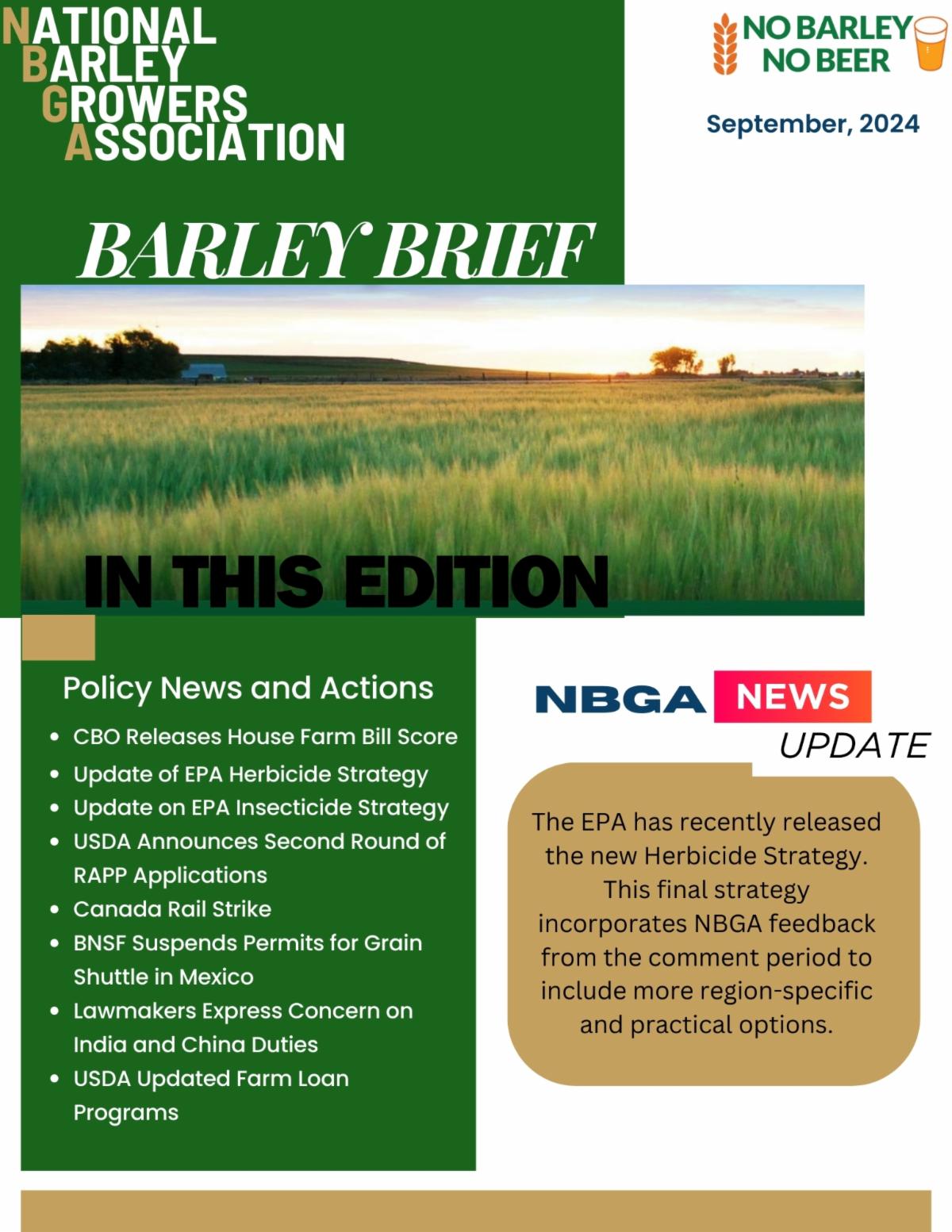
This final strategy incorporates NBGA feedback from the comment period to include more region-specific and practical options. Farmers should refer to the EPA’s mitigation menu website and product labels for detailed information on the required and available mitigation measures specific to their locations and conditions. Additionally, the EPA also recognized that in some instances more than one pesticide would be used on an area, in this case EPA has directed users to follow the strictest set of measures amongst the used pesticides. 


Timeline of EPA Herbicide Strategy

January 2022 - EPA committed to fully complying with the Endangered Species Act (ESA) before registering any new conventional pesticides.

April 2022 - EPA released an ESA Workplan on how it will address challenges under the Federal Insecticide, Fungicide, and Rodenticide Act (FIFRA), including how EPA assesses effects to listed species in its pesticide evaluations and consultation processes

November 2022 - EPA released ESA workplan update

July 2023 - EPA released draft Herbicide Strategy with 90 day public comment period

October 2023 – NBGA submitted comments on the draft Herbicide Strategy; EPA received over 18,000 comments, approximately 250 unique comments with the remainder being from mail-in campaigns

April 2024 – EPA issued update on draft Herbicide Strategy (summary below)

August 20, 2024 – EPA issued final Herbicide Strategy


EPA Releases Insecticide Strategy


On August 9th EPA released its draft Insecticide Strategy with a 60-day comment period ending September 23rd. A request for an extension of the comment period that was submitted by 240 organizations, including NBGA, was denied by EPA. The Insecticide Strategy aims to help bring the agency’s pesticide program into compliance with the Endangered Species Act and establish mitigations to reduce potential risks (e.g., run-off and spray drift) that insecticides may pose to listed species and their critical habitats. NBGA is actively reviewing both the Insecticide Strategy and the additional case studies supporting the EPA's draft strategy to provide detailed comments by the deadline. The Insecticide Strategy, like the Herbicide Strategy, aims to reduce runoff risk through the implementation of mitigation measures. This strategy could significantly impact how pesticides are applied, and NBGA is working to offer comments to the EPA to ensure that barley growers maintain the necessary flexibility and control over spraying decisions.

USDA Announces Second Round of RAPP Applications


The U.S. Department of Agriculture’s Foreign Agricultural Service (FAS) has announced the application guidelines for the second phase of the Regional Agricultural Promotion Program (RAPP). This phase will allocate $300 million out of a total $1.2 billion set aside for the program over five years.


While the initial phase targeted marketing efforts in South and Southeast Asia, Latin America, the Middle East, and Africa, this second phase will now also support marketing in the European Union. However, funding for programs in Mexico, Canada, and China will remain unavailable. Funds will begin to be distributed starting January 1, 2025.  The U.S. Grains Council received funding, including specifically for barley export promotion activities, through the first round of RAPP and intends to apply for additional funds in round two. 


Canada Rail Strike


On August 24, the Canadian Industrial Relations Board (CIRB) ordered CN and CPKC workers to return to work and mandated binding arbitration. Some of the Canadian labor groups have indicated plans to challenge the ruling in court. The CIRB's decision has, at least temporarily, averted a major work stoppage that if prolonged could have more severely disrupted U.S. agriculture supply chains.


BNSF Suspends Permits for Grain Shuttle in Mexico


BNSF has put a hold on all permits for grain shuttle trains to Mexico from August 21 to September 20 due to ongoing service problems that have left equipment stuck in Mexico. During this time, shipments will need to be redirected to other railroads. NBGA was among 26 farm and commodity groups that sent a letter to Administration officials expressing worries about delays and disruptions in Mexican rail service.


Read More


Lawmakers Express Concerns Over Duties on 2,4-D from India and China


Members of Congress are urging the Department of Commerce to “carefully review the facts” before deciding on countervailing duties for 2,4-D, a commonly used pesticide. This supports concerns raised by some U.S. agricultural groups, including NBGA, that duties on 2,4-D would adversely impact supply and price for growers since there is currently only one U.S. supplier. The countervailing duties are being sought by U.S. manufacturers that contend India and China are unfairly dumping 2,4-D into U.S. markets at low prices. The Department of Commerce is expected to announce preliminary duties by September 10, unless an extension is granted.


Read More

USDA Updated Farm Loan Programs 


The U.S. Department of Agriculture (USDA) has announced changes to the Farm Service Agency’s (FSA) Farm Loan Programs, starting September 25, 2024. These changes aim to improve financial stability for farmers by increasing access to financing. The updates will offer more accessible loan options for covering operating expenses and purchasing land and equipment. Additionally, the changes are intended to simplify USDA direct loan procedures, making it easier for farmers to secure the funding they need for their operations and asset acquisition.


BARLEY IN THE NEWS

Beer Institute Releases June 2024 Domestic Tax Paid Estimate


Council Connects Mexican Brewers To U.S. Barley Producers


Barley Production Forecast Down 20% From 2023 Despite 72% of Acreage Rated in Good to Excellent Condition


EVENTS AND INFO

Facebook  Instagram  Web  X

SHARE THE NEWSLETTER BELOW

X Share This Email
LinkedIn Share This Email