August 31, 2022

Top stories

■ After weeks of silence, Gannett revealed that it laid off 400 employees and cut 400 open positions (Poynter) / 'The median pay of a Gannett employee is $48,419, meaning this layoff is equivalent to about $19.4 million in salary savings.’ (Media Guild of the West) / 'Interesting tidbit: “…the regional editor in the Plains Region told her staff that she was instructed to protect larger metro papers, leading to cuts at smaller publications.” Is Gannett quietly killing off what remains of its smallest pubs?’ (Jess Aloe) / Earlier: They were some of the last journalists at their papers. Then came the layoffs. (Washington Post) 


■ 'Layoffs, senior executives quitting, a staff no confidence letter leading to the CEO's departure, and a monthly burn rate of $700k+. It's been a summer of turmoil at the Center for Investigative Reporting / @reveal . Here's my story about how it happened’ (Steven Perlberg) 


■ The Washington Post could seek news brand acquisition to boost subscriber count (Axios) 


■ The photo of classified documents at Trump's Mar-a-Lago resort, annotated: ‘Keeping Time magazine covers is very typical for Trump, who displayed magazine covers at his properties. Unlike other Time covers that he displayed, this one was real.’ (Washington Post)


■ Survey finds young people follow news, but without much joy (Associated Press) / Fatigue, traditionalism, and engagement: the news habits and attitudes of the Gen Z and Millennial generations (Media Insight Project) 


■ Open letter to Philadelphia Inquirer calling for immediate action on DEI failures; 'These failures have led to the loss of multiple journalists of color within the newsroom over the last year, and as a result there are now zero Black male reporters at the paper outside of the sports desk.' (Philadelphia Association of Black Journalists) 


■ ESPN’s Leah Hextall on her ‘very difficult’ first NHL season and the need for change in hockey (The Athletic) 


■ Gay journalist from small-town Louisiana threads her own story into tale of mysterious 'misfit' (nola.com) 


■ Trial begins in newspaper carrier attack (American Press) / Earlier: Charges in newspaper attack should have been upgraded to hate crime, attempted murder, says civil rights lawyer (Beauregard News) 


■ Family of Shireen Abu Akleh to hold news conference at National Press Club Thursday (National Press Club) 


■ The night we lost Diana: 6 reporters look back at one of the biggest tragedies in royal history (ELLE) / A moment in time: AP journalists remember Diana's death (Associated Press via Star Tribune) / ‘An up-and-coming anchor named Brian Williams broke into regular coverage on MSNBC to announce the news to Americans in the early morning hours of Aug. 31.’ (Washington Post)

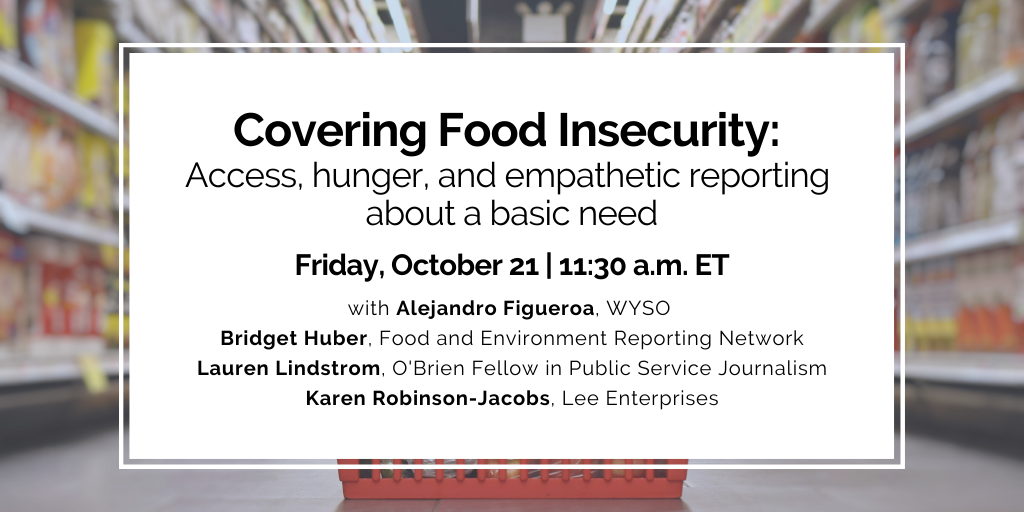
Upcoming program called Covering Food Insecurity: Access, hunger, and empathetic reporting about a basic need. Click for more details.

Most people know what it is to get hungry. But persistent hunger and a lack of access to convenient and affordable healthy foods is something much more, disproportionately affecting communities already underrepresented in news coverage. Food insecurity can be difficult for journalists to cover consistently because of its seeming invisibility. 


Join the National Press Club Journalism Institute at 11:30 a.m. ET on Friday, Oct. 21 for a discussion via Zoom about what journalists can cover at the intersection of food access, community impact, and systemic racism. 

Register now

White House photographer Pete Souza and I stood up to copyright bullies. Here’s how you can, too.

By Alan Kotok


Former White House photographer Pete Souza recently received a notice of copyright violation for a photo he took while working at the White House. A few weeks earlier, I got a similar notice from the same organization and, independently, we took similar actions that got similar results: The notices were retracted.


In both cases, the notices came from a copyright enforcement group called Copytrack GmbH, based in Germany. Since 2018, Copytrack has acted as the enforcer for WENN Media Group, a company in the U.K. that claims to hold the rights to libraries of entertainment images, then sends Copytrack to collect penalties from those accused of improperly using its images.


In Souza's case, the claim of copyright infringement is utter nonsense. Souza shot photos of the president for the White House. Thus, as government property, those images are in the public domain. After he explained that in a response, Copytrack told Souza its claim was an error and retracted the violation notice.


My case was different. Copytrack sent me a notice on July 7, 2022, saying an image in our November 2011 Science & Enterprise story violated WENN's copyright. Science & Enterprise is a daily news site reporting on the intersection of science and business, including robotics technology. In November 2011, we wrote about advances in robot intelligence that the Honda Motor Co. said made its Asimo line of humanoid robots more autonomous. 


The story featured a photo of an Asimo robot, which Copytrack said was copyrighted and used without WENN's permission. I took the photo from a press release with Honda's announcement. But according to Copytrack, I owed them EUR 220 in damages and another EUR 250 a year if I wanted to continue using the image.


When news reporting is "fair use"


As a photographer as well as a publisher, I'm sensitive to use and misuse of images and steer clear of copyrighted content. So I went back to the Honda company website and found that same November 2011 announcement. The Honda release was accompanied by a set of images, including the image Copytrack said was copyrighted by WENN. A little more checking revealed a separate Honda website for the Asimo project, with that same release and image embedded in the text.


I'm not a lawyer, but after working in publishing since 1990, I know a little about copyright. I searched provisions of the U.S. copyright law in the government's website and discovered section 107 of the law spells out exemptions for fair use of copyrighted material that include news reporting. One factor in determining fair use is the nature or purpose of the copyrighted material. In this case, the image was part of Honda's press materials designed to disseminate news.


In addition, I made sure Copytrack knew I was ready to call in help. In my response to Copytrack on July 10, I cc'd the Electronic Frontier Foundation and the Society for Advancing Business Editing and Writing (SABEW), two groups I support, and noted in my message that they're "two organizations that monitor abuses of copyright law threatening legitimate news gathering, reporting, and publishing."


On July 12, Copytrack sent me a message saying, "We have reviewed the information you have provided us and decided to close the claim. Thank you for your kind cooperation."


You can decide for yourself if WENN and Copytrack are just sloppy in checking out the validity of their claims, or if they are going after anyone they can, then backing off when shown they're wrong. But if you're in the media business today, you need to know at least the basics of intellectual property law so the likes of Copytrack and WENN can't push you around. And you need to set standards and follow those standards when using materials from other sources. 


And finally, join industry groups that help protect against copyright trolls. You don't have to fight those bullies alone.


Alan Kotok is editor and publisher of Science & Enterprise and co-chair of the National Press Club Photography Team.

Manager's Minute: My team members like me but not our company, how do I manage that?

Jill Geisler, Bill Plante Chair in Leadership & Media Integrity at Loyola University Chicago and Freedom Forum Fellow in Women’s Leadership, on what to do if employees are loyal to their supervisors but critical of their organizations.

Manager's Minute: My team members like me but not our company, how do I manage that?

Watch nextWhat does culture really mean for an organization?


Get more career advice: Read Jill's columns | Watch Manager's Minute videos

National Press Club news

Resources

This newsletter is written & edited by the National Press Club Journalism Institute staff: Beth Francesco, Holly Butcher Grant, and Julie Moos. Send us your questions and suggestions for topics to cover.

Get this from a friend? Subscribe, and view the archives.

If you value this newsletter, consider supporting The Latest with a tax-deductible, recurring gift to the Institute: Even $5 a month will help fund the technology and time it takes to provide this important service.  
Facebook  Twitter  Linkedin  Youtube  

The National Press Club Journalism Institute promotes an engaged global citizenry through an independent and free press, and equips journalists with skills and standards to inform the public in ways that inspire a more representative democracy. As the non-profit affiliate of the National Press Club, the Institute powers journalism in the public interest.