March 15, 2023

Top stories

BuzzFeed encourages reporters to write more stories in attempt to turn profit (Wall Street Journal) 


DirecTV sues Nexstar, station owners over retransmission fees (Reuters) 


New Vice Media CEOs on Nancy Dubuc exit, the brand's 'distinct proposition' amid sales talks and big 'Bama Rush' doc (Variety) 


OMG: Ousted Project Veritas founder James O'Keefe launches new venture he says is 'Uber for journalism' (Mediaite) 


Forbes is hosting an Equal Pay Day forum. Are they underpaying their own female journalists? (Forbes Union)


Snapchat makes its content guidelines public (Axios)  


Why did Twitter ban a small 165-year-old Iowa newspaper? No one seems to know (Forbes) 


Muck Rack survey: Two out of three journalists have been impacted by economic uncertainty (Business Wire) 


Missy Ryan named Pentagon correspondent (Washington Post) / Max Kim is the new L.A. Times correspondent in Seoul (Los Angeles Times) / Paul Sonne joins the Times’s Russia team (New York Times Company)  


What’s next for Tucker Carlson after we all saw his texts? (Daily Beast) 


Benjamin Hall, Fox News reporter hurt in Ukraine, makes a comeback (Washington Post)


News channel France 24 suspends four journalists over anti-Semitism allegations (POLITICO) 


Dillon James receives 8 years for assault on newspaper delivery person (KPLC News) 


Diamond Sports, owner of TV rights for 42 teams, files for bankruptcy (Washington Post)


Google is adding AI to its work apps. Here's what that means. (Washington Post)


Press freedom 


Florida lawmakers advanced bill making it easier to sue media outlets for defamation (WFLA) 


Moscow ramps up pressure on Radio Free Europe/Radio Liberty (VOA)

CRAFT
Sunshine Week: A celebration of access to public information

The transportation beat: Investigative reporter shares must-request records & biggest access issues

It is Sunshine Week, an annual celebration of access to public information launched by the News Leaders Association in 2005. To commemorate the occasion, we’ve asked journalists across different beats to share their tips for requesting open records and responding when facing roadblocks to access.  


Today, we hear from Mark Walker, an investigative reporter who covers transportation for The New York Times and president of Investigative Reporters and Editors.

Mark Walker

What are the biggest access issues you have faced when seeking records in the airline industry?


Walker: There are several FOIA exemptions tied to transportation records. The most challenging one when it comes to access would probably be Exemption 7, which relates to information from an investigation that is ongoing.


There have been several near-miss airplane collisions at airports across the country. For example, the Federal Aviation Administration is investigating a close call between a Learjet and a JetBlue flight on Feb. 27, at Boston Logan International Airport. These types of incidents are being investigated by the Department of Transportation and independently by the National Transportation Safety Board. Release of this information is exempt under FOIA exemption 7, which prohibits the release of information tied to an active investigation. 


What are examples of public records that reporters should ask for on the transportation beat? 


Walker


  • Motor vehicle collision crash data
  • Airline consumer complaint data
  • Transit crime data 
  • Airlines' on-time and flight delay data
  • Federal Railway Administration train derailment data 
  • Electric vehicle charging stations data


The agencies [to contact for these records] would be the Department of Transportation, the Federal Aviation Administration and Federal Railroad Administration, and the National Highway Traffic Safety Administration.


How do you narrow a request without losing the scope of what you’re trying to get? 


Walker: Federal agencies are required to have a FOIA public liaison who is a supervisory official to whom requesters can raise concerns about the status of their requests and negotiate the scope of their requests. Nothing prevents requesters from contacting these FOIA public liaisons to talk through a request. 


If you are looking to narrow your request, you can do a couple of things: 


For starters, you can request a rolling production of records. Often, a FOIA office will hold off releasing the records to your request until it has every document in hand. To help, pitch a rolling request.


If the agency says there are too many responsive records to process promptly, talk to them about eliminating potentially non-responsive records from your request. An example of a non-responsive record could be internal agency newsletters sent by email. 


Another obstacle that could require you to limit the scope of a request is when the estimated completion date seems excessive. A requester could try limiting the search to a specific period or to several officials within the agency you’ve filed the request with. Adding keywords also could help limit the request.

‘Let the correspondence tell the tale’: Open records tips from a government accountability reporter

Sarah D. Wire shares her advice on tracking down open records. Wire covers government accountability, the Justice Department, and national security for The Los Angeles Times with a focus on the Jan. 6, 2021, insurrection and domestic extremism. Wire also sits on the National Press Club Board of Governors.


What are examples of public records pertaining to Jan. 6 that journalists might not think to request?

Sarah D. Wire

Wire: I'm a fan of using the side door whenever possible. State and local agencies, like local election boards, are a treasure trove for communications with people in Trump's orbit right after the 2020 election, and they usually respond more quickly than federal agencies and with fewer redactions. 


Include communications with secretaries and assistants in your requests. Some states include communications with vendors under their records statutes. We've learned a lot from the emails sent between Arizona senators and the outside group that performed the Maricopa County audit, which American Oversight sued to obtain and then made public.


I enjoy timelines, so calendars and schedules are always good for helping lead people through events. But don't just get the calendars of the key people; also ask for the calendars of the people they interact with but whom the public might not know for color, detail, and corroboration.


What is your response or process when a public records request is denied?


Wire: I start with calling the records officer to get more information about why the request was denied. Sometimes a friendly call coupled with a willingness to modify my request slightly results in getting records after all. I always have a copy of the relevant access statute on hand

when I call.


What’s an open record request you never thought you’d be making?


Wire: When I covered Congress, I routinely requested correspondence between the staff of members of a state delegation and various federal agencies. In 2015, I stumbled across a fascinating story about a multi-year battle over the legal boundaries of a private cemetery

surrounded by federal land in Arkansas.


I largely let the correspondence tell the tale, and it is still one of my favorite articles.


See additional open records advice on covering law enforcement and covering local government.


Share your FOIA and open records successes — or how you've worked around roadblocks — with The Latest subscribers. We'd love to feature your advice in this newsletter.

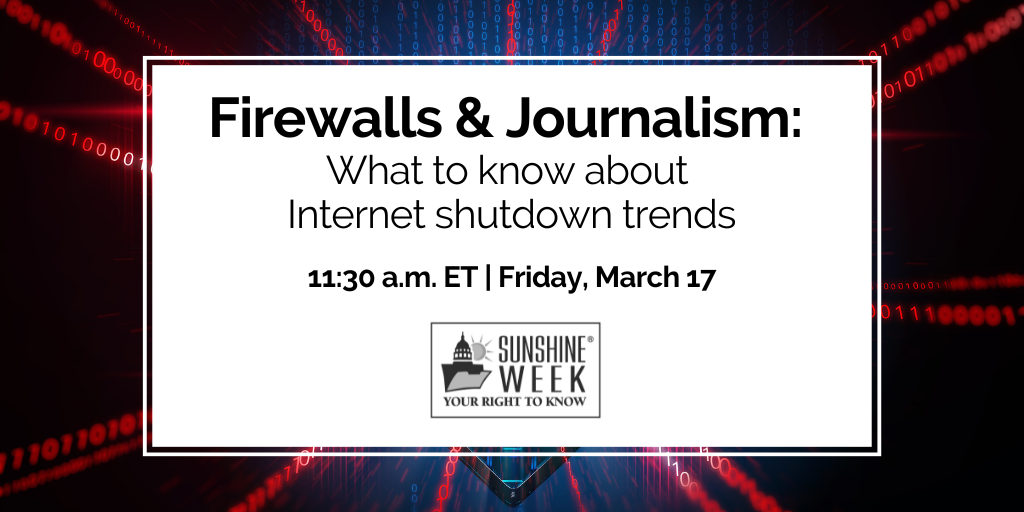
Firewalls & Journalism: What to know about Internet shutdown trends

An open and free Internet is widely seen as essential to journalists to both conduct their reporting and to disseminate their work. But a worsening trend of authoritarian and illiberal governments moving to erect digital firewalls and cut off Internet access, particularly during times of natural disaster or political crisis, is imperiling the ability of large swaths of the global population to stay informed and for journalists to track critical news developments.


More countries than ever in 2022 saw Internet shutdowns, with at least 187 incidents documented across 35 countries, according to the digital rights group Access Now. 


Join us from 11:30 a.m. to 12:30 p.m. ET on Friday, March 17, for a virtual panel discussion that will delve deep into the worrying spread of Internet kill switches and what it specifically means for a free press. The program is being produced by the National Press Club’s Press Freedom Committee and nonprofit affiliate Journalism Institute in honor of Sunshine Week.

REGISTER NOW
Resources

This newsletter is written & edited by the National Press Club Journalism Institute staff: Beth Francesco and Holly Butcher Grant. Send us your questions and suggestions for topics to cover.


Get this from a friend? Subscribe, and view the archives.


If you value this newsletter, consider supporting The Latest with a tax-deductible, recurring gift to the Institute: Even $5 a month will help fund the technology and time it takes to provide this important service.  

Facebook  Twitter  Linkedin  Youtube  

The National Press Club Journalism Institute promotes an engaged global citizenry through an independent and free press, and equips journalists with skills and standards to inform the public in ways that inspire a more representative democracy. As the non-profit affiliate of the National Press Club, the Institute powers journalism in the public interest.