June 3, 2022

Top stories

■ Journalist Danny Fenster returns to work that sent him to prison (Detroit Free Press) 


■ The FBI tried to ambush my source. Now I'm telling the whole story. (The Intercept) 


■ Sun-Times names Jennifer Kho executive editor; The former managing editor of HuffPost and Guardian US will be the first woman and first person of color to lead the paper’s newsroom in its 178-year history (Chicago Sun-Times)


■ Opinion: Many reporters think Kevin McCarthy is dumb. Why can't they say so? (POLITICO) 


■ Barry Sussman, Washington Post editor who oversaw Watergate reporting, dies at 87 (Washington Post) / Why the press will never have another Watergate moment (Washington Post) / 50 years after the Watergate break-in, John Dean relives the scandal that changed his life (Los Angeles Times) 


■ CREEM magazine, Detroit-born rock bible, makes big return with digital archive, print edition (Detroit Free Press) / 'When CREEM ceased publication in 1989, it left a massive void that has never been filled, though many have tried’ (New York Post) 


■ National Spelling Bee champion decided by blazing fast, first-ever spell-off (Yahoo) / Earlier: When the words drop, these journalists will be ready (New York Times


Press freedom


■ 'May has been the deadliest month for women journalists this year with at least five documented killings' (Coalition For Women In Journalism)


■ China-linked Twitter harassment targets female Asian journalists who work for western news outlets, says new report (Axios)


■ Ukraine grants citizenship to top Russian journalist who denounced war (Reuters via U.S. News & World Report)

"Most editors are juggling a million different things at any given time, so keeping pitches concise is crucial. They’re less likely to be receptive to an idea if they have to read paragraphs of preamble before you get to the point. The email’s subject line functions as your idea’s headline; use that to your advantage! You’re trying to catch their attention amid an inbox full of other pitches."


-- Alyse Stanley, multiplatform editor for the Washington Post’s Launcher, via #ACESChat

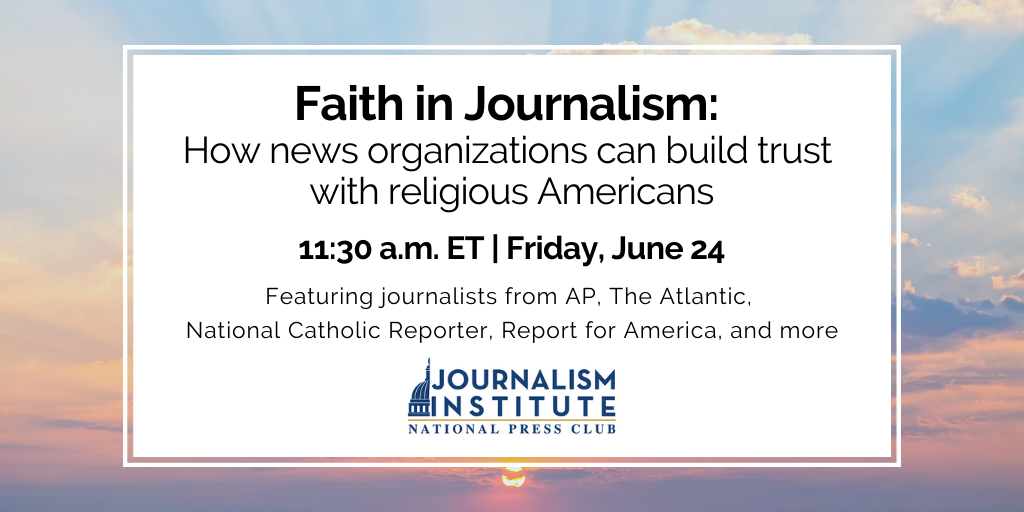
Faith in Journalism Programs Twitter.png

More than 75 percent of Americans say religion is an important part of their lives. How do these Americans see themselves and their faith reflected in news coverage? What does reporting on faith get right and wrong? How do editors and reporters think about who they’re reaching with these stories and who they’ve lost? And how might this coverage build trust in journalism among communities who have been historically misrepresented?


Registration is open for this program, which will take place on Friday, June 24 at 11:30 a.m. ET. Participants will learn:


  • How journalists of faith navigate challenges from inside their newsrooms and from inside their faith communities
  • Whose faith is centered in coverage and whose is marginalized, mischaracterized, or misunderstood
  • Which best practices can help extend our community’s understanding of itself


Panelists include:


The conversation will be moderated by Julie Moos, the Institute’s Executive Director, and is supported by an operational grant from the Deseret Management Corporation.

Manager's Minute: I promised myself I'd save more time for me this year. How do I keep that promise?

Jill Geisler, Bill Plante Chair in Leadership & Media Integrity at Loyola University Chicago and Freedom Forum Fellow in Women’s Leadership, on how leaders can reclaim time for themselves without negative consequences.

Manager's Minute: I promised myself I'd save more time for me this year. How do I keep that promise?

Read next: Three ways to say ‘no’ – shamelessly


Get more career adviceRead Jill's columns | Watch Manager's Minute videos

Help choose National Press Club scholarship winners

The Club's Scholarship Team needs your help to judge applications for the next round of National Press Scholarships on Saturday, June 11, at 10:30 a.m. 


Judging will be conducted virtually via Zoom over a two-hour period. Participants will have the chance to review application materials the week prior to the meeting. If you'd like to be one of the judges, contact Alexis Garcia (lexy.garcia@gmail.com) for details.


Depending on the size of the judging group, winners will be picked for either the Dennis and Shirley Feldman Fellowship or the Scholarship for Journalism Diversity Honoring Julie Schoo. Both categories are extremely competitive this year, and the Club could use your help picking the student who best exemplifies the core values of these awards.


The Dennis and Shirley Feldman Fellowship recognizes a student pursuing graduate studies in journalism with a one-time stipend of $5,000 to help defray tuition costs.


The Scholarship for Journalism Diversity Honoring Julie Schoo consists of a $5,000 one-year scholarship. The purpose of the scholarship, named for the former executive director of the National Press Club Journalism Institute, is to recruit promising future journalists who will bring diversity to American journalism. The award can be renewed up to three years, for a total of $20,000 toward educational expenses.

Resources

This newsletter is written & edited by the National Press Club Journalism Institute staff: Beth Francesco, Holly Butcher Grant, and Julie Moos. Send us your questions and suggestions for topics to cover.

Get this from a friend? Subscribe, and view the archives.

If you value this newsletter, consider supporting The Latest with a tax-deductible, recurring gift to the Institute: Even $5 a month will help fund the technology and time it takes to provide this important service.  
Facebook  Twitter  Linkedin  Youtube  

The National Press Club Journalism Institute promotes an engaged global citizenry through an independent and free press, and equips journalists with skills and standards to inform the public in ways that inspire a more representative democracy. As the non-profit affiliate of the National Press Club, the Institute powers journalism in the public interest.