May 25, 2022

Top stories

■ After Texas school shooting, the Onion posts 21 stories on homepage with the same headline: ‘ “No way to prevent this,” ’ says only nation where this regularly happens’ (Variety) / Analysis: Media coverage of Texas school massacre invokes Sandy Hook (CNN) / ‘Last Thursday, following the massacre in Buffalo, Texas Tribune editors met to discuss how we'd cover future mass shootings. I'm gutted that we had to make use of those plans just five days later.’ (Sewell Chan) 


■ 'I’m curious about what journalists have to say about covering these horrific events. How to do so without inflicting secondary trauma, what they’ve learned in the course of reporting, what they wish they’d known beforehand.' (Jelani Cobb) / ‘Take no for an answer. Never forget that you are meeting someone at what is likely their worst moment. Maybe you get the interview later, maybe you don’t. No one owes us their story. And no one’s humanity is worth sacrificing for one story — including your own as a journalist.’ (Errin Haines) / Explain your goals, process and integrity when covering mass shootings (Trusting News)


■ 'I was a kid when a classmate was shot and killed. That trauma lasts,' says Washington Post columnist (Washington Post) / Remember, journalists, to take care of yourselves (Poynter) / Veteran journalist fights to have work-related PTSD recognized (The Star) 


■ 'This is on you': Beto O'Rourke confronts Abbott, Cruz at Texas school shooting press conference (Austin American-Statesman via USA Today) / 'Beto is now gaggling outside of the Abbott presser with what appears to be every television camera in America, raging in English and in Spanish, and msnbc cut away from Abbott to carry Beto live.' (Meredith Shiner) / 'I'm hearing from friends in Uvalde that there are so many members of the media there right now that the city ran out of hotel rooms last night.' (Lauren McGaughy)  


 Former White House Press Secretary Sarah Huckabee Sanders wins Republican nomination for Arkansas governor, AP projects (Fox News) 


■ How two Texas newspapers broke open the Southern Baptist sex scandal (Washington Post) 


■ ‘The New York Times’s multipart series on Haiti, “The Ransom,” has rekindled a debate over how comprehensively journalists should credit the experts they speak to during the course of reporting’ (New York Times) / Opinion: Why historians are at war with the New York Times (POLITICO) 


■ How the publishing world is muscling in on Hollywood deals: For authors, ‘the future is multihyphenate’ (Hollywood Reporter) 


■ ‘How to Murder Your Husband’ writer convicted of murdering husband (New York Times) 


Press freedom


■ TMZ files emergency motion to block its former reporter from testifying for Johnny Depp (Law&Crime) / Who is TMZ's Morgan Tremaine? 'Journalist's privilege' in Depp-Heard trial (Newsweek) / Misinformation and baseless rumors about Amber Heard rack up millions in views during Depp defamation trial (Insider) 


■ Two years after death of George Floyd, 50 journalists have sued for treatment at BLM protests (Freedom of the Press Foundation)


■ Maryland man accused of assaulting police, AP photographer at Capitol (Associated Press via The Daily Record)  


■ US has not been asked to help in probe of reporter's killing (Associated Press via Spectrum News 1 OH) 


■ Lebanese general renews mediation over missing US journalist Austin Tice (Associated Press via ABC News) / Biden administration revives efforts to secure release of Austin Tice, other hostages (Al Arabiya English)

“A safe way to open the interview is to ask, ‘what would you like to tell me’, or ‘what happened to you?’. This gives the interviewee the sense that they can be in control of the interview and its content. … Do not interrupt the flow of their story or distract them by asking questions they may think are irrelevant (even if you think they are important). This information will likely arise over time.”


-- Dart Center for Journalism & Trauma, “Interviewing in the aftermath of trauma

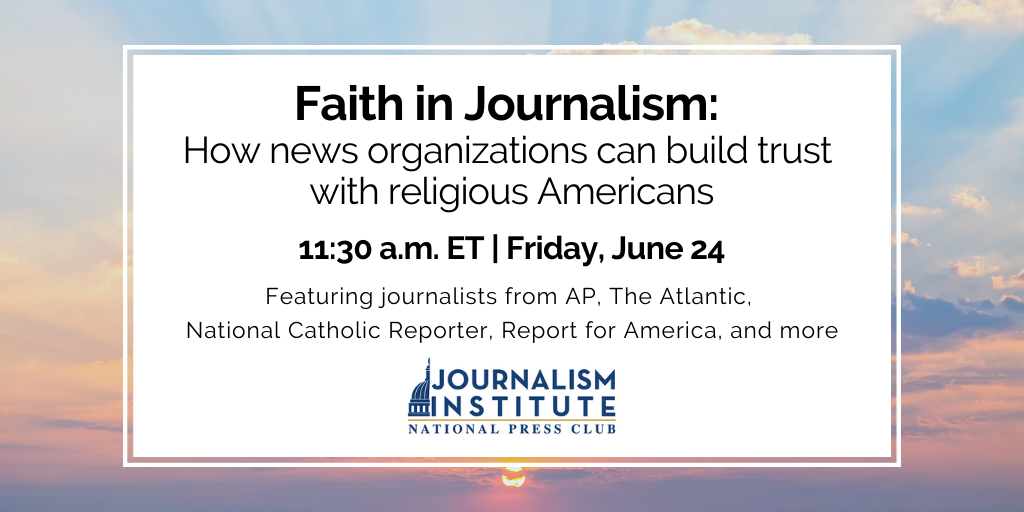
Faith in Journalism Programs Twitter.png

More than 75 percent of Americans say religion is an important part of their lives. How do these Americans see themselves and their faith reflected in news coverage? What does reporting on faith get right and wrong? How do editors and reporters think about who they’re reaching with these stories and who they’ve lost? And how might this coverage build trust in journalism among communities who have been historically misrepresented?


Registration is open for this program, which will take place on Friday, June 24 at 11:30 a.m. ET. Participants will learn:


  • How journalists of faith navigate challenges from inside their newsrooms and from inside their faith communities
  • Whose faith is centered in coverage and whose is marginalized, mischaracterized, or misunderstood
  • Which best practices can help extend our community’s understanding of itself

Manager's Minute: How do you know if you’re a micromanager?

Jill Geisler, Bill Plante Chair in Leadership & Media Integrity at Loyola University Chicago and Freedom Forum Fellow in Women’s Leadership, on ways to avoid micromanaging your team.

Manager's Minute: How do you know if you’re a micromanager?

Watch nextI’m head of a big group. How involved should I be in day-to-day operations?


Get more career adviceRead Jill's columns | Watch Manager's Minute videos

Resources

This newsletter is written & edited by the National Press Club Journalism Institute staff: Beth Francesco, Holly Butcher Grant, and Julie Moos. Send us your questions and suggestions for topics to cover.

Get this from a friend? Subscribe, and view the archives.

If you value this newsletter, consider supporting The Latest with a tax-deductible, recurring gift to the Institute: Even $5 a month will help fund the technology and time it takes to provide this important service.  
Facebook  Twitter  Linkedin  Youtube  

The National Press Club Journalism Institute promotes an engaged global citizenry through an independent and free press, and equips journalists with skills and standards to inform the public in ways that inspire a more representative democracy. As the non-profit affiliate of the National Press Club, the Institute powers journalism in the public interest.