February 2024

The Wonders of Math at Home!


Dear friends,


I have spent a lot of time over the last 30+ years talking to Waldorf homeschoolers who wish that the ‘Waldorf’ bit was stronger in their lives, who feel inadequate, who spend way too much time thinking wistfully about the various classroom-based activities and lessons their children are missing out on. Indeed, there are many things that we simply cannot do at home which can only be done with groups of children, possibly in a classroom.


But—wait for it—there are many things that we as homeschooler—home being the operative word here—can do much better than can be done at school. 


In the following article I wrote the other day on my blog, I set out the whole of the Christopherus math curriculum, from first through eighth grade. It of course flows from the Waldorf curriculum, but, more importantly, as with everything we do at Christopherus, it flows from a deep understanding of child development, my time as a teacher and then a homeschooling parent and my 40+ years’ experience with children. So there are many things in our curriculum that are not done at school. Cooking is a biggie and I link that with the geography curriculum—what better way to learn about a country than to learn about how the people there cook. Another home-based subject is real gardening as opposed to gardening at school (so growing things we then eat is part of that). 


Christopherus springs from the reality of being at home with children. Examples include housework as circle time; local geography starting with your neighborhood; third grade weather (not a subject which appears in the usual school-based Waldorf curriculum) based where you live so that it is experiential; fifth grade botany again beginning with local plants—in your yard, nearby parks, the terrace outside your apartment, your biome etc; sixth grade physics focused on things in your yard and garage and nearby playground; and more. All of these subjects begin in the home in a way which does not quite work within the confines of group and school and classroom experiences. Isn’t that great!? Shouldn’t homeschooling be primarily based at home?


And astronomy in seventh grade is a great theme which actually spans seventh into eighth grade! Not a subject for classrooms at all, especially if one wants to begin with naked eye observation as we do. Oh—and let’s not forget sixth grade math based largely on the child starting her own small business and being entirely involved with the household budget for that year. Can’t do those things in a classroom!


So here is the blog article I wrote about Christopherus math through the grades. I would be very grateful if folks forwarded it to anyone they know who is thinking about becoming a Christopherus family. And friends and relatives wondering what are earth you are doing might also be interested.

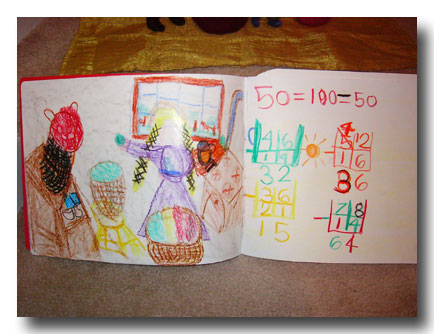
mathlessonbook image

Christopherus math through the grades


At Christopherus we are proud to provide a math curriculum based on the holistic reality of numbers and operations, grounded in the child’s own experience and deepened from grade to grade. From collecting nuts to memorizing math facts, from freehand geometry to modeling the Platonic Solids, our math curriculum, flowing from the profound knowledge of the child’s developmental stages as expressed by Waldorf education, is filled with the beauty and mystery of math.


We begin in first grade. We provide a story about squirrels collecting nuts: in most parts of the world, the children can observe squirrels doing just that (Australians have to find a different animal to use!). Through their nut collection activities, the squirrels in the story share (division), store away (subtraction), find more (addition) and find lots more (multiplication)! The four processes are presented together and the profound truth of mathematics, that at its core it is a whole, is thereby experienced by the children. They are not pulled out of their experience by abstraction but rather, their natural stage of learning at this tender age is honored and utilized.


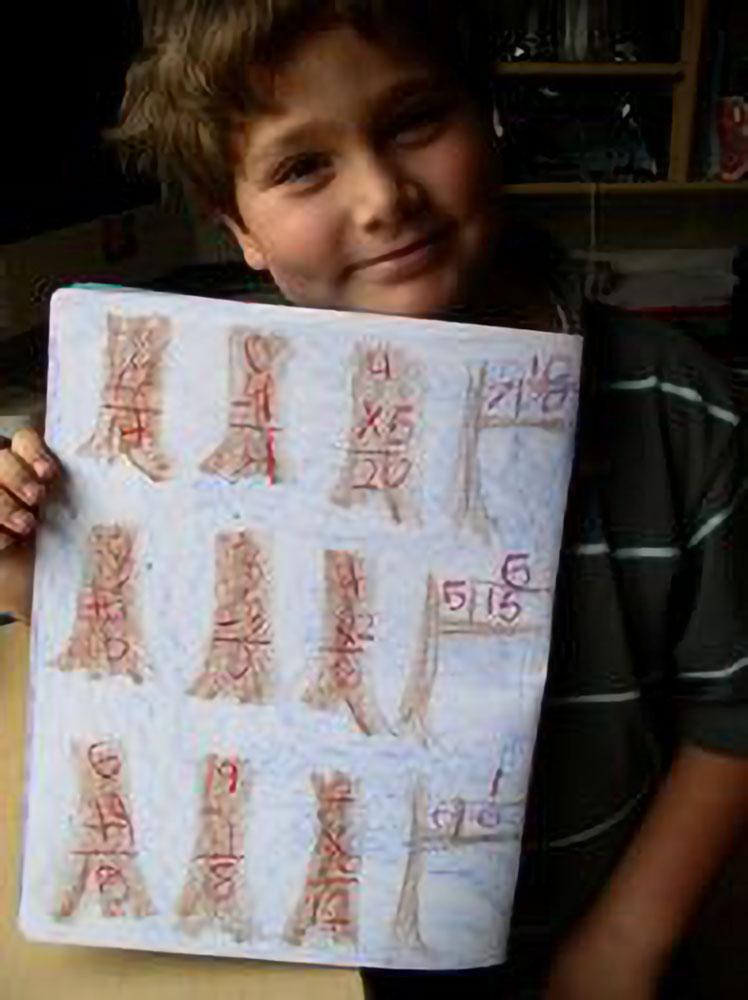
In second grade the story continues and now the squirrels go up and down a tree as they work with their nuts. Thus the four processes move from the horizontal to the vertical. Colored stripes the child colors onto his tree helps him keep multi-digit numbers neatly in order. This is not about ‘making it pretty’. Over the years, one of the main ways that children become discouraged by math is the confusion which results from an inability to keep their written number work from getting tangled up. A solid foundation for orderly work is laid by this simple aid.


Number journeys start late in first grade or in second grade. We progress from ‘Sara went to the orchard and picked 5 apples. She gave 3 to her mother. How many did she have left?’ to ‘Sara went to the orchard. She picked 5 apples from one tree and 5 from another. She gave her brother Toby 2 apples. At home she gave half of her apples to her mother and kept the rest. How many did she have?’ And as the child gets older, we ditch Sara and simply say ‘Take 100. Divide it by 4. Add 6. Subtract 11. Divide by 2. What have you got?’


By working with Number Journeys, we help a child learn to focus, concentrate and exert his powers of memory. If he gets lost on his journey he cannot solve the problem—this has nothing to do with what his parent-teacher says. The work itself demands he do what is necessary. This is an important pedagogical moment in homeschooling which helps avoid head-to-head arguing. If you don’t know how to divide, then you cannot do this work. If you cannot keep track as we move along with the narrative, you will get lost. Simple as that.

Click here to keep reading


Get Help from Donna—Take Hold Grades Webinars

Would you like me to help you get to grips with the curriculum and prepare for next year? Would you like help with transitioning from kindergarten into first grade; navigating discipline and and how to best meet your child’s stage of development; figuring out how to deal with the increased workload in the middle grades; getting advice about teaching and preparing lessons pertinent to your particular home situation? Maybe you would like to find out about our Take Hold Grades Webinars.


There will be a 3 session webinar (each session 2 hours long) per grade, from first through seventh. Each grade’s sessions are held in the course of a week and webinars take place this summer, in July and August. The dates are now set—click below.


Registration opens 1 April and each webinar is limited to only 15 participants so that the sessions will be intimate and personalized, based on the questionnaires each participant will fill in, and the conversations that unfold. We will work together and it will surely be so helpful for parents to share and hear how other parents grapple with their own challenges and joys in their homeschool and parenting situations.


The sessions will be recorded but only for those who register and pay and will not be for sale to others.


I hope many of you will join! Questions welcome! Get in touch!


Take Hold Grades Webinars: click here for more information


Various Webinars 

Our special subjects webinars have been ticking over nicely and some, including Child Development, Nurturing Gratitude in Children, Festivals at Home and An Introduction to Anthroposophy, along with the first of our monthly Early Years Conversations (this first one about being at home with little ones) are all now available as audio downloads.


We originally released them as videos, but as there is nothing to look at other than me talking (!!), we decided audio downloads are a better option. However, when, in the future, we record videos which do have a visual component such as slides, then those will be later sold as videos.


Our next Early Years webinar is focused on babies—being with babies, breastfeeding, slings, family bed, not overstimulating them...and generally gong completely against the usual conventional view of how one should raise a baby! Have a baby or planning on one? Please join us! More information here.

madonna-cloak image


New 7th Grade Curriculum

I am forging ahead with completing our 7th grade curriculum. Right now I am working on the history materials and really enjoying making the audio downloads. At the moment I am living into the French Revolution, Napoleon and the Haitian revolution and Toussant L’Overture. It’s wonderful for me to provide the children with lively biographies of people such as these—as well as Robespierre, architect of the Terror and Charlotte Corday who assassinated the mob-inciting Marat. 


My goal is to help the children see how all of these individuals were passionate defenders of liberty, fraternity and equality—yet each in his or her own way failed to live up to those noble ideals. Robespierre spoke eloquently about freedom yet instituted the Terror; Charlotte Corday blamed Marat for the death of thousands because of his writing and so assassinated him; Toussant tried to liberate (what was later called) Haiti as a free republic yet made himself dictator with unlimited powers. Human beings are complicated and seventh graders are becoming aware of this.


Seventh graders are still too young to be taught history via cause and effect: but they can be inspired by the biographies of people. There are those historical characters who espouse what is destructive and continue on this path; there are those filled with the greatest of good who shine goodness around them; and there are those who speak of the greatest of ideals but manage to do the greatest of harm. Children of this age soak up the examples of these people and through their examples, start to create their own moral compass to see them through the complexities and challenges of life.


As with our audio downloads for the sixth grade curriculum, my hope is to help parents with the enormous amounts of prep work required in the middle grades—you and your child can listen to my narratives and then discuss them together. I also now, as part of the new 5th grade, provide some of the stories of the Ancient Mythologies block as audio downloads—again, for the parent to listen to with the child (younger ears can listen as well). This should help keep the spirit of the main lessons alive but reduce some of the work that parents need to do.


By the way, if you are currently doing our sixth grade with your son or daughter and would like to continue with Christopherus next year, do get in touch—I am offering a special Take Hold grades webinar for seventh grade which is a bit different from the other grades’ webinar series. Read here for details.


The newly updated Christopherus fifth grade curriculum is coming along….but sloooowly….it should be ready in May. More updates for you all closer to the time.


Til March,

Blessings on your Homeschool Journey

Donna