|
Dear friends,
Busy, busy---we are working through all of our publications, updating most and moving all of them (eventually) over to print on demand via Lulu. By March, second grade will be completely updated and available and will be followed by third grade. Here is the current list of publications (excluding second grade) available via Lulu and thus sent to those outside the US at domestic rates for their country.
I would like to start writing specifically about parenting in subsequent issues of this newsletter---I would like to look at the actual role of the homeschooling parent, both as educator and parent; at self development; at the cultivation of specific qualities such as patience, gratitude, clear thinking and a feel for truth, all imperative to us as parents and educators and members of society. How to embody such qualities without telling children about them but rather, how to tackle the far more important task of being a living example of, for instance, a seeker after truth.
If anyone would like to get the ball rolling and send in their thoughts, questions, comments, struggles, inspirations and so on, that would be great!!
For my part, I would like us to begin with a rather long excerpt from the lecture by Rudolf Steiner he gave in 1919 on education, specifically with reference to the brand new Waldorf School. We include a lecture by Steiner in each grade’s curriculum---this one (without the cuts) is included in our fourth grade curriculum. I have made some comments sprinkled throughout what Steiner writes, to help expand upon or explain what he is saying. My comments appear in red and within square brackets []. Feel free to send in your thoughts and questions about this for inclusion in the next issue of this newsletter:
| |
|
Idealism must work in the spirit of [the School’s] curriculum and methodology; but it must be an idealism that has the power to awaken in young, growing human beings the forces and faculties they will need in later life to be equipped for work in modern society and to obtain for themselves an adequate living.
The pedagogy and instructional methodology will be able to fulfill this requirement only through a genuine knowledge of the developing human being. Insightful people are today calling for some form of education and instruction directed not merely to the cultivation of one-sided knowledge, but also to abilities; education directed not merely to the cultivation of intellectual faculties, but also to the strengthening of the will. The soundness of this idea is unquestionable; but it is impossible to develop the will (and that healthiness of feeling on which it rests) unless one develops the insights that awaken the energetic impulses of will and feeling. [Waldorf education is never just about acquisition of skills----as requirements for skills vary as societies change, educating with a set of skills in mind can, at best, be rather short-sighted. Instead, if one develops qualities in the child, then s/he can grow to meet the changing requirements of the world s/he joins as an adult.]
| |
|
From birth to about the sixth or seventh year, the human being naturally gives himself up to everything immediately surrounding him in the human environment, and thus, through the imitative instinct, gives form to his own nascent powers. From this period on, the child's soul becomes open to take in consciously what the educator and teacher gives, which affects the child as a result of the teacher's natural authority. [This is why we work via imitation with little ones and never pull them into adult ways of thinking. One day a child is a princess, the next a dog, the next a pirate. Through play and through imitation of those around him and the stories he hears, a child learns about the world and himself.]The authority is taken for granted by the child from a dim feeling that in the teacher there is something that should exist in himself, too. One cannot be an educator or teacher unless one adopts out of full insight a stance toward the child that takes account in the most comprehensive sense of this metamorphosis of the urge to imitate into an ability to assimilate upon the basis of a natural relationship of authority. [In other words, the child builds a ‘scaffolding’ of how to be in the world, based on imitation of adults. In the 7–14 year stage, this scaffolding then shifts to accommodate the authority---the natural and rightful authority—of the adult’s example. Those teachers and parents who become ‘friends’ with their child(ren) and do not offer this sort of authority (authenticity) weaken the child’s incipient ‘I’ as the child is thrown back prematurely onto himself. ]
The modern world view, based as it is upon natural law, does not approach these facts of human development in full consciousness. To observe them with the necessary attention, one must have a sense of life's subtlest manifestations in the human being. This kind of sense must run through the whole of education; it must shape the curriculum; it must live in the spirit uniting teacher and pupil. In educating, what the teacher does can depend only slightly on anything he gets from a general, abstract pedagogy: it must rather be newly born every moment from a living understanding of the young human being he or she is teaching. [So no educational or social agendas---instead, real knowledge of what a child is and what she needs.]
| |
|
While the first school years are properly spent on teaching the child
to write and read, the teaching must be done in a manner that permits the essential character of this phase of development to be served. If one teaches things in a way that makes a one-sided claim on the child's intellect and the merely abstract acquisition of skills, then the development of the native will and sensibilities is checked; while if the child learns in a manner that calls upon its whole being, he or she develops all around. Drawing in a childish fashion, or even a primitive kind of painting, brings out the whole human being's interest in what he is doing. Therefore one should let writing grow out of drawing. One can begin with figures in which the pupil's own childish artistic sense comes into play; from these evolve the letters of the alphabet. [A ‘Golden Rule’ of Waldorf education is that one always begins with activity---children need to first do, then later—possibly years later—understand. This is the opposite of adult learning, where an adult should always understand first what she is doing! More on these Golden Rules in our Self Study Course and Curriculum Overview.]
| 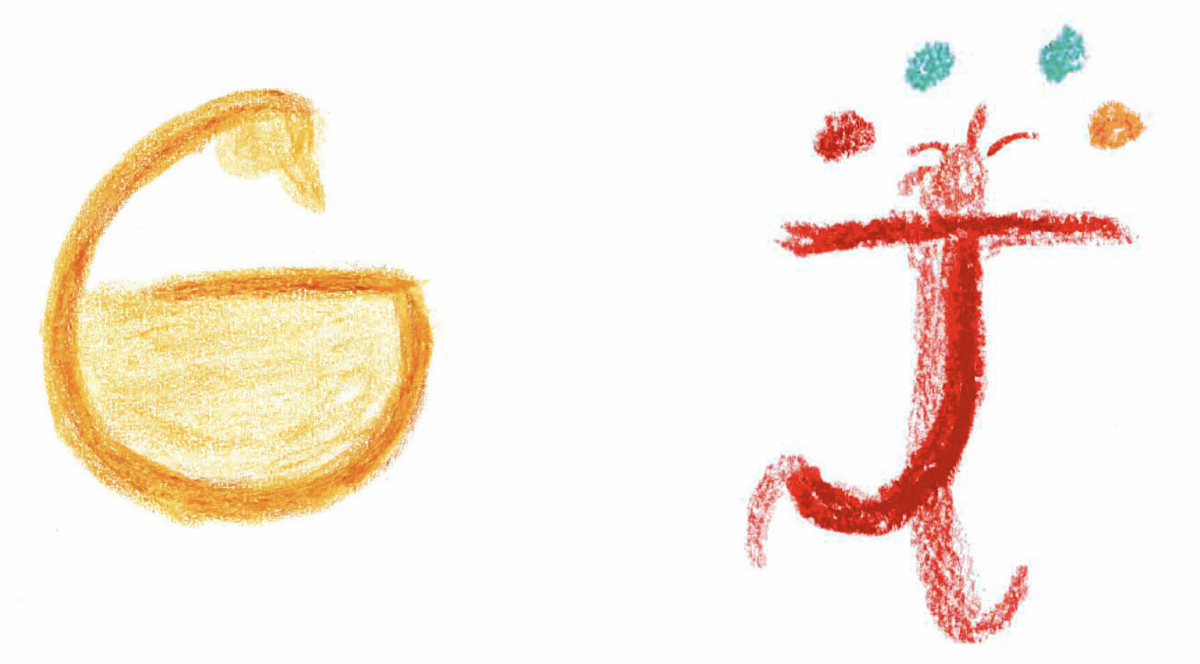 | |
From the Christopherus First Grade Curriculum | |
|
Beginning with an activity that, being artistic, draws out the whole human being, one should develop writing, which tends toward the intellectual. And one must let reading, which concentrates the attention strongly within the realm of the intellect, arise out of writing.
When people recognize how much is to be gained for the intellect from this early artistic education of the child, they will be willing to allow art its proper place in the primary school education. The arts of music, painting and sculpting will be given a proper place in the scheme of instruction. This artistic element and physical exercise will be brought into a suitable combination. Gymnastics and action games will be developed as expressions of sentiments called forth by something in the nature of music or recitation.
People will discover how great a power resides in an artistic manner of instruction for the development of will and feeling. However, to teach or instruct in this way and obtain valuable results can be done only by teachers who have an insight into the human being sufficiently keen to perceive clearly the connection between the methods they are employing and the developmental forces that manifest themselves in any particular period of life. The real teacher, the real educator, is not one who has studied educational theory as a science of the management of children, but one in whom the pedagogue has been awakened by awareness of human nature.
For instance, there is the acquisition of certain things purely through memory that is connected to the developmental forces at work between the sixth or seventh and the fourteenth year of life. It is this property of human nature upon which the teaching of arithmetic should be based. Indeed, arithmetic can be used to cultivate the faculty of memory. [While learning those times tables can be tedious, it is an inestimable assistance in the cultivation of memory, a faculty under threat from a computer-driven life. Memorizing poetry is another part of this.]
One may fall into the mistake of trying all too anxiously to make the child understand everything one tells him. The will that prompts one to do so is undoubtedly good, but does not duly estimate what it means when, later in life, we revive within our soul something that we acquired simply through memory when younger and now find, in our mature years, that we have come to understand it on our own. [This can be very difficult for a modern person to understand—it flies against all conventional educational practices where one is forever explaining things to children. By sometimes letting things ‘sit’, one a) gives the child space to find his own answers b) helps a child to look within and not constantly without for answers---a vital habit of soul once computers are used and c) helps a child know that he is on a journey and that ‘some day I’ll know that’.]
Here, no doubt, any fear of the pupil's not taking an active interest in a lesson learned by memory alone will have to be relieved by the teacher's lively way of giving it. If the teacher engages his or her whole being in teaching, then he may safely bring the child things for which the full understanding will come when joyfully remembered in later life. There is something that constantly refreshes and strengthens the inner substance of life in this recollection. If the teacher assists such a strengthening, he will give the child a priceless treasure to take along on life's road to arouse the child's own activity, but such fruits lose their flavor with the end of childhood. The flame enkindled in the child from the living fire of the teacher in matters that still lie, in a way, beyond his “understanding,” remains an active, awakening force throughout the child's life.[A plea for an enlivened, soul-embued education---often it’s not so much what one teaches but always how one teaches.]
| |
|
I hope people have found this inspiring. I look forward to feedback and hope to print comments, questions and my own input in the next Homeschool Journey.
Til March,
Blessings on your homeschool journey,
Donna
| | | | |