|
I am on Facebook! Are you?
My Legislative page is frequently updated with the latest news throughout the state and the district.
Like me on Facebook and be the first to know.
Update on Previous Issues:
Florida House Mobile App:
Follow Me:
.
|
|
| |
Today marks the beginning of the 2015 Special Session A. I hope you find the information enclosed to be helpful to you during the Special Session slated to last from June 1st to June 20th. One of the most important facts to keep in mind during the upcoming budget discussions is that Florida is constitutionally required to balance its budget each fiscal year. This means the state cannot spend more than it receives in revenue and the work must be complete and signed by the Governor by July 1, 2015.
In this week's newsletter, I am providing information regarding the Special Session, as well as a link to a survey. I deeply appreciate the time you take to consider the information below as well as to provide your thoughts on the Special Session. I have also provided a link to the proclamation which includes the budget and conforming bills which were poised for conference during the 2015 Regular Legislative Session.
2015 Special Session A Proclamation
Proudly Serving Manatee and Sarasota Counties
|
Special Session Budget Outlook
|
When Session adjourned, the House and Senate had passed their own appropriations bills within their respective chambers but neither chamber had taken up the other body's legislation/spending plan. This puts the House and Senate in line to either refile the appropriations bills and begin work on the fifth step, Budget Conference, or amend what had been passed and being in Conference. The creation of the budget is based on 6 main steps and when the House and Senate reconvene, the Legislature will be half way through the process.
The main work of the Special Session will begin when the Speaker of the House and President of the Senate appoint members of each chamber as conferees. The conferees are responsible for resolving any differences in the separate House and Senate budgets in order to create a single budget. During conference, they must determine not only the items that will receive funding but also how much funding will be allocated for each item. I expect for budget conferees to be announced before the formal conference.
Finally, following a successful conference, the two bodies produce a single conference report, called the General Appropriations Act. The General Appropriations Act (GAA) is then sent to the Governor who has line item veto authority over items within the document, for passage.
More information is available in my newsletter on the budget process provided below.
March 27th, 2015 Newsletter on the Budget Process
|
| Medicaid Expansion, Low Income Pool (LIP) and Exchange Subsidy Eligibility Currently, there are approximately 865,000 low-income, uninsured Floridians who would qualify for Medicaid under expansion, and it is estimated 257,000 of these same Floridians currently qualify for private health insurance subsidies in the federal exchange. If Florida chooses to expand Medicaid, these estimated 257,000 Floridians could lose eligibility for those federal subsidies and be put into Medicaid. The House leadership believes the state budget and ongoing negotiations with the federal government over the future of the Low Income Pool (LIP) should be separate from the debate over Medicaid expansion, and the Senate leadership believes that these issues should be addressed together. Medicaid expansion in Florida will cost an estimated $55 Billion over ten years, including an estimated $3.5 Billion in state funds. The value of Medicaid coverage is debatable. I believe the State of Florida's goal should be to keep people out of Medicaid if they have an affordable private market alternative. I believe we should not do anything which could make Floridians lose private coverage and move to a program that in my opinion has poor clinical outcomes.
- According to a five-year University of Virginia study, hospital surgical outcomes are far worse for Medicaid recipients than for people with private insurance, Medicare, or even those with no insurance at all. Additionally, a survey by the American College of Emergency Physicians shows that under expansion, emergency room visits increase.
- Other studies of specific diseases (including cancer and vascular disease) found higher mortality rates, higher surgical complication rates, and higher rates of late-diagnosis for people with Medicaid compared to people with private insurance and even the uninsured.
|
| Medicaid is Already the Largest Single Expenditure in the State's Budget
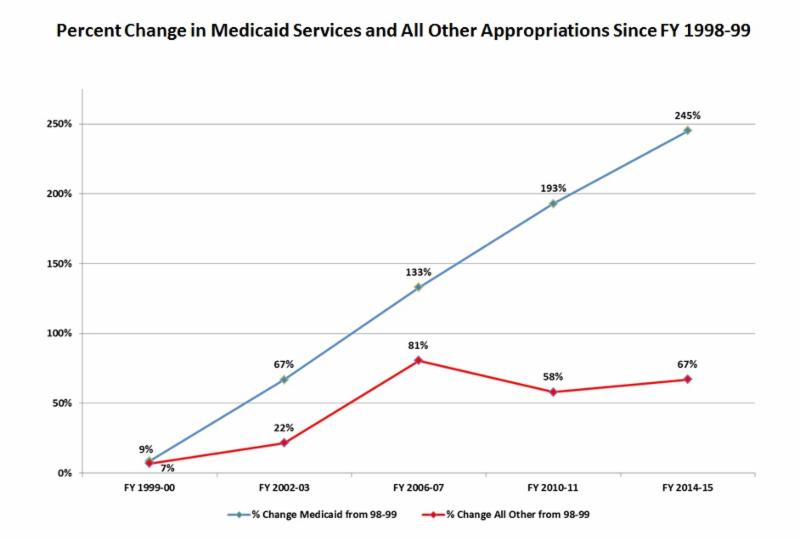
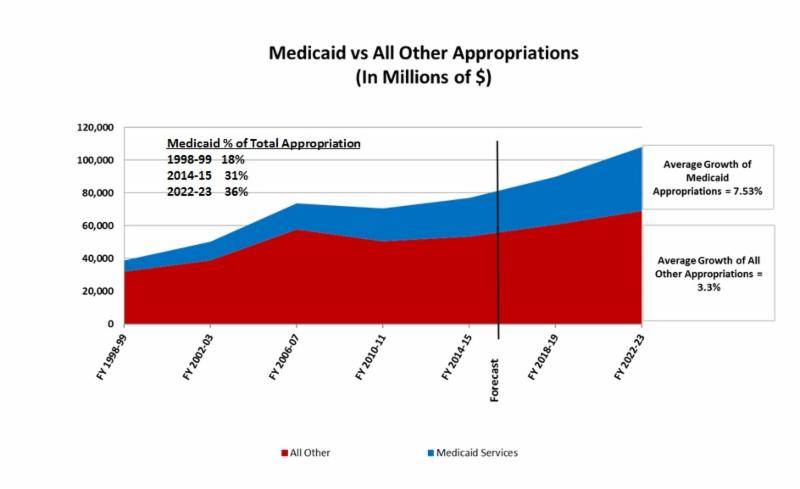
- Medicaid currently consumes approximately one-third of our state budget (including state and federal dollars) and Medicaid spending is growing by more than twice that of other appropriations.
- By Fiscal Year 2022-23, it is estimated Medicaid will encompass 36 percent of total appropriations, and that is without Medicaid expansion.
- Even without expansion, it is estimated that just a one percent shift in today's Medicaid matching rate would cost Florida approximately $180 million annually.
- Even if the federal government covered 90 percent of the cost of expansion, full Medicaid expansion could potentially cost the state $3.89 billion over a 10 year period.
- A one percent shift in the federal matching rate for the expansion population could cost Florida an additional estimated $40 million annually.
|
| Medicare vs Uninsured vs Medicaid Patients According to a University of Virginia study analyzing 893,658 major surgeries over a 5-year period:
- Medicare patients - 45% more likely to die before leaving the hospital than patients with private insurance.
- Uninsured patients - 73% more likely to die before leaving the hospital than patients with private insurance.
- Medicaid patients - 93% more likely to die before leaving the hospital than patients with private insurance.
|
| Of the 865,000 Eligible for Medicaid Expansion
- 46% do not work and any plan with a work requirement will not cover these Floridians.
- 82% are able-bodied adults with no dependents.
- 100% qualify for the Medically Needy program. However, in order to pay for Medicaid expansion under the Florida Senate plan, the Medically Needy program would be eliminated.
|
| Important Facts for Florida's Budget Florida's Fiscal Year:
Florida's Top 5 Spending Areas in the Budget:
- Healthcare
- PreK-12 Education
- Transportation & Economic Development
- Higher Education
- Justice
Florida's Budget has Three Major Categories of Funding:
- The General Revenue Fund
- State Trust Funds
- Federal funds
|
Below is a link to a brief survey on the upcoming Special Session. Your input is critical to the legislative process. Thank you in advance for taking the time to complete it and please feel free to share this information with anyone you believe may be interested in providing their thoughts.
Special Session Survey Link
|
Out and About In the District
|
Thank you to all the local groups who have generously allowed me to speak to their membership about the Legislative Session.
|
|
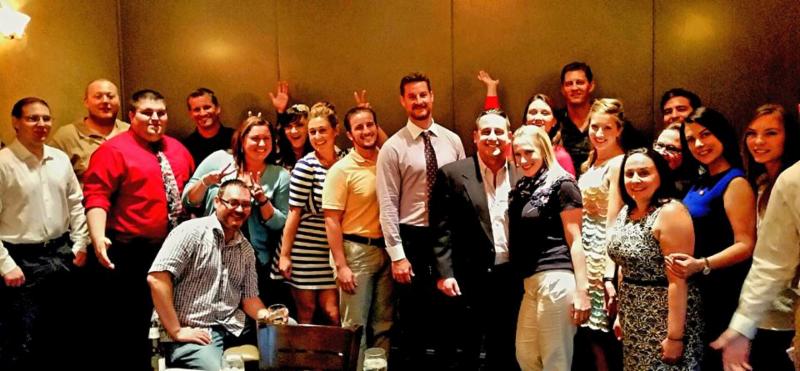
| On May 14th, I met with both the Sarasota Young Republicans and the Manatee County Young Republicans |
|
Monday, June 1st to Saturday, June 20th: Special Session A (Tallahassee)
|
Contact Me:
Unit A 402 South Monroe Street
(941) 341-3117 (850) 717-5073
|
|
| |
|