|
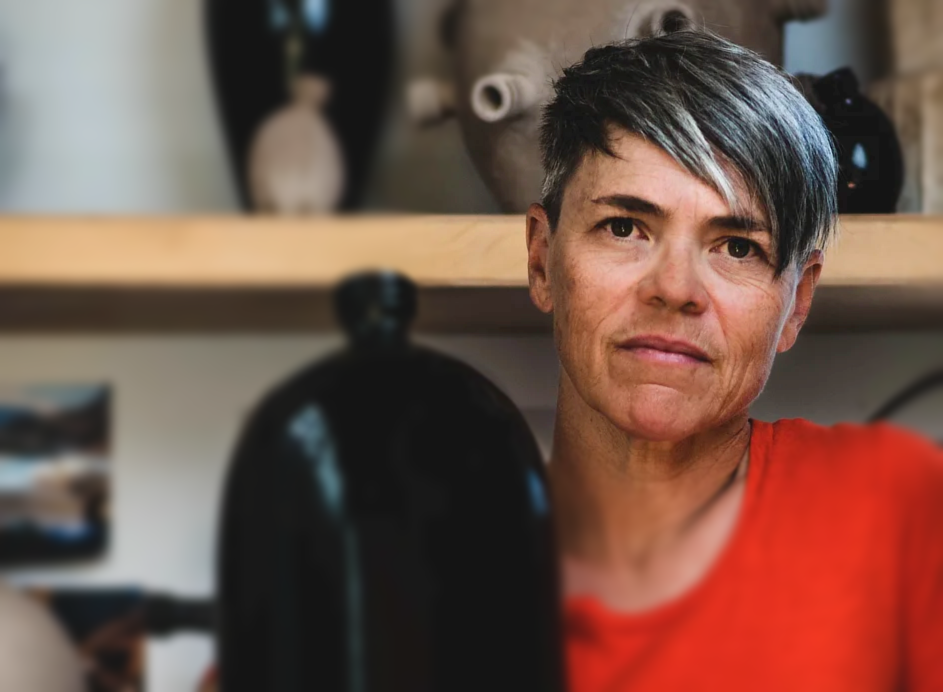
“I rarely end up in the place I think I’m going because the clay has its own ideas. I like the feeling of being led by the materials.”
JAMI PORTER LARA, CERAMIC ARTIST
“I rarely end up in the place I think I’m going because the clay has its own ideas. I like the feeling of being led by the materials.”
Jami Porter Lara is a leading light in a new day for ceramic artists. Perhaps like no other artform, the heart and mind of the ceramicist falls into the clay, revealed to us, the viewer, as shape and from, but also as message and conviction. Lara’s approach to creativity is woven together by her concerns around cultural inheritances and a desire to be a “citizen of the natural world.”
Born in 1969 in Spokane, Washington, Lara has lived in New Mexico since 1980, out of her studio in Albuquerque's North Valley. Her creative career was sparked relatively late in life; “I’d done so much critical thinking,” she said, “I was almost paralyzed.” At aged 40, seeking a more creative life and, in a fine arts program at the University of New Mexico, she fell for the “organic simplicity of clay.”
On a research trip around Southwestern borders, she was struck by the spatial relationship between discarded ancient pots and modern discarded water bottles. Both objects served vital purposes for those who owned them—to carry water—and both were discarded when no longer required. Through each object, old and new, there is a cultural link across time as well as place.
Lara worked to bring to life what she had seen and developed a visual language around her black vessel conceptual sculptures. “It was about the connection between the plastic bottles and the pots,“ she said. “Thinking about how they represented this unbroken lineage of people moving through the landscape.”
Lara's work also directly engages with the industrialized mass production that is central to any modern consumer culture. But she also stops us in our tracks to ensure we keep our perspective. Although she recognizes the harmful impact we have across the planet, she also creates context. "Saying that humans are only pollutants is a failure of imagination. Yes, we’re destructive, but we’re also creative.”
In order to create her bottles, Lara uses firing techniques that were developed over 2,000 years ago in the region. In this way, not only does her artistic narrative connect with cultural history, but her process of production draws past and present together. By doing so, she compels us “to recognize that the bottle belongs to the long human history of functional vessels we use to contain and transport the necessities of life.” As a mic drop, she adds – “Viewers can reflect on what they leave behind.”
More from Jami Porter Lara at the bottom of the Muse.
|