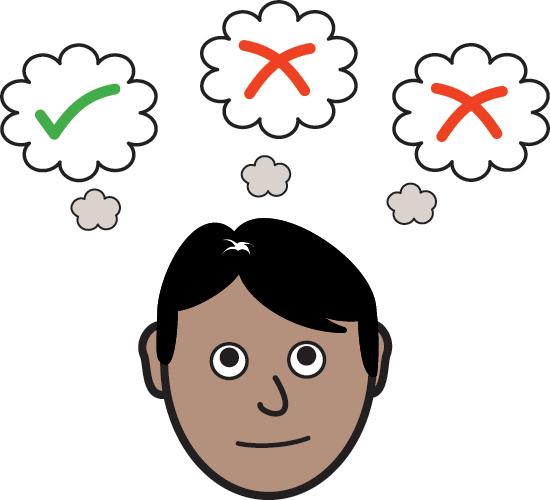
When supporting people to live the lives they choose, sometimes questions come up about informed choice.
What is Informed Choice?
A person makes an informed choice when she has been given all known available options in a way she can understand, including how each option may affect her life-both positively and negatively. A person should understand the risks involved, if any, and how risks can be addressed. By making informed choices, a person has power and control over her life.
1. We all build skills for making informed decisions by actually making decisions and we all need opportunities and support to do so.
We rarely make a decision in isolation. We all need information from others to help us make informed choices. We seek out experts, those with experience, and people we trust to help us make decisions. We ask for information in language we understand and at a pace we are comfortable with. We make decisions others don't always agree with and we change our minds. Regardless of the amount of help or time that is needed, or our fears around a person making choices we don't agree with, a person's right to make choices about his life should be respected and supported by others involved in his life. Each person has the right to make his own choices through exploration and expression of his values, not the values of people supporting him.
2. Listen with empathy. This helps a person know she is heard and validated. Feeling validated can help her overcome fear about making independent decisions.
There will be times when a person and those closest to her feels fear associated with the potential risks involved with making independent decisions. When helping a person make an informed choice, be empathetic to the fact that her life is interrelated, meaning that her decisions are made together, or mutually, with other people she has relationships with. Help her and others in her life feel heard and validated so that they feel a part of the process and not dismissed from the process. Fear can be useful if it serves as a warning that a choice can be detrimental to health, safety, or security. It is when fear holds us back from experiencing the joys in life and doing the things we really want to do that the fear becomes a barrier.
3. Know what is important to and for a person so that you can provide him with information that is meaningful to him. Find ways to overcome barriers by knowing what resources can support a person. Ask others for help if you don't know.
Everyone shares the need to be a valued, respected, and contributing member of the community. We all need to feel in control of our own success. The ways each person experiences and expresses these things are unique. When supporting a person to make informed decisions, find out what he cares about, what he wants, and what is important to him. Know and share available options he can choose from to achieve his goals, and offer possible ways to prepare for or avoid any risks involved. In this way, we can work to help him and those closest to him feel the power of making informed independent and interdependent decisions. When people feel empowered, they discover the possibilities in life and increase expectation of what can be achieved. When people are provided with opportunities to try and even fail, it provides opportunities to learn and grow. People are then able to recognize how barriers, like fear, can be overcome and they gain courage and wisdom through the experience.