|
News Summary (June 2024)
Background
Operation 1027 resumed this month in Northern Rakhine State which indicates China’s tolerance of the regime in Nay Pyi Taw has gone thinner. Just days after the operation resumed one of the members of the Brotherhood Alliance, which is reading the operation, Ta’ang Palaung Liberation Army (TNLA) said it is poised to take control of two major towns in Northern Shan State, Naungchio and Kyaukmae. Now they are moving toward Pyi Oo Lwin, the town which hosts the junta’s biggest military training institute. Other priced targets the alliance is targeting are the capital of Northern Shan State Lashio also the headquarters of the regime Northeastern Command, and Mandalay, the seat of Burma's last king.
In the west another member of the alliance the Arakan Army (AA) is making further gains this month, now they control the second-largest city in the State, Thandwe.
It is no secret that the Chinese government at the highest level is backing these rebel groups fighting the regime led by Min Aung Hlaing, whom Beijing most despise among so-called Myanmar leaders.
China perhaps may be looking for how to maintain stability in Myanmar in the post-Min Aung Hlaing era, they seek support from former leaders of Myanmar including a reformist former president U Thein Sein in trying to keep the country united after the current conflict ended.
U Thein Sein was invited to Beijing during the last week of June to mark the 70th Anniversary of the Five Principles of Peaceful Coexistent also known as Bandung Principles. Several Chinese leaders including President Xi Jinping attended the event.
As Beijing looks ahead to how to help rebuild post-conflict Myanmar, the United States is also trying to seek insight into the situation in the country. It was reported in the media that a senior US official met a senior Myanmar Navy Officer in Vietnam this month, further details of the meeting were not disclosed to the media.
It cannot be coincident that the US tried to reach out to the Myanmar navy which is presumed as the most disgruntled wing of the Myanmar military against Min Aung Hlaing’s leadership.
It should be known to everyone or need to accept that post-conflict Myanmar will no longer be the same as it was in the post-coup era. It should be accepted that Burma's hegemony over the ethnic groups and ethnic regions will no longer exist in Myanmar.
However, a source said a senior United Nations official who visited the region recently was known to have discussed with a group of anti-regime civil society organisations in the Malaysian capital Kula Lumpur to understand their thoughts on Myanmar’s future.
A senior CSO actor who attended the meeting in KL said he was disappointed to note that the Myanmar CSOs were still pushing for a similar Burmese dominance in Myanmar politics under the leadership of Daw Aung San Suu Kyi and her party the National League for Democracy (NLD).
With the events unfolding in Northern Shan State and Rakhine State in recent days, it could be said that groups like TNLA and AA are going to emerge as the key stakeholders in discussion on the country’s political future.
It may be the right time for all groups to accept that the process of negotiation to shape Myanmar’s future political structure must start now. All the participants in such a discussion must have equal status, it will be not healthy for the process if the pro-Burma groups continue to push for their dominance as was the case in previous rounds of peace negotiations between the Government in Nay Pyi Taw and the ethnically based rebel groups (from 2011 to 2021).
The elected government led by NLD leader Daw Aung San Suu Kyi from 2016, also strongly pushed a pro-Burma agenda. Which was evident during the Rohingya crisis in 2016/2017.
As the political crisis deepens and the conflict intensifies in Myanmar the suffering of the people of Myanmar has intensified, there are cases of rice shortages reported in major cities across the country and the number of internally displaced people is increasing. It is incumbent upon the conflicting parties to come up with how to address the humanitarian crisis as they discuss a way forward for a stable political future in Myanmar.
Context
By the time this news summary is published the Three Brotherhood Alliance may be on the verge of taking control of the capital of Northern Shan State Lashio and the ruby mining town Mogoke. After these successes, the rebels are likely to push to take control of Pyi Oo Lwin and the country’s second-largest city Mandalay, where the alliance is fighting alongside the people's defence forces (PDF).
The current strategy the junta is adopting is militarily to stop the rebel troops in Pyi Oo Lwin, while it tries diplomatically appeasing China to secure a ceasefire. That could include allowing China to resume the Myitsone project in Kachin State.
There is no doubt that China wields a strong influence over the TNLA and other rebel groups fighting the regime and Beijing could encourage the rebel groups to agree to a new ceasefire if the regime in Nay Pyi Taw agrees to its demands.
Among the list of demands from China to the regime could be to restore political stability in Myanmar so that it can use the country for its economic and strategic interests.
For political stability, China may want the removal of Min Aung Hlaing in the first place and to start a political dialogue among the warring factions in Myanmar and hold a new election.
China has always not agreed with the policies of Daw Aung San Suu Kyi and the NLD, however, since the NLD muster strong support among the people of Myanmar, Beijing has always seen the NLD as a stabilizing factor in Myanmar. There have been reports of Chinese diplomats requesting to meet the jailed NLD leader Daw Aung San Suu Kyi, but it was turned down by Min Aung Hlaing.
Even though the US and the West may want to prevent the further influence of China in Myanmar, however, it has limited control over the situation and Western countries are currently preoccupied with major global issues, such as the war in Ukraine and Palestine.
According to a report in the Diplomat website the U.S. assistant secretary of state for East Asian and Pacific Affairs Daniel Kritenbrink, met Kyaw Lin Zaw. a commander in the Myanmar Navy, in Hanoi on June 21-22. The meeting was held secretly and according to an unknown US diplomat quoted in the Diplomat’s report, no significant progress has been made and the US wants to end the political oppression and the ethnic strife in the country.
Economic chaos, monk boycott- will these factors weaken the junta?
Inflation has been a key cause of public discontent with the ruling governments across the world, there is no difference in Myanmar. Even under the tight grip of military rule, Myanmar saw a major uprising due to rising inflation and rising prices of commodities in 2007.
Today Myanmar faces the highest rate of inflation it has ever faced in the past. The price of staple rice has now gone beyond the reach of many families who depend on daily wages. The currency depreciation is also unprecedented since the junta took overpower. The rate of exchange for the US dollar was only 1500 Kyat to 1 US dollar when the junta seized power in 2021, it is now close to Kyat 5000 to a dollar. The depreciation of the kyat also caused a rise in the price of fuel and gold. The junta’s response, as it did in the past, was to crack down on the market operators, instead of trying to repair its fundamental economic policies.
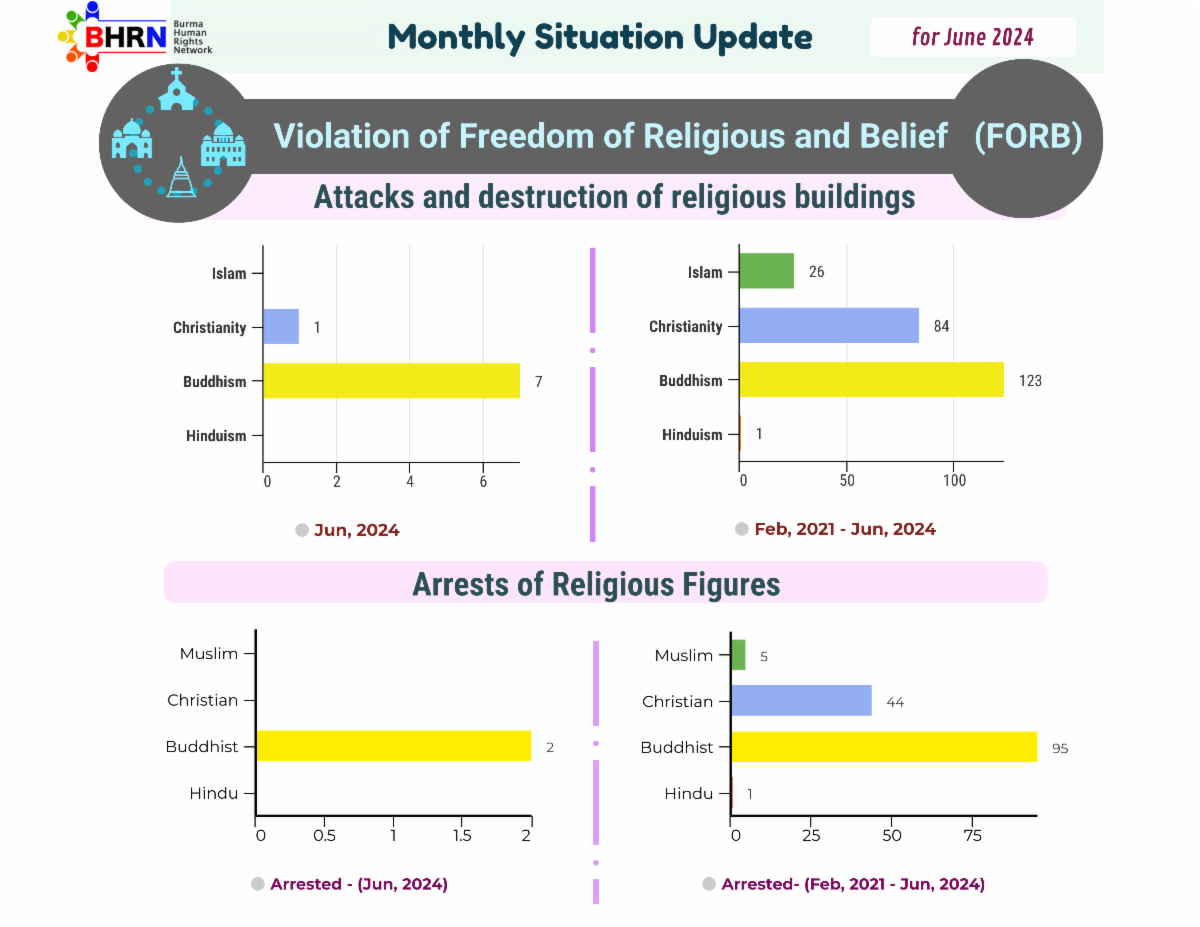
The uprising in 2007 which was started due to the rise of fuel was later taken over by monks, which was brutally crackdown by the junta. Now, the monks who were involved in the 2007 revolution which is popularly known as the "Saffron Revolution" are calling more than 300 000 monks in the country to take a similar measure. Their call intensifies with the killing of a prominent monk by the junta troops in mid-June.
The 77-year-old monk, Badanta Muninarbiwuntha, who was a member of the highest monk council in the country the State Sangha Maharnayaka Council, was shot dead by the junta troops on a highway in Mandalay Region because the car he was travelling did not follow a rule of the junta which say not to close the windows while driving the cars.
The incident has led to a quiet boycott by the monks in 20 townships across the country, their protest is to refuse food donated by the junta officials. However, the monks close to the junta are calling their fellow monks to forgive the killing of Badanta Muninarbiwuntha. So, there is an increasing divide among the monks after the incident.
The junta’s policies to control inflation seem too wayward, their response to inflation is to arrest the business operators, who raise the salaries of their staff in response to the rising cost of living. It also threatened the private banks, which raise their mortgage ratios, with a hefty fine. Other measures include arresting affluent Myanmar people who transfer large sums of money, especially to Thailand to purchase properties there.
There is no need to remind the people in Myanmar, that those who lead the Myanmar military at different times are the dumbest individuals in handling the country’s economy. Many can say so from their personal experiences.
|