Videos and slides are now available from the Fifth Annual Mid-Atlantic Ocean Forum, hosted May 17 and 18, by the Mid-Atlantic Committee on the Ocean (MACO) at the Alexander Hamilton U.S. Custom House in New York City. For the first time since 2019, ocean stakeholders and industry professionals from around the region gathered in person for the event’s robust schedule of expert panels and networking activities.
Discussions centered on pressing ocean issues of the moment and those on the horizon, including climate-ocean action, offshore wind energy, conservation efforts in the region, diversity, equity and inclusion, sustainable ocean economies, and more.
“The opportunities to transition to a just and renewable future are before us, and ones that we need to be collaborative in finding ways to achieve,” MACO Chair Michael Snyder said in his opening remarks. “At the same time, we must be respectful and appreciative of the biodiversity and the important ocean habitats that sustain our economies. Truly these are monumental, generational challenges that we face but I’m invigorated by everyone here, your presence and energy.”
|
Mike Snyder, Ocean and Great Lakes Program Manager, New York State Department / Chair, Mid-Atlantic Committee on the Ocean |
|
Throughout the Forum, participants submitted resources, questions, and input-both online and in-person. Additionally, several sessions leveraged the online survey tool Mentimeter to solicit input from both in-person and virtual attendees. Input received and Mentimeter results are reflected in the summary below, and will be considered as MACO, its Work Groups, and other collaborative efforts define their future actions.
Day 1 Synopsis
The Forum kicked off with a panel on the interaction of climate and oceans, one of the major drivers for ocean planning and management in the Mid-Atlantic. The session sought to inform federal and state priorities and recognize diverse stakeholder perspectives on ocean-climate actions and activities in the Mid-Atlantic, including considerations for inclusive and equitable approaches to benefit distribution and planning processes.
Summarizing her state’s approach, New York Department of State Deputy Secretary of State, Kisha Santiago, said, “We’re shepherding in the energy transition with a real committed focus on equity and working exceptionally hard to bring in people who have legitimate concerns about how this transition will affect them, which includes better accounting and education on how doing nothing will harm them more.”
Click here to view the questions and responses that were received.
|
|
A Tribal Data and Geotools session provided updates on the Mid-Atlantic Regional Council on the Ocean’s (MARCO) plans for expanding engagement with state and federally recognized tribes in the region through Bipartisan Infrastructure Law funding and the introduction of an Indigenous Nations, Communities and Cultures map collection on its Ocean Data Portal. The Eastern Region Geospatial Coordinator for the Bureau of Indian Affairs (BIA) presented about services provided by the BIA Branch of Geospatial Support (BOGS). Representatives of the Portland, Oregon-based Ecotrust shared lessons for the Mid-Atlantic from their development of an Indigenous Traditional Knowledge Database with tribes on the West Coast.
“Governments and private institutions frankly are not doing a good enough job of supporting tribal data sovereignty,” said Ecotrust Tribal Network Strategist Carson Viles, a member of the Confederated Tribes of Siletz Indians. “That can be as simple as fundraising in a way that doesn’t obligate tribes to share information, but it comes down to values of prioritizing collaboration over extraction and advocating for the perspective of our tribal partners as far as their right and responsibility to steward and take care of the teachings and knowledge in their community in the ways that they see fit.”
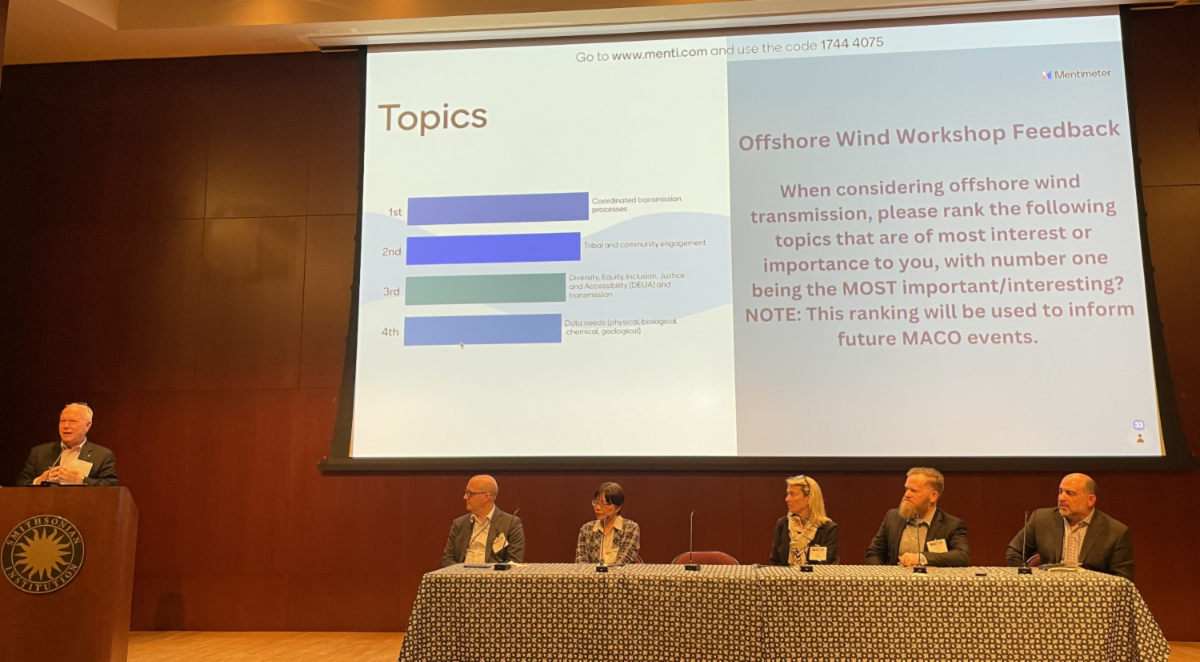
The day concluded with a two-part session that summarized the status of federal and state offshore wind energy transmission studies in the region, as well as how Community Benefit Agreements between developers and communities can help address community concerns related to offshore wind. The session served as a kick-off to an upcoming workshop, anticipated in early 2024, that will further explore offshore wind energy transmission planning. Mentimeter was used to help inform topics for the 2024 workshop. View the results here.
|
|
Left to right: Tony Macdonald, Director of Monmouth University Urban Coast Institute; Wright Frank, Renewable Energy Policy Chief at BOEM; Jian Fu, Program Lead at DOE Systems Integration Wind Energy Technologies Office; Laura Smith Morton, Partner at Perkins Coie LLP; Josh Gange, Renewable Energy Program Specialist at BOEM; Nick Napoli, MARCO Senior Advisor and Northeast Regional Ocean Council Executive Director. |
|
Dr. Kira Lawrence, senior scientist at the New Jersey Board of Public Utilities, said during the panel presentation that, “We think regional coordination is absolutely critical if we’re going to get to this 30 gigawatt and beyond goal that is already materializing along the Eastern Seaboard.”
In the online chat, MACO Steering Committee member Kelsey Leonard, of the Shinnecock Indian Nation, shared that the National Congress of American Indians passed a resolution urging a moratorium on offshore wind development. The document calls for greater federal engagement of tribal nations in the process, fair compensation for the use of their lands and resources, and steps to ensure that development does not harm their environment or cultural heritage.
Day 2 Synopsis
The second day of the forum opened with a welcome from Tricia Hooper, Regional Coastal Management Specialist at the National Oceanic and Atmospheric Administration (NOAA) Office for Coastal Management. “With increasing demands on ocean commerce, recreation, energy production, and conservation, the Mid-Atlantic waters are getting busier everyday. We look forward to continuing to hear from all of you, the people who live and work and play in the Mid-Atlantic, throughout the rest of today’s forum about how you think we should be using these ocean waters.”
|
|
MARCO Executive Director Avalon Bristow took to the stage to thank everyone for joining and making the Forum possible, and to provide an overview of the robust work plan that MARCO is undertaking with support from Bipartisan Infrastructure Law funding. She also honored Laura McKay, a member of the MARCO Management Board since its inception. McKay is the Program Manager at the Virginia Coastal Zone Management Program and will be retiring this summer after years of dedication to ocean conservation in the Mid-Atlantic region. |
|
MARCO Executive Director, Avalon Bristow
Virginia Coastal Zone Program Manager/MARCO Board Member, Laura McKay
|
|
The first session of the day was a Diversity, Equity, and Inclusion: Allyship in Action workshop led by Nicole Jean Christian, Empire State Fellow at the New York Department of State, and Christie Mazzeo-Pfoertner, Oceans and Great Lakes Technical Specialist at the New York State Department of State (NYSDOS). Jean Christian described the difference between assisting and supporting in the role of allyship: “You’ve got to take a chance, you’ve got to be a little vulnerable, not always comfortable, but necessary – particularly in this space which we are dealing with now, when it comes to our role in restoring, cultivating, and supporting the ocean.” Interactive breakout sessions focused on trust and accountability in our personal and professional lives, with multiple members of the NYSDOS assisting in person and virtually. View a list of resources provided during the session.
|
|
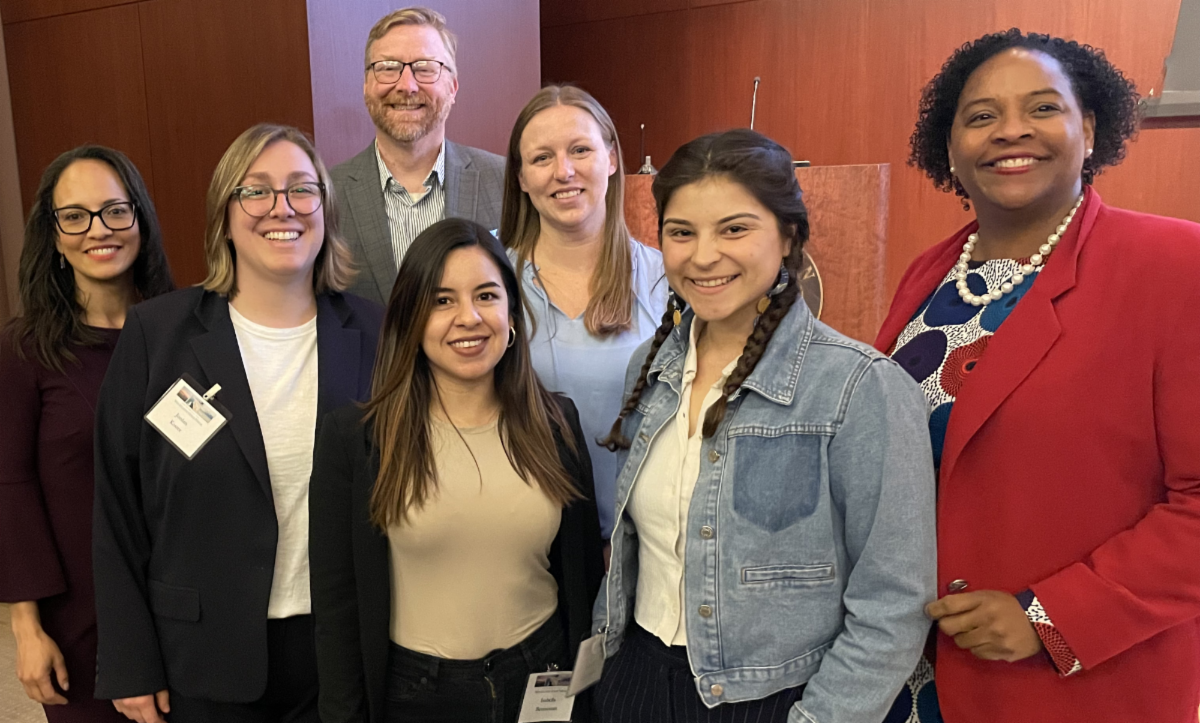
Left to right: Kisha Santiago, Deputy Secretary of State, NYSDOS; Jordan Koster, NYSDOS; Mike Snyder, MACO Chair; Isabella Betancourt, NYSDOS; Christie Mazzeo-Pfoertner, Oceans and Great Lakes Technical Specialist, NYSDOS; Elizabeth Mogus Garcia, NOAA Coastal Management Fellow; Nicole Jean Christian, Empire State Fellow, NYSDOS |
|
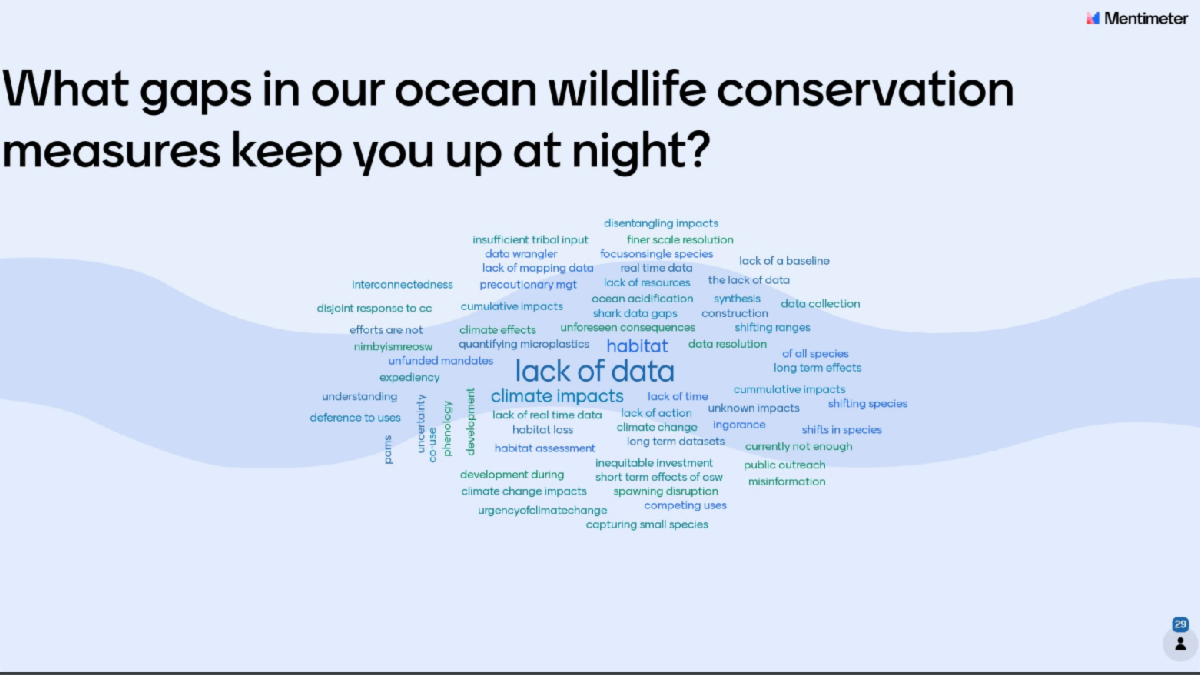
After a short networking break, the forum reconvened for the Mid-Atlantic Ocean Wildlife: Charting a Course for Biodiversity Conservation session led by McKay and Kevin Hassell, Environmental Specialist at the New Jersey Department of Environmental Protection. The session focused on the importance and need for ocean data in making informed decisions regarding ocean conservation and presenters highlighted new and emerging issues and responses to wildlife conservation concerns. Dr. Sean Hayes, Protected Species Branch Chief, NOAA Northeast Fisheries Science Center noted, “We have to balance our needs with ecosystem sustainability.”
The session utilized Mentimeter to collect responses from both virtual and in person attendees. Click here to view questions and responses received.
|
|
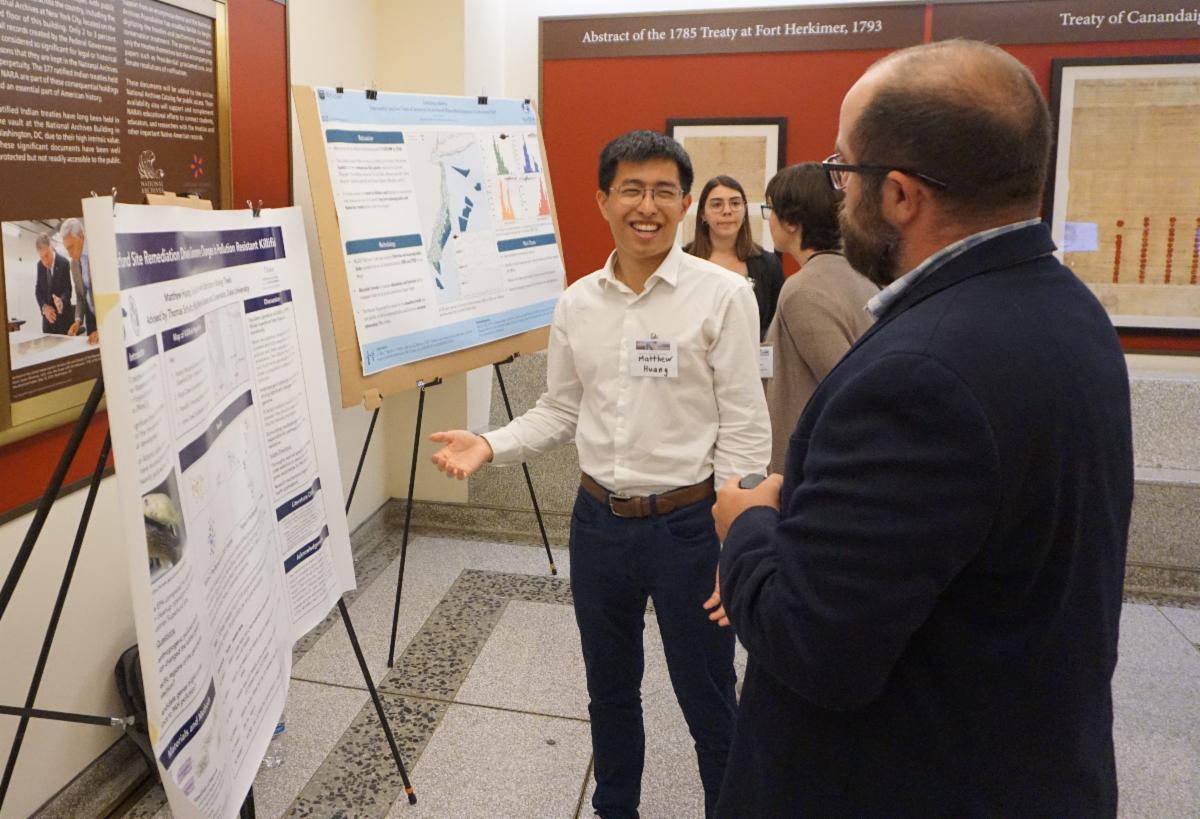
Matthew Huang, Duke University, presenting "Pollution Mitigation Drives Genome Changes in PAH Resistant Killifish at a Superfund Site"
|
|
The final session of the Forum was a panel discussion on Planning for Sustainable Ocean Economies. Led by Snyder, the panel was composed of national, state, regional and urban ocean justice perspectives. The discussion highlighted the importance of regional approaches toward ocean and coastal management, such as through Regional Ocean Partnerships (ROPs) including MARCO. |
|
Panelists acknowledged the successes of ROPs in fostering cross-jurisdictional coordination that also reflect local priorities around ocean and coastal planning, which has led to strong bipartisan support for ROPs. For example, the Regional Ocean Partnership Act was recently passed by Congress, and significant funding for ROPs was included in the Bipartisan Infrastructure Law. Panelists underscored the importance of enhancing visibility, promoting knowledge sharing, and fostering a deep appreciation within participating agencies for the valuable work accomplished at the regional scale through ROPS like MARCO.
Incoming MACO Chair Kristi Lieske, Ocean Planner for the Delaware Department of Natural Resources and Environmental Control, gave a charge for action: “I encourage you to take all of the information that you’ve heard over the past two days and bring it home with you. Don’t leave it here. It is going to take all of us working together to find solutions and common ground.”
|
|
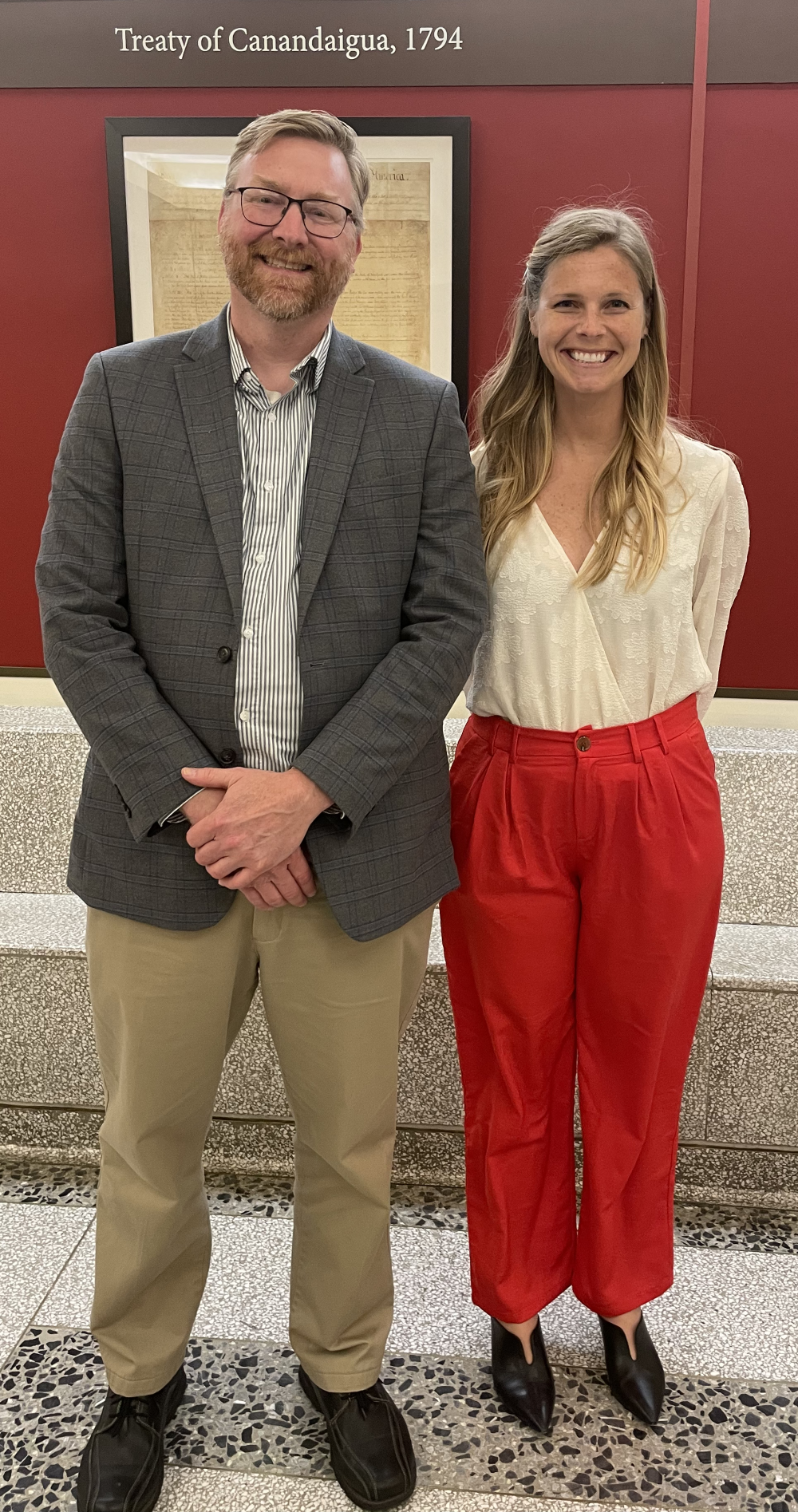
Outgoing MACO Chair Mike Snyder with incoming MACO Chair Kristi Lieske |
|
Tony Macdonald, Director of the Monmouth University Urban Coast Institute, concluded the Forum with a summary of its discussions, highlighting partnerships forged and looking to the future. "We have a grand experiment, which is the ocean. We need to be thinking about how the world is changing around us and using the power we have as individuals, as well as the allies we can develop, in support of our efforts. With the climate crisis, the reality is that we are now managing for the future."
Take Our Survey
MACO and MARCO thank all of those who participated in the Fifth Annual Mid-Atlantic Ocean Forum. The discussions, presentations, and interactive sessions have illuminated the pressing challenges our oceans face, as well as the remarkable solutions that lie within our reach. We encourage you to capitalize on the resources made available during this forum. The success of our collective mission lies in our continued dedication and collaboration.
Please complete this survey to help inform future events and enable us to improve the impact and engagement of the Mid-Atlantic Ocean Forum.
|
|
Photo Credits: Header (L-R): Coral, NOAA-OER/BOEM; Wind turbines, Ralf Hettler; Kayaks, Raul Rosa; Shipping container, Dan Barnes; Schooling fish, Jet Chen Tan; U.S. Naval ships, Gina Addison. Body. Footer (L-R) Fishing boat, William Sherman; Diver, Michael Eversmier; Beach scene, Christie Mazzeo-Pfoertner |
|
ABOUT MARCO
Established in 2009 by the Governors of New York, New Jersey, Delaware, Maryland and Virginia, MARCO provides a forum for our coastal Mid-Atlantic states to collaborate on shared regional priorities related to marine habitats, renewable offshore energy, climate change adaptation, and ocean water quality. MARCO initiated and oversees the Mid-Atlantic Ocean Data Portal to assist the region with ocean planning efforts. For more information about MARCO, visit our website, MidAtlanticOcean.org.
CONNECT WITH US!
Thank you for your continued interest in MARCO. We welcome questions and feedback you may have, including content for upcoming issues of MARCO News. To provide comments or suggestions, or to join our email distribution list, please click "Join Our Mailing List" below, or contact us at: info@midatlanticocean.org.
|
|
|
|
|
|
|