|
Historically, Most Soldiers are
Non-Killers in Battle:
Vietnam as the first Pharmaceutical War and
about the male ego on sex and combat
By Heather Gray
Followed by Review of "On Killing" by Dr. James Leiberman, M.D.
October 13, 2017
"Secretly, quietly...these soldiers found themselves to be conscientious objectors who were unable to kill their fellow man." The secrets were well kept, in "a tangled web of individual and cultural forgetfulness, deception and lies tightly woven over thousands of years....
the male ego has always justified selective memory, self-deception,
and lying [about] two institutions, sex and combat." (Marshall)
We are fortunate that Ken Burns and Lynn Novick have produced the documentary about the Vietnam War on PBS as it provides an opportunity to analyze so much about this tragic period in our history. There is also no way Burns and Novick could have depicted everything, yet one of the important aspects left out of the film regarding the United States and the Vietnam War was how military training had changed since WWII to make the American military recruits into reliable killers. That statement might be surprising to some, yet it is also encouraging, in that historically, whether we are Americans or not, the vast majority of humans don't want to kill. In fact, historically only 15% to 20% of us have been willing to do so. With the changed US military training, however, by the Vietnam War approximately 90 to 95% were willing to kill. However, psychologist Lt. Colonel Dave Grossman in his 1995 book "On Killing: The Psychological Cost of Learning to Kill in War and Society" notes, importantly, that to make sure the soldiers killed, Vietnam became the first pharmaceutical war.
In December 2003, after the US invaded Iraq, I wrote an article for Common Dreams entitled "Most Soldiers are Non-Killers in Battle: The Aftermath of State Sanctioned Violence and Who It Targets" based on the analysis of Dr. Grossman's book. Below are a few paragraphs from that article, followed by a fascinating 2009 review of Dr. Grossman's book by E. James Lieberman, M.D., Clinical Professor of Psychiatry, Emeritus of George Washington University School of Medicine. Dr. Leiberman adds considerably to the analysis with more comparative information on the psychological impact of imposing demands on individuals what is not normal behavior for the majority of us, such as killing other human beings.
From my 2003 article on Grossman's book "On Killing":
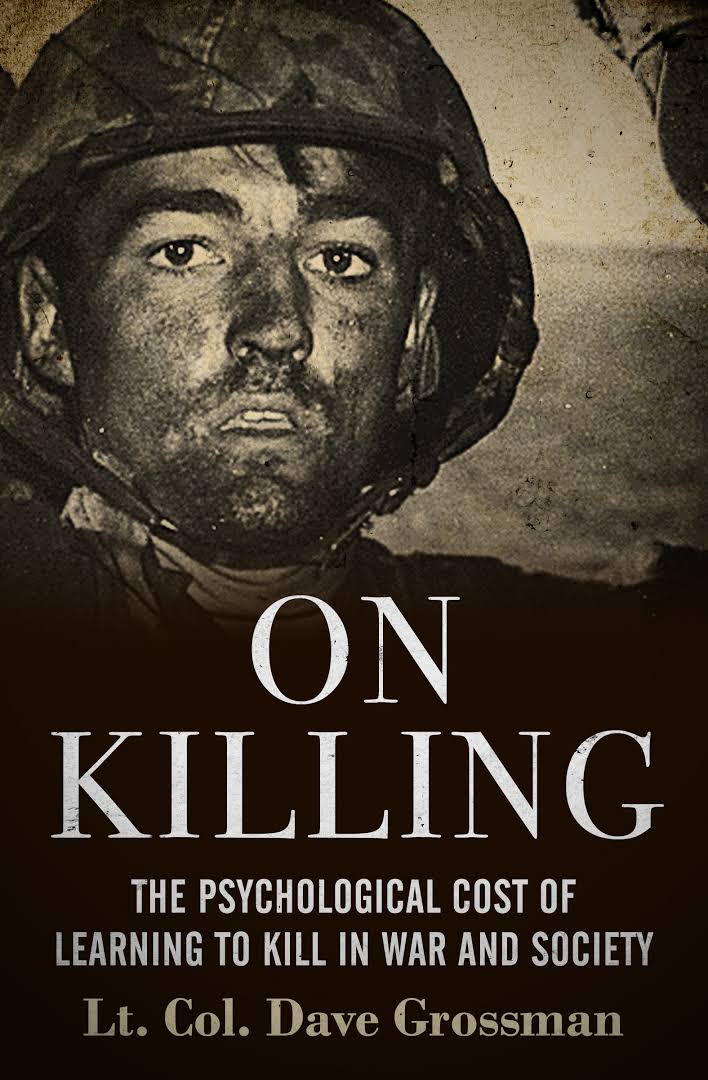 Perhaps one of the most compelling arguments against sending our young women and men to war is that most of us don't want to kill at all. In spite of being taught how glorious the battles might be, most of us don't comply with the request to kill. In his fascinating book On Killing, psychologist Lt. Colonel Dave Grossman devotes a whole chapter to the "Nonfirers Throughout History." Research has found that throughout history, in any war, only 15% to 20% of the soldiers are willing to kill. This low percentage is universal and applies to soldiers from every country throughout recorded history. Interestingly, even distance from the enemy does not necessarily encourage killing. Grossman offers the fascinating finding that "Even with this advantage, only 1 percent of the U.S. fighter pilots accounted for 40% of all enemy pilots shot down during WWII; the majority didn't shoot anyone down or even try to." Perhaps one of the most compelling arguments against sending our young women and men to war is that most of us don't want to kill at all. In spite of being taught how glorious the battles might be, most of us don't comply with the request to kill. In his fascinating book On Killing, psychologist Lt. Colonel Dave Grossman devotes a whole chapter to the "Nonfirers Throughout History." Research has found that throughout history, in any war, only 15% to 20% of the soldiers are willing to kill. This low percentage is universal and applies to soldiers from every country throughout recorded history. Interestingly, even distance from the enemy does not necessarily encourage killing. Grossman offers the fascinating finding that "Even with this advantage, only 1 percent of the U.S. fighter pilots accounted for 40% of all enemy pilots shot down during WWII; the majority didn't shoot anyone down or even try to."
The U.S. obviously didn't appreciate this low percentage of killers, so it began changing the way it trained its military. Americans began using a combination of the "operant conditioning" of I.P. Pavlov and B.F. Skinner in their training, which desensitized our soldiers through repetition. One marine told me that in basic training not only do you "practice" killing incessantly but you are required to say the word "kill" in response to virtually every order. "Basically the soldier has rehearsed the process so many times," said Grossman, "that when he does kill in combat he is able to, at one level, deny to himself that he is actually killing another human being." By the Korean War 55% of U.S. soldiers were able to kill and by Vietnam an astounding 90 to 95% were able to do so.
Grossman also states that Vietnam is now known as being the first pharmaceutical war in which the U.S. military fed our soldiers enormous amounts of drugs to dull their senses while they engaged in violent behavior and they are likely doing the same in Iraq.
Addressing the question of the low percentage of killers in battle, Grossman says that "As I have examined this question and studied the process of killing in combat from the standpoint of a historian, a psychologist and a soldier, I began to realize that there was one major factor missing from the common understanding of killing in combat, a factor that answers this question and more. That missing factor is the simple and demonstrable fact that there is within most men an intense resistance to killing their fellow man. A resistance so strong that, in many circumstances, soldiers on the battlefield will die before they can overcome it."
The fact that we don't want to kill is a thankful affirmation of our humanity. Do we really want to behaviorally modify our young men and women into professional, skilled killers? Do we really want to modify our youth's behavior in this way? Do we really want our youth desensitized to their own humanity and that of others? Isn't it time we addressed the real evils in the world, the real axis of evil being racism, poverty and war? Do we really want our tax dollars used to kill the poor of the world, destroy their countries and make us all more violent in the process? Surely we can better than this! (Gray)
____
"There are no atheists in foxholes," the saying goes, but according to this important book there are many conscientious objectors. In World War II and before, only 15 to 20 percent of soldiers fired their weapons at enemy soldiers in view, even if their own lives were endangered. Lt. Col. (Ret.) Grossman, a military historian, psychologist and teacher at West Point, builds upon the findings of Gen. S. L. A. Marshall in Men Against Fire (1978) and confirmatory evidence from Napoleonic, Civil and other wars. "Throughout history the majority of men on the battlefield would not attempt to kill the enemy, even to save their own lives." (p. 4) This refusal is profound, surprising, and well-hidden. To Grossman this is welcome proof of our humanity. Not a pacifist, he trains soldiers to kill, but wants them to regain the inhibitions needed to function peacefully in society.
The compunction against killing occurs in close combat situations, including aerial dogfights where pilots can see each other. It does not prevail with killing at a distance by artillery or bombing from airplanes. Machine gun teams also boost the firing rate because individuals cannot simply pretend to fire or intentionally mis-aim. In aerial combat one percent of pilots made over thirty percent of kills; the majority of fighter pilots never shot down a plane, perhaps never tried to.
Grossman spent years researching the innate resistance to killing and efforts to overcome it by armies throughout history--previously a taboo topic. He tells of desensitization, operant conditioning, and psychotropic drugs that raised to 90 percent the proportion of U.S. troops who shot to kill in Vietnam. The high incidence of PTSD among our three million Vietnam veterans follows disinhibition compounded by unprecedented unit instability and rapid return home from the front. He also points to loss of support at home for the war.
"In a way, the study of killing in combat is very much like the study of sex. Killing is a private, intimate occurrence of tremendous intensity, in which the destructive act becomes psychologically very much like the procreative act." Hollywood battle scenes are to war as pornography is to sex; they provide spectacle and mechanics but no sense of intimacy. For centuries there were wars aplenty and lots of babies were born, so killing and sex were accepted while battlefield and bedroom behavior was a domain of ignorance and myth. Media today perpetuate the falsehood that killing, like sex, comes easily to normal men. Grossman takes heart for humanity from the normality of nonviolence.
In the U.S. Civil War, well-trained soldiers fired over the enemy's heads, or only pretended to fire. Of 27,000 muzzle-loading muskets recovered at Gettysburg, 90 percent were loaded, almost half with multiple loads! That could not be inadvertent. Further evidence was the low kill rate in face-to-face battles. Like Marshall's assertion about World War II, "Secretly, quietly...these soldiers found themselves to be conscientious objectors who were unable to kill their fellow man." (p. 25) The secrets were well kept, in "a tangled web of individual and cultural forgetfulness, deception and lies tightly woven over thousands of years....the male ego has always justified selective memory, self-deception, and lying [about] two institutions, sex and combat." (p. 31)
A long section deals with psychiatric casualties. Despite the exclusion of 800,000 men on psychiatric grounds (4-F) in World War II, over half a million U.S. fighters suffered mental collapse. After two months of continuous combat, 98 percent of surviving troops suffered some psychopathology. The two percent who endured such combat with impunity appear to be "aggressive psychopaths." (p. 50). Fear of injury and death, surprisingly, does not cause the mental stress that killing does: sailors at great risk aboard ship did not crack because they were not involved in personal killing. Trying to intimidate civilians by bombing cities only backfired in England and Germany: survivors were enraged and hardened rather than demoralized. Psychiatric casualties come from exhaustion, hate, and the burden of killing, not from fear.
Killing face-to-face is much harder than killing from behind: fatalities are high among fleeing troops. Killing at close range (bayonet, knife, hand-to-hand) is harder than from long distance. Chapters on atrocities analyze their causes and consequences in grisly detail. Stanley Milgram's experiments on submission to authority are relevant, as are principles of group solidarity, accountability and absolution. Anti-social actions need justification and support. Post-traumatic stress disorder (PTSD) reflects a failure to accept and rationalize acts of killing.
The high rate of firing in Vietnam followed training with desensitization and operant conditioning. Human silhouettes replaced bull's eye targets in shooting drills. A reflexive "quick shoot" response was cultivated. Regarding the enemy as less than human overcomes inhibition. Yet soldiers are responsible to military authority, which both enables shooting and restricts it. Unauthorized or errant shooting is severely punished. This control factor is missing in civilian society where, Grossman alleges, young people are pulled toward violence by media/video game conditioning and desensitization proven effective in boot camp.
Veterans of the Vietnam War have no higher rates of violent crimes than non-veterans, he notes, but they have very high rates of PTSD. Vietnam was the first time that soldiers joined and left units in the field as individuals; they had not trained and bonded together. Psychiatric casualties were low, in part due to use of psychotropic and other drugs, but unit cohesion was lost. The cooling-off period, as on troop ships with group support disappeared with evacuation by plane. The war was unpopular, and soldiers got no heroes' welcome at home.
About two percent of soldiers lack the killing inhibition; they score high on measures of "aggressive psychopath." Another one percent in this diagnostic category cannot endure military discipline. Grossman says the adaptable two percent serve well, return to civilian life and function as good citizens.
Evaluation
Grossman, a dogged and effective voice of reform, is a loving critic of the military. His narrative is a mixture of inspiration and horror that brings to mind the saying "Military intelligence is an oxymoron." Soldiers live and work in an undemocratic organization: they don't elect their leaders and they are not free to refuse orders. Most come to it young and inexperienced. This book might prove to be a touchstone document for informed consent for military service. When recruits sign up they should have the vivid understanding of benefits and risks presented here. Parents, teachers and politicians should know these things too.
There are studies galore connecting increased aggression with exposure to violent TV and videogames. Grossman doesn't favor censorship; he believes that deglamorization and condemnation of violence will prevail. I am less optimistic. In two other areas he seems to exaggerate sources of harm. He cites high incarceration rates as correlates of increasing domestic violence, but the dramatic rise of our prison population is due largely to nonviolent drug offenders caught by discriminatory laws. And among factors contributing to PTSD after Vietnam, he rails against alleged--but unproven-hostile torrents against returning veterans by peace activists--spitting, and epithets like "baby killer."
Missing from the discussion and bibliography are No Victory Parades (1971) by Murray Polner and The Spitting Image (1998) by Jerry Lembcke. Reviews of the latter at Amazon.com are instructive. Loss of public support for the war was important, of course. For the perspective of a psychotherapist who worked with veterans extensively, see War and the Soul: Healing Our Nation's Veterans from Post-traumatic Stress Disorder (2005) by Edward Tick.
The National Academy of Sciences publication Opportunities in Neuroscience for Future Army Applications seems to validate a chilling point made by Grossman: Armed forces here and abroad are looking for a chemical that would result in "armies of sociopaths." (p. 49) Powerful forces in society strive to undermine the benign, nonviolent default position in intraspecies conflict. They have succeeded to a considerable degree in war, police work, news reports and entertainment that is pervasive and perverse. The richest and most powerful nation has become an anxious, muscle-bound warrior state riddled with internal problems.
It is easier to kill millions at a distance than one face-to-face. Dave Grossman confronts this conundrum with intelligence and passion. Other animals do not suffer intra-species killing. We have engineered killing to a fare-thee-well and have to restore the dominion of good nature over homicidal ideology. Our fabulous habitat--that paradise between animals and angels--is not too big to fail.
E. James Lieberman, M.D., Clinical Professor of Psychiatry, Emeritus,
George Washington University School of Medicine
|