|
This week in Tallahassee...
|
|
We are officially half way through the 2018 Legislative Session. I want to say a big 'thank you' to all of you who have traveled to Tallahassee to meet with me and my staff. I am thankful for the opportunity to represent you this legislative session.
As we continue in the remaining weeks of the legislative session, I encourage you to reach out to my office to share your thoughts on the Budget and any of the many pieces of legislation before the Senate.
|
|
Update on the Florida Budget
|
This week, the Senate passed SB 2500, their proposal for the FY2018-19 State Budget. For more information on SB 2500,
click here.
The proposed budget reflects the Senate's strong commitment to supporting our students, and recognizes the link between education and our economy. From unprecedented per-student funding for our K-12 schools, to continuing historic investments in need and merit-based student financial aid, we understand that there is a significant return for taxpayers when we invest in Florida's future. Additionally, with the permanent expansion of the Bright Futures scholarship, students who have earned the right to attend college have a better chance of reaching their goal without financial burdens standing in the way of their dreams.
The Senate is committed to protecting Florida's environment and the budget reflects that by including $154 million for Florida Forever Programs, $183 million for Florida's Everglades, and $95 million for Springs Restoration.
The Senate is also taking action to end Florida's opioid crisis by providing viable solutions to help communities combat this horrible epidemic. By funding over $53 million for the treatment and prevention of opioid addiction, we are taking steps in the right direction to solve this rampant crisis in our state.
Additionally, we recognize the selfless dedication of those who work so hard to keep our communities safe, and our budget reflects that by proposing a pay raise for state law enforcement officers and state firefighters.
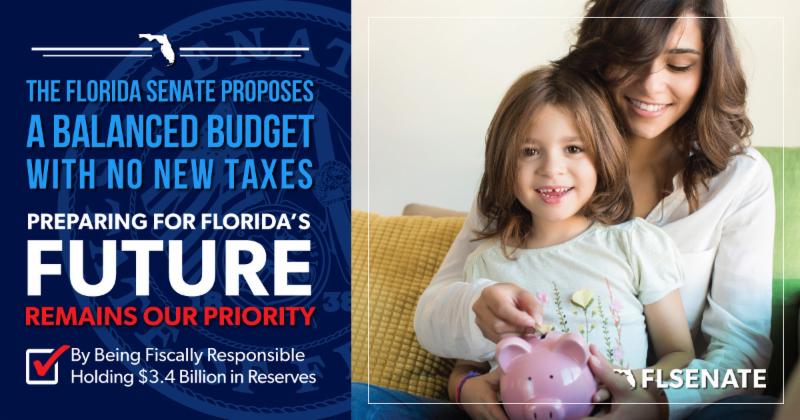
Preparing for Florida's future remains our top priority. By putting forth a balanced and fiscally responsible budget with no new taxes, the Senate is putting Florida families and communities first.
In the remaining weeks of the Legislative Session, we will begin Budget Conference, where the House and Senate will come to an agreement on the Budget. Once both chambers agree and pass an identical budget, it will then be sent to the Governor for final passage or veto.
|
|
Status Update on my Sponsored Legislation
|
SB 190 - E911 Systems - This bill requires the Technology Program within the Department of Management Services to develop and implement a plan by January 1, 2019, to require that a 911 public safety telecommunicator, when prudent and requested by a caller or when necessary, be able to transfer an emergency call from one local, multijurisdictional, or regional E911 system to another local, multijurisdictional, or regional E911 system in the state. It establishes requirements for the plan. SB 190 also requires the implementation of a Text to 911 system. This bill has passed the second committee of reference. For more information on SB 190,
click here.
SB 252 - State Employee Higher Education Fee Waivers -
This bill modifies the tuition and fee waiver benefit that is extended to the employees of the State of Florida. Specifically, the bill modifies from 6 credit hours per term to 18 credit hours per calendar year the requirement that state universities and Florida College System institutions waive tuition and fees for state employees, on a space-available basis. This bill has passed the first committee of reference. For more information,
click here.
CS/SB 706 Crime Stopper Organizations - This bill amends s. 90.595, F.S., creating a new category of privileged communication to the Florida Evidence Code.
The bill provides the communication that relays a tip of alleged criminal activity to a crime stoppers organization is considered privileged communication under the Code.
The bill authorizes a person charged with a criminal offense as a result of a tip being provided to a crime stoppers organization to petition the court for an in camera inspection of the protected information and authorizes the court to, in the event it determines that all of the specified criteria are satisfied, order the production and disclosure of all or any part of the protected information. This bill has passed the first committee of reference. For more information,
click here.
SB 952 Cruelty to Animals - This bill increases the offense ranking on the Offense Severity Ranking Chart of the Criminal Punishment Code from a Level 3 to a Level 5 for a violation of s. 828.12(2), F.S., aggravated animal cruelty. Effectively this increases the corresponding sentencing points for purposes of calculating the lowest permissible sentence from 16 points to 28 points.
The bill also amends s. 828.12, F.S., by adding a provision that allows the court to prohibit a person convicted of a violation of s. 828.12, F.S., from owning, possessing, keeping, harboring, having contact with, or having custody of or control over any animal for a period of time determined by the court. This bill has passed the first committee of reference. For more information on SB 952,
click here.
SB 1142 Expunction of Criminal History Records - This bill revises the eligibility requirements that must be met for a person to seek a court-ordered expunction of a criminal history record.
Currently, a person is ineligible for a court-ordered expunction of a criminal history record that resulted in a trial, without regard to the outcome. The bill permits a person to obtain a court-ordered expunction of a criminal history record if the outcome at trial was a not guilty verdict. Currently, a person seeking to expunge a criminal history record that resulted in a trial, without regard to the outcome, must have the record sealed for a minimum of 10 years prior to seeking an expunction of such record. The bill provides that a person seeking to expunge his or her criminal history record that resulted in a not guilty verdict at trial does not have to obtain a sealing of the record for a minimum of 10 years prior to seeking an expunction of such record. This bill passed the first committee of reference. For more information,
click here.
SB 1168 Insurance - This bill creates new requirements for assignment of post-loss benefits from personal residential property insurance policies. The bill does not allow personal lines residential or commercial residential property insurance policies to prohibit the post-loss assignment of benefits. It provides, however, that an agreement to assign post-loss benefits is not valid unless the agreement:
Is in writing;
Is limited to claims for work performed or work to be performed by the assignee;
Contains an accurate and up-to-date statement of the scope of work to be performed;
Allows the insured to rescind the assignment within 7 days after execution without penalty or fee;
Prohibits any check or mortgage processing fee or administrative fee;
Provides that the insured or insurer may be responsible for payment for any work performed before the rescission of the assignment; and
Contains a notice provision informing the homeowner of certain rights and obligations.
The bill requires the assignee to:
Provide a copy of the assignment agreement to the insurer within a specified time;
Provide the insurer with a written estimate of the work to be done; and
Provide specified notice to the insurer no later than 30 days before initiating litigation against an insurer.
The bill allows the insurer to inspect the property at any time. The assignee may raise the insurer's failure to in good faith attempt to inspect the property within 7 days after learning of the loss and promptly deliver to the assignee written notice of any perceived deficiency in the assignee's notice or work performed, for purposes of estopping the insurer from asserting that the work done was not reasonably necessary or the assignee provided insufficient notice.
The bill provides that acceptance by an assignee of a valid assignment agreement constitutes a waiver by the assignee of any claims, with specified exceptions, against named insureds for payment arising from the loss. This waiver is valid even if the assignment agreement is determined to be invalid.
The bill provides that in a civil action relating to a residential homeowner's property insurance claim under a policy in which an assignment agreement was executed, a proposal for settlement may be made by any party no earlier than 30 days after the civil action has commenced.
The bill requires each insurer to report specified data on each residential property claim paid pursuant to an assignment agreement in the prior calendar year to the Office of Insurance Regulation (OIR).
The bill restricts an insurer's ability to deny claims or rescind a policy based on misrepresentations on insurance applications and restricts an insurer's ability to require or recommend specific vendors to policyholders. This bill has passed the first two committees of reference and has one remaining stop before the Senate Floor. For more information on SB 1168,
click here.
CS/SB's 1400 & 1640 Vacation Rentals - This bill creates the "Florida Vacation Rental Act" within part III of Chapter 509, F.S., explicitly preempting the regulation of vacation rentals to the state and separating the regulation of vacation rentals from the regulation of public lodging establishments, such as hotels and motels. The Division of Hotels and Restaurants (division) within the Department of Business and Professional Regulation (DBPR) is authorized to implement the act, including licensing vacation rentals and enforcement. The bill requires license applications to include an emergency contact telephone number. The license number must be displayed in advertisements for a vacation rental. Multiple unit vacation rentals must be inspected biannually in the same manner as hotels and motels.
Under the bill, local governments only may regulate activities that arise when a property is used as a vacation rental, provided the regulation applies uniformly to all residential properties. However, the bill grandfathers local regulations adopted before June 1, 2011, which prohibit vacation rentals, or regulate the duration or frequency of vacation rentals. Sb 1400 has one more stop before it can be heard on the Senate Floor. For more information on SB 1400,
click here.
|
|
Passed On The Senate Floor
|
HB 6021 Guardian Ad Litem Direct-Support Organization - This bill removes the scheduled repeal date for the Guardian ad Litem Foundation, the DSO for the Statewide Guardian ad Litem Office. For more information on HB 6021, click here.
HB 53 Coral Reefs - The bill establishes the Southeast Florida Coral Reef Ecosystem Conservation Area (conservation area). The conservation area includes the sovereign submerged lands and state waters offshore of Broward, Martin, Miami-Dade, and Palm Beach Counties from the St. Lucie Inlet in the north to the northern boundary of the Biscayne National Park in the south.
For more information on HB 53, click here.
SB 204 Land Acquisition Trust Fund - This bill
increases the annual appropriation from the Land Acquisition Trust Fund (LATF) for spring restoration, protection, and management projects from $50 million to $75 million. Additionally, the bill requires $50 million to be appropriated from the LATF to the St. Johns River Water Management District for projects dedicated to the restoration of the St. Johns River and its tributaries or the Keystone Heights Lake Region. For more information on SB 204, click here.
SB 220 Bankruptcy Matters in Foreclosure Proceedings - This bill specifies how certain documents from a person's bankruptcy proceeding may be used as evidence in a foreclosure action against the same person. For more information on SB 220, click here.
CS/SB 444 Pregnancy Support Services - This bill creates s. 381.96, F.S., to codify the existing Pregnancy Support Services program (program) which has been funded by the state since the 2005-2006 fiscal year. The program provides pregnancy support and wellness services, such as direct client services, program awareness activities, and communication activities, through a statewide alliance of community organizations. The bill directs the Department of Health (DOH) to contract with the Florida Pregnancy Care Network (network) and specifies contract deliverables for the program, including financial reports, staffing requirements, and timeframes for achieving obligations. The network is to contract only with providers that exclusively promote and support childbirth. For more information on SB 444,
click here.
SB 498 Office of Public and Professional Guardians Direct-support Organization - This bill removes the scheduled repeal date of the law governing the Foundation for Indigent Guardianship, Inc. The Foundation serves as a direct-support organization for the Office of Public and Professional Guardians within the Department of Elder Affairs. For more information,
click here.
|
As always, I greatly value all of your comments and emails. Please feel free to reach out to my office to share your thoughts or concerns, or if we can ever be of any assistance. I look forward to representing you this Legislative Session.
Your Friend and Neighbor,
Proudly Serving Sarasota and Charlotte Counties
|
|
|