March to End Homelessness
BY HOUSING MATTERS
Saturday, May 18
10am-12:30pm
Meet at Santa Cruz City Hall, 809 Center Street
On Saturday, a compassionate coalition of local businesses, non-profit organizations, and hundreds of supporters will March to End Homelessness in downtown Santa Cruz. The March is the second annual gathering organized by Housing Matters. This event is anchored in inspiring hope for actionable solutions to homelessness through the advancement of public policy. Click here for more information about the March.
| |
|
23rd Year of Reel Work Labor Film Festival Ends Soon
BY SARAH RINGLER
The dedicated group of volunteers led by Jeffrey Smedberg brought out another year of films that dealt with issues the affect the working class. Here is the final film.+ Check it out.
| |
|
A Thousand Pines
(Sebastián Díaz, 2023, 77 min, Mexico & USA)
In this tale of labor and family that shines a light on the precarity of temporary work visas, Raymundo Morales leads a crew of workers who have to make the challenging decision to leave their families in rural Mexico to plant commercial pine forests in the United States.
Speakers: Sebastián Díaz, filmmaker, and Angeles Moreno, graphic designer.
Watch the trailer for A Thousand Pines on YouTube.
Sat., May 18, 7pm Resource Center for Nonviolence, 612 Ocean St., Santa Cruz
Hybrid event: Register to join virtually at bit.ly/RW24May18
| |
|
A Conversation on the Expectation of Privacy
BY PETER GELBLUM
The Santa Cruz County Chapter of the ACLU of Northern California will host an event regarding the rapidly increasing use of mass surveillance technology by local, state, and federal law enforcement agencies May 20, 7-8:30pm. These developments affect everyone. As just the most recent example, in the last few months the cities in Santa Cruz County have allowed their police departments to acquire dozens of automated license plate readers, which automatically and constantly photograph every vehicle that passes the cameras, recording the date and time of the image.
The stellar group of expert panelists will discuss topics including:
· the current surveillance situation
· what new invasive technologies are in the works
· the dangers of mass surveillance
· how to monitor law enforcement's use of surveillance technology and hold them accountable for misuse
· our reasonable expectations of privacy, and
· what we can all do to protect our privacy and advocate for more protections.
The panel will be moderated by Gary Patton, former County Supervisor, attorney, and UCSC adjunct professor, including teaching the Privacy, Technology, and Freedom course.
The panelists are:
Tracy Rosenberg, Media Alliance, Executive Director; Oakland Privacy
Nick Hidalgo, ACLU Northern California, staff attorney Technology and Civil Liberties Program
Matthew Guariglia, Electronic Frontier Foundation, Senior Policy Analyst
Mike Gennaco, OIR Group, Independent Police Auditor for City of Santa Cruz, Office of Inspector General for Santa Cruz County Sheriff's Office
The event includes ample time for the panelists to answer questions from the attendees. Register HERE. The Zoom link will be provided upon registration.
| |
|
Nine Reasons Organic Should Replace Chemical Farming Near Homes and Schools
BY WOODY REHANEK
1) In Santa Cruz County, there are 50 conventional farms and 16 organic farms within a quarter mile of PVUSD schools, not including the three schools in Monterey County; all three have fields within a quarter mile. We, at Safe Ag Safe Schools, want to help transition all fields near local schools and residences to organic.
2) Around a million pounds of pesticides have been applied in SC County each year for at least the past 6 years, the vast majority of these in the Pajaro Valley. Two thirds of those pesticides are fumigant gases, which have been documented to drift up to 7.5 miles. Watsonville's footprint of 6.5 square miles is ringed by fields where pesticides are applied.
3) Chloropicrin, used to fumigate berry fields before planting, is a nerve gas. The state lists it as a Toxic Air Contaminant. It has been awaiting review in California as a possible carcinogen for over 10 years, has already been designated as a carcinogen by the World Health Organization agency, International Agency for Research on Cancer. Meanwhile, it is still the most widely used toxic pesticide in SC County. Over half a million pounds are applied here each year, primarily in the Pajaro Valley.
4) The fumigant 1,3-dichloropropene, or 1,3-D, marketed by Dow as Telone, is a Toxic Air Contaminant and Carcinogen, and often used in combination with chloropicrin. It is banned in 34 countries, yet applied within a quarter mile of our PVUSD schools. California's Office of Health Hazard Awareness set a "safe harbor" level of 0.04 parts per BILLION (ppb). In liquid terms, 1 ppb is one drop of water in an Olympic-size pool. State agencies continue to haggle over supposed "safe" levels of 1,3-D. Six pesticide air monitors in California, including one at our district's Ohlone Elementary in north Monterey County, demonstrate that annual averages have consistently exceeded 0.04 ppb. The cumulative impacts to human and environmental health over time of 1,3-D in combination with other chemicals, for example, chloropicrin, have never been measured, in gross violation of state laws.
5) Acute exposures to the carcinogen and toxic air contaminant 1,3-D, especially when combined with climate change impacts like wildfire smoke, can lead to respiratory problems in farmworkers and what the Californian Department of Pesticide Regulation labels "bystanders," or community residents. Research at UC Merced found that even minute increases in levels of 1,3-D in the air — as little as 0.01 parts per billion — corresponded with increased frequency of emergnecy room visits for asthma in central and southern California from 2005-20ll, according to the Journal of Asthma, Hamid Gharibi et al, 4-2-19.
6) This year, Tom Broz and his crew at Live Earth Farms planted 80,000 strawberry starts of the Albion pathogen-resistant variety from UC Davis. He rotates his fields with brassica crops (cauliflower, broccoli, mustard) grown, harvested, and tilled-in as natural fumigants prior to strawberry planting. You don't need chemical fumigants to grow great berries. Chemical fumigants enable berry growers to grow the same crops year-after-year on the same ground without using crop rotation. This violates a basic principle of healthy-soils farming which has been applied for millenia.
7) Dick Peixoto's Lakeside Organic Gardens grows 50 varieties of vegetables by feeding the soil with compost, using crop rotations and cover crops, demonstrating the economic viability of organic farming practices. Organic crops are higher in nutrients and pesticide-free. Lakeside Organics has become the largest organic grower/shipper/packer in the United States.
8) Organic farming builds healthy soil as it stores carbon. A 19-year side-by-side trial by UC Davis scientists found that conventionally farmed land neither stored nor released much carbon. When both cover crops and compost were used on organically farmed land, soil carbon content increased 12.6% over the course of the study. One application of quality compost can store 4 metric tons per acre of CO2 per year for 3 years or more. Organic farming is climate smart.
9) The future of farming in the Pajaro Valley depends on maintaining the quality of our rich soils. Healthy soil sequesters carbon, reduces runoff and flood risks, and increases resistance to pests and plant diseases. Environmental degradation and planetary warming threaten our students' future. The fields around their schools should not contribute to those problems.
Let's work to transform them into models for solutions. Come out to McQuiddy Elementary School in Watsonville and meet behind the school at 95 Wagner Ave. on May 21 at 5:30pm to show your support. Click HERE for more information on Safe Ag Safe Schools.
| |
|
Elect To End Hunger and War
BY KEITH MCHENRY - COFOUNDER FOOD NOT BOMBS
On April 24, Joe Biden signed authorization to spend $95 billion on the wars in Ukraine and Palestine saying that it was “a good day for world peace."
Food Not Bombs will honor its 44 years on the front lines of the peace and social justice movement on Saturday, May 25.
The first group in Cambridge, Massachusetts spent two years helping build the June 12, 1982, March for Nuclear Disarmament that attracted over a million people to the Great Meadow in Manhattan. They held their first “Free Concert for Nuclear Disarmament”, later to be called Soupstock, on May 3, 1981 at Sennott Park in Cambridge. Food Not Bombs volunteers also participated in the protests against the wars in El Salvador, Iraq, Afghanistan and Yugoslavia. Today we are facing the real possibility of a world war if we don’t rise up to stop it. This will be one of the messages expressed at the Soupstock 2024 free concert on Saturday, May 25 at the Duck Pond Stage at San Lorenzo Park in Santa Cruz.
Food Not Bombs volunteers in hundreds of cities around the world are sharing meals with the hungry and taking actions to stop the bloodshed in Ukraine, Palestine and the increasing threat of a global war between nuclear armed nations. The Jerusalem and Tel Aviv chapters of Food Not Bombs have been holding protests against the Gaza genocide outside the US Embassy. Polish chapters are providing meals to war refugees fleeing Ukraine and an increasing number of local homeless. The lines of those seeking food are growing longer at Food Not Bombs meals in cities all across the United States as the government sends billions of dollars worth of bombs to wage those wars. Hungry children stand together waiting for a warm bowl of stew from Food Not Bombs in Manila and Bangkok, “We really do need food, and not bombs.”
While the war of hunger is ravaging families across the exploited lands of Africa, Asia and the Americas, there is one famine that stands out as the most horrific today.
Western nations are forcing the starvation of hundreds of thousands of children in Gaza. Mothers struggle to choose which of their children will get that next crumb of bread. The first of several Flour Massacres was unleashed on February 29, 2024 when at least 118 Palestinians were killed and 760 injured after Israeli forces opened fire on civilians seeking food from aid trucks on the coastal Al-Rashid Street in Gaza City. United Nations Human Rights chief Volker Turk denounced the rampant hunger and looming famine in Gaza and the using of starvation as a "weapon of war", which he decried as a "war crime." On March 18, Reuters reported that Gaza's health ministry said 27 children and three adults had died by that time from malnutrition. They added that over 210,000 people were on the brink of starvation in northern Gaza. Conditions only became more dire and many more have died.
The attacks on the starving were not enough. On April 1, the Israeli military, using AI targeting assistance from the CIA contractor Palantir, sent missiles through the World Central Kitchen logo on their relief van in Gaza. Seven aid workers were killed in the attack. The World Central Kitchen made a hasty retreat from Gaza ending any possibility of even the most inadequate relief.
The CIA data-mining company Palantir co-founded by Joe Lonsdale, PayPal co-founder Peter Thiel and other Silicon Valley vulture capitalists started with money from CIA’s venture capital arm In-Q-Tel. The current CEO is billionaire co-founder Alex Karp.
If the insanity in Palestine is not dangerous enough, there is Biden’s decade long regime-change war against Russia in Ukraine, another tragic legacy of the faltering American empire. While laying waste to Gaza, Biden’s administration also continues with its carnage in eastern Ukraine in some illusionary regime change war against Russia that the West can never win. The Pentagon claimed in leaks to the New York Times that Ukraine has lost 500,000 soldiers, killed or seriously wounded, since the beginning of the Russian special military operation. The once productive soils of wheat depicted on the blue and yellow flag of that war-torn nation are littered with bombs and the graves of Ukraine's men and women.
There is money enough for war even if the desperation of poverty is crushing millions of Americans. Hour after hour, call after call from the desperate seniors of rural America flood the Food Not Bombs Hunger Hotline, each with tales of their last few cans of tuna or an empty gas tank. Many are frustrated that they have been given the run-around by one agency after another and are angry that the government is pouring billions into foreign wars of choice while Americans struggle to survive.
A 2023 survey conducted by Payroll.org found that 78% of Americans are living paycheck to paycheck, a 6% increase from the previous year. According to Biden’s Department of Housing and Urban Development, homelessness in America increased by 11% from 2022 to 2023. HUD also claims they can end homelessness for $20 billion and yet the federal government just sent $61 billion to Ukraine and $26 billion to Israel.
Along with the threat of a global conflict between nuclear armed nations and a genocide, a war on America’s homeless is also raging. While Joe Lonsdale’s Palantir is aiding in the bombing of Palestinians turning their homes into rubble, he is also coordinating a nationwide program to “solve” the homeless problem here in the United States. The Cicero Institute, that he founded, posts “The United States has a growing homelessness problem – and bad policies at the local, state, and federal level exacerbate that problem.”
The Cicero Institute provides a “Model Bill” they call, “Reducing Street Homelessness Act,” to state and city legislators which their website notes is legislation based on the 2022 Missouri HB 1606.
So far, the Cicero Institute has placed bills in at least nine states including Arizona, Florida, Georgia, Kentucky, Missouri, Oklahoma, Texas, Tennessee, and Wisconsin. Texas became the first state to pass such a law in 2021, and Tennessee and Missouri followed in 2022.
Cynthia Griffith wrote about Wisconsin’s Assembly Bill 689 and Senate Bill 669 on the Invisible People website, “Concentration camps and secret committees, out-of-state lobbyists, and flat-out lies – as unbelievable and terrifying as it sounds, this is a glimpse into what’s happening behind closed doors in 2024 Wisconsin.”
The Cicero Institute website reported a recent success,”This morning (March 20, 2024) in Miami Beach, Florida, Governor Ron DeSantis signed HB 1365/ SB 1530, which will make Florida a leading state in the fight against the failed homelessness policies that have wreaked havoc on so many American cities. HB 1365 will ban street camping and upend how Florida provides treatment and help to the homeless – and holds providers and cities accountable for failure.” This is the same Ron DeSantis that provided legal advice to those who tortured prisoners at Guantanamo.
In early April, this movement against America's poorest people had another victory in their nationwide campaign to make it a crime to be homeless. Kentucky bill HB 5, the “Safer Kentucky Act” was signed into law. The 78-page bill criminalizes "homelessness” and decriminalizes the use of deadly force against individuals engaging in unlawful camping. Under this law, “if a property owner believes an unhoused trespasser is attempting to commit a felony or attempting to dispossess them, they can shoot the homeless person.”
The war includes police raids on camps and the destruction of survival gear at a cost of millions to the already strapped taxpayers. The Washington DC chapter of Food Not Bombs started a fundraising campaign to buy pup tents and sleeping bags for the homeless who are being forced out from their camp. The group posted on May 8, “Today we purchased about $500 worth of tents in preparation for the Foggy Bottom encampment sweep scheduled for May 15.”
According to the Santa Cruz Sentinel, two million dollars was provided to the city of Santa Cruz to clear the homeless camps that Food Not Bombs had been delivering food to at Harvey West Park and along Coral Street. To be fair there are claims that some of the two million would be used to build 55 tiny homes with a shared restrooms. We will see.
Americans can’t depend on their government to address the crisis of poverty so it has been left up to groups like Food Not Bombs to provide food and shelter. The COVID lockdowns shuttered indoor food programs for the poor. This was the case in Santa Cruz where the local Food Not Bombs group provided the only daily hot meal for three years without missing a single day. When the CZU Lightning Complex fires forced people out of their homes they came to eat and find clothing at the Lot 27 meal. Floods sent more to our meals. The group served through the atmospheric rivers even sustaining an arrest in Garage Ten at the height of one blasting storm. If it wasn’t for Food Not Bombs daily feasts downtown, Santa Cruz may have experienced a huge increase in shoplifting bordering on looting. A hungry man is an angry man, as the saying goes.
Tent cities grow larger while politicians crow on about their military campaigns. The live-streamed carnage of Gaza is shocking, sparking mass protests around the globe. A student movement demanding universities divest from Israel and the military contractors that profit from the genocide have sprung up on at least 150 campuses. Local Food Not Bombs chapters are helping.
At San Francisco State, the students formed committees to address things they saw happening on other campuses that led to violence or to media narratives that stated that the encampments were only about university/campus issues.
“We wanted to center Palestinians in Gaza, instead of us. It’s not about us. So there was a lot of outreach. Reaching out to a lot of organizations like Food Not Bombs to provide food and water. We also were very fortunate to have had widespread faculty (academic staff) support.”
Santa Cruz Food Not Bombs is also supporting our campus divestment camp providing food and opening one of their kitchens to the students.
These protest camps are starting to send a panic through some members of the ruling class.
During the Ash Carter Exchange on Innovation and National Security in Washington DC on May 7, former U.S. general Mark Milley and Palantir’s CEO Alex Karp chatted with some dismay about the student protest movement. The general reminded the audience that the US dropped nuclear bombs on Japan and that civilian deaths in war are really nothing new so why are students even protesting about Gaza?
Palantir’s Alex Karp told the assembled national security members that the Palestine solidarity campus protest movement is an existential threat to American empire: “We think these things that are happening across college campuses are a sideshow. No, they are the show,” and he adds, “If we lose the intellectual debate, you will not be able to deploy any army in the West, ever.”
In a CNBC interview aired on May 13, “Palantir co-founder Joe Lonsdale on college chaos: It’s showing ‘rot’ at a lot of these places.” The website’s subhead adds, “Joe Lonsdale, 8VC founding partner and Palantir co-founder, joins ‘Squawk Box’ to discuss the rise in college campus protests, the state of college campus wars, the advancement of defense technology on the battlefield, his trip to India, and more.”
If these CIA contractors are correct, the movement against the genocide may be a turning point. This could be a time of transformation as the cruelty of the corporate dystopia is being live streamed for all to see.
The revulsion at such horrors while most of us are struggling to pay our bills could remove any doubt that we need to reject the current economic and political system. It is time for a change, a revolution, a world that expects everyone to thrive and live as equals.
A vision of such a world can be found in the many mutual aid projects like the Food Not Bombs meals. One such project started in San Antonio, Texas. A Food Not Bombs activist who once volunteered with the Santa Cruz group joined the San Antonio Cares Collective. Like Food Not Bombs they spent their time helping provide food and survival gear with the homeless.
His friend and fellow collective member was Aaron Bushnell, a 25-year-old US Air Force serviceman. Aaron set himself on fire in front of the Israeli Embassy in Washington DC on February 25 telling the camera as he walked to the front gate “I will no longer be complicit in genocide” and then he called out; “Free Palestine, Free Palestine” as flames engulfed his uniformed body.
Before his protest he posted, “Many of us like to ask ourselves, 'What would I do if I was alive during slavery? Or the Jim Crow South? Or apartheid? What would I do if my country was committing genocide?' The answer is, you’re doing it. Right now.”
| |
|
Gingerly
BY WOODY REHANEK
Gingerly at dawn two quirky raccoons
amble past a balustrade
emblazoned with geraniums
& vanish on the run.
Doing no harm is akin to catching
lightning in a bottle.
You draw a Joker & a one-eyed Jack,
play your hand, & pull the throttle.
In May muscular fists of fog close in,
trying times for humans and geraniums.
We’ll be here in the valley of shadows,
facing the music, trimming Buddhas,
waiting for the sun.
**********
| |
|
Photo by TARMO HANNULA
A black-necked stilt pokes through the waters of Elkhorn Slough.
| |
|
Bird Knees
BY KATHLEEN KILPATRICK
We are upright primates,
stiff-legged as compared
with other apes.
With years of bending
forward at the hips and waist
and resting on our buttocks,
most of us crouch
poorly, if at all.
From too much and too little
of the wrong kinds of posture,
accidents, genetics, hard work,
awkward moves, from walking
flat-footed on flat surfaces,
leveled, hazarded, and hardened
by our human enterprise,
from wrong shoes, bad habits,
from living longer
than originally designed,
our knees wear out.
Many kinds of avians, like us,
stand and walk on legs
held straight, lock-kneed,
that is, assuming
birds have knees.
Those bird legs fold
conveniently beneath them,
can spring to launch in flight,
come clawed to grip
a branch or prey.
Once, in a park beside the sea,
I saw a legless pigeon,
or so it looked,
rocking, gliding forward
on feathered, rounded belly,
as if on tiny, hidden wheels,
managing, somehow,
to get around and peck for food.
I did not see it fly.
My wish now is that, like a bird,
I could hop easily on one leg,
the left knee, reinforced
with metal, plastic, and cement,
its rusted hinge replaced, repaired.
The other side, now caving in,
no longer holds me upright.
So many of my age share talk
of knees, and other body parts,
the aches, distortions, limitations,
the remedies, and surgeries, and pain,
our bones now lightened,
fragile as a bird's.
I can stand on one locked knee,
balance with a touchdown,
hobble with support.
When I resort to wheels,
there is no hiding them.
Oh, to spring and launch,
to be winged and flighted,
with supple bird knees
to bend, and squat,
and ease my landing,
to break my fall,
before my fall breaks me.
| |
|
Santa Cruz County Covid-19 Report - Rt rises above 1
By SARAH RINGLER
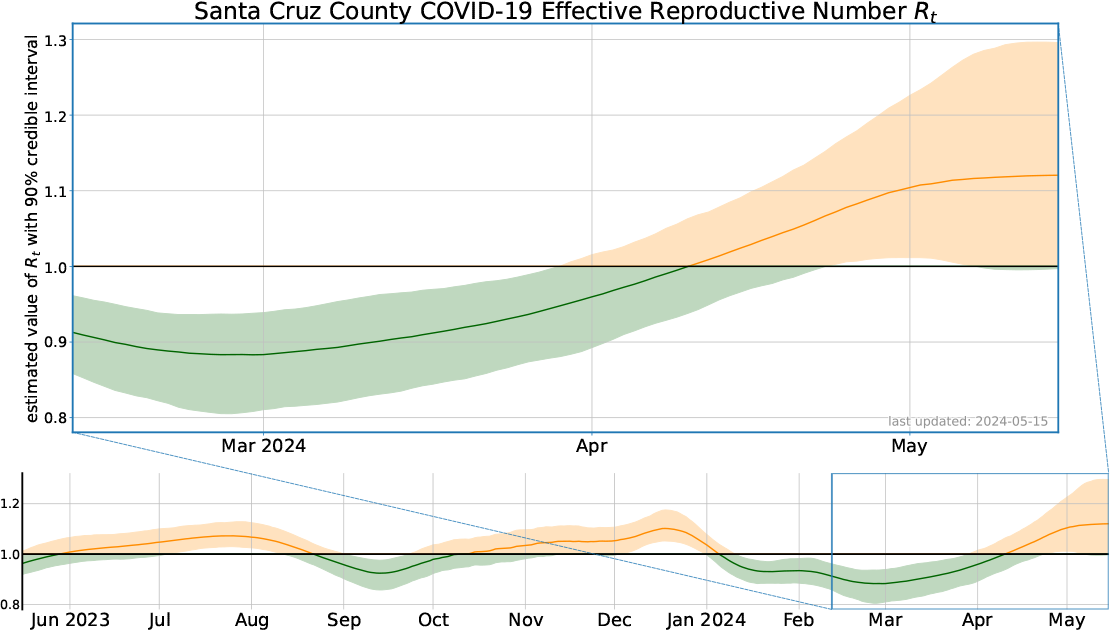
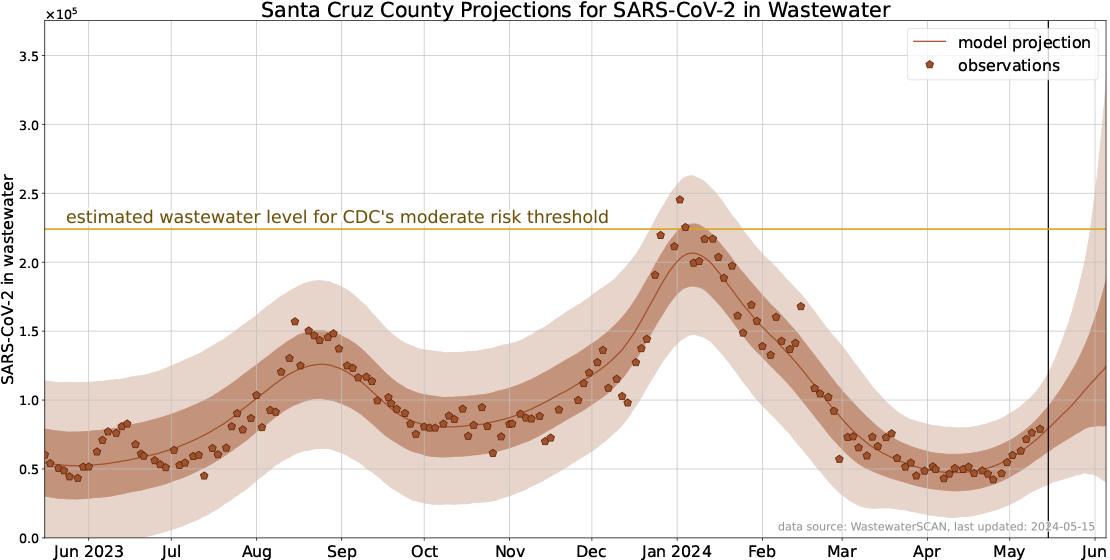
The California Department of Public Health and Santa Cruz County Health Department regularly release data on the current status of Covid-19 in the county as well as information on influenza, Respiratory Syncytial Virus (RSV), and Mpox. Since cases of Covid are still appearing, and there are still vulnerable people, I will continue reporting the graphs below.
At-home Covid-19 test kits are currently available at the Watsonville Public Library, Main St.
The three graphs below were updated on May 15.
The first graph is the Effective Reproductive Number. When the line rises above one, it shows that the spread of the virus is increasing. Below one means the spread is decreasing.
The second graph below shows data that the Health Department collects for Covid from wastewater at the City Influent, for the city of Santa Cruz, and from the Lode Street pump stations for the county.
The third graph below shows hospitalizations.
The vaccination data for the county has stayed fairly constant increasing very little over time. Go HERE for new information on vaccination records, treatments, vaccines, tests, safety in the workplace and more.
| |
|
Photo TARMO HANNULA
Fashion Street - A musician performs on the wharf in Monterey.
| |
|
Labor History Calendar - May 17-23, 2024
a.k.a Know Our History Lest We Forget
May 17, 1838: First women’s anti-slavery conference in Philadelphia.
May 17, 1954: Supreme Court outlaws segregation in public schools.
May 18, 1814: Birth of Michael Bakunin.
May 18, 1855: Birth of George Speed, active in Haymarket defense, Coxey’s Army and Pullman strike; IWW organizer.
May 19, 1920: Miners win battle of Matewan (West Virginia) over Baldwin-Felts gun thugs.
May 19, 1925: Birth of Malcolm X, African-American revolutionary organizer.
May 19, 2017: 4,000 Haitian garment workers strike to double wages.
May 20, 1933: rubber workers strike in Akron, Ohio.
May 20, 1999: 2,000 carpenters launch wildcat strike in San Francisco.
May 21, 1946: US government seizes coal mines to break national strike.
May 22, 1911: Trolleymen return to work afrer 10-day strike defending fired union activists. City-wide general strike wins all demands on May 25 in Montevideo, Uruguay.
May 23, 1838: 4,000 Cherokee die in “Trail of Tears” forced removal.
May 23, 1946: US railroad strike starts and later crushed when President Truman threatens to draft strikers.
May 23, 2008: IWW songwriter U. Utah Phillips dies.
Labor History Calendar has been published yearly by the Hungarian Literature Fund since 1985.
| |
|
“Many of us like to ask ourselves, 'What would I do if I was alive during slavery? Or the Jim Crow South? Or apartheid? What would I do if my country was committing genocide?' The answer is, you’re doing it. Right now.”
Aaron Bushnell, a 25-year-old US Air Force serviceman posted this before he set himself on fire in front of the Israeli Embassy in Washington DC on February 25.
| |
 | |
Photo by TARMO HANNULA
Easy Biscotti
By SARAH RINGLER
Italian cookies form their own category in the cookie world. They often have interesting shapes, are not quite as sweet, and usually are very lightweight and crunchy. One variety, biscotti, are unusual because they are baked twice. There are many variations but this is the easiest biscotti recipe I could find; and, it turned up in my mother’s recipe box under the heading, “from Dede.”
Originally, the traditional biscotti recipe that came from a Prato baker, Antonio Mattei, was only made out of flour, sugar, pine nuts and almonds. There were no eggs, butter or leavening. He brought them to the second world’s fair, the 1867 Exposition Universelle, held in Paris, where he won a prize and also introduced them to the rest of Europe.
Biscotti
2 ¾ cups flour
1 1/2 teaspoons baking powder
½ teaspoon salt
1 cup sugar
½ cup butter, melted
2 tablespoons anise seed
1 teaspoon almond or vanilla flavoring
1 tablespoon water
1 cup coarsely chopped almonds
3 eggs
Sift or whisk flour with baking powder and salt in a medium bowl. Set aside.
Melt butter and cool. In a large mixing bowl beat the melted butter, sugar and anise seed. Beat in the eggs until smooth. Add the flavoring and water. Again, beat to mix well.
Gradually add the flour mixture to the egg and sugar mixture. Add the almonds and mix until completely blended. Refrigerate for 2-3 hours.
Preheat oven to 375 degrees. Lightly butter a cookie tin. Divide the dough into three parts. Form each part into a long loaf the length of a shallow cookie pan, and about 2 inches wide by ½ inch high. Line them up side by side leaving space between them. They will expand and you don’t want them to touch. Bake for 20 minutes. Don’t overbake. I removed mine when I saw that the ends were turning slightly brown.
Using a long spatula, remove the loaves from the pan and put on a cutting board. With a sharp knife, cut the loaves diagonally into 5-6 inch long slices that are about ¾ inch wide. Put the slices, cut side up, back on the cookie sheet and bake another 10-15 minutes until they are solid like toast but not browned. Cool on racks and then store in airtight containers. Makes about 4 ½ dozen cookies.
| |
|
Send your story, poetry or art here: Please submit a story, poem or photo of your art that you think would be of interest to the people of Santa Cruz County. Try and keep the word count to around 400. Also, there should be suggested actions if this is a political issue. Submit to coluyaki@gmail.com
Send comments to coluyaki@gmail.com
If you are enjoying the Serf City Times, forward it on to others.
Subscribe, contact or find back issues at the website https://serf-city-times.constantcontactsites.com
Thanks, Sarah Ringler
| |
|
Welcome to Serf City Times Our county has problems and many people feel left out. Housing affordability, racism and low wages are the most obvious factors. However, many groups and individuals in Santa Cruz County work tirelessly to make our county a better place for everyone. These people work on the environment, housing, economic justice, health, criminal justice, disability rights, immigrant rights, racial justice, transportation, workers’ rights, education reform, gender issues, equity issues, electoral politics and more. Often, one group doesn’t know what another is doing. The Serf City Times is dedicated to serving as a clearinghouse for those issues by letting you know what is going on, what actions you can take and how you can support these groups.This is a self-funded enterprise and all work is volunteer.
Copyright © 2024 Sarah Ringler - All rights reserved
| | | | |