 | |
PHOTO CONTRIBUTED
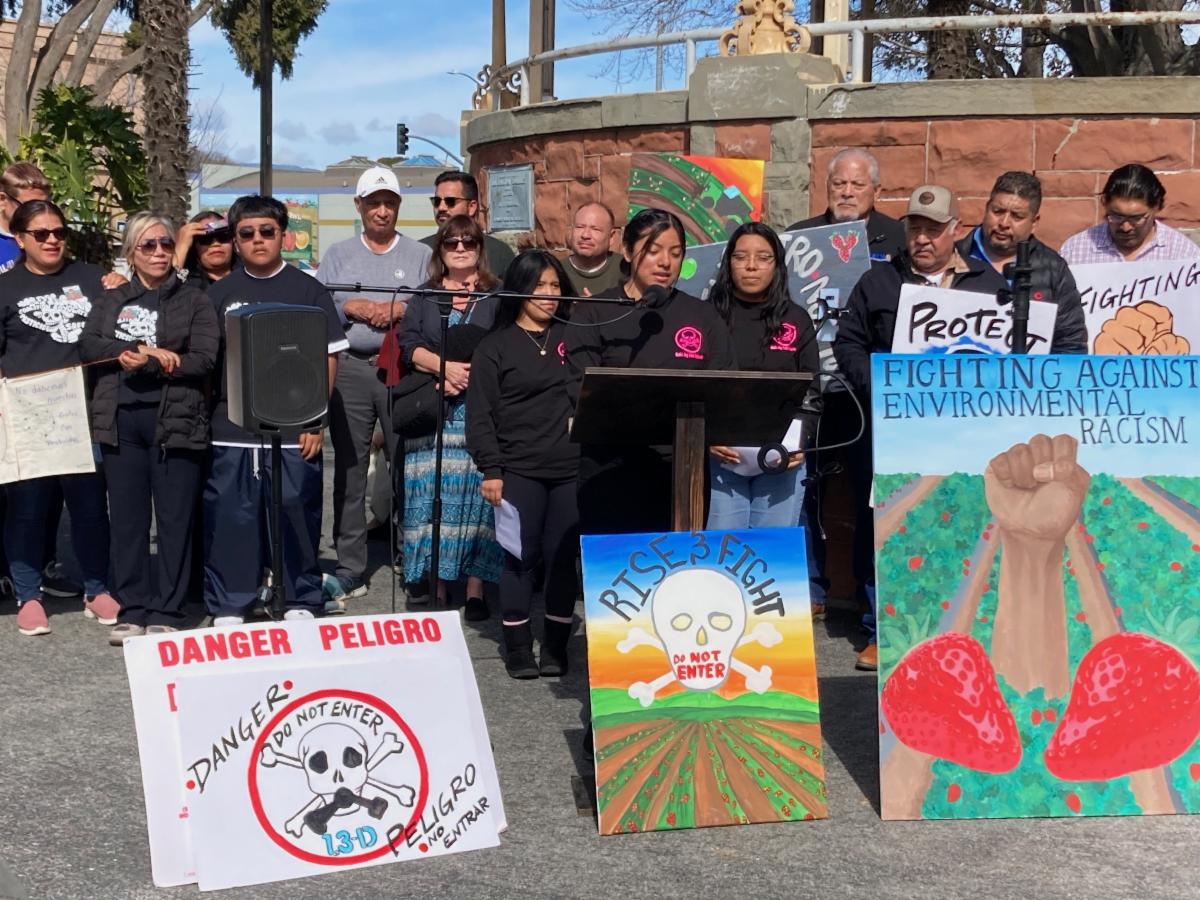
Rocio Ortiz of Watsonville High delivers a poem about the environmental injustice of pesticide use in Watsonville City Plaza on Feb. 15. She is accompanied by two other Watsonville High students, Anali Rivera and Jessica Gonzales; all have worked in the fields at the same time as going to high school.
Farmworker Communities Call for State to Address Civil Rights Violations in Pesticide Policies & Practices
Advisory Opinion released by Judges of the People’s Tribunal on Pesticide Use and Civil Rights
BY JANE SELLEN
WATSONVILLE— More than 50 people, farmworkers and their allies, nurses, union leaders, local students and their teachers on their lunch break, gathered amidst colorful protest posters in Watsonville Plaza on Feb. 15, for the release of a report alleging civil rights violations due to discriminatory policies and practices of the California Department of Pesticide Regulation and the State’s County Agricultural Commissioners.
The charges were in the form of an Advisory Opinion that came out of last Sept. 12 People’s Tribunal on Pesticide Use and Civil Rights in California held in Lindsay in Tulare County. The Tribunal, a kind of People’s Court outside of formal legal structures, had one hundred participants, dozens of whom gave testimonies about their experiences with pesticides and the governmental regulatory system that failed them.
The Advisory Opinion was written by the three judges of The Tribunal, Caroline Farrell of Golden Gate University School of Law, Dr. Ann Lopez of the Center for Farmworker Families, and Robert Chacanaca the retired President of the Monterey Bay Central Labor Council, as well as the event’s main organizer, attorney-professor Gregg Macey of the University of California Irvine’s School of Law.
The Watsonville news conference was emceed by Greenfield City Council member and Safe Ag Safe School's organizer Yanely Martinez. Ms. Martinez explained:
"The State of California uses more harmful pesticides than any other and allows farmworker communities like this one in Watsonville to be exposed to highly hazardous chemicals that can permanently damage brains, lungs, and even cause cancer.
"Big Ag and the pesticide companies would like the whole issue of pesticides to stay unseen, unheard, invisible. But we must end the invisibility, end the secrecy surrounding pesticides, and end the environmentally racist policies that allow communities that are disproportionally Latino and Indigenous to be harmed. Thousands of lives are at stake."
Ms. Martinez called up a series of speakers who commented, some in English and some in Spanish, upon the Advisory Opinion and offered examples of racially discriminatory actions by pesticide regulators. The speakers included two of the three Tribunal judges, Professors Lopez and Farrell, Professor Macey, as well as Jane Sellen of Californians for Pesticide Reform (CPR), Teresa Gomez of the Ventura County Coalition Advocating for Pesticide Safety (CAPS 805), and three Watsonville High School students, Rocio Ortiz, Jessica Gonzales, and Anali Rivera.
CPR’s Co-Director, Sellen, alleged numerous examples of racially discriminatory practices by the State, including a reference to the regulation of the State’s third most used pesticide, the fumigant 1,3-dichloropropene:
"We’ve seen our state regulator, the Department of Pesticide Regulation … ignore the state’s own expert scientists and allow a cancer-causing fumigant pesticide to be used at many times above the safe level. When we challenged them, they fought us in court for years, with Dow Chemical by their side, just for the right to keep on poisoning farm working communities."
Dr. Lopez offered a local example of concern:
"Use of pesticides linked to childhood cancers disproportionately impacts Latinx areas of the Monterey Bay region. The 95076 zip, which includes Watsonville, stands out as one of the few in the county that has a majority Latinx population at 70.7%. A full 60% of all Latino residents in all the Santa Cruz County zip codes live within the 95076 zip, while only 12.6% of the white population lives there. However, In Santa Cruz County, 98.5% (168.9 of 171.4 pounds) of the pesticides associated with childhood leukemia and 95.2% (2113.1 of 2220.1 pounds) of the pesticides tied to childhood brain cancer were applied in 2019 in the 95076 zip code alone."
She added: “This is pure environmental racism.”
Several speakers echoed the findings in the Advisory Opinion, telling of their experiences working in agricultural fields and encounters with racially discriminatory practices. Anali Rivera, a Watsonville High senior who was working in the fields as early as twelve years old, spoke of being sent into a pesticide-sprayed area that made her “eyes burn and get watery.” Ms. Rivera said she then wondered, “Are there any safer alternatives for pesticides? Why harm those who provide for us?”
Professor Macey summarized the main charges in the Advisory Opinion. "Community testimony makes clear that the California Department of Pesticide Regulation and several County Agricultural Commissioners:
• do not receive the vast majority of reports or complaints that they would otherwise receive from the Latino/a and transnational Indigenous communities they serve;
• miss multiple opportunities to find that health hazards appear generally throughout those communities, triggering a field inspection and potentially canceling permits or specifying that no additional permits be issued;
• do not ensure that warnings, trainings, and other essential protections for Latino/a and transnational Indigenous farmworkers are equally available;
• do not give adequate attention to local conditions including the effects that pesticides will have on Latino/a and transnational Indigenous communities when granting permit approvals; and
• fail to reevaluate pesticides and whether pesticide use practices must change when it has reason to believe that they may cause unreasonable adverse effects to people or environment."
The Advisory Opinion calls for the following:
(1) Immediate investigation of the evidence presented in this Advisory Opinion by the California Department of Justice Office of the Attorney General’s Bureau of Environmental Justice to ensure adequate enforcement of California Government Code § 11135 and its implementing regulations, first by holding administrative hearings to determine compliance of certain County Departments of Agriculture with state civil rights law, starting with Kern, Tulare, Fresno, Ventura, Santa Cruz, and Monterey Counties.
(2) Immediate consideration of evidence presented in this opinion by the California State Legislature to correct for ongoing violations of civil rights by, among other reforms, requiring that DPR enact an affirmative civil rights compliance program similar to one recently implemented by EPA’s Office of Environmental Justice and External Civil Rights; and
(3) Immediate and further development of evidence presented in this opinion by EPA to ensure DPR compliance – as a recipient of federal funds and whose practices continue to result in adverse, disparate impacts to protected classes – with federal civil rights law, including Title VI of the Civil Rights Act of 1964.
The news conference was sponsored by Californians for Pesticide Reform, the Center for Land, Environment and Natural Resources at UC Irvine School of Law, Safe Ag Safe Schools, and the Monterey Bay Central Labor Council.
| |
Santa Cruz for Bernie Endorsements |  | |
Please note that links in the flyer above aren't activated. Click HERE to register to vote or check your registration status. Same day registration and voting at Vote Centers located around the the county from Feb. 2-March 5. Find locations HERE. Click HERE to see recommendations from Progressive Santa Cruz.
SantaCruz4Bernie - Important Voter Information and Recommendations
BY JEFFREY SMEDBERG
California's Open Primary disregards political party affiliation and puts all candidates on everyone's ballot — except for President — and party Central Committees.
For the office of US President, March 5 is an actually party primary. The Primary allows each political party to choose its favorite to appear on the November ballot. So you must be registered in a specific party to get a ballot with their candidates' names on it. (The Democratic Party is one of the few that allows No Party Preference voters to choose a crossover ballot at any in-person Vote Center without re-registering.) If you want to vote your conscience and choose Jill Stein or Cornell West, for example, you will need to be registered with the Green Party or Peace and Freedom Party, respectively. Marianne Wiliamson is on the Democratic ballot. Changing your registration is quick and easy at any in-person Vote Center.
Find Vote Center locations, dates and hours at VotesCount.us. If you have not chosen a party, as a No Party Preference voter you will not see any Presidential candidate on your ballot. In November, everyone's ballot will include one candidate for President from each party. But in heavily blue California, I can already predict the November outcome.
I would offer a caution to registered Democrats who want to support Jill Stein or Cornell West. I, like you, wish them success in their primaries. But if you change your party registration, you will not be able to vote for Santa Cruz County Democratic Party Central Committee candidates. Your vote in these local elections can really make a difference.
What's the Democratic Party Central Committee? People elected to the DCC manage the local Democratic Party, organize voter registration drives, and endorse candidates. SC4B has endorsed DCC candidates in Supervisor Districts 3, 4 and 5 who are committed to moving the Party to the left. This vote for the Central Committee only occurs during Primary Elections with no runoff, and you must be registered as a Democrat to get a ballot that has the candidates' names on it. See recommendations in the poster above.
|  | |
Vote Yes on Measure M
BY SARAH RINGLER
Vote Yes on Measure M for more democracy, the right to vote on height, more affordable housing and no unaffordable high-rises without a vote of the people.
Donate, sign up to help and add your name to our list of supporters at www.Yes-on-M.org
On the flyer to the left are listed some of the donations to No on M from wealthy tourism, construction and real estate businesses who could benefit from high-rises for out-of-towners at the expense of housing for locals and middle and low income people.
| |
Yes, They Are Coming For The Homeless - Billionaire Joe Lonsdale, Cofounder of CIA Contractor Palantir Initiates Campaign to Intern the Homeless
BY KEITH MCHENRY, CO-FOUNDER OF FOOD NOT BOMBS
A confluence of horrific policies are converging that threaten the freedom of America's homeless. California Governor Newsom and big city mayors across the western United States are demanding the "right" to drive the homeless from view and have pushed for the Supreme Court to remove the Martin v. Boise restrictions on criminalizing the unhoused. The case Johnson v Grants Pass based on the Martin ruling will be heard on Apr. 22 at the US Supreme Court in Washington DC.
The effort before the US Supreme Court along with California Prop 1, the CIA linked Cicero Institute’s legislative campaign and just introduced California Senate Bill 1011 ban on public camping are among the measures lining up to force the homeless into mental facilities or internment camps.
In 2016, the CIA linked billionaire, Joe Lonsdale started the Cicero Institute which is spearheading a nationwide effort to criminalize the homeless. He also co-founded the CIA data-mining company Palantir with PayPal co-founder Peter Thiel and other Silicon Valley vulture capitalists. Peter Thiel got his start with the CIA's law firm Sullivan and Cromwell launching a career in deep state manipulation of our society. According to journalist Whitney Webb, “Palantir's first backer was the Central Intelligence Agency's venture capital arm In-Q-Tel, but the company steadily grew and in 2015 was valued at $20 billion.”
Palantir currently serves as a contractor to all 17 of the U.S. intelligence agencies, as well as many other U.S. federal agencies including the Pentagon.
After Palantir, Joe Lonsdale founded and remains as Chairman of both Addepar, which has over $4 trillion USD on its wealth management technology platform, and OpenGov, which provides software for over 2,000 municipalities and state agencies.
Joe Lonsdale’s, The Cicero Institute, provides legislative templates to states and cities.
His website on homelessness starts, “States should ban unauthorized street camping.”
“Street camps are dangerous to the public and the vulnerable homeless alike. They are often hotbeds of violence, especially against women and children —especially those who are homeless themselves.
The public widely supports enforcing ordinances against dangerous street camps and moving individuals into emergency shelters.”
He goes on to write, “States should amend civil commitment laws to make it easier to help those who cannot help themselves — and keep them out of prison.” adding, “Many street homeless suffer from chronic and untreated mental illness. For those that are a public nuisance or a danger to themselves or others, there must be a third option besides prison and abandonment.”
So far the Cicero Institute, has placed ten bills in at least eight states including Arizona, Georgia, Kentucky, Missouri, Oklahoma, Texas, Tennessee, and Wisconsin. Texas became the first state to pass such a law in 2021, and Tennessee and Missouri followed in 2022.
Cynthia Griffith wrote about Wisconsin’s Assembly Bill 689 and Senate Bill 669 on the Invisible People website, “Concentration camps and secret committees, out-of-state lobbyists, and flat-out lies — as unbelievable and terrifying as it sounds, this is a glimpse into what’s happening behind closed doors in 2024 Wisconsin.”
And it gets even worse. “Kentucky GOP’s New Bill Decriminalizes Use of Deadly Force Against the Unhoused, writes Zane McNeill for the Jan. 17, edition of Truthout.
“Republican lawmakers in Kentucky introduced a bill last Tuesday that would criminalize homeless encampments and expand the state’s Stand Your Ground law to allow property owners to confront unhoused people with a gun. The bill, dubbed the “Safer Kentucky Act,” already has received more than 45 Republican co-sponsors and the Kentucky State Fraternal Order of Police has committed to testify in support of the legislation when it has a committee hearing."
Another dire measure is California Proposition 1, Behavioral Health Services Program and Bond Measure (March 2024) that would fund a $6.4 billion bond to drastically expand the state’s mental health and substance abuse treatment infrastructure. A majority of the money, $4.4 billion, would be used to build 10,000 in-patient and residential treatment beds across the state. The Cicero Institute says “states should amend civil commitment laws to make it easier to help those who cannot help themselves.”
I have lost homeless friends to the mental health system who were perfectly happy with their independence, were not a danger to themselves or others and didn’t use drugs. In two cases they were just free spirited “hippies” until someone in Santa Cruz County government decided to haul them off to the mental hospital where their health failed. In one case she died a few days after being released because she stopped taking their mind numbing psych drugs. Another lost nearly 100 pounds in less than half a year and his life’s work of jewelry, drums and his spiritual website were trashed along with the working van he lived in.
Then there is California Senate Bill 1011 introduced by Senate GOP leader Brian Jones of San Diego and Democratic Sen. Catherine Blakespear of Encinitas. Modeled after San Diego's cruel "Unsafe Camping Ordinance," Senate Bill 1011 would prohibit encampments within 500 feet of schools, open spaces and major transit stops. It also bans camping on sidewalks if shelter space is available; requires cities or counties to give an unhoused person 72-hour notice before clearing an encampment; and mandates "enforcement personnel" to provide information about homeless shelters in the area.
If the US Supreme Court strikes down the Ninth Circuit ruling that homeless persons cannot be punished for sleeping outside on public property in the absence of adequate alternatives, it could set the stage for interning our homeless neighbors and friends.
This is of particular concern since the number of people becoming homeless is already on the increase and is sure to explode as economic conditions worsen. Pressure to “do something about all the people living on the streets” could provide the political justification from the forced removal of the those living outside. Housing and Urban Development reported an 11% increase in the number of unhoused Americans in 2023 from the year before. According to a new report from Harvard's Joint Center for Housing Studies claims that housing is unaffordable for half of all American renters.
Rather than spending the $95 billion being allocated to the waging of wars it could have been redirected to humane solutions to our failed economy but just as those in power view Palestinians as “human animals” they also view the homeless as less than human. If they can exterminate 15,000 children in less than four months as the world looks on in horror, there is really nothing these monsters are not capable of doing to any of us.
If you are in California, join the rally and civil disobedience on the west side of the State Capitol Building on March 16, noon-2 at 10th Street between N and L streets in Sacramento.
There is also a rally planned for Apr. 22 outside the US Supreme Court.
Keep up to date on the Johnson v Grants Pass Case HERE.
|  | |
We Need More Readers
If you know of people who might be interested in receiving the Serf City Times, forward this issue to them. Add this link https://serf-city-times.constantcontactsites.com/home and have them click on Home in the menu bars at the upper right to subscribe.
| |
Survey on Aging Well in Santa Cruz County
By SARAH RINGLER
From now to March 31, the County of Santa Cruz's Human Services Department has opened an online survey that hopes to collect feedback on aging and living with disabilities in our county. That information may be used to develop the county's Master Plan for Aging. The goal is to ensure that people of all ages and abilities can be active and engaged in their community. For information and to take the survey, click HERE. Be sure and advocate for more public restrooms.
| |
Help the Warming Center
By SARAH RINGLER
The Warming Center operates from 12-3pm at the levee-side of 150 Felker St. in Santa Cruz. People can access blankets, jackets, tents, clothing, shoes, hygiene supplies, as well as cold and wet weather support gear. The Homeless Emergency Information Hotline 246-1234 will be updated with weather news and info regarding emergency shelters and how to access them.
Donations are needed from money to street clothing, shoes, all rain and cold-weather gear, blankets, tents, etc. Donation Barrels are located at:
- REI Sports, on Commercial Way (next to Marshall's)
- 150 Felker St., Santa Cruz
To donate money online: Click Here. Mail money to: Warming Center Program, PO Box 462, Santa Cruz, 95061 Office is at 150 Felker St. Santa Cruz. Our Website.
| |
|
History Is Memory
By WOODY REHANEK
Tenderloin, Cow Hollow, Mission:
All Sunday morning neighborhoods
in the gray San Francisco dawn.
Walking Tenderloin's Turk @ Hyde,
the crossroads where Miles Davis
played the Blackhawk in 1961:
tiny park, auto shop, vacant lot,
derelict building. No sign to honor
the history made here...Chris Caen
asks, "What are the pieces that make
a neighborhood"? One of them is
historical memory. Put a plaque
that says in April, 1961 great jazz
spilled out into the streets.
They put a park on the Embarcadero,
saying here Harry Bridges organized
the famous ILWU to benefit dock-
workers. Memory is the keystone
to building community. Unmarked
landmarks are the skeletal remains
of communities with lapsed memory.
******************
San Francisco, 2-13-05
| |
|
Photo by TARMO HANNULA
A coot cruises the waters of Pinto Lake at Pinto Lake City Park.
| |
|
Santa Cruz County Covid-19 Report
By SARAH RINGLER
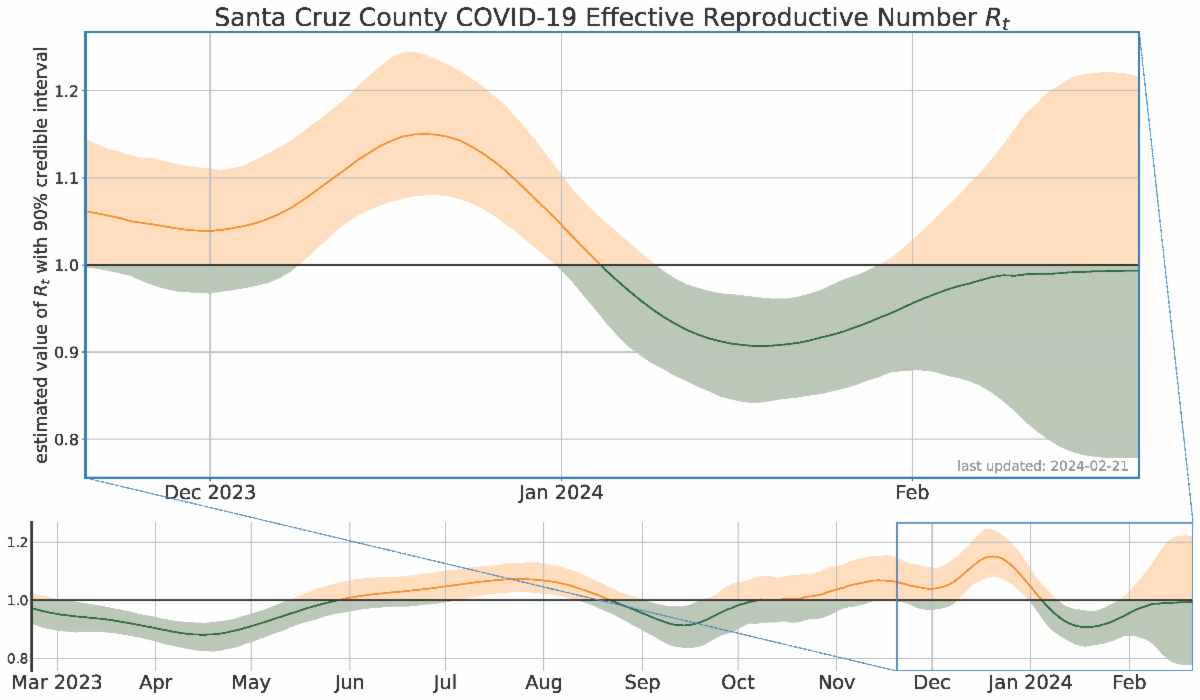
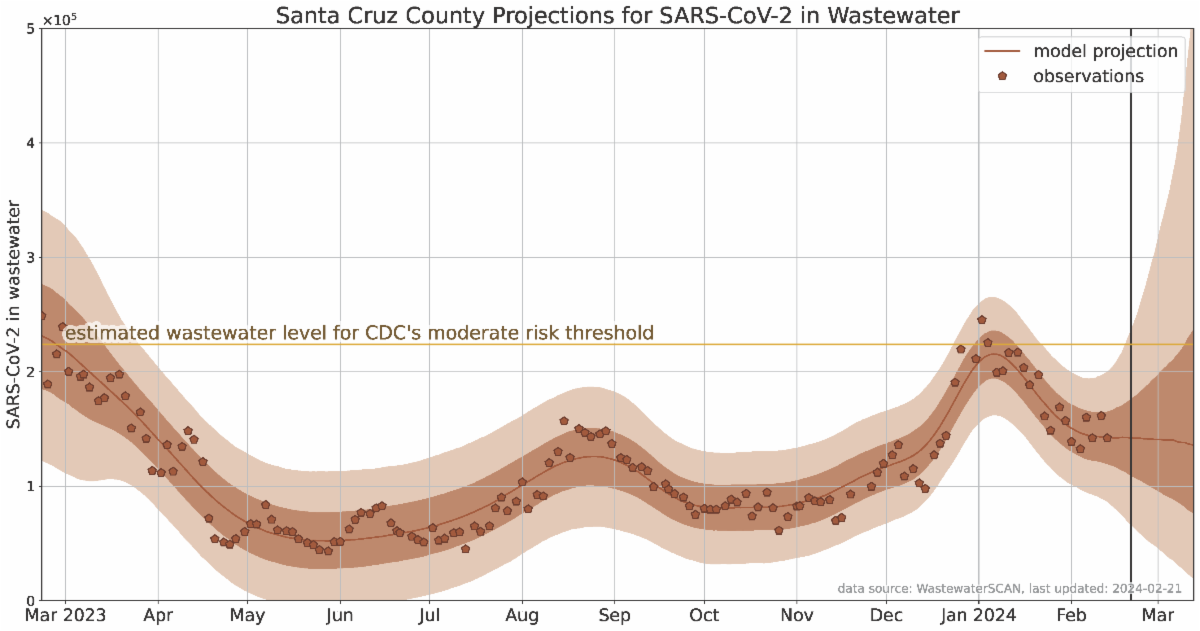
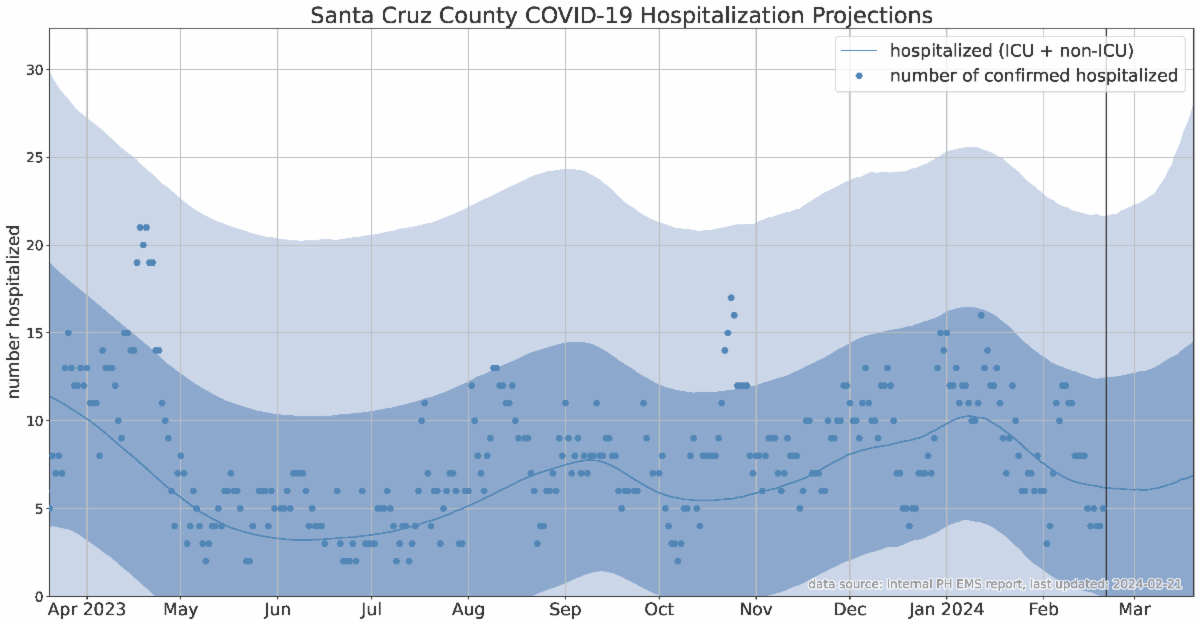
The California Department of Public Health and Santa Cruz County Health Department regularly release data on the current status of Covid-19 in the county as well as information on influenza, Respiratory Syncytial Virus (RSV), and Mpox. Since cases of Covid are still appearing, and there are still vulnerable people, I will continue reporting the graphs below.
At-home Covid-19 test kits that were sent free from the government earlier are now expiring. The program that started in Jan. 2022 has distributed 600 million test kits. If you still have those tests, before using, check the date on your box or go HERE to get information. Go HERE for free tests.
The three graphs below were updated on Feb. 21. The first graph below shows the Rt Number. Numbers above one show the spread of the virus is increasing. Below one means the spread is decreasing.
The second graph below shows data that the Health Department collects for Covid from wastewater at the City Influent, for the city of Santa Cruz, and from the Lode Street pump stations for the county.
The third graph below shows hospitalizations.
The vaccination data for the county has stayed fairly constant increasing very little over time. Go HERE for new information on vaccination records, treatments, vaccines, tests, safety in the workplace and more.
| |
|
Photo Tarmo Hannula
Fashion Street - Graffiti on the streets of Zacatecas, Aug. 2023. "Heads up. We don't like weird compliments or greetings. Avoid doing it. Attention: the Women" by Andrea Honni.
| |
|
Labor History Calendar - Feb. 23-29, 2024
a.k.a Know Our History Lest We Forget
Feb. 23, 1904; Hearst’s San Francisco Chronicle attacks Japanese workers.
Feb. 23, 1996: 2-day general strike begins in Hamilton Ontario.
Feb. 23, 2018: Teachers strike shuts down public schools across West Virginia.
Feb. 24, 1834: Six British farm laborers arrested and deported to Australia for organizing a union.
Feb. 24, 1912: Women and children beaten by police during Lawrence strike.
Feb. 25, 1913: IWW Paterson silk strike begins.
Feb. 25, 1941: 2-day Dutch strike against Nazi deportation of Jews begins.
Feb. 25, 2010: 21 killed in Garib sweater factory fire in Bangladesh.
Feb. 26, 1943: Mine disaster kills 75 miners at Red Lodge, Montana.
Feb. 27, 1921: El Salvador shoemakers win strike for higher wages: prompts government crackdown.
Feb. 28, 1877: Vancouver Island’s first Coal Miners Union.
Feb. 29, 1968: Memphis mayor demands striking sanitation workers return to work without union; strike continues until April 16.
Labor History Calendar has been published yearly by the Hungarian Literature Fund since 1985.
| |
|
"In America, anyone can become president. That's the problem."
George Carlin
| |
 | |
Photo by TARMO HANNULA
Portable Yummy Pancakes - Good Hot or Cold
By SARAH RINGLER
Eating on the run is not a good way of feeding yourself. You don’t properly digest your food and you barely taste it. Even worse, you may find yourself more frequently drawn to fast food restaurants that have mastered the ability to manufacture a combination of appealing prices, accessibility and flavors that are seductive to most humans. Are you thinking KFC or Big Macs right now?
I’m presenting an option here that with a few common ingredients and less than an hour of preparation, you have a ready supply of quick, flavorful emergency meals. They’re called o-konomi-yaki and are a Japanese style pancake that can be eaten hot or cold, plain or with soy sauce. They can also be frozen; take a few out of the freezer and put in the microwave at work for a quick and satisfying lunch or snack.
It’s kind of a mystery to me why they taste so good. Looking at the ingredients may not move you, but for some reason, the taste is more than the sum of the ingredients. The whole wheat flour fried in oil on a griddle creates a nutty crust surrounding the softened vegetables inside. They are easy to make and a great way to use up leftovers. I like to use leftover fish but canned tuna or salmon also work well.
This recipe comes from “The Tassajara Bread Book,” Edward Espe Brown’s 1970s bible for making bread. After seriously studying this book, I went from baking 100 percent whole wheat bread that could double as a doorstop, to making something actually edible. Whenever I make a yeast-bread I still follow his guidance. I recommend this book as a primer for anyone interested in baking their own whole grain breads.
O-konomi-yaki
1/2 cabbage, finely sliced
1 large carrot, grated
1/2 onion, chopped
3 celery stalks, chopped
1/2 to 3/4 cup cooked meat or fish – canned tuna or salmon works very well
2 cups whole-wheat flour
1 egg, beaten
2 tablespoons brown sugar
1 teaspoon salt
1 tall can evaporated canned milk
Enough water to make a batter
Corn, peanut, sunflower oil or any oil that can take a high heat
Thinly slice the cabbage. Grate the carrot. Chop the onion and celery. Cut up the leftover meat or fish into 1/2 inch square pieces. Put into a large bowl. Stir in the flour, brown sugar and salt.
In a small bowl, beat the egg and stir in the canned milk. Pour this mixture into the flour, meat and vegetable mixture. Stir in enough water to make a batter. The batter shouldn’t be too runny and should hold its shape.
Heat up a griddle on medium heat. Add a teaspoon or so cooking oil and spoon about 1/2 cup of batter onto the pan. Spread it into a thick pancake. When the edges are firm and holes form in the middle of the pancake, flip it and cook the other side. I try to cook 3 pancakes on at a time. Check to see that they are done by pushing down on the pancake with a spatula.
This recipe makes about 16 pancakes, enough for about 4-5 people. They can be eaten right off the griddle, reheated, or eaten cold. Soy sauce is a good accompaniment.
| |
|
Send your story, poetry or art here: Please submit a story, poem or photo of your art that you think would be of interest to the people of Santa Cruz County. Try and keep the word count to around 400. Also, there should be suggested actions if this is a political issue. Submit to coluyaki@gmail.com
Send comments to coluyaki@gmail.com
If you are enjoying the Serf City Times, forward it on to others. We need readers, artists, photographers and writers.
Subscribe, contact or find back issues at the website https://serf-city-times.constantcontactsites.com
Thanks, Sarah Ringler
| |
|
Welcome to Serf City Times Our county has problems and many people feel left out. Housing affordability, racism and low wages are the most obvious factors. However, many groups and individuals in Santa Cruz County work tirelessly to make our county a better place for everyone. These people work on the environment, housing, economic justice, health, criminal justice, disability rights, immigrant rights, racial justice, transportation, workers’ rights, education reform, gender issues, equity issues, electoral politics and more. Often, one group doesn’t know what another is doing. The Serf City Times is dedicated to serving as a clearinghouse for those issues by letting you know what is going on, what actions you can take and how you can support these groups.This is a self-funded enterprise and all work is volunteer.
Copyright © 2024 Sarah Ringler - All rights reserved
| | | | |